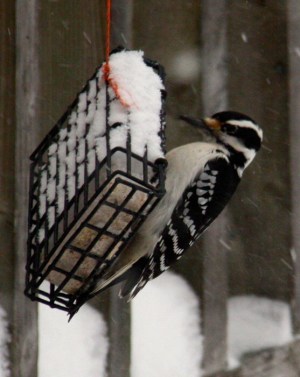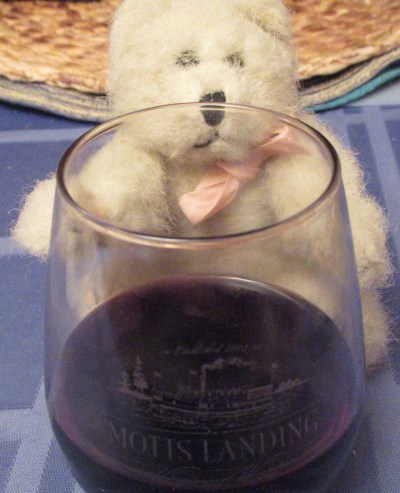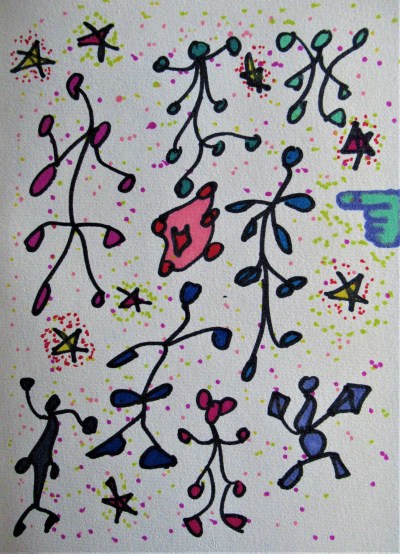
Empty Nest

fundy 05 mist+wolfepipers 153

Emptiness
is an
Empty Nest

The wind at the window
scratches tiny notes.
I can no longer hear the tune
nor read the words.

Who walks beside me
as I pace my lonely path,
abandoned
in this empty house.

My self-portrait
stares back at me:
a splintered selfie,
framed in a sliver
of silvery glass.

Above me,
the monkey-faced moon,
that itinerant tinker,
walks a fractured way
over broken glass.

The knapsack on his back
is cobbled together
from a finery of cobwebs
and clumsy clouds.

IMG_0039

Bath Time

62074164_10157302392400522_2936552509885382656_n

Bath Time

              My grandfather took a bath once a year, On New Year’s Eve, so he could be ready, so he said, washed and clean, for the New Year. His bath day / birthday was a family event. If we wanted a bath, well the bath water didn’t stay hot for long in the bath-tub at the top of the house, under the rafters, so an old tin bath was dragged into the kitchen and a black, iron kettle was placed on the hob, and water was boiled. One by one, we were immersed, and scrubbed, to emerge pink and glossy. All this happened in the kitchen in front of the fireplace, where we sat up wrapped in bath-robes and blankets, drinking hot cocoa so we wouldn’t catch cold. But my grandfather took his bath at the top of the house, under the rafters, in the old chipped enamel tub with its lion-claw feet, water-stained sides, and its old brass taps. He walked up there fully clothed, walked into the bathroom, and shut the door behind him, drawing the bolt with a finality that shut us all out. He sang the great choruses from Aida, and Nabucco, and we imagined him, wallowing there, in the warm water, with all his clothes on, for it was hard to imagine my grandfather naked. Then, half an hour later, he would emerge, looking just like he did when he walked into the bathroom. We never heard the water running, nor did we hear it draining away. All we heard was the The Hebrew Slaves’ Chorus and my grandfather swinging his Blacksmith’s hammer as he battered at the New Year’s Anvil.

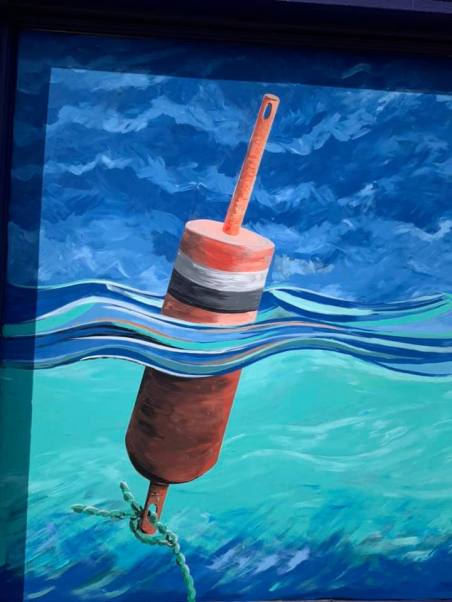
Comment: I didn’t have a photo of an old bath tub in my collection, so the lead picture is one of Geoff Slater’s murals: a buoy (pronounced ‘boy’ in Wales), taking a bath in the sea.  Let me know if you like these Welsh childhood memories, and I will keep adding to them. They are certainly fun to write and I find incredible the many ways in which memories surge as I am learning to speak Welsh. Each new chapter in my journey seems to start a new wave of thought.

Wet Welsh Rain

IMG_0730 (2)

Wet Welsh Rain

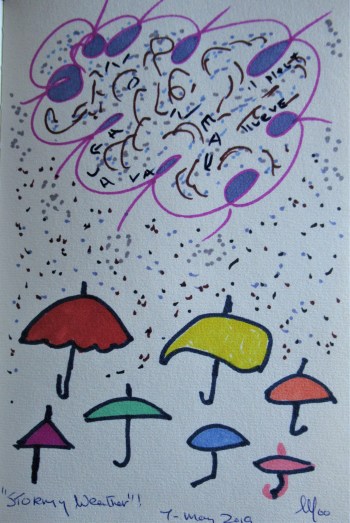
              Day after day, rain, drives in over Singleton Park and Swansea Bay. It claws its clouded way, shroud clad in grey cloud, up Rhyddings Park Road, through Brynmill, and up to the Uplands and Sketty, as it was then, now Sgetti. In those days, the rain got everywhere. It swirled around ankles and knees wetting everything below the hem of the raincoat. Umbrellas kept the shoulders dry. But when the wind blew, and gamp and brolly turned inside out, and people looked as though they were duelling with the wind, and threatening to poke each other’s eyes out, then a good soaking was sometimes better and safer and, in the worst of the rain and the wind, the gamps and brollies came down.  As for the puddles: they were everywhere. You walked in them, whether you wanted to or not, and your leather shoes turned into a pulp that let in water. Socks slopped around your feet, wetter than soggy blotting paper aka blotch [hands up if you remember blotch!]. Heads down, we faced the wind, draped around bus stops, waiting for buses that never came singly, but only in threes after much long suffering. Wind like a whiplash drove the rain before it and everywhere, woolen scarves turned into wet wash cloths and woolen gloves became underwater rain-sodden mittens.

Comment: As Tropical Storm Arthur gathers in the North Atlantic, we would do well to remember the good old days of summer holidays in Wales when it rained every day, bob dydd, during the whole two-week vacation. But did it really rain back then? Who remembers now? I seem to remember it was sunny every day, especially when the cricket was suspended with the words Rain Stopped Play displayed across the television screen. Ant the lunch time cricket scores: what joy to listen to them and to discover one day, as I listened on my illicit radio hidden in my school dormitory,  that play had been stopped because of “piddles on the putch, sorry, I mean puddles on the pitch” [hands up if you remember that announcement!]. I am sorry to say that particular radio announcer did not stay in his job for long. A great pity: I found him rather amusing.

We would do well, too, to recall the twelve days without electric power that followed Hurricane Arthur, back in 2014 [hands up if you remember Hurricane Arthur!]. Alas and alack: how accurate are our memories? And did all of those things really happen? As the street vendors and newspaper vendors [hands up if you remember paper boys!] used to cry out on street corners “Echo, Echo, South Wales Echo: Read all about it” or “Post, Evening Post, South Wales Evening Post, read all about it!” The South Wales Echo and the South Wales Evening Post hands up if you remember them … Oh those were the days … or were they? … click here and read all about it!


Time Flies

mistec4

Time Flies

… bends like a boomerang,
flies too rapidly away,
limps back to the hand.

Endless this shuffle of unmarked
days dropping off the calendar,
extinct so many animals
that exited Noah’s Ark.

Hands stop on the clock.
The pendulum swings:
time and tide stand still,
do not move.

‘As idle as a painted ship
upon a painted ocean.’

The print in my grandma’s house:
seemingly moving seas,
sails swelled out,
the ship stays firm in its frame.

Our garden fills with birds
and squirrels, light and dark.
Morning ablutions: each day
a twin of the day before.

The TV screen fills up its washbasin:
tired, shadow faces boring us
with endless wit and wisdom.

Time flies:
an albatross around the neck,
an emu, an ostrich, a dodo,
all flightless,
an overweight bumble bee,
too clumsy, too heavy to fly.

Avila 2007a 102

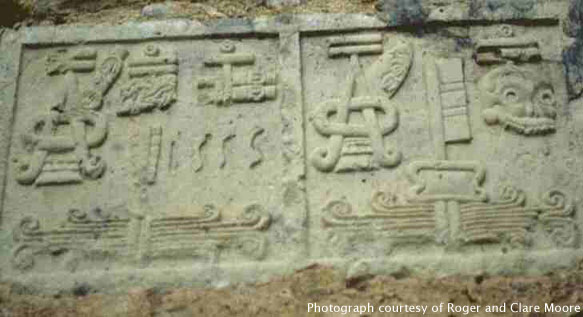
Comment: The top photograph shows the year 1555 marked in standard figures and in glyphs from the Mixtec calendar (Oaxaca, Mexico). … time flies you can’t they fly too fast … This is a conundrum from the General Knowledge Paper in the school leaving exams (1961). Punctuate this sentence: time flies you can’t they fly too fast … Proposed answer: Time flies? You can’t. They fly too fast!”  I seem to believe there were about ten of these on that paper. However, never trust your memory.

The second photograph shows fledgling storks in Avila, Spain, trying to fledge, to fly, to leave their nests. Some will succeed earlier than others. Those who do not manage to fly, who are not brave enough to leave their nests, will sit there. After a while, their parents will not feed them. And then they must fly or starve. Sometimes, time flies. Sometimes, time sits on its hands and the clock hands refuse to move. Think: time enjoying yourself (it just flows by). Think: time in the dentist’s chair with a root canal, time lying prone having an anal biopsy for prostrate cancer, time spent, those everlasting ten minutes, while a cataract is being removed and a new lens is inserted.

Oh yes, time is flexible. Not only is it flexible, it is insistent, inexorable, unstoppable. Those clocks tick on, whether we are awake or asleep. The seconds lull us with their security, the minutes lull us with their monotony, hours lull us with their harmony, days faze us, daze us … hours: each one wounds, the last one kills. Time marches on. We can rewrite the past (revisionism), but we cannot relive it, except in our dreams.
Avila 2007a 150

 Doors close.
We can never go back.
Empty

IMG_0228 (2)

Empty

Empty now the house, clean the floors where she
spattered food and scattered her toys, polished

the tables, grubby no more, where small hands
clattered fork and spoon, her breakfast not wanted.

Empty the bathroom, the tub where she bathed.
Dry the towels, full the toothpaste tubes she

emptied in ecstasy. Where now her foot
-prints, her laughter and tears, the secret

language she spoke that we never understood?
Empty too my heart where, a wild bird, she

nested for the briefest time, then flew, yet
I possess her still, within my empty hands.

Commentary: The lead painting is the one Finley painted for me. I received it as a Christmas present, a couple of years back when she was 3 or 4. When asked if she wanted to add some more to the painting as the canvas wasn’t full, she replied: “No, it’s finished. That’s just how I want it.” Picasso once said that he spent the first half of his life learning to paint and the second half learning to see again as children see. Sometimes we complicate our art so much that we kill our inspiration and our vision. Some poets necessitate a dictionary in order for a reader to understand their words, yet when the meaning emerges, we find that the poem is convoluted, stilted, almost meaningless and even emptier than it was before.

Question: why do we try to gild the lily? Why do we lead to the slaughter the gift of the goose who lays the golden eggs? Are we writers or assassins? Are we not capable of putting meaning on paper with the directness and simplicity of a child? Good questions all. Sometimes I think that poets are like the existentialists of Albert Camus’s novels: they are the assassins of language and the murderers of direct and clear writing. And who are the victims? The words, images, metaphors, feelings that are strangled in the cradle or forced into captivity behind prison bars of jumbled lines and scattered thought.

Original ideas? No, not at all. This is the basic argument that Francisco de Quevedo (conceptismo) had with Luis de Góngora (culteranismo) in the Spanish literary salons of Madrid between 1613and 1627. The literary insults they wrote to each other are still a scandalous joy to read. These two seemingly separate styles of writing, which are actually very similar on many levels, eventually blended together and led to a total renewal of the Spanish literary language.  This in turn was bastardized by second-class imitators who did not have the skills of the original ‘super’ artists. And thus the pendulum swings: innovation > standardization > parody and satire of a worn out language > fresh inspiration and innovation.

As for me: how I would love to regain the clarity of vision and the joy of words that I experienced when I was a child. Back then, the world was a magic place, the pen and pencil were magic wands, and the empty page was a blank canvas to be filled with wonder. Alas: then I was sent to school. Rules were set. Bars were installed. Blinkers were inserted. Doors and windows were locked. Creativity ended. I will say no more.

Her Shadow

IMG_0063

Her Shadow

“Birds, birds,” she shrieked with delight.
“The drab one is a girl like you,” I told her,
“but the bright one is a little boy.”

“Yellow,” she cried again with joy, “Yellow.”
Tiny hands plucked at air, catching nothing.

I can still see her standing there, her nose,
all wet and runny.  She left damp, snot-stained
marks, a sort of signature, on the cold wet glass.

She’s long gone now, way back home, but still
the window stays unwashed and her shadow
often comes between me and the morning sun.

Midnight

IMG_0225

Midnight

Primary red, this label, and the wine, fresh-drawn,
plucked from the bottle, tumbling tinto, into the glass.

Swirled, streaked ruby by overhead lights, bubbles
bright with hints of garnet, purple, brick at meniscus.

Sniffed, it smells of warm autumn days, scintillating
leaves, just crisping, turning color, and fruit all ripe.

Tasted: fruit bursts into hints of raspberries,
strawberries, spices, a touch of garrigue, mysterious.

Wine descends like water on a dry, hot, dusty day,
or rain after drought, when thirsty lands lap up

liquids, and rejoice in moisture’s blessings.
Raised now the glass, vineyard and vintners toasted,

midnight greeted, saluted the old day past and gone,
welcomed the fresh day walking in, swaddled, new born.

White Wolf

IMG_1843 (2)

White Wolf
Rhodri Mawr

Winter’s white wolf
shakes ice from her coat,
makes snowflakes fly,
blanches our world.

Nose pointed skywards,
she howls a North wind
straight down from the Pole
as we shiver indoors.

Snow gathers in the air,
thick as winged moths,
then drops to the ground,
plays dead in deep drifts.

Snow banks climb higher,
blotting out light.
Soon, Arctic cold will wrap us
in its endless night.

Avila 2008 381 (2).jpg

White Wolf  in Island View


Comment: Y blaidd gwen yn y gaeaf / The white wolf in winter, translated from the original Welsh of an anonymous Gŵyr poet, circa 1613. Oh I do love messing about with images and words. I don’t have a photo of a white wolf, so instead I have posted a photo of my lapdog, Tigger, who weighs in at 115 lb. Tigger, of course / wrth gwrs, is a delicate champagne color rather than white. When he sheds hair in the summer known in the doggy trade as ‘blowing his coat’, it is like a snow storm coming off the back porch. The nesting birds and the chipmunks and squirrels can be seen carrying chunks of his fur back to their nests. They will keep wonderfully warm, wrapped in the raggle-taggle gypsies torn from coat. There are several jokes and pieces of misinformation or weird humor, woven into my poem. I wonder how many you can spot? Each of my poems is a puzzle, in one way or another, so have fun solving the riddles!

Empty Nest

IMG_1258 (2)

Empty Nest

The wind at the window
scratches tiny notes.
I can no longer hear the tune
nor read the words.

Who walks beside me
as I pace my lonely path,
abandoned in this empty house.

My self-portrait
stares back at me:
a splintered selfie,
framed in a sliver
of silvery glass.

Above me,
a monkey moon,
that itinerant tinker,
walks a fractured way
over broken glass.

The knapsack on his back
is cobbled together
from cobwebs and clumsy
veils of drifting clouds.

Comment: Another Golden Oldie from that same throw-away manuscript that I discovered a couple of days ago. I wrote this one the year after my mother’s death. My father was in hospital and I had flown back to Wales to visit him. When I was not with him, I wandered alone in a large house, empty of people, but filled with memories. The whole experience was rather surreal, just like the imagery I conjured up to describe it. Early spring, but a cold one. After hospital visiting hours, I wandered an untidy house and an unkempt garden. My mother had departed. My father was on the way out. I was alone with a life-time of memories. “No hay pájaros en los nidos de antaño” wrote Cervantes in the Quixote. “There are no birds in last year’s nests.” With no brothers, no sisters, no close family, and no friends left in Wales, I found that out the hard way. Those days of wandering, ‘upstairs, downstairs, in my lady’s chamber,’ taught me that most difficult of lessons in the hardest of ways.

IMG_0456 (2)

Striations

IMG_0299

Striations

There are striations in my heart,
so deep,
a lizard could lie there,
unseen,
and wait for tomorrow’s sun.

Timeless:
this worm at the apple’s core
waiting for its world to end.

 Seculae seculorum:
the centuries rushing headlong.

Matins:
wide-eyed this owl
hooting in the face of day.

Somewhere,
I remember
a table spread for two.
Breakfast:
an open door,
a window that overlooks
a balcony and a garden.

“Where are you going, dear?”

  Something bright has fled the world.
The sun unfurls shadows.
The blood whirls stars around the body.

“It has gone,” she said.
“The magic.
I no longer tremble
at your touch.”

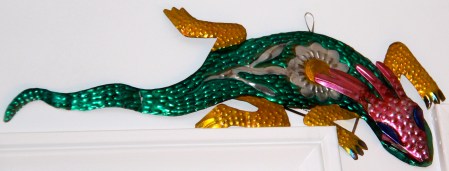
Comment: A real Golden Oldie. The lizard, it’s probably an iguana, came originally from Oaxaca, Mexico, and now sits over the door on the front porch. I had to bend his tail to get him into my carrying bag, poor thing. I found this poem in my poetry discards file, though what it was doing in there is a mystery to me. I think I discarded the longer manuscript in which it was included. Never mind, I have re-found, rediscovered it and it merits a place here, on my blog, along with the iguana. Byddwch lawen: rejoice and be glad.