Virtual Reality

Virtual Reality
or
The Coconut Shy

Aunt Sallies, all of them, sitting there,
in front of the camera, virtual statues,
three whole rows of coconuts gazing
vacantly out of the screen or sitting,
mute like swans, with sound and vision
turned off so nobody will know that
they are there in name only, or perhaps
it’s a pseudonym, a nickname, hiding
the true identity of the sly persona
shying obscurely away from the camera.

Shy, yes, but only at first. The ice breaks.
Conversation flows. A jabberwocky of noise
breaks over headphones, crackles in ears,
meaningless, at times, as the air waves wander,
break up, people switch on or off, or,
having said their say, go mute and fade away.

I think of monkeys, climbing to the top
of the temple steps, sitting there in rows,
plucking at the fur of the friend below them,
then cracking between thumb and index finger
the fleas and other creatures they have found.

And that’s what they will do with the work
that other people present to them – nit pick,
quarrel, pick minor squabbles, disagree with
a noun here, an adjective there, a dangling
participle over there, see, quick, give it
a flick, a twist of the wrist, that’s what
the showman said. There. See? Gone now.
And doesn’t that feel so much better?

Now I sit among them, my own effigy
staring back at me like a death mask in life’s
Madame Tussaud’s virtual wax works,
Jolly Roger, another skull-and-crossbones
faking it for the camera that tells no lies,
even though I despise the shown falsehood –
of ‘stand together or we fall alone’ and yes,
I feel myself falling, toppling off the saw dust
piled into the metal cup, to lie on the ground,
battered and broken, but the show must go on,
though, for me, that’s the final curtain.


Good Friday

Good Friday

Crucifixion and Death

1

Now is the hour of his parting,
such sweet sorrow, they say,
but not on this day.
Yet we’ll meet again, sang Vera Lynn,
don’t know where, don’t know when.

There he lies, helpless, on the street.
Why is that man in blue
kneeling on his neck?
“I can’t breathe.”
Can’t anyone hear his cries?
Is there anybody out there listening?

Watchers stand round and watch.
Someone makes a video on a cell phone.

Who gifted him this gift,
this parting gift he never chose.
Everyone who follows him
and tries to walk in his shoes
knows he had no choice.
They know he didn’t choose.

2

Do you feel the baton stab into the guts?
The plastic shield’s edge slash into the face?
The knee come up, no ifs, no buts?

Eyes water from tear gas and pepper spray.
Thunder flashes crack and roll, deafening
ears, taking years from marchers’ lives.

Did you follow him through Jerusalem?
Did you walk in his footsteps, step by step?
There is a green hill far away, or so they say.

The cameras rolled as they cuffed him
to his pavement cross, men in blue smiled,
winked at each other, watched him fade.

His loss was not their family’s loss.
Just another loser tossed beneath the bus.
The watchers watched and nobody made a fuss.

They stood and stared and nobody cared
until cell phone videos hit the tv screens.
 Now it’s fake news, whatever that means.

The believers will believe what they’re told.
You can’t put a price on what he was losing,
on the many things that others have already lost.

3

Leg-irons and chains:
that’s what remains from his journey here.

Iron, cold iron, splintered, burning wood.
A death bed on the sidewalk
his last will and testament.

A flaming cross lifted him to the skies,
that cross burning before his eyes.

Before he goes, we must double-check:
whose is that knee upon his neck?

“Let me breathe, let me breathe.
Take away your knee.
Justice, why hast thou forsaken me?”

Commissioner, forgive them.
They didn’t know what they did,
when all around the dying man
men closed their eyes and ears,
buried their heads, and hid.

4

Good Friday in Island View:
a foot of snow fills the streets,
empties the churches.
The Easter Weekend lurches
towards its predestined end.

But how do you end
two thousand years of hurt,
four hundred years of persecution,
of cruelty and neglect?

How do you end
eight minutes and forty-six seconds,
with that black man lying there,
choking, a white man’s knee on his neck.

He died in the shade
of orders that were given and obeyed,
orders that should never have been made.

The Rover’s Return

The Rover’s Return

The eternal return to The Rover’s Return,
renovated, again and again, but filled
with the ghosts of Ena Sharples and others
who walked this cobbled street before,
and every episode more or less the same,
though décor, characters, accents change
and life becomes ever more complicated
from episode to episode, the street slang
changing slightly, and ageing characters
ageing more and more as time goes by,
and yet the trumpet’s martial sound,
the rhythms of the northern brass bands,
the first of those accents to break the plum
in the mouth snobbery of Oxford English
and the BBC’s domination of the language,
and ‘hey, Mr. Oxford Don, me no graduate,
me immigrate,’ echoing round the abandoned
buildings where the working class once worked,
and the elderly were cared for by their friends
and neighbors, not tossed into care homes,
and abandoned to their fate, as they have been
so often of late, and all things change, in time
with the clocks that tick-tock forward, their clock
work everlasting, and the pigeons still there,
and those crazy chimney pots, and that cat,
slithering down the roof, and the rovers still roving,
then returning, once again to the Rover’s Return.

Click here for Roger’s reading.

Comment: For more than sixty years I have listened to Coronation Street and some things have never changed, the trumpeter from the Brass Band, the rain on the cobbles, the memories and ghosts that linger among brickwork and paint. It takes me back to my childhood, when ITV was the upstart channel that dared to challenge the might of the mighty, one might almost say, the almighty BBC. And now, here in Island View, I turn away from the color and recall the old black and white sets, with their selection of two channels, one of them advert free, and their scheduled times of programs, not the TV blaring twenty four hours a day and two hundred channels available at the touch of a button.

It’s all one sentence, though I had to stop and take a couple of breaths while reading it. My good friend and fellow poet, Jane Tims, has called me ‘the master of the long sentence,” and I do love long sentences, especially when I am in rant mode, like now. But I am also very much aware of other friends that warn me that “your sentences are too long. They are too complicated. I don’t understand them. Write shorter sentences.” OMG, FFS. LMA* – 4 – UAW** – IMHO.

Translation of unusual terms: LMA* = Leave Me Alone. UAW** = You aRe Wrong.

Acknowledgements: My quote from the poem, inaccurate, and from memory, is from John Agard, whose poetry I love. I acknowledge now his poem and its influence upon me. I too am no Oxford don, and I too am an immigrant. His wonderful reading of the full poem can be found here. John Agard, Oxford Don.

White Wolf

White Wolf

The white wolf of winter
exits her den-warmth and
shakes snow from her coat. Flakes
fly, whitening the world.

She points her nose skywards,
clears her throat, howls until
cold winds blow their chorus
of crystals, crunchy crisp.

We cower behind wooden walls,
peer out through frosted glass.
The white wolf draws near and she huffs
and she puffs until door frames rattle.

The snow drifts climb higher,
blotting out the light. Night
falls, an all-embracing
Arctic night of endless
snow snakes slithering on
ice-bound, frost-glass highways,
side roads and city streets.

Outside, in the street lights’
flicker, snow flies gather.
Thicker than summer moths,
they drop to the ground, form
ever-deepening drifts.

Our dreams become nightmares:
endless, sleepless nights, filled
with the white wolf’s winter
call for snow and even more snow.

Click here to hear Roger’s reading.

Questions

Questions
Four Elements, p. 137

After my mother died,
I lit a candle in every church,
a real bees’ wax candle,
not those tiny electric lights
that glow for a little while,
when you insert money
in the insatiable slot.

Like the minuterie
on each landing of a Parisian
staircase, it gives enough light for
a quick prayer, or a very short
moment or two of silence.

Where does the light go
when the electricity switches off?
Where does the flame go
when the candle is snuffed?
Where did my mother go
when her light went out?

One day, but not too soon, I hope,
I will have to follow her and find
the answers to all of my questions.

Click here for Roger’s reading.

Waiting for Godots

Waiting for Godots

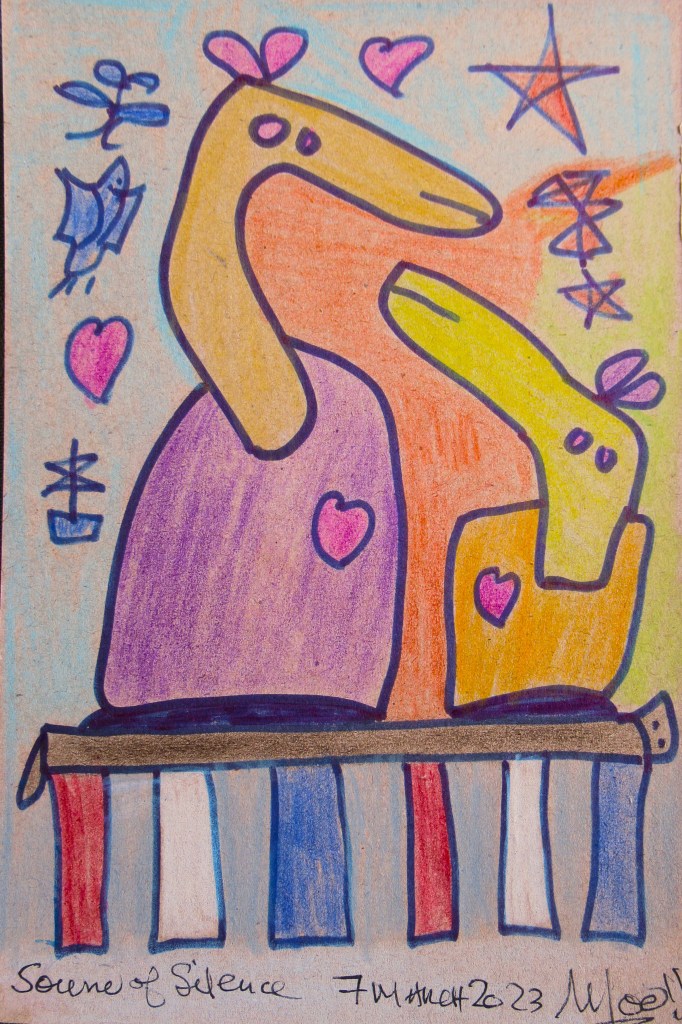
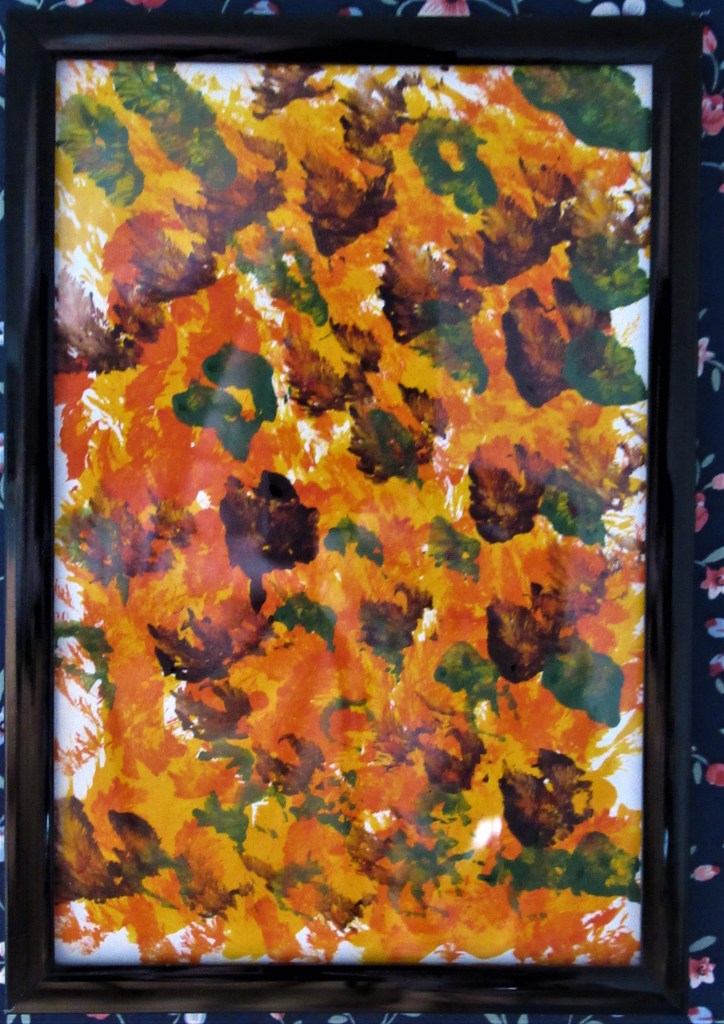
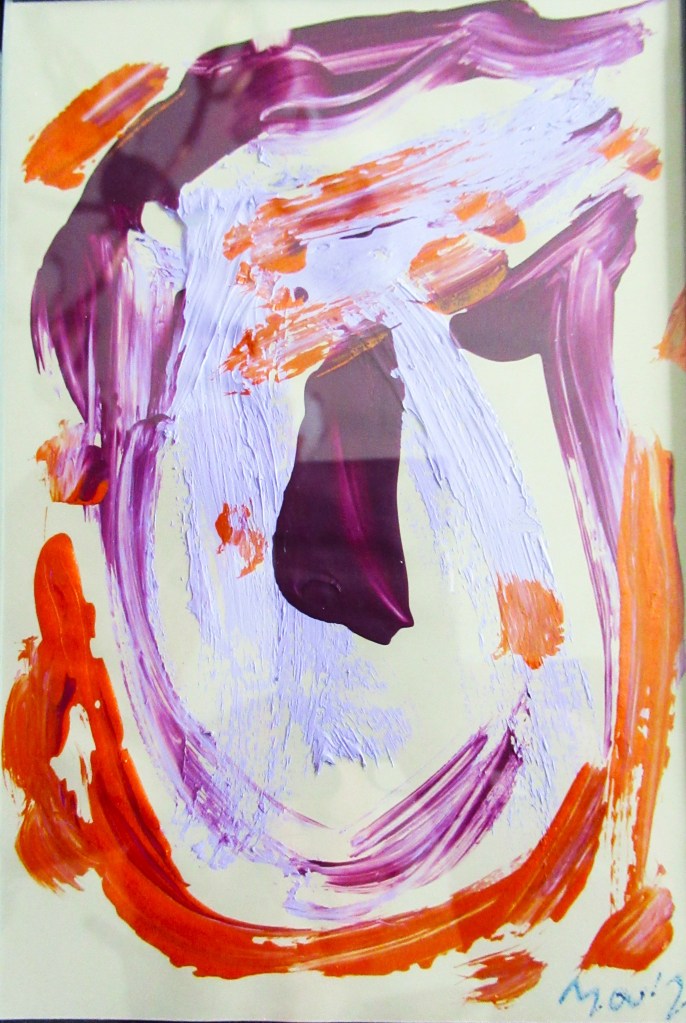
What do authors do when they send manuscripts to agents or presses? They have several choices. For example, they can listen to the sound of silence. Listen carefully to the paining above. What does it say to you? Absolutely nothing. Quite. It doesn’t communicate. It’s the sound of silence.

Another choice, they can read and re-read Beckett’s Waiting for Godot. Alas, in this case there are many Godots out there and all of them are super-busy gazing at their navels – and I don’t mean oranges. Some indulge in the wonderful world of “Mirror, mirror, on the wall…” and we all know what the answer is to that question. And we know what happened to Narcissus when he saw himself in the river water. Or have we forgotten? Our failure to share cultures is also a sound of silence – two solitudes, gazing at each other, neither one having anything in common with the other one, except maybe the weather. And we can’t always agree on that.

A third choice, they can climb into their dustbins, Queen’s English for garbage cans, and stand there waiting for someone to put the lid on so they can go back to sleep. Allusion / elusion – you don’t know what I am talking about? Well, maybe we are living in two separate solitudes. It wouldn’t surprise me in the least.

A fourth choice, they can take up painting, and scribbling, and drawing, and doing all sorts of things. But, if the phone rings and you don’t recognize the number – don’t pick up the phone. It’s probably a fraudulent scam call. And if you don’t know the e-mail address, put it in Spam and then block it. It’s probably some bot from another country trying to trap you into giving them your bank account details and signing your savings away. Whoever it is or they are , I doubt if it’s an agent or an editor!

Challenge

Challenge

What is the biggest challenge you will face in the next six months?

The months change but the challenge never does. How does one stay alive? How does one survive? How does one pass the time from one minute to the next, one hour to the next, one day to the next, one week to the the next, and one month to the next?

I faced a challenge this morning. I got to the shop and could not climb over the piled up ice to reach the slippery step that led to the salted sidewalk that led to the shop’s entrance. Fortunately a kind young man took my arm, and helped me upwards, onto the sidewalk. He waited while I shopped and brought me back down to the car, arm in arm, and carrying my shopping. I gave him a poetry book, Septets for the End of Time, as a reward.

What will be the next big challenge? I honestly don’t know. Starting the snow blower at -20C, perhaps? Blowing the snow and avoiding a slip, a fall, a sit down on a snow bank from which I cannot get up? Who knows? I don’t. I need more medicine – will my biggest challenge be finding that the pharmacy has again run low on my medication and I have to wait for my renewals? I have just had a blood test – three months late – and I don’t know what the results will be? Will that be my biggest challenge – coming face to face with a negative result that demands more action? I just don’t know. Driving out the other day, I met a speeding car on my side of the road, in my lane, coming straight towards me. The driver was staring at his cell phone, one hand on the wheel, eyes down, concentrating on something that certainly wasn’t the road. I swerved aside, towards the snow bank, honked the horn, and he looked up, eyes wide with shock, and swerved away. Brown trouser time, I guess, for that unfortunate individual.

It would be so nice to have a smart answer. My biggest challenge will be to find a solution to the chess problem that has puzzled me for years – how to defend Queen side openings when Black. My biggest challenge will be to draw the cards for a perfect hand of cribbage. My biggest challenge will be to pay the grocery bills as the prices rise. My biggest challenge will be to pay the dentist’s bills when I have no dental coverage and the savings dwindle every month. My biggest challenge will be how to avoid the pain in my teeth now that I can no longer afford the dentist. My biggest challenge will be to crawl to the telephone and get help if I manage to fall in the kitchen and cannot get up.

So, what is my greatest challenge over the next six months? Living from day to day, without falling downstairs and killing myself – how about that for an answer?

Goodbye

Goodbye

It is never easy to say Goodbye. Some goodbyes are easier than others. Some are indeed difficult. “In my end is my beginning and my beginning is in my end.” Conscious goodbyes are one thing. We say farewell knowing we will never be back that we will never see each other again. These are the hard ones.

I stood in the bar of El Rincon, in Avila, at 6:00 am, waiting for the taxi that would take me to Madrid and away for the last time. I was planning to return the following year and then it hit me – this was indeed my last goodbye and I would never return to that place. A tidal wave of emotion swept over me and I felt a deep, earthy sorrow – the sorrow of permanent loss.

It was matched on two other occasions. The first occurred when I drove to the sea shore of my childhood in Wales, with my mother’s ashes in the back seat and strict instructions on how and where to scatter them. Walking away was one of the most difficult things I ever did. Even more difficult was leaving my father, a widower now, in his bed, and saying that goodbye. It was not the final goodbye, but I knew I would never see him again, in that house, under those circumstances.

I cried in the taxi, all the way to the railway station. Great, heart-rending sobs that tore me apart, body and soul. The spill over from my nostrils reached the floor of the cab, a long, thick spider-thread of deep-seated despair, because I knew my life had changed forever, and the support on which I had always counted would no longer be there.

People and pets – both are difficult. Holding the paw of a beloved cat, while the vet slips the needle in, and the companion of ten, fifteen years, drifts quietly to sleep. Or watching a faithful dog, slipping slowly downhill, and knowing that someday, soon, the decision must be made, the dark deed done. The knowledge that one relieves suffering and brings an easy release does not decrease the heartfelt pain of that last goodbye.

I used to visit the Sappers Club in Toronto. In the basement of that establishment I discovered a wealth of photographs from WWI. The old men would lead me downstairs and, through thick salt tears, explain what each photo meant to them. Round about midnight, a group of them would stand before a photo called Goodbye Old Friend. It depicted a shell-shocked, broken horse, with a pistol held to its head. The men, they explained, had volunteered for war, and knew all about its suffering. The animals were innocent, and knew not the reason why. Ah, ending the sufferings of the innocent, human or beast, that is, perhaps, the saddest farewell, for some, but not for others.

We each will hold a private moment within our own hands and minds. To share or not to share – that is the question, for each of us – poor creatures, as Dylan Thomas says, born to die.

My Teenage Self

My Teenage Self

What advice would you give to your teenage self? In one word – grow up. Useless advice really, because it happens, whether we want it to or not. That said, I have lost so many young rugby players that I coached or played with, to driving accidents and other misfortunes, sometimes self-inflicted via alcohol or drugs, that to say grow up – please! – is so important.

Each morning I read the obituaries in the local newspaper. Afterwards, I look back over the path I have journeyed. If I had perished at the age of the current ‘missing person’ – say, 45 – 50 – 55 – 60 – I think of all that I would have missed in those intervening years. Then I grieve for all that they will have missed in the life that should have lain ahead of them.

“Don’t cry over spilt milk” – Old Welsh Proverb. And no, we mustn’t cry over what is lost. We must celebrate what has been achieved, Dylan Thomas (1914-1953), one of Wales’s greatest Anglo-Welsh poets, dead at 39 – what other glory may have lain ahead of him? Garcilaso de la Vega (1501-1536), one of Spain’s purest and most innovative poets, dead at 35. What more might he have written in an extended lifetime? Federico Garcia Lorca (1898-1936), executed, many say tortured and murdered, at the age of 38. Think of the theatre, the poetry, the Gypsy Ballads, the songs of a dark love – what more did he have, hidden inside him, that was never allowed to spread its wings and fly out into the light of day?

So, I would give to my teenage self, the same advice that I would give to any teenager – grow up – please, grow up, don’t go too soon, – and please grow into that unique and wonderful being that you have the potential to be.

Shoes and Socks

Old Roman Road
Puerto de Pico
Ruta de la Plata
Avila

Shoes and Sox

So, I am in anti-prompt mode this morning. Why should I tell you about my shoes when I want to talk about my socks? They are so closely associated anyway and you can’t have one without the other – well, you most certainly can, but it’s never quite the same thing.

So, I was walking the Camino de Santiago / the Road to St. James, back in the day, just being a Pilgrim and making a quick Pilgrim’s Progress, while on the bus, but a much slower one when I decided to get off the bus, put on my shoes, and walk. No, I didn’t have hiking or walking boots, just a very comfortable pair of sneakers and a very thick pair of socks.

I left the hotel early and set out, on foot, from Leon to Astorga. The sun shone. The heat rose up from the tarmac. I sought the shade from the poplar trees that lined the road and rapidly realized how popular they are for the long-distance walker. And I sweated. I carried my pilgrim possessions in an Army and Navy Stores backpack. It didn’t weight much, but it grew heavier as the day went on. I had expected to meet people along the way, but I didn’t. No other pilgrims. A farmer – I asked him if this was the road – and he said yes. A ragged looking priest from a small roadside chapel who invited me to spend the night. Two dogs that ran down the hill and barked at me and then ran back up again.

By the time I got to Hospital de Orbigo, just down the road from Puente de Orbigo, I was tired. I went into the first hotel I found, asked for a room, and got one. The owner gave me a funny look and let me find my own way to a room, very isolated, at the end of a long corridor. When I got there, I decided to have a shower, and took my clothes off, starting with my shoes. As I took my shoes off, it hit me – and it was a combination of week old kippers, soaked in the Bishop’s Gaiters, and anointed with long-past-it raw milk / lait cru Camembert. My sox had the pox.

I stripped off, left my socks on, and paddled in the shower. It did no good at all. I put shampoo in the toilet bowl, stood in the bowl, stamped up and down as if I were trampling out the vintage where the grapes of wrath were indeed stored – it did no good at all. I flushed the toilet multiple times and still those poxy sox refused to release their ripeness. I took them off, laid them out to dry, to see if that would help, and went down to the bar for supper and a brandy (or two).

When I came back to my room, inspiration struck. I whistled- as if calling my dog. The sox got up of their own accord and – I kid you not – walked towards me. I opened the garbage bag and pointed to it, and the sox walked right in. I tied the bag up with a plastic tie, added two more plastic bags outside the first one, went happily to sleep, got up next morning, and walked to the bus stop, abandoning my socks in their safety blanket for the hotel owner to find.

Moral of the story – if you want to get to your destination, don’t get off the bus until your journey ends.