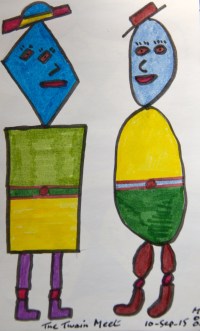
Predicting My Death 3

fundy-05-mistwolfepipers-081


Predicting My Death before Yours

3

Know this: I have no regrets. Not in anything that touches you.
No regrets, that is, save for the thing I have done to hurt you.
Many things. Some underhand. Some unsuspecting. Some deliberate.
You know, after all these years, the way I am. Unthinking.

Selfish. Never unfeeling. Often unknowing. So many negatives.
Is it negative to embrace my death before it comes? I don’t
think so. Perhaps it’s the most positive thing I’ve ever done,
this coming to grips with the maggots that gnaw me away,

night and day, gnawing me away. They aren’t invisible. You see
them  sometimes yourself: in the bottle I drain to send me to sleep;
in my tone on the phone when I answer an unwelcome call; in kicks
delivered to sleeping dogs that I can never let lie. Why? I cannot

answer that question. It bounces like a pinball round my head:
why? why? why? But try as I may, there is never any answer.
Why am I made as I am? Why do things happen the way they do?
Why do you still love me, in spite of all my faults, my kinks?

There: I’m being negative again. Be positive: this is my last will
and testament. My love, I leave to you the pleasant memories.
Days in the sun in Spain; our daughter born healthy; grooming
the show dogs; digging the snow together. Our very presence here

in Canada is a sign of the highest bond that could ever unite
two people: leaving their homes, their families, their friends,
their birthplace, their nationality to set up a new home together,
crossing the sea to reach this new found land of ice and snow.

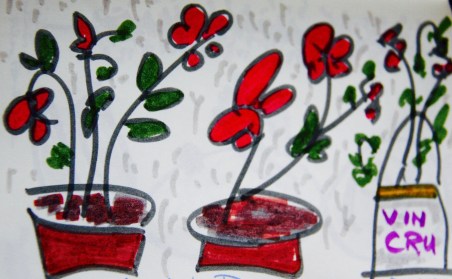
 

Predicting My Death 2

fundy-05-mistwolfepipers-081

Three Poems Predicting My Death before Yours

2

There never was anybody else but you. Too late now when
you’ve discovered this to tell you that there probably
never will be anyone else. Middle age: I look back on all
the things we’ve done together. Shall I count the ways?

No: I’ll make a list. So often we’ve sat together at the table
planning the next set of duties that will keep us occupied
by driving us apart. But of all the people in the world
you’re the only one who doesn’t need a list of what we’ve done

or haven’t done. Goodrich Castle, last year in England,
was your discovery. We went there together at your instigation.
A part of you that will always be me, that first discovery
of ruins, new to us, growing from red bed-rock. I thought I had

seen everything worth seeing till I looked on Goodrich,
explored its towers, its labyrinth of connecting rooms.
Civil War tore down the curtain walls, fired the stables,
driving the horses wild with fear. Sometimes, at night,

I can feel that fear pumping through my veins. Knowing
I will die before you, knowing I will leave you alone
to defend yourself between curtained walls, isolated,
besieged by the same memories that mill in my mind.

Predicting My Death 1

fundy-05-mistwolfepipers-081

Three Poems Predicting My Death before Yours

1

I cannot always talk to you. There are so many barriers.
The hoovering, the cleaning, cooking the daily meals.
When we go to bed, you are tired, I’ve had too much to drink.
We know our routine answers off by heart. There’s never any time

for each other. House work, gymnastics, paying the bills,
even housekeeping on the computer: they all take time.
Time, time: so little of it left. I can feel death’s seeds
rooting in heart and chest. Premonitions: so little time.

Comment:

Rummaging in the dusty memories that line my bookshelves, I rediscovered a sequence of love poems I wrote for Clare, 25 years ago, in 1991. This is the second in the sequence. A Golden Oldie, it grips today even more than it did back then. I am growing old. The insurance company’s statistics tell me that soon, all too soon, I will join those statistics and become another black number on a white page. According to those statistics, Clare will survive me, but we don’t know by how much.

How do we prepare ourselves for such things? Our society, a society that sees violent death every day on the road, on the street, on television, backs away from death. We don’t face it, not in the same way they do in Oaxaca, for example, where it is celebrated once a year on the Day of the Dead. Homes are lit up. The dead ones favorite food is prepared. Little altars are illuminated by candles. Photos appear. Do the dead return to their homes to join in the celebrations? Sometimes, I guess they do. Certainly the would be made welcome if they did.

Perhaps Francisco de Quevedo, the seventeenth-century Spanish poet who was the subject of my doctoral thesis, was right. “The day I was born, I took my first step on the road to death.” He writes too of “this death that I carry within me, that has walked beside me all my life.” “If death is a law, and not just a punishment,” he writes, “then we must accept it and obey its call.” I guess it’s easier, if you are a Stoic or a Neo-Stoic, to face up to such things.

I once asked my grandfather, a man who survived the trenches of the First World War, if he was worried about dying. He looked at me in silence for a long time. I was very young and we were sitting in the sunshine on the bench by the old Swansea Hospital where he went daily to gossip with his friends. “Roger,” he said. “We are all going to die. We will die if we worry about it. We will die if we don’t. So why worry?”

I certainly don’t want to go. I didn’t want to go twenty-five years ago and I really don’t want to go right now. I have decided to take my grandfather’s advice. I’m not going to worry and I am going to continue to enjoy myself for as long as possible because: “For there are many fine things to be heard and good things to be seen / before we go to Paradise, by way of Kensal Green.”


Your Voice

IMG_0196 2.jpg

Your Voice
Love poem

Still in the still of the rain
I sense you near.

The room is full
of the scent of emptiness
yet even the silence
turns my head.

The walls expand
to enclose the world.

With gaudy flags
on a colored map
I mark your progress
through my memory,
upwards and inwards
your progress to my heart.

A moth glistens in the circle
cast by my reading light.

Your stealthy footsteps
sound in the corridor.

A voice, your voice,
drifts through the night

Thought Police

img_0184

Thought Police

Why are they always men,
these blue-clad figures
who wear our dreams like badges
and stare into our eyes,
bright lights behind them,
as they check our numbers
and make us count from one to ten
and up and down again.

Be warned:
you can’t walk in the street
without seeing a curtain
flicker at a window;
unseen lips repeat your words
as they wander,
stray cats and dogs,
from house to house.

Walls have watchful eyes
and lusting ears
that clutch each wayward thought
reporting it to people
who have our best interests at heart,
or so they say.

Don’t look up
but there’s someone
leaning over you,
reading these words right now.

Dulcinea

img_0282

Dulcinea

 Men of La Mancha

Insubstantial dream
extracted from a madman’s mind,
who dares to magic her back to this world?

Who could want what with her now?
She exists nowhere.
Can you conjure her up from mists?

Once she was Echo: her voice
dependent on a mad rogue’s tongue.

Moonlight through the glade.
White foam atop the sea.
Betrayal of every dream
once she is found.

For he who creeps into her bed
finds plain Aldonza there.
The enticing breasts that made him drool
are shrunken dugs when seen up close.

Her horse is but a donkey
and she herself is but a dream
woven from the fabric of another’s whim.

Begone.
Allow Dulcinea her well-earned rest.
Take care lest she roll over and start to snore:
Dulcinea turned Aldonza ever more.

Sancho Panza

img_0282

San Chopanza

 Men of La Mancha

“How much did you say?
Is it in writing?
Let me see the words.
Better, since I cannot read,
let me taste the gold.

You have not brought it?
Just this paper signifying cash?
And promises? Promises
I can trust because you’re known
to keep your word?

Thank God I cannot write.
I will not make my mark.
Men like you I met
when I governed my island,
and I chased them from my realm.

Owners of hollow staffs,
muscular women
strong in the arm and weak
in defense of their honor.
Do you, sir, take me for a fool?

When you awake the man,
beware the grown-up’s fist.
Do you know who I am?
Have you read my history
that tours the world in print?

 Read it, sir, and know me
for who and what I really am.
And the next time that we meet,
if you would drive a bargain,
bring gold, good food, and wine.”

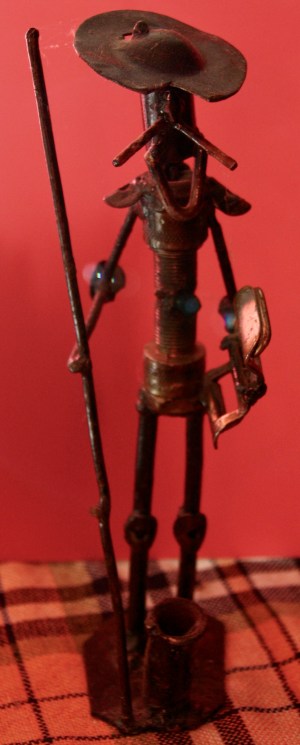
Don Quixote

IMG_0282.jpg

Donkey Hotay

 Men of La Mancha

Saddle his steed
and let him ride
uphill and down.

The world is wide
enough for a knight
and his faithful squire
to find at road’s end
what they most desire.

Let him obey his vow.
Let him best portray how
a true knight,
worthy of the name,
guards from shame
his knightly honor
and his beloved’s fame.

Let no mage
despoil that Golden Age.

Onward, ever onward,
to glory and renown,
and let him once again

tilt at windmills and knock
falsehoods down.

Bacchants

IMG_0157

Bacchants
after

Velásquez

Go down to Queen Street
on a summer evening,
or walk to Odell Park
and look in the dark
beneath the trees:

you’ll find them
gathered round a fire,
drinking meths or after-shave.

Fly Karsh from Ottawa.
Lodge him in the Beaverbrook
then bribe these Bacchants with free
booze and bring them to him.

One day their photos will hang
with those of Hatfield or Robichaud
in the New Brunswick Hall of Fame.

That’s what Velásquez did
when he painted his dwarfs
and topers, and you can see them
in the Prado today,
as famous as
Spain’s King and Queen.

Mad Dog Wind

img_0154

Mad Dog Wind
Barcelona

from
Last Year in Paradise
(1979)

It rushes through the city,
loses itself in hotel lobbies,
comes out to snatch and snuffle
at the empty hands of children.

It hustles leaves,
leaves paper-trails
of flighty pigeons
flapping, indignant,
across the square.

Delayed by doors,
it snorts at windows,
shudders
tight-closed shutters,
rages at rooftops,

chases
a ragged herd of clouds
around the sky
high above the Ramblas.