Pilgrim

Pilgrim
Oaxaca, Mexico

Outside the church,
a boy pierces his lips
with a cactus thorn.

The witch doctor
catches the warm blood
in a shining bowl.

He blesses the  girl
who kneels before him.

On her head she carries
a basket filled with flowers
and heavy stones.
He sprinkles it
with her brother’s blood.

All day she will walk with
this basket on her head
until evening’s shadows
finally weigh her down.

Cobbles clatter beneath her clogs.

When the stones grow tongues,
will they speak the languages
in which she dreams?

Comment: Revisiting and revising some earlier poems. The early version can be found here. The original poem comes from the collection Obsidian’s Edge, which can be found on Amazon.

Chance Encounter

Chance Encounter
Overheard one night at the bar

“Meeting her, unexpected,
with another man, that night,
and me, with another woman,
all four of us looking
bemused by what the other
had chosen in each
others absence

… time suspended …

and the halted, faltering
politeness of a nod,
a handshake, ships
passing in the night,
signs and signals
no longer recognized.”

Angel Choir

Angel Choir
(on seeing the Northern Lights at Ste. Luce-sur-mer)

listen to the choristers with their red and green voices
light’s counterpoint flowering across this unexpected son et lumière
we tremble with the sky fire’s crackle and roar

once upon another time twinned in our heavenly bodies
we surely flew to those great heights and hovered in wonderment
now our earthbound feet are rooted to the concrete
if only our hearts could sprout new wings and soar upwards together

the moon’s phosphorescent wake swims shimmering before us
the lighthouse’s fingers tingle up and down our spines
our bodies flow fire and blood till we crave light and yet more light

when the lights go out we are left in darkness
our hearts fill with dreams of what might have been

Lamentations

El Cristo de Carrizo

“Contemplate this crucifixion.
Each of your sins is a thorn
driven into His brow.

Each misdemeanor spears
the sacred side,
draws water and blood
from the open wound.

Your sinful deeds
drive nails anew
into hand and foot.

Christ lives in you.
Your misdeeds nail him
daily to the cross
He bears for you.

He hangs there,
open-eyed.

No death,
no resurrection,
just an everlasting suffering
from these nails
you daily drive.”

Comment: This poem is a very golden oldie. I wrote it in 1979 while walking the Camino de Santiago / the Road to St. James. I should add that this was long before it became fashionable to do so. I walked alone and, save for my thoughts, I was indeed very lonely. In fact, the long days walking, the solitude, got to me. I needed to talk, to meet people, and so, after long discussions with sundry people along the route, I determined to take the bus or the train to the main pilgrimage centres and to walk out from them in either direction. This allowed me to meet people, explore the towns with their churches, traditions, and museums, and to learn much more about the nature and art traditionally associated with the pilgrimage. In this fashion, I spent five days in Leon, two days in Hospital de Orbigo, a week in Astorga, another week in Ponferrada, and nearly two weeks in Santiago itself.

I wrote a collection of poems while I was studying the cities and the landscape. This particular poem is a summary of the conversation I had with the old priest, determined to convert me to Catholicism, who introduced me to the Cristo de Carrizo, in Leon.

In 1613, Francisco de Quevedo, the Spanish poet on whom I wrote my doctoral thesis (Toronto, 1975) wrote a collection of heartfelt mea maxima culpa poems dedicated to his aunt. It bore the title of El Heráclito Cristiano / The Christian Heraclitus.  This in turn was based on an earlier cycle of poems, Lamentaciones de Semana Santa / Lamentations of Holy Week (1601), which Quevedo appears to have written following the Spiritual Exercises of Saint Ignatius of Loyola.

These spiritual exercises consist of a set of contemplations based on the Stations of the Cross, Via Crucis, in which the contemplator meditates on each of the moments of Christ’s torment and suffering leading up to his death by crucifixion at the end of Holy Week. The purpose of the exercises is to try and recreate in the mind of the contemplator the sufferings of Christ, to imagine his pain, and to feel his suffering at a personal level. This is an act not only of contemplation and contrition, but also of purification of mind and spirit.

This year, during Holy Week (from Palm Sunday to Easter Sunday and the Resurrection), I attempted to follow in the footsteps of Quevedo and to contemplate the current world situation and my own specific situation, as influenced by the lock down in New Brunswick instigated on account of the Corona Virus pandemic.

Lamentations for Holy Week, then, is my attempt to examine myself and my own conscience at a time of great personal stress, a stress that I share with all those who are infirm, frail, in ill health, alone, and getting on in years. These are the people most affected by loneliness and the threat of the pandemic to our lives.

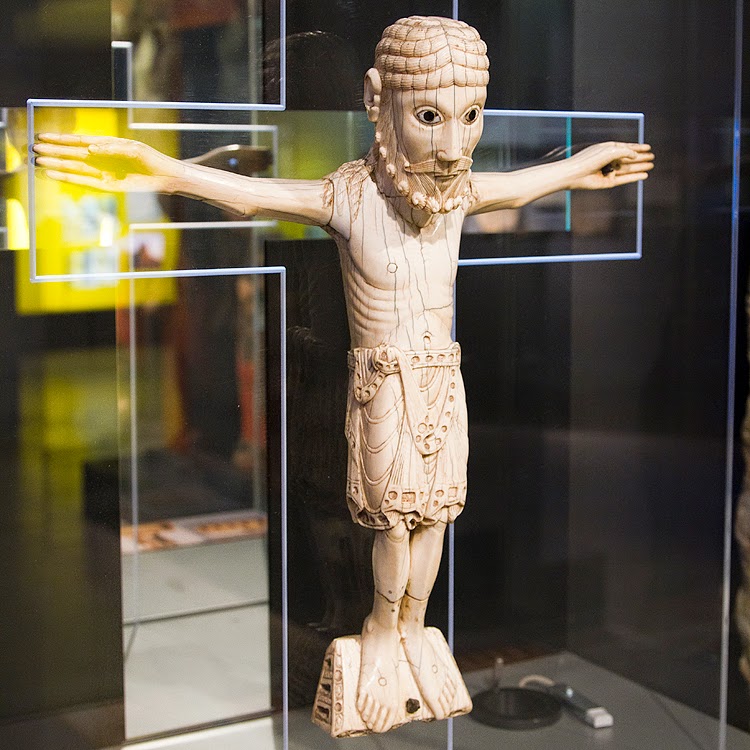
The Cristo de Carrizo is a hand-carved ivory cross, Mozarabic in origin. It shows Christ, on the cross, with his eyes open, looking at the viewer. Christ is not dead, in this crucifixion, but very much alive, and suffering. Image taken from Wikipedia.
Lost

Lost

My body’s house has many rooms and you, my love,
are present in them all. I glimpse your shadow
in the mirror and your breath brushes my cheek

when I open the door. Where have you gone?
I walk from room to room, but when I seek,
I no longer find and nothing opens when I knock.

Afraid, sometimes, to enter a room, I am sure
you are in there. I hear your footsteps on the stair.
Sometimes your voice breaks the silence

when you whisper my name in the same old way.
How can it be true, my love, that you have gone,
that you have left me here alone? I count the hours,

the days, embracing dust motes to find no solace
in salacious sunbeams and my occasional dreams.

Comment: Another golden oldie, polished, rewritten, and revised. Today is Clare’s birthday and fifty-five years ago today we got engaged, on her birthday, in Santander, Spain. I wrote this poem a couple of years ago when she was visiting our daughter and grand-daughter in Ottawa and I was left alone to look after the house. I will be including this poem in my new collection, All About Ageingin an age of pandemic, on which I am currently working.

My vision of absence and of the bereaved wandering, lost, the house the couple once shared, is sharpened in this age of pandemic in which we live. My heart goes out to all those who have suffered short term or long term effects from the pandemic. My premonitions and visions, my memories and dreams, reach out especially to those who have lost loved ones and who live in the daily reality of that loss.

Yours

Some flowers don’t fade
even after 55 years

Yours

Yours are the hands that raise me up,
that rescue me from dark depression,
that haul me from life’s whirlpool,
that clench around the jaws that bite,
that save me from the claws that snatch.

Yours are the hands that move the pieces
on the chess board of my days and nights,
that break my breakfast eggs and bread,
that bake my birthday cake and count
the candles that you place and light.

You are the icing on that cake, and yours
is the beauty that strips the scales
from my eyes, then blinds me with light.

Lament

Lament
for three brothers
dead before him

“Eric, Phillip, Peter:
why did you leave me?
Why did you,
where did you go?

Eric, Phillip, Peter:
you went out
through the door,
so silent,
didn’t even slam it,
why did you go?

Eric, Phillip, Peter:
I hardly even knew you,
the house, my life,  
so empty without you,
shadows so scary,
why did you leave me,
where did you go?

Eric, Phillip, Peter:
vacant and silent,
lonely the house,
such a big world
without you,
so full of menace,
so full of woe,
why did you leave me,
why did you go?”

Can you tell me …

Painting by the very talented
line-painter, Geoff Slater

Can you tell me …

… why an incoming wave
is a flash of a handkerchief
an invasion of white water,
a hand at dockside waving good-bye?

… why each wave separates,
thrives for a little while,
then dies on the beach,
wrapped up in its lacy
shroud of foam?

… why errant stars fall,
leaving their constellations
to wander the world alone,
each shooting star, a child?

… why a mother abandons that child,
turns her back on her husband,
and looks silent at the wall?

… why, one night, that husband
walks out of his house,
and never returns?

Summer is Ice-Cream

I can’t put a real ice-cream up here,
it might melt and spoil the computers,
yours and mine,
so here’s a cardboard one instead!

… after my grandfather died I slept with my grandmother in her large double bed when I was there on my own … but when all the cousins were there we shared a double bed and three or four of us slept at the top and three or four of us slept at the bottom and we were so small and short in those days that our feet never touched in the middle and the bed was like an earth worm … an octopus earth worm with several heads and no feet … or all the feet in the middle … like a centipede … and sometimes my parents would have to snuggle in with us too … though we scarcely woke up when they arrived or departed … and with tears we would go tired to bed … and the grown-ups would promise that it was only for an hour or two … for a little rest … and we were so far north that the summer sun was in the sky until late at night … but sleep we did and they never woke us up … and we didn’t wake up until the dawn chorus of birdsong … bird after bird chirping and singing in the hedge with its bluebells and primroses … the hedge that divided one bungalow field from the other …

… and we were in the first bungalow field, which was the best one, obviously, because we lived in it … and there was another bungalow field behind us and we could look through the gaps in the hedge and occasionally there were gaps we could crawl through … but they were well guarded because there was an all out war between the two fields and we didn’t like the boys in that second field and they didn’t like us … and we fought our skirmishes through the hedge and at the gaps in the hedge and the people in the field behind us would rent out their bungalows to boys with strange accents who would be instant enemies the moment they opened their mouths or heard us talk and vice versa, the other way round … and it was the silent arrow or spear shot or thrown through the hedge … and the long trailing root set out to trip the unwary, and once we tied a rope across the field, a trip wire to trip those foreign warriors, and we meant to take the rope down before it got dark, but we forgot and we missed the enemy but we caught my father and all the uncles walking back home in the dark from the local pub … and didn’t they trip and all fall down in a great big squealing piglet pile … and the aunties thought it very funny because once they were down, they couldn’t get up again … and the aunties said it had nothing to do with the rope … that they were all falling down anyway, falling down all the way home from the pub they were, and stumbling … but we had hoisted our allies with our own petard and next day we were brought to justice and the justice was severe … and what, they said, if we had caught one of the farmer’s cows … and if it had broken a leg … then who would be responsible then, to the farmer, for payment, and we all hung our heads in shame for those days everyone was big on responsibility and being responsible was a big thing … and even the dog, our scout and protector, our war horse and chariot, for we were Ancient Britons that summer, sat there silent and serious and hung his head in shame at the hot bitter words and he wasn’t even wagging his tail … and the adult jury, twelve sober uncles, tried men and true, all pronounced us guilty and sentenced us to a day without cricket, a day with no jam on the bread, a day in which we must eat up all the greens, a day with no puddings, a day with no sweets, no treats, no ice cream …

… but summer was ice-cream! Who wants ice cream in winter when the hands are cold and the ice wind blows straight down from the Arctic? But in summer, to rob a child of ice-cream is to commit a capital crime against childhood … and the ice cream was miles away, and to run to get it and to bring it back before it melted was a rare adventure that had to be carefully planned … go to the end of the field, run through two sets of lanes, stop at the first ice cream shop and if there was no ice cream there because it had all been eaten by that awful foreign army, run another mile to the next shop … and if you were lucky there would be some ice cream there … and no we didn’t want cones … cones were for the babies … the tiny children who couldn’t control their ice creams … we wanted wafers, like the big boys we were, although we were all still in short trousers … and there were three penny wafers and six penny wafers, and even chocolate bars with thin chocolate on the outside and the ice cream inside … and there were lollipops and other marvels … like Cadbury’s ’99’ … but that day all this was forbidden … forbidden because we had set a trip wire for the enemy and caught, by accident, our very own men … oh the injustice, the burning injustice of it all …

Summer Storm

No, it’s not a beach scene, sorry.
It’s the view from my kitchen window
when a major rainstorm blew through the garden
just a couple of weeks ago

… and suddenly, one day on the beach, it started to rain … one small cloud turned into a big one … and the sky became black … from out of nowhere, a great clap of thunder and the storm scene from Beethoven’s Sixth Symphony, the Pastoral, came resounding down in a shower of sound and everybody was running for shelter … into caves … under cliffs … under trees, on the far side of the rocks out  of the wind, and the water, and the horizontal tide of rain that brought relief from the heat … and some of us just stood out there … under the waterfall … enjoying the soaking … watching the water run over our hands, our faces, and our skins … 

… and that summer, like he storm and all the other summers, came to its abrupt end … we locked up the bungalow, walked up the lane laden with our bags and our packages … and when we got to the corner, we waited for the yellow and brown Swan bus that would carry us into town … and on the bus we retraced our steps, slowly and tiredly, away from the hedges, the sea shore, the sand and the beaches, and back to the red-brick houses and life in the cities from which we had come and to which we must now return …

…  and behind us, the salt sea, its bright sailor suit sparkling with waves and glee, waving us good bye from across the headland and away from the rapidly vanishing bay …