Share a story about the furthest you’ve ever traveled from home.

Daily writing prompt
Share a story about the furthest you’ve ever traveled from home.

Share a story about the furthest you’ve ever traveled from home.

Once upon a time, I lay in the sea, at midnight, in Brandy Cove, and I watched the moonlight lap over the waves as I lay there. I began to relax and felt the moon rise. Then I rose up with it, just like Cyrano de Bergerac, and I rose, rose, rose, up into the sky until I was level with the moon.

Was this the furthest I have traveled from home? No.

Once upon a time I climbed with Don Quixote and Sancho Panza upon the back of Clavileño and I rose up, up, up into the skies until I danced among the seven sisters, the Pleiades, and counted them, one by one. Sancho told me they were little goats, all colored differently. “And look,” he said. “That’s the earth, down there, as small as an orange pip.”

Was this the furthest I have traveled from home? No.

A long time ago, I visited Stonehenge and marveled at the temple my ancestors had created there to tell the time and worship the sun. Seven thousand years ago, they told me. I closed my eyes and dreamed I was back there with them, digging the post holes and raising the stones.

Was this the furthest I have traveled from home? No.

I also visited Hengistbury Head in Dorset. There I discovered the scrapes the Reindeer People had scratched in the chalky soil nearly ten thousand years ago. Older than Stonehenge, I lay down in the rocky soil high above what is now the English Channel. My mind went back in time. The waters slowly receded and I saw green grass where herds of reindeer crossed the meadows that still attached Albion to the mainland of Europe.

Was this the furthest I have traveled from home? No.

Once upon a time, I truly traveled and visited Avila. I wandered among the ancient ruins of the pre-Christian monuments. There I stroked the granite of the Toros of Guisando, and watched the ever-lasting storks as they nested in the towers of all the churches. I also walked the Roman Road at the Puerto del Pico. When I ran my hands over the bodies of the verracos, I marveled upon how far away from home I found myself, and how small the world really was.

Was this the furthest I have traveled from home? No.

Once upon another time, I really traveled, this time by plane. I flew to Oaxaca, Mexico, and went back a thousand years or more in time. I read the Pre-Columbian Mixtec Codices, climbed the temples, visited the tombs, consulted a witch doctor, drank mescal, ate chapulines, and entered a world beyond my world.

Was this the furthest I have traveled from home? I no longer know. But I do know that el mundo es un pañuelo – the world is a handkerchief, as the Spanish say. Yes indeed. It is a small, small world. Alas, too many people are blowing their noses into it right now and I see and grieve for this, even when I am at home.

What does your ideal home look like?

Daily writing prompt
What does your ideal home look like?

What does your ideal home look like?

My ideal home looks exactly like the one I am living in right now. In the country, surrounded by trees, with blossoming crab apples in the front garden and a mountain ash in full view from the kitchen window, what more could I ask for? Blossoms in the spring, a gradual flowering throughout the summer, and now, as fall approaches, the fruit ripening.

Verde, que te quiero verde. – Green, for I love you green. But what exactly is green? I sit on the front porch in the cool of summer, and look out on a sea of greens – green grass, green leaves, light green, medium green, dark green, and all kinds of shades and hues as the sunlight filters a subtle dance of colors through the leaves. The eye distinguishes so many different shades of green. Alas, I do not have the vocabulary to distinguish verbally what I see visually. Ah, poor poet, linguistically damaged, and writing with one hand tied behind my back, I suffer from an ability to feel and an inability to express. Terminological inexactitudes, Winston Churchill called them. But in my case, they are the lies I must create when the truth overwhelms me with its beauty.

And in winter, when the cold winds blow, and the leaves lose the safety of their trees to be blown hither and thither at the wind’s will, what then? A blanket of whiteness, shadows shifting beneath the moon by night, and a million brilliant sparkles beneath the sun by day. And the visitors, every night the deer come, stay awhile, then vanish, only to reappear the next day. At midnight, in the moonlight, I watch them from my window as they dance on their hind legs and nibble the hanging fruit that the mountain ash reserves, just for them, so that they will survive, as they have done for millennia, in this paradise that surrounds my ideal home.

Low Ebb

Low Ebb

We have been apart too long, my love,
night’s dark corridor lying between us
and neither of us approaching the other
when doors close and blinds are drawn.

The way to the heart of the matter is not
an easy path to walk, not any more.
Our secret ways and dreams lie cold
upon chill, empty sheets and pillows.

Each day the tide revives the beach,
flowing out, abandoning its wet debris
for the sun to perform its magic: fresh
seaweed drying above warm sand.

Sea-birds bury their beaks, writing claw
letters as crabs burrow, dig deep, waiting
for the tide to return and re-create
its alternate reality of dreamy waters.

Half of my bed performs its nightly duty.
The other half lies cold, empty, lonely.
No sea-life wanders there, not even in
my most creative dreams of sun and sand.

Comment: The loneliness of old age is compounded by many factors, including ill-health, sleeplessness, and the need to sleep in separate rooms. How many homeless people suffer that loneliness, and more, and at ages much less than ours? And then there’s the distress of trying to live in poverty, to survive from day to day, with safety net that will not protect us, if we chance to fall. A sad world then, as Polly Toynbee points out in today’s Guardian.


What TV shows did you watch as a kid?

Daily writing prompt
What TV shows did you watch as a kid?

What TV shows did you watch as a kid?

Well, first of all I want to define the age group that outlines the meaning of ‘kid’. Here’s one definition: What age range is a kid? Children (1 year through 12 years) Adolescents (13 years through 17 years. They may also be referred to as teenagers depending on the context.) If we start with the 1-12 year old age group, then I can safely say I had no favorite TV shows as a kid, quite simply because during those years, we didn’t have a TV. Ipso facto, not having a TV, I couldn’t watch one.

That said, our first family TV was bought by my maternal grandfather in June, 1953. It was very small, black and white, very grainy, and was the only one on the street where he lived. I remember all of us crowing into the sacred room where the TV stood and watching the Coronation of Queen Elizabeth II. I was 9 years old at the time. I don’t remember much about the Coronation, but it was my first TV show.

Early TV. In the beginning, there were black and white sets. The BBC had only one channel. It came on from 12 noon until 1:30 or 2:00 pm, then shut off until 5:00 pm when it opened for evening programming until 9:30 pm or 10. I was safely tucked into my bed by then. And since I visited my grandparents at odd times, I rarely saw any TV shows. I do remember Sooty, a hand puppet, hitting Harry Corbett, the puppet-master, with a hammer (!), and I have vague visions of Muffin the Mule, a string puppet, dancing on a piano.

By the age of nine, I had been removed from my first boarding school and was attending my second. There were no television sets in boarding schools in those days. So, guess what? There were no favorite programs. In the holidays, with both parents working, to make enough money to send me to boarding school, as they so frequently told me, I often spent time with aunts and uncles (no TV) or with my paternal grandmother (no TV). The bungalow was our favorite summer residence, and that didn’t even have running water or electricity, let alone a TV set. It had one radio, an item of religious importance, that ran off a battery, and was for the sole use of my uncle. It sat on a high shelf and was untouchable. One bungalow in the bungalow field actually had a telephone, and that was only used for emergencies.

So, in the age group I am writing about, age 1-12, I rarely, if ever, saw a TV set and I certainly had no favorite programs. Radio programs, yes. But that is a different story, one that tells of a single radio in the dormitory, to the sound of which, eight or ten or twelve boys, in rows of beds, fell asleep to the sound of music. It also tells of prowling masters who would enter the dorms and switch the radios off. I will not go into the horrors of boarding school life during those formative years. I have done that elsewhere. But the shows that I remember were all true life horror shows where real flesh and blood, in the 6-12 age group, suffered appallingly, at the hands of older boys and brutal masters. But those shows, and I remember them well, were never seen on TV and were denied vehemently by the perpetrators, boys who had been bullied in their turn, and masters who claimed they were only doing their duty and making men of us. Men, indeed, and an adulthood that I, among many others, never wanted to enter.

Underworld

Underworld

In the secret world of my goldfish bowl
I speak in bubbles but only hear silence.

My fish-eye lens bends the pendulum
of the grandfather clock. Westminster chimes,

inaudible, do not intrude. Noiseless are time’s
ripples across the surface of my submarine sphere.

I feel, rather than hear, my troubled heart beat.
The foreboding sounds of distant voices leave

me untouched and becalmed. Rocked in love’s
cradle, these amniotic waters nourish and soothe.

In my beginning will be my end. One day I’ll return
to the beaches of my childhood, where the sun

always shines, and the moon path over the waves
is a welcoming walkway leading to the underworld.

Write about a random act of kindness you’ve done for someone.

Daily writing prompt
Write about a random act of kindness you’ve done for someone.

Write about a random act of kindness you’ve done for someone.

Sir Alex Ferguson, one of soccer’s greatest managers, once said that it wasn’t the victories he remembered, but the defeats. So it is with my own coaching career – it’s the losses I recall. Same thing with random acts of kindness. There have been many, too many to count. I will not paper my e-walls with glowing memories of past kindnesses. But what about those random acts of kindness I failed to do? Here’s one of them.

            Crave More: I hate those words. I always choose a cart with the shop’s name on the handle. I can handle that. I can’t handle a shopping cart that screams Crave More at me every time I stoop down and place another item in the wire grid. If stores were honest, they would inscribe their shopping carts with a sign that said Think More, Crave Less, and Save Your Money. I bet that would quickly cut into profits.

            Anyway, there I was, in La-La-Land, leaning on my cart, still half asleep, when this ghost drifted towards me. “Help me,” it said. “I’m hungry. I need food.” I woke up from my dream, looked at the ghost, tall, skeletal thin, cavernous eyes and cheekbones protruding, gaps in the teeth, grey face drawn and lined. The single word “Sorry” came automatically to my lips. Then I felt shame. I looked at him again. “I only carry plastic.” The excuse limped heavily across the air between us. I saw something in his eyes, I knew not what, and I turned away.

            Then, as I walked away, I added 100 lb of muscle to the scarecrow frame. Took forty years away. Filled his body with joy and pride, and remembered how he played when I used to coach him, hard and fast, but true. I ran my hand through the card index of former players that I had coached. I knew their moves, and attributes, the way they played the game, their stronger / weaker side, their playing strengths, their weaknesses. I remembered him holding up the Champion’s Cup. But I couldn’t remember his name.

            I pushed the cart all over the store in a frantic search for him. I went to the ATM and took out cash. I could hand it to him. I could tell him he had dropped it. I went through a thousand scenes. I could invite him to the snack bar. I could tell him to buy what he needed and follow me to the check out lane where I would add his purchases to my cart. I looked everywhere. He was nowhere to be seen.

            A single opportunity. One chance. That’s all we get. Miss it, and we blow the game. Take it, and we win the Championship and hold up the Cup.

How would you describe yourself to someone who can’t see you?

Daily writing prompt
How would you describe yourself to someone who can’t see you?

How would you describe yourself to someone who can’t see you?

Well, that would depend on why they couldn’t see me. “Those who have eyes, but cannot see.” Many have stood beside or before me, looked into my eyes, as I looked into theirs, and never saw me. “The most difficult role in the play is that of the fool,” said Don Quixote, “for he who would play the fool must never be one. So many people saw me deliberately playing the role of the fool and forgot the above quote. They also forgot what Antonio Machado wrote: “The eye you see is not an eye because you see it, it is an eye because it sees you.” And there you have it: why would I bother describing myself to people of that ilk, so stupid and blind with their own limited wisdom, that they couldn’t see me anyway.

Keenan’s Well, by Seamus Heaney, is a wonderful poem. It tells us about Rosie Keenan, his blind from birth neighbor, who played the piano and sang all day. She let them touch her books, like books of wallpaper, and feel the letters of braille by means of which she was able to read. They allowed her to touch their faces with her oh-so-sensitive fingers, and she said she saw them, as well as knowing them by their voices. When he read her a poem about Keenan’s well, she told him that she, blind from birth, ‘could see the sun shining at the bottom of it now.”

How would you describe yourself to someone who can’t see you? I wouldn’t waste my time and energy trying to do so.

What traditions have you not kept that your parents had?

Daily writing prompt
What traditions have you not kept that your parents had?

What traditions have you not kept that your parents had?

What traditions have you not kept that your parents had?

To the best of my knowledge, my parents only had three traditions. I have not kept any of them.

Tradition 1: They took two weeks holiday every year in August. Both were hard-working, and that holiday was always a precious break from work. Being employed in academia and a life-long inhabitant of the Ivory Tower, I have not had holidays forced upon me by a 9 to 5 work schedule. Research and creativity do not function according to a 9 to 5 clock. I realize how fortunate I am, and I give thanks every day for my intellectual and creative freedom.

Tradition 2: They fought like cats and dogs at every opportunity. It was so bad that, at one stage, in my innocence, I thought that cats were females and that dogs were males, and that was why they opened instant hostilities whenever they saw each other. Luckily, I have no siblings to challenge this view of events, and my parents are long gone, so they won’t be worried either.

Tradition 3: My maternal grandmother’s birthday was just before Christmas. On her birthday, every year when I was a child, my mother would come home early from work, but my father wouldn’t. He often didn’t come home at all. Office parties. My mother would hang around the house for a while, consoling herself. Then she would get angry, tell me to pack a bag, pack one herself, and call a taxi. This would take us to the railway station or the bus station, and off we would go to grandma’s house to celebrate her birthday. My father, looking sheepish and hang-dog, would arrive late Christmas Eve, or early Christmas morning. On Boxing Day, the gloves came off, and they were at it again. That’s why it’s called Boxing Day. Well, that’s what I thought anyway.

So there you have it. Three traditions that my parents had and that I have never kept.

Heartbreaking

Heartbreaking

How many have broken their hearts,
reading what I have written, as I have
broken mine, reading what others wrote?

My words reach out, naked, stripped
of false trappings, fake images,
my flesh and blood damp on the page.

Who knows where my words will land,
on fertile ground, on desert sand, or will
they lie on dry, stony paths, infertile?

So many people now scorn living words,
preferring those dull dry three-word chants,
fists clenched, or raised, that hypnotize.

Their love of words, thoughts, ideas, life
have been coffined in confining boxes,
cardboard castles, corrugated cans,
that they lock, then throw away the key.

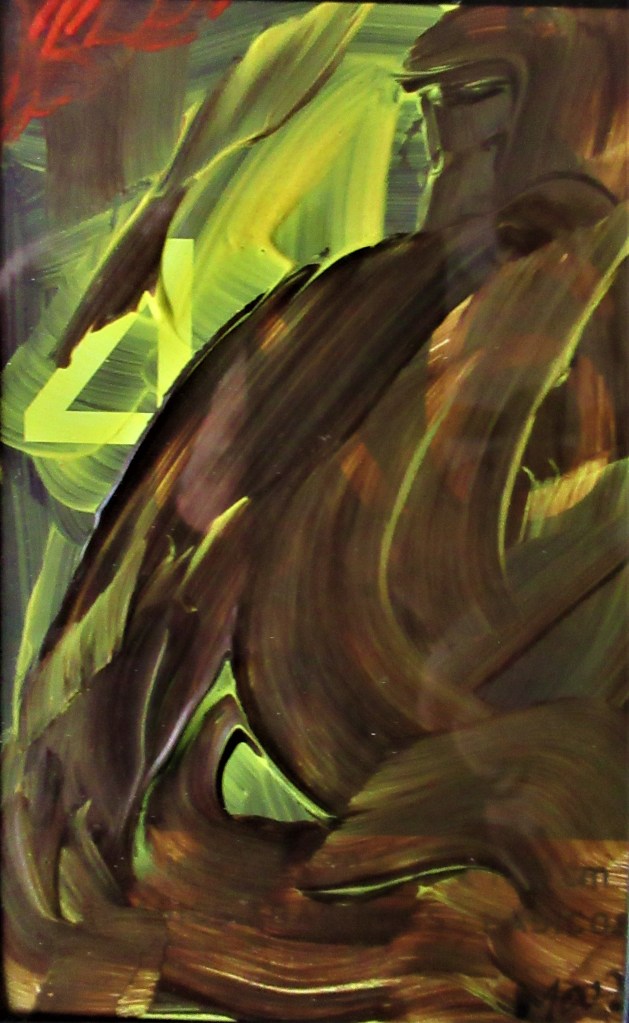
Comment: Thank you Moo for your painting – Words fall like leaves and drift away. It make a fine companion to the poem.