Safety Blankets

IMG_5811_2


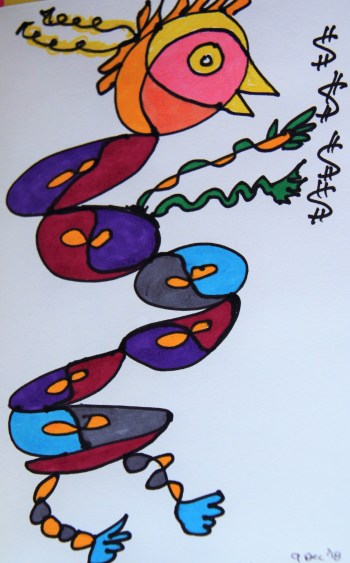
Serendipity, really, that the links below should appear so close together. First, Meg Sorick’s post on drawing toys  and childhood memories. Some of us can draw (well done, Meg, congratulations). Others can’t, and must take a line for a walk, or must color or crayon or live with their black and white memories. Yet we never forget these early comforters, these early friends.

Traumatic, sometimes, the separation of us from our childhood beloveds and then the substitution of wool and cotton, of Teddy and struggle from the flesh and blood that never quite fulfilled the hollowness within us.

“Grow up,” the grown ups said. And offered us a world of cynicism and misery.

I remember when I asked the priest (I was about 4 years old at the time) if I would see my dead dog when I got to heaven.  He told me that dogs didn’t have souls and I’d never see him him again. Tough luck. I was lucky. The dog wasn’t. Apparently that particular priest had never heard of the Rainbow Bridge.

‘You must grow up,’ he said.

“If that’s your reality,’ I said, echoing the words of Atahualpa, ruler of the Incas,  “I don’t want to go to your heaven, and I don’t want to grow up. Ever.”

“So what will you do, who will you be?”

“I’ll be Peter Pan,” I said. I think I was four, but I might have been five.

At an international conference, a few years ago, while I was still recognized, before the age of 65, as a real, productive human being, a young lady, hearing my strange, outlandish accent, asked me “Where did you grow up?” “I don’t think I have,” I replied.

Why do we have to grow up? Picasso said that he had spent most of his adult life learning to see the world once more through the eyes of a child. And why ever not? Metaphors, beliefs, myths, acceptance, understanding, friendship, openness, willingness to learn  … things that are gradually worn away as hierarchy, authority, obedience, socialization are taught to us by those who think know best.

Are these the ones who also brought us so many things that are wrong with our world? The inability to think for ourselves, fear of authority, the need to fit in and be accepted, fear of the mob, the crowd, of those who believe in what they are told to believe. The fear of the other. The need to destroy that which we don’t understand.

Advertisements? I love them and sing them all day long. Tee-shirts with slogans? Wonderful. I wear them and show them proudly to my friends. Sound bytes? I never question them and I circulate them to my friends. For ‘whether I think for myself or no, I’m sure is only touch and go’. You may or may not recognize the poet, but I do. I was born less than a mile down the road  from him. You’ve probably never heard of him, but I have.

Accept my poet-neighbor and reject what modern society throws at me? It’s a difficult choice, isn’t it? How do we choose and why? What do we think and why do we think it? Or do we just follow the mob, the herd instinct, the sheep?

“If there were five sheep in the field, and one got out, how many would be left? Mary.”

“None, miss.”

“What do you mean, none? What’s one from five, Mary.”

Mary was the local farmer’s daughter. She didn’t think like that.

“No, miss,” said Mary. ” Sheep don’t think like that. If one got out the field, the rest would follow. There’d be none left.”

Terrible mathematics. Wonderful sheep psychology. A young creative mind thrown on the rubbish heap of ‘true’ knowledge at five years of age. Dismissed as an ignorant fool. What a pity.

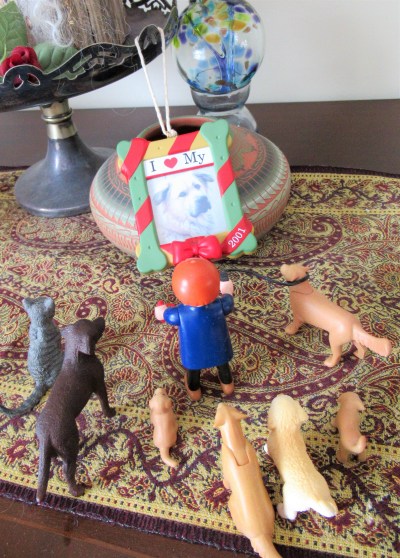
And what’s wrong with Teddy Bears and childhood toys? I love them. I still have my daughter’s Paddington Bear beside my bed. Yellow Sou’wester, yellow welligogs, for those who know what they are. Here’s Meg Sorick’s take on my folly:

https://megsorick.com/2018/12/09/the-year-of-drawing-adventurously-week-49-toys/

Who is Meg Sorick? In my own mind, she is a bright, intelligent human being, who looks upon our ageing and cynical world with childhood in her mind, and intelligence in her paint-brush and her pen.

As for the real world? What’s it all about, Alfie, Bertie, Cecily, Dewi?

Living in my own world, with a creative Joey in my Kangaroo pouch, not really Roger the Ripper Roo, I honestly don’t know. A Marsupalian view of the universe? Why ever not? If you can believe in the koala, and the marsupials, and the kookaburra, and the platypus duck, you can believe in anything. Read the linked article below about childhood teddies … if you dare … I did … many won’t.

https://www.theguardian.com/society/2018/dec/12/still-have-childhood-teddy-psychological-power-toys-we-keep


Coat of Arms

coatofarms.png


I’ve never yearned for a coat of arms. All those advertisements for this and that, DNA tests to prove your ancestry, where your family name comes from, how many famous people were in your past, how many convicts … and the convicts were often poorer family members, wallowing in poverty and forced into theft, money, a loaf of bread,  a chicken, a lamb, some eggs, something to feed the children, to pay the bills … the possibility of blue bloods and royalty outweighed by the probability of some dark skeletons swinging on gallows somewhere in the distant past.

Yet when I got my online advent calendar this year, there was the coat of arms game … make your own coat of arms. So I did. The choices were very limited, not too original, and came with a ‘clan history’ that has absolutely nothing to do with me. A bear and a dog … I can live with those, especially as the bear is apparently my Canadian spirit animal. A Welsh dragon draped round the top of the frame … wrong color and definitely not Y Ddraig Coch, the blood Red Dragon of Wales, but still a symbol I can happily live with. Down below, we have Sun and Moon, the symbol of Oaxaca and title of the first book in the Oaxacan Trilogy (first published in 2000). Unfortunately, I have reversed the symbols to give us Moon and Sun. Oh dear. Such things happen.

Then we have a snowman and a beer tankard. Sounds good to me. I have now lived in Canada for more than fifty years in Canada and I know all about snowmen, and the taste of beer, sometimes mulled, to take away the cold. I am not so sure about ‘my clan’ as I don’t really think that I have one. I feel it is a very foreign term  like Hi there, gang. I can take Robin Hood and his Merry Men, but Roger and his Merry Gang, no thank you, that’s not for me. Sorry. As for ‘throughout the land’, I wonder which land they are referring to: Wales, England, France, Spain, Mexico, Canada … I don’t really feel that any of these stand up as my ‘land’ … except possibly for Canada, and as for Canada, well, this land is enormous. I have certainly visited some of it, but by no means all, and there is so much more to see and hear.

‘In Battle’, well, I have never been in a battle. I dislike violence and fighting, and I cannot imagine how a phrase like that got in there. ‘Fierceness’ same thing, I am as mild as milk and very easy-going. ‘Loyalty’, yes: that’s what the bear and the dog are famed for. ‘Us bears never forget’, or words like it, from the Chronicles of Narnia. Oh dear, there I go … I can hear mother bear now … ‘Stop sucking your paw’.

Seize the day is goodCarpe Diem … but never in battle … in poetry, maybe, or else in gathering old age where every moment of every day seems more and more precious. I wold have preferred Horas non numero nisi serenas, but they didn’t have that one, even though, nowadays particularly, it is the happy hours that I count, and not all of them spent in a local bar, or home alone, with my own beer mug.


Ghosts

IMG_0125.JPG

How many ghosts loom out of our past and stand over our beds at night ready, willing, and waiting to enter our dreams and haunt us? I guess we all have them. But, like the animals in Animal Farm, where some are more equal than others, I guess some of us are more haunted by our childhood past than other people are.

What haunts me most from my childhood? Loneliness, rejection, and abandonment, I think. An only surviving child, I was sent to boarding school at a very early age. This initiated the sense of rejection. In my own mind, I was clearly being thrown out and equally obviously, nobody wanted me around. This reinforced my sense of abandonment. Rejection and abandonment were complicated by loneliness. When I came home for the holidays and talked about ‘school’, nobody in the family knew what I was talking about, because nobody in my family had ever been to a boarding school. My school experiences were foreign to the rest of the family.

We lived in a working class area of Wales. It didn’t take long for my ‘posh accent’ to further single me out and this led to even more torment inside and outside the family. I will not repeat some of the things that were said, but I have never forgotten them. Only recently have I begun to understand what many of those words and snide comments actually meant.

“Sticks and stones can break my bones,
but words will never hurt me.”

The old Welsh proverb seems to ring true. I certainly got the sticks and stones, above all the sticks, daily beatings and canings in school. Back home, the words swarmed like black-fly and yes, they stung, hurt, and did a great deal of damage, much of which still clings around me.

Loneliness: how important was that? Both my parents worked, so when I was home from school for the holidays, I was either at home all day during the working week, alone from early morning until late afternoon when my parents came home, or fostered out to family members, not all of whom wanted me around. Many, many days I spent at home, on my own, face pressed against window panes, waiting, watching the eternal rain.

There were some blessings: I learned very early how to cook and I have carried the love of cooking with me always and everywhere. For me, cooking is a joy, a filler of space and time, a beloved occupation that dispels loneliness, and abandonment, and fear. Cooking: the thinking, the planning, the creativity, the activity … I hated cleaning up afterwards, always have. But, it’s amazing how many people love you, and love to hang around you, when you know how to cook, and how to cook differently and well.

Why do I write about this now? Well, I read this article on trauma and addiction a few minutes ago and it moved me greatly. Clearly it’s time for me to face some of those past ghosts and to banish them from my life. Can I do this? I don’t know. But I’ll give it a WIGAN, a jolly good try.

Crocodile Tears

SD 16


Crocodile Tears

         The crocodile lives in the wind-up gramophone. The gramophone lives in the top room of the house. The boy winds up the gramophone with a long brass handle, round and round, till the spring is tight. The tight spring frightens the crocodile and he sits quietly in his cage. But as the record goes round, the spring loosens up and the crocodile roars and demands to be freed. He’s the Jack that wants to jump out of the box. His long-term dream is to eat up the witch who looks out of the window and watches the boy as he plays in the yard.

         Last week the boy decided to dig. He picked up a spade and dug a deep hole that went all the way down to his cousin in Australia. The little dog laughed and joined in the fun, scraping with his front paws and throwing earth out between his back legs like happy dogs do. The witch in the window cackled with laughter and the rooks in the rookery rose up in a cloud and cawed in reply. Only the boy can see the witch and he only sees her when she sits in the window. But he knows she wanders through the house, and the air goes cold when she enters and exits the rooms, especially when she brushes past the boy and sweeps his skin with her long, black gown.

         When the boy gets tired of digging, he drives the spade into the ground and leaves it standing by the hole. When his father comes home after work, it’s dark and he doesn’t see the hole but he does see the spade. So he doesn’t fall in to the shaft of the coal-mine that goes all the way down to Australia. No free trip to the Antipodes for that lucky dad. He beats the boy for that, for digging that hole. Then he beats him again for lying: the hole doesn’t go to Australia. Australia is too far away and the angle is all wrong. The boy laughs when he sees that his dad doesn’t know where Australia is.

         “Ha-ha,” he laughs and his dad beats him again, this time for laughing.

         Sometimes at night the boy can hear rats running through his bedroom walls. They scuttle and scuffle as they hunt through the guttering. The crocodile growls from time to time in that upstairs room. The witch cackles with laughter. The boy puts his head under the blankets and cries himself to sleep. Sometimes he wishes the crocodile would come and eat up his dad. But he loves his dad like the dog loves his dad even though his dad beats both the boy and the dog. Sudden beatings, they are, beatings that arrive without warning: hail and thunder from a sunny summer sky.

         “Well, you’re not laughing now,” his father announces.     When the father beats the boy, the dog cowers beneath a chair. The boy hears the crocodile growl and smiles through the tears as he wipes salt water from his eyes.

         “Are you laughing at me? I’ll make you laugh on the other side of your face,” the father taunts the son and beats him again.

         The crocodile growls. The old witch cackles. The rooks in the rookery rise up in the air and the father’s hair stands up on end like it does when lightning lights up the sky, and thunder rolls its drums, and the sky rattles like an old farmer’s cart whose iron-rimmed wheels have not been greased. The veins stand out in his father’s cheeks as the old man raises his hand to the boy.

         The old man tells the same old jokes again and again. The boy must always remember to laugh at them as if he had never heard them before. If he doesn’t laugh, his father gets angry. Some of the jokes are good, and the boy likes the one about the Catholic who goes into the bar in Belfast and asks the barkeep if they serve Protestants. Or is it the one in which the Protestant goes into the bar and ask the barkeep if they serve Catholics … anyway … one night, the boy has a dream and it goes like this. The crocodile escapes from the gramophone. The witch hands the boy a leash and a collar and between them they restrain the crocodile.

         “Walkies?” says the boy.

         The crocodile nods his head and croc and boy walk down the street to the Kiddy’s Soda Fountain on the corner.  When the boy walks in with the croc, the waitress raises her eyebrows and opens her mouth.

         “Do you serve grownups in here?” the little boy asks her.

         “Of course we do,” says the waitress.

         “Good. I’ll have a glass of Dandelion & Burdock for myself and a grown-up for the crocodile. Please.”

         The witch says grace, the boy sips his Dandelion & Burdock, and they all shed crocodile tears as the boy’s pet crocodile chomps on the fast disappearing body of the boy’s dad.

Westminster Chimes

Empress 005

Westminster Chimes

Not all clock towers and churches ring out with Westminster Chimes, and that is particularly true of churches where the carillons are so distinctive and those who toll the bells are so unique. That said, the Westminster Chimes are probably the most famous in the world: 4 sets of 4 notes, striking on the full hour, followed by the clock tower striking the hour itself. The build up is basic: 4 notes for the quarter hour, eight notes for the half hour, 12 for the three-quarters, and 16 before the hour strikes.

Last night I awoke at 3:15, just in time to hear the hall clock strike the quarter. The initial sounds lost themselves in the mist of sleep and I only caught the last two notes clearly, hence the bell tower of Ste. Luce-sur-mer, above, partly disguised by the St. Lawrence river mists. Doze mode, I guess, and I heard the notes at half past, then again at a quarter to, and finally the hour. I wonder how many remember the rhyme that the clock chimes? I repeat it every night as I lie awake, listening: 1/4: All through this hour, 1/2 All through this hour, be by my side, 3/4 All through this hour, be by my side, and with thy power, 4/4 All through this hour, be by my side, and with thy power,  my footsteps guide.

Dozing through the night is a funny thing and the mists of sleep walk through one’s head in many forms. Often, I count the chimes, only to find that it is not three o’ clock, but four or five. The mists have crept into my head and I was sleeping when I thought I was waking and 1 and 2 and 3 are not always followed by four and I wonder if there is a life-lesson in there somewhere that will help us through this current upside-down world of carnival and topsy-turvy pan et circenses, predicted by Juvenal in his satires. The Wikipedia definition of the second-century phrase is fascinating: “In a political context, the phrase means to generate public approval, not by excellence in public service or public policy,  but by diversion, distraction or by satisfying the most immediate or base requirements of a populace— by offering a palliative: for example food (bread) or entertainment (circuses).” O tempora! O mores! (Cicero).

Sometimes we have to take steps backwards through time to fully understand the meaning of our own times. In the meantime, we can look out of the window, here in Island View, and see the ruins of the summer garden, slowly crumbling before our eyes. Then we can quote again, this time from Samuel,  ‘Ichabod, Ichabod, the Glory has departed.’


Insomnia

IMG_0114

Insomnia

Mine was at its worst in Moncton in 2015. I was committed to eight weeks of radiation treatment, and after two weeks, I slept restlessly, if at all. Some of the other residents of the hospice were worse off than me. They got up at all hours of the night and paced the floors downstairs, nursing their wounds, both mental and physical, searching for the peace and the sleep that eluded them. I never went down to join them. My case was different. All cases are slightly different. In spite of this society’s attempts at social engineering, each of us is an individual and we deal with our own problems in our own way.

In my case, the need to pee during the night dominated my sleep. I would sleep in ninety minute cycles, then get up and visit the bathroom, then return to bed for another ninety minutes. Sometimes, I was lucky and the cycles went for two hours, or two and a half hours. I rarely got more than three hours sleep. Upon returning to bed, I would often just lie there, remembering, thinking, musing, hoping, waiting for sleep to come. Often my cycle would reject the sleep I needed, and I just lay there waiting until I was ready to pee again. These were not great times. Luckily I never fell asleep so deeply that I wet the bed. Some did, but I was one of the lucky ones and managed to keep my bedding clean.

During this time, I learned to divide the night into segments. I thought of the segment that ran from 10:00 pm to 3:00 am as an uphill climb with the initial joy of dropping off to sleep tempered by the knowledge that the urge to urinate would soon be upon me. The segment from 3 am to 4 am was the plateau at the top of the hill: I rarely slept during this period and would look frequently at my clock while the minutes ticked by. Sometimes I would turn on the light and just watch the second hand throbbing slowly round. It was like watching sand sift through an hour glass, or water sift through the fingers: uncontrollable, unstoppable, life just slipping away. I had plenty of time to think and much to think about. I relived my life during those eight weeks and a lot of it was unpleasant as I blamed myself for the situation I was in.

At 4 am, the universe shifted, and I was able to relax and slide downhill into the Land of Winking, Blinking, and Nod. With the urges of the earlier segments fading, I would often get two sound sleeps at this stage, one from 4 to 6 and the other from 6-8. If I was lucky, I would sleep from 4-7, or even 4-7:30 am. These were bonus nights and I awoke after a three hour sleep session to find myself greatly refreshed.

Three years after my treatment, many things have returned to normal However, those sleep patterns have not changed that much. I no longer feel the need to urinate at such regular intervals, but I still dip in and out of those same sleep cycles. They have become a part of my system. The easy part, tired, sleeping from bed-time to about 2:30-3:00. The lying awake, anywhere between 2:30 – 4:30, then the relaxing slip into dreamland, for the last part of the night.

The good thing is that my dreams have changed. I am no longer chased by the ghosts of times past who pace through my night, awake and asleep, to prove that my suffering is due to past moments of childhood iniquities discovered in soulful daily examinations  induced by a consciousness of minute sins demanded by the weekly confessional. Now, I dream of many things, of shoes, and ships, and sealing wax, of cabbages and kings, and if the sea is boiling hot and whether pigs have wings. This is much more fun: I find I can now control my dreams, re-think them, and re-write the endings. In my waking periods I do just this, and my dreams adapt and change and become more pleasant as I fall back into sleep. This has turned into a time of great creativity: but that is a tale for another day.

Seeds

20180916_183415-1_resized

Seeds

As creative artists, we seek to leave seeds and plant seeds. Just one idea, seeding elsewhere authenticates us as artists and creators. Some seeds fall on stony ground, we know that. Others do not take immediately, but lie dormant for some time. Some, a few, a very few, a happy band of siblings. drop, root, and grow into the flowers we always wanted to create.

We must always have confidence in our seedlings. We must believe that they will survive, somehow, somewhere, in spite of the random nature of the universe. Write with that belief. Create with that belief. Be strong. believe. Even when others doubt you and, what is worse, you doubt yourself. Never doubt yourself.

My Hollyhock doesn’t doubt. It came from nowhere and gifted itself upon us. Now it has gifted us with pod after pod of wonderful seeds. Some will be lost. The squirrels, chipmunks, and mourning doves, not to mention the passerines, will get others. But some will survive, take root, and flourish, just like this one did.

Believe, my friends, believe. And never stop creating.


KIRA Writing Retreat #2

KIRA Writing Retreat #2

IMG_0084

A second KIRA Writing Retreat will be held from Sunday, October 14, 2018 to Saturday, October 20, 2018. A maximum of five participants will be selected to work with the Kingsbrae  Artistic Director, Geoff Slater, Professor Emeritus and Award-Winning Poet, Dr. Roger Moore, and Award Winning Short Story Writer, Jeremy Gilmer. Full details are available from the Program Director, Mary Jones, at kira@kingsbraegarden.com or by telephone at 506-529-8281.

Click on the attached link for A Brief Overview of Life and Art at KIRA.

 KIRA Promotional Video


Falling into Fall

20180823_152000-1_resized

Falling into Fall

Not just Beaver at the Beaver Pond. Wonderful, this transition from end of summer to start of fall and look, there’s  a little pot of gold at rainbow’s end. By tomorrow, some tiny mouse will have gnawed the edges in search of sustenance. Meanwhile, this moment of perfection caught forever in the transient eye of the passing camera. Tread carefully when you walk these woods. Look everywhere, not just at the path ahead. But watch out for those tree roots. Their little hands will reach out and pull you down and you’ll roll in the already fallen leaves, an old man turned into a child once more. But oh, it’s so much harder to leap to your feet and run, run, run from shadows and the nightmare hands that haunt your dreams and reach out to grasp you.


Loss of …

IMG_0062.JPG

Loss of …

By the time I remembered your name,
I had forgotten your face. Then I couldn’t
recall why I wanted to talk to you.

I trace dark landmarks on the back of scarred
hands: blood maps, unremembered encounters,
dust covered photographs, grey, grim, anonymous,

not belonging in any family album.
At night I cruise among islands, emerald green
against sapphire seas. Why didn’t I visit

some of these places? Golden sand trickles through
night’s fingers and time’s hour glass, as stars
sparkle and planets dance in Platonic skies.

My memory fails. I wake each morning
unaware of where I have been the night before.
I track the sails of drifting ships, white moths.

I think I have caught them in overnight traps,
but they fly each morning in dawn’s forgiving light.
I give chase with pen and paper, fine butterfly nets

seeking wild thoughts waiting to be caught, then tamed.
I grasp at something just beyond my fingertips,
but I can’t quite remember what it is.

Comment: I first published this poem on July 31, 2018 (click here for the original post). Here it is now, in revised form. I find the revision process to be totally fascinating: the polishing of old ideas, the arrival of new ones, a different structure, a reshaping of the poem’s internal logic. So much happens in the revision process. Many great poets wrote and rewrote their poems, again and again.  I consider Francisco de Quevedo and Juan Ramón Jiménez to be poets who continually revised. A perusal of the variants to their poems (28 versions in the case of some of Quevedo’s poems) gives the reader an understanding of how the great poets think, of how they purge, intensify, sometimes simplify, usually improve their initial instincts. We lesser poets can learn so much from the greats. Above all, we can understand that poetry is a life-long practice, that it is a love of words and emotions, that it is a desire to catch and preserve the uncatchable that can never be completely caught. The critics say that the reader can never know the writer’s intentions. I agree with that, to a certain extent, as I never know why I am writing what I put down on the page. I guess I often have no intent. More important, my original intention can change as I write, and what I write is by no means what you understand I wrote when you read, for each of us processes the imagery, especially metaphors, in a different, and very personal, fashion. That said, when I rewrite a thought pattern emerges and my intentions become that much clearer, not from the words on the page, but from the footpath that led me in different directions until the final version emerged on the page.