On the outside

IMG_0192

On the Outside Looking In …

I walked home on my own. As usual. I’d hated the church Christmas party with all its trumped-up noise, childish games, and artificial gaiety.
The priest, formidable yet effeminate in his long black skirted robe, had made us sit in a circle on the floor, legs crossed. He stood inside that circle and placed a bar of chocolate on the wooden boards. Then he walked around the group and whispered a word in each boy’s ear.
“You must wait until you hear your secret word,” he explained. “Then one of you, when I speak that word, whoever it happens to be, may have the chocolate bar,” he stared at us, large, yellowed, horsey teeth, no hair, eyes golden, fierce, like an eagle’s, beneath bushy eye-brows. “When you hear your secret name, you must run and grab the chocolate bar. Understood?”
I had come to the party on my own as both my parents worked. The mums and dads who had brought their offspring to the party leaned forward in keen anticipation. The boys all nodded.
“Are you ready?” The priest watched us as we nodded and then he shouted “Alligator!”
Nobody moved.
“Elephant!” The boys shuffled forward, like inch worms, hands twitching, fingers flexing and grasping.
“Tiger!” A sigh emerged from multiple mouths. Some of the boys licked their lips.
“Lion!” One boy moved, but the priest shooed him away. “Sit down. That wasn’t your word.”
“M-m-mouse!” The boys heaved, a sea-wave about to crest and break.
“I do love this game,” said the priest to the parents. “And so do the boys, don’t you boys?”
“Yes, father …” came the chorus.
“Monkey!” All the boys, except one, leapt into springy action. They dived, crawled, leaped to their feet, ran … a surging heap of boys writhed on the floor as the chocolate bar was torn apart and the long-awaited fights ensued.
All the boys moved, except me. I just sat there.
“I said ‘Monkey,’” the priest frowned at me. “That’s your word. When I say ‘Monkey’, you join in with the other boys and fight for the chocolate bar.”
I shook my head.
“Have some Christmas fun. Join in the game.”
I again shook my head.
“Why not?”
“It’s not right. You’re just mocking us.  I want to go home,” I stood up and walked out of the church hall. I turned at the door and saw the priest glaring at me while a mound of boys continued to scrummage on the floor.
As I walked home, it started to snow. Not the pure white fluffy snow of a Merry Christmas Card, but the dodgy, slippery mixture of rain, snow, and ice pellets that turned the streets of my little seaside town into an ice rink. I turned up the collar of my coat, bowed my head, and stuffed my hands into my pockets. Two houses before my own, I stopped.
A neighbor’s house. With a window lit up in the gathering dark. I drew closer, pressed my nose against the window and looked in. A Christmas tree, decorated with lights, candles, more decorations, a fire burning on the hearth, two cats curled up warm before the fire, presents beneath the tree, stockings hanging from the mantelpiece. For a moment, my heart unfroze and I felt the spirit of Christmas. Then I thought of my own house. Cold and drafty. No lights, no decorations. No fire. The snowball snuggled back into my chest and refused to melt.
When I got home, our house stood chill and empty. My parents were out at work and the fire had died. Nothing was ready for Christmas. I sat at the kitchen table, took out my colouring book and began to draw.
When my mother came home, I showed her my drawing.
“Very nice,” she said, barely glancing at it.
“But mum, you haven’t really looked.”
She stared at the picture again. This time, she saw the Christmas tree and the lights, the cats and the candles, the decorations and the presents.
But she never noticed the little boy standing outside the house in the falling sleet, peering in through the window.
Bilingualism

IMG_1092 (2).JPG

Bilingualism

I went on a French immersion course last week. The instructor asked each one of us to address the class for ten minutes in French. When my turn came, I stood up and announced that I didn’t know what to say.

The instructor then suggested I tell the class about my dreams. What do you dream of? I said that I didn’t have any dreams, I just had nightmares, not rêves but cauchemars, you know, nightmares. She asked me to describe my nightmares and I said I couldn’t. So, she repeated, describe your dreams. I don’t have any. Do you dream about your mother? Yes, I said, but I don’t call them rêves / dreams I call them night-mères / cauche-mères, sometimes couche-mères. Couche-mères, the instructor repeated the word.

The look she gave me: finger-nails scraping down a chalkboard. She turned her headlights on me and I sat there, frozen in the twin beams emanating from her eyes. Yes, night-mères, I repeated, because I set myself goals, not just dreams, achievable goals, and then I have night-mères, inspired by my mother, who says I will never achieve any of my dreams, because they are not her dreams, the ones she has for me, and they are the only ones that count.

You are here to speak in French, the instructor said, and you must speak French for another five minutes. So I told the class about the seals in the Parc du Bic in Quebec. The seals are like a plague, I said, like mosquitoes, only bigger and nastier, quite vicious, in fact. So the people who made Off to keep the mosquitoes away designed a new chemical spray that would keep the seals away. Now the French for seals is phoques, and since this is mainly a problem in Quebec, at the Parc du Bic, and not elsewhere, they called their product, you guessed it, PhoqueOff.

It’s quite simple to use, I said. It’s a spray, not an ointment, and you point the spray in the general direction of the seals. Then you squeeze the button and loudly say “PhoqueOff” at which point all the seals slide off their rocks with a little splash and vanish into the sea, leaving you alone on the beach.  I have tried it myself, I tell them, and I know it works so I highly recommend it to anyone who is plagued by seals.

I still don’t know why she threw me out of the class.

Railway Yards

IMG_0681 (3).JPG

Railway Yards

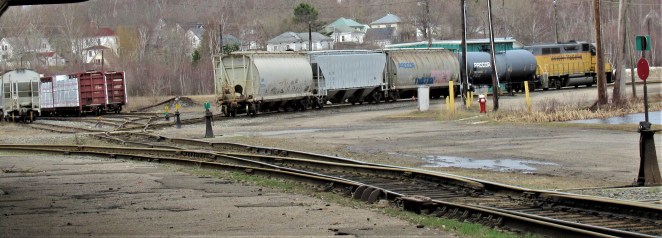
The enemy came to bomb them. And they did. Tracks rooted out, twisted like spaghetti. Engine sheds burned down. Rolling stock ruined. Many children that year lived with the fear of thunder and lightning as Swansea, my home town, burned, in spite of the black out curtains and the air raid precautions. My father’s father lived by the railway yards. When I stayed with him overnight, the shuffle and clank of steam engines and the clatter of coal trucks scarred my dreams.

My mother’s father lived by the sea and each night the ebb and flow of the tides rocked me to sleep when I stayed in his house. I told the time by the tides and I knew every ship that entered and left Swansea Docks. Standing on the front step, with field glasses to sweep the bay, I could read the ships’ names, painted on bow or stern, and then check their movements in the local paper, the South Wales Evening Post.

Timetables: they ruled my life: time tables for the trains, tide tables for the ships.
When they drove me away to boarding school, I was far removed from the rail yards and the sea. I was now summoned by bells, my every activity chimed in by bell after bell. Bells: wake up, get dressed, eat breakfast, be silent. Bells for each class, for the angelus, bells for dinner, supper, bed time, and baths. Bells on the altar as we knelt before tall candles that flickered light as the tinkling bells flicked sound across the chapel. The only escape from bells came during field games. No bells then, just whistles. But bells and whistles whittled the timetables of a carefully regulated working life.

When we moved from Swansea (Abertawe) to Cardiff (Caer Dydd), our new house also backed onto train tracks and railway yards. The rattle of rolling stock lulled me to sleep. Each day, I opened my eyes to the clash and clang of early-morning shunting. Each night, at exactly 3:10 a.m., the express train to London would rattle past my bedroom window and shake me awake as I lay in my bed. The one day I didn’t hear the train, I woke up anyway, listening for its sound. When silence stalked beneath the stars, I knew there had been an accident, and I couldn’t get back to sleep. Radio and newspapers, there was little television then, screamed the news, so many people dead and injured. We mourned for the unknown dead, just like we did in the mine disasters and the bombings.

Lights out at 9:30, prefects and house masters on patrol outside dormitory doors enforced the silence that ruled the night in those inland boarding schools that I was forced to inhabit. No trains, no ships, no tides, no rattling of rolling stock, no steam whistle, no salt smell of the incoming sea disturbed my dreams, just the snoring and whimpering of lonely little boys lost in their iron-frame beds and longing for the comforts of home.

Ste. Luce-sur-mer

PEI + bockle 2008 059.jpg

Ste. Luce-sur-Mer
(1995 &1996)

marooned and listless
monarch of all he surveyed
this ancient sea-side crab
caught naked on a wave-wet beach

surrounded by thronging gulls
their powerful beaks
pulling at the carapace
half-buried in the sand

moment of truth
the second the oyster’s
protective vacuum breaks
the crab sucked from the sand

battered the scattered body
spread over crisp sheets
pillowed on mermaid-hair
claws that once clicked

silent now hushed
listen to the tide
watch the wind’s footprints
walking on warm summer sand

St. Patrick

Empress 314 (2).jpg

St. Patrick

At Tara Manor, a long way from the Emerald Isle,
bold deer emerge at night to nibble the Hosta
Lilies and desecrate lawn and flowerbeds. They
arrive all curious, ears twitching, tails raised,

a wonder for some, a plague for others, culled,
last year, to no effect, with mothers giving birth
this spring to triplets and twins. Dead in a ditch

they resemble the Irish Elk, raised from damp,
peat bogs, or long-dead moose, white rib-cages
air-filled, ghosts galloping down Ghost Road.

He didn’t establish aquaculture. Salmon,
bringers of Celtic wisdom, spirit beings not
to be confused with commercial products,
but repositories of knowledge, swimming

Wikipedias to be consulted like oracles and
relied upon in difficult times. Where now do
we go to trust the truth, CNN, Fox News, CBC,
The Daily Gleaner, The Telegraph-Journal?

Commentary:

Yesterday’s post  https://rogermoorepoet.com/2019/08/26/think-about-it/  started a dialog about whom do we trust for information and how and why do we trust them. Today’s poem continues the same theme, but in a different format and with very different words and intent. Traditional wisdom, and the time to think things out carefully, is lost, save among the indigenous. Our times demand speed, hurry, instant decisions, merciless schedules f do, do, do, and little time for think, think, think.

What is this life, if full of care, / we have no time to stand and stare?” The Newport / Cas Newydd (Wales) poet |W. H. Davies expressed this well in his poem Leisure, full version here:  https://en.wikipedia.org/wiki/Leisure_(poem)  Stop the world, I want to get off. Many have made the request, few have managed it. Yet all of us feel, at one stage or another, the need to ‘get away from it all’. So, what are you going to do about it? Do you even have five minutes to sit down and think … answers to be written on rice paer, folded neatly, and floated out to sea in a pea green boat manned (if that’s the right word) by an owl and a pussy cat.

IMG_0790 (2)

Full House

IMG_1173 (3).JPG

Full House

Full house: echoing footsteps, shadows,
everywhere, a litter of toys, crayons,
colored pages, jigsaw puzzles, Barbie
and Ken found at the back of a shelf.

Memories: pinned to the fridge, found
in strange places, an almond on my chair,
a drawing in my notebook, a message,
unintelligible, scrawled on shopping lists.

That peremptory voice calls my name
and I drag myself from sleep, only to know
it was a dream, netted up from slumber’s
dark midnight sea. I drift off again and

see her again, opening the bedroom door,
calling, calling, ever present in voice,
song, and dervish dance, such energy,
round and round, bouncing on my bed,

rolling the exercise ball across the floor,
oblivious to danger, harm, the perils of
unbalancing, stumbling, slipping, falling,
aware of the need for sticking plaster

comforts littering thighs, knees, calves,
feet arms, elbows, where ever instant
attention calls for instant, urgent treatment.
I will always remember the ambushes

that rolled off the tongue, phrases way
beyond the skills of a four-year old. What
if her mother is a lawyer, the youngster
shouldn’t control that sort of language.

She remembered so much from her last
visit. We thought she would have forgotten
us, but no, she remembered where almost
everything was hidden, out of sight but

no longer out of reach. Just a little bit taller,
stronger, more determined, faster, so fast
and loud we could not keep up. This morning
I awoke to the silence of an empty house.

Ghosts

IMG_1055 (2)

Ghosts

My grandfather would wheeze, then cough, as he leaned on the old black dresser in the Welsh kitchen with its vast, cast iron fireplace. “As black as the hobs of hell,” he would say, and “as warm as our kitchen.” It was full of nooks and crannies where pasties and pies could stay warm, soup cauldrons could hang from iron chains, and copper kettles could whistle wild tunes and call us all to endless cups of tea. Sergeant-major tea: so strong and filled with so much sugar that a tea-spoon could stand upright and never fall over. Gassed in the First World War, my grandfather was always out of breath and each time he coughed, he brought up a tiny part of his lungs. “One day,” he announced between wheezes, “there’ll be nothing left.”
Twice a day, my grandfather would roll up the newspaper and brandish it like a conductor’s baton. The first time would be when I came home from school and it was time to do my homework. The second time would be after supper when it was time for me to go to bed. Each time he rolled up that newspaper, he would tap it gently on the dresser to get my attention, and then he would speak those famous words: “Let battle commence.” I would fight to escape to the street to play with my friends. I would fight to stay on my feet and I never, never wanted to go to bed. I hated to be entrenched alone, upstairs, in the cold shadows of that ghostly no-boys-land where I could hear mice and rats scuffling behind the dugout walls and smell the sour smells of old age and illness that stalked my dreams.
“Up the wooden hill to Bedfordshire,” my grandfather would sing, conducting with his baton and pointing to the stairs. I was never afraid of him. He was dark, strong, tall, and very gentle, a great man in his own right, one of those tall men who would always stoop to help a little child. If I was too troublesome, he would start to cough. And if he started to cough, the pink phlegm would come and he’d spit it into the red and blue polka-dot handkerchief he always carried. The pink phlegm caused consternation and in the ensuing panic, I would bolt for the stairs, go up to my room, undress, put on my pajamas, and bury myself in the vast double bed I shared with my grandmother. My grandfather’s bed was in the middle room downstairs. I didn’t realize then, as I do now, that he could no longer climb those stairs up which I scuttled.
After a while, I left of my grandfather’s house and went back to live with my father. One day, my grandfather, as he prophesied, coughed too much and that was the end of him. After the funeral, my father took me back to see my grandmother. Aunties and uncles, cousins, family friends that I didn’t know, neighbors known and unknown, spilled over the house in an invasion of tears and grief. After the friends had gone, my father and I decided to leave and the family gathered on the doorstep to wave us goodbye. I waved back to them all. “Goodbye,” I shouted. “Goodbye aunties, goodbye uncles, goodbye grandmother.” I paused. My grandfather stood there waving to me. “Look: there he is. I knew he couldn’t have gone.” I pointed and waved. “Goodbye grandfather!”
“Don’t be stupid. He’s not there,” my father said. “He’s dead.”
“I can see him,” I said. “He’s there. I can see him.”
“He’s not there. He’s dead.” Tears ran down my father’s face.
Sitting here, writing these words, I can still  see my grandfather, standing on that doorstep, waving goodbye. And I can still feel my father’s long dead, shadowy hands reach down, grab me by the shoulders and shake me, shake me, shake me, until I too am crying and the ghosts of my milk teeth are again rattling in my head.


IMG_1063 (2).JPG


Things

18581930_1306791786107970_4016640231053970709_n-1

Things I carry with me

            That old black cast-iron stove, wood-fired, that baked the best ever breads and cakes and warmed the bungalow on cold, summer mornings. The Welsh dresser with its age-blackened rails that displayed the plates, and cups, and saucers. The old tin cans that ferried the water from the one tap located at the end of the field. Full and wholesome, its weight still weighs me down as I carry it in my dreams. The Elsan toilet from the shed by the hedge and the shovels that appeared, every so often, as if by magic, as my uncle braved the evening shadows to dig a hole on the opposite side of the field, as far from the bungalow as possible.

            The outhouse at the end of the garden. The steps down to the coal cellar where they went when the sirens sounded, to sleep in the make-shift air raid shelter, along with the rats and mice that scurried from the candles. The corrugated iron work shop in the garden where my uncle built his model ships, the Half-Penny Galleon and the Nonesuch. The broken razor blades I used to carve my own planes from Keil Kraft Kits, Hurricanes and Spitfires, an SE5, and once, a Bristol Bulldog. Twisted and warped, they winged their ways into nobody’s skies, though once we built a paper kite that flew far away in a powerful wind and got tangled in a tree. The greenhouse from which I stole countless tomatoes, red and green. Kilvey Hill towering above the window ledge where the little ones sat when there were more guests than chairs in the kitchen. The old bombed buildings across the street. The bullet holes in the front of the house where the Messerschmidt strafed us.

            The old men spitting up coal dust from shrivelled lungs. The widows who took in lodgers and overnight travelers. The BRS lorries, parked overnight, that littered the street. The steep climb upwards into those lorries. The burrowing under dirty tarpaulins to explore the heavy loads, and many other things. The untouchable, forbidden drawer where the rent money waited for the rent collector’s visit. The old lady, five houses down who, when the shops were shut, sold warm Dandelion & Burdock and Orange pop for an extra penny a bottle.  The vicious, snub-faced Pekinese that yapped fierce defiance from the fortress of her lap. The unemployed soccer referee who on Saturdays walked five miles to the match and five miles back just to save the bus fare, his only financial reward. My father’s shadowy childhood. His first pair of shoes, bought at five years old, so he wouldn’t go barefoot to school.

            Wet cement molded onto the garden wall, then filled with empty bottles to be smashed when the cement set solid. The coal shed where the coal man delivered the coal: cobbledy-cobbledy, down the hole. The outside toilet with its nails and squares torn from yesterday’s newspaper. The lamp-lighter who lit the lamps every evening as the sun went down. The arrival of electricity. The old blackout curtains that shut in the light and shut out the night. The hand rolled fabric sausage that lay on the floor by the door and kept the heat of the coal fire in the kitchen. The kitchen itself with its great wooden chair drawn up by the fire. That chair: the only material possession I still have from that distant past.

A Different Kind of Doorway

different kinf of doorway.png

A Different Kind of Doorway

When one door closes, another opens. And yes, they are so important, these doors, that open and close. One day everything is open to us; the next, the future seems closed. But another door opens and we walk right through.

Avila 2008 072 (2).jpg

Or maybe we don’t. So much depends. The brain drain, as they called it. The migration of students from Great (as she used to be) Britain to North America.  “Make sure,” they told us, “That you can see light at the end of the tunnel. If you can’t, don’t go.” I went to Canada for a year and stayed here for the rest of my life. I came to New Brunswick for a year and stayed here for the rest of my life.

Regrets? None. Dim o gwbl /  none at all, as we say in Welsh, the language of my maternal grandfather, from the land of my father(s), who never spoke a word of it. A language that I am just learning now with great pleasure, in the evening of my life. I am losing my French. I am losing my Spanish. I am learning Welsh.

So how do we open those doorways? Well, that depends on you, each one of you. Keep your eyes open. Study. Learn. Don’t waste your life. Recognize your talents. Don’t despair. Never give in. Nil carborundum illegitimi. No. Don’t allow yourself to be beaten down. Believe. Breathe deep and believe. And remember: there is always light at the end of the tunnel. Any tunnel. Don’t give up. Never give up. You just have to find that light. Seek: and you will find it.

Avila 2007a 105 (2).jpg

Wanderer

Wanderer
El Árbol de Tule

caminante.png

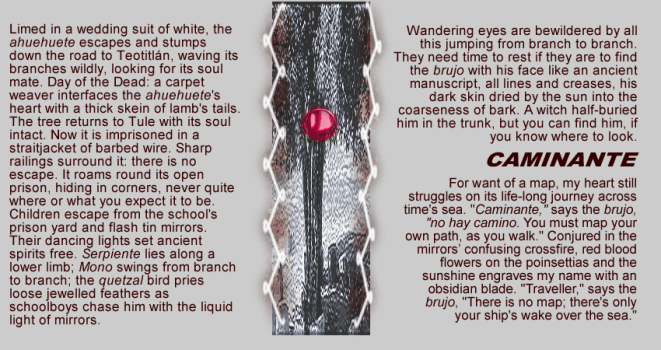
So many tales are told about the árbol de Tule, that thousand year old tree standing outside the city of Oaxaca. Hernán Cortés is said to have sat beneath it when he came to Oaxaca in 1525, or thereabouts. And it was old then, and famous in folklore. The tree is also famous for the pictures that nestle in trunk and branches. For small change, the little boys, released early from school, will point their mirrors up, into the tree, and spotlight with reflected sunshine the features that you seek. A thousand years, or more, have produced a thousand images, or more. Even the face of  Hernán Cortés himself is said to be captured somewhere along the tree-trunk’s art gallery, if you can only find it.

Like Borges’s eternal library, your own portrait can be found there, somewhere. You must search patiently for it, staring into the tree bark until it takes on your features. Then you can move on, knowing that whatever happens you will be caught forever in the life of one of the world’s wonders: el árbol de Tule. But beware of imitations and avoid the plastic imitations and the photos from cheap camera’s that will trap your soul forever, leaving no trace of you in the real world. Ignore these warnings at your peril, or you too will be locked into your cell phone and sentenced to life imprisonment within those digital walls.