Morning in Island View

IMG_0262

Morning in Island View

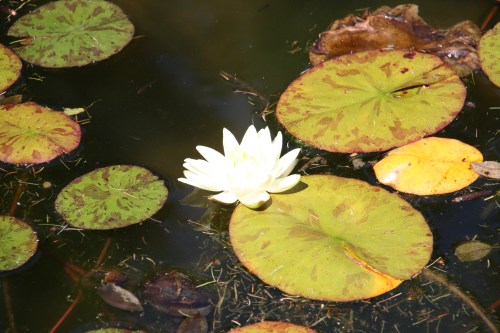
             Morning in Island View and I dream of warm lips rising from stone cold waters. Somewhere, the early sun floats petals across a lily pond. Framed among lilies, my beloved’s face drifts through a watery space. So sweet, her embodiment: she lies languid among the lilies, beside herself in bloom after bloom, each flower gigantic in its frame beneath a wooden footbridge.

            I envision her as she was, this lily who will toil not, nor spin, and who sighs with the morning breeze that ripples her smiling countenance into a thousand fragments. She lies cushioned amid the lily pads, a work of wonder in a liquid impression of fragmented light.

            Fortune rattles its poker dice and they fall haphazardly, here and there, wherever they will. Once thrown, like the spoken word that can never be recalled, they lie there, still on the table’s green baize. They fall, but not by chance and chance itself blossoms with their falling. Like Venus born from the waves, my beloved rises from the waters, born in a conjurer’s trick of blossom turned flesh and pulled from the stream’s dark sleeve to flash her mysterious magic in a thicket of flowering water.

            Now, I see her everywhere: a model in a window, languid in a pavement puddle where raindrops ripple her eyes, couched among the floating clouds as evening steals color from the day. Dusk’s shadows draw their curtains across street and square and now she becomes my lily of the lamplight and I frame her anew in the streetlight’s afterglow, night’s figment dreamed alive beneath distant stars. I walk with her, hand in hand, at noon, when the cathedral wears its strawberry suit, and again in the late afternoon when a blueberry blush descends with bells.

            One evening, in a fit of hope, or is it despair, when my heart pants for a cooling stream, I tread the lily pad path across the pond’s untroubled waters. Dark bells ring out their jug-o-rum chorus as I seek the light of her countenance. Dusk is a violent bruise, scoured purple and red across the waters as I try to become one with my lady of the lake.

            I still don’t know what drew me out. But when I emerged, I sensed that all had changed and that nothing had changed more than I had, the viewer, that once-young man, now old and arthritic, typing away, one finger at a time, battering my key-board to recreate the wanderlust of those day-dreams wrought sous le Pont Mirabeau, along the banks where the Seine flows, or up by the bouqinistes where bridges span the river, words bounce off the page, and painted lilies in the Marché aux Fleurs bewitch the viewer with a staring madness that mirrors pondweed and drifting hair. Now my beloved’s face floats through the cathedral’s eye that ripples in the river. I see the great rose window of Notre Dame, and I seek her once again in those dark waters where she holds out her hands, a place mat for my un-drowned heart.
Time Flies

mistec4

Time Flies

… bends like a boomerang,
flies too rapidly away,
limps back to the hand.

Endless this shuffle of unmarked
days dropping off the calendar,
extinct so many animals
that exited Noah’s Ark.

Hands stop on the clock.
The pendulum swings:
time and tide stand still,
do not move.

‘As idle as a painted ship
upon a painted ocean.’

The print in my grandma’s house:
seemingly moving seas,
sails swelled out,
the ship stays firm in its frame.

Our garden fills with birds
and squirrels, light and dark.
Morning ablutions: each day
a twin of the day before.

The TV screen fills up its washbasin:
tired, shadow faces boring us
with endless wit and wisdom.

Time flies:
an albatross around the neck,
an emu, an ostrich, a dodo,
all flightless,
an overweight bumble bee,
too clumsy, too heavy to fly.

Avila 2007a 102

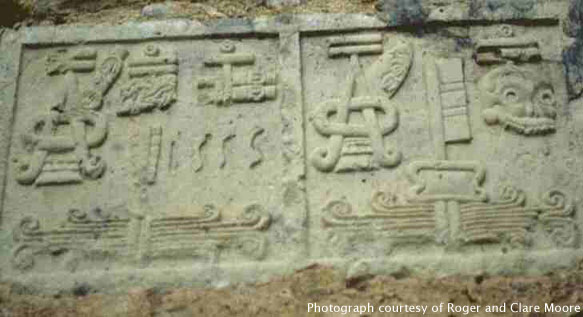
Comment: The top photograph shows the year 1555 marked in standard figures and in glyphs from the Mixtec calendar (Oaxaca, Mexico). … time flies you can’t they fly too fast … This is a conundrum from the General Knowledge Paper in the school leaving exams (1961). Punctuate this sentence: time flies you can’t they fly too fast … Proposed answer: Time flies? You can’t. They fly too fast!”  I seem to believe there were about ten of these on that paper. However, never trust your memory.

The second photograph shows fledgling storks in Avila, Spain, trying to fledge, to fly, to leave their nests. Some will succeed earlier than others. Those who do not manage to fly, who are not brave enough to leave their nests, will sit there. After a while, their parents will not feed them. And then they must fly or starve. Sometimes, time flies. Sometimes, time sits on its hands and the clock hands refuse to move. Think: time enjoying yourself (it just flows by). Think: time in the dentist’s chair with a root canal, time lying prone having an anal biopsy for prostrate cancer, time spent, those everlasting ten minutes, while a cataract is being removed and a new lens is inserted.

Oh yes, time is flexible. Not only is it flexible, it is insistent, inexorable, unstoppable. Those clocks tick on, whether we are awake or asleep. The seconds lull us with their security, the minutes lull us with their monotony, hours lull us with their harmony, days faze us, daze us … hours: each one wounds, the last one kills. Time marches on. We can rewrite the past (revisionism), but we cannot relive it, except in our dreams.

Avila 2007a 150

 Doors close.
We can never go back.

The Journey

IMG_0681 (3)

The Journey

I sense the rust in her mind’s clockwork
clogging her brain, slowing down thought.

I watch her search for words, stumbling through
sentences.  “Wind up the flowers,” she says
handing me the key for the grandfather clock.

When she says “water the clock” I receive
the plastic watering-can meant for the flowers.

Fellow travelers, we journey side by side on life’s
train. I watch her as she looks out of the window
at the passing countryside with its tiny stations.

She frets as she clasps her weak hand in her strong
one and I realize she’s worried because she no longer
knows when, where, or how the journey will end.

Comment: I wrote this originally in memory of my grandmother. However, as I have been involved in the rediscovering / revision / rewriting of older poems, I have come to realize that, as our visions change,  our poems become more accessible to a wider audience. In other words, given what is happening right now with the pandemic, none of us know when, where, or how the journey will end. This leads directly into the twin themes of the fragility of life and the nature of memory. What do we remember? Why do we remember a particular incident? Did it happen just as we remember it or have we already doctored our memories, re-creating them, so to speak.

I have a clear memory of seeing Sir Frank Worral batting at St. Helen’s in Swansea, when I was about 11 years old. A close friend of mine, an outstanding cricketing historian, checked the details in Wisden and told me that Frank Worral wasn’t playing in that match, so I couldn’t have seen him batting. And then there was Sir Everton de Courcy Weekes: I swear a saw him score a century at Bristol, yet, again according to my friend who checked the records, he only got fifty in that game! Games: what mind games the mind plays with us as we age. So, do I go with the fantasy land of my memories in which much has been (re)-invented? Or do I go with the world of truth and checkable reality? As an academic, I lived in the latter world: research, check, double check, avoid expressing personal opinions, facts, facts, facts, and exact dates. As an ageing poet, I would much rather live in that former world where truth and reality march hand in hand with fairy-tale and fiction, a little bit of one and a smattering of both.

How far is from fairy-tale and fiction to the dream world we inhabit at night? Just a short step, I reckon. Sometimes I remember my dreams and write them down when I wake up. Sometimes they vanish and I can only recall some vague feelings of joy and anguish. And what is life, that fragile, dream-like reality? Is it really a dream, as Segismundo tells us in Calderón’s La Vida es Sueño? Or is it a real world? And if it is real, do we create that reality or do we dream it? And if we dream it, do we sleep walk, sleep talk, sweet talk our way through it? Or do we portray it just like it really is, with no creativity, just a factual repeat of reality as we know it?

¿Qué es la vida? Un frenesí.
¿Qué es la vida? Una ilusión,
una sombra, una ficción,
y el mayor bien es pequeño,
porque toda la vida es un sueño,
y los sueños, sueños son.

What is life? A frenzy.
What is life? An illusion,
a shadow, a fiction,
and the greatest good is small,
because life is a dream,
and dreams are nothing
but dreams, after all.


Midnight

IMG_0225

Midnight

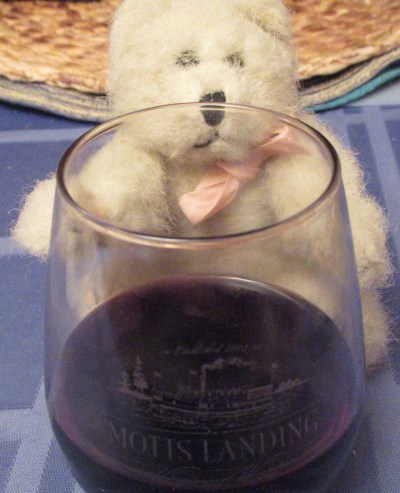
Primary red, this label, and the wine, fresh-drawn,
plucked from the bottle, tumbling tinto, into the glass.

Swirled, streaked ruby by overhead lights, bubbles
bright with hints of garnet, purple, brick at meniscus.

Sniffed, it smells of warm autumn days, scintillating
leaves, just crisping, turning color, and fruit all ripe.

Tasted: fruit bursts into hints of raspberries,
strawberries, spices, a touch of garrigue, mysterious.

Wine descends like water on a dry, hot, dusty day,
or rain after drought, when thirsty lands lap up

liquids, and rejoice in moisture’s blessings.
Raised now the glass, vineyard and vintners toasted,

midnight greeted, saluted the old day past and gone,
welcomed the fresh day walking in, swaddled, new born.

Word without end

IMG_0937 (2)

Word Without End
Antonio Machado

Tree: rowan, mountain ash, larch, tamarack,
hackmatack, spruce, birch, maple, passerines
flying from branch to branch. Birds: more words,

woodpeckers, downy, hairy, pileated, cardinals,
finches, purple, house, golden, rain-rusted robins,
crows, aerial magicians, wondrous in flight.

Spring: fresh branch tips, tiny fox gloves, leaf buds,
folded fiddleheads soon to open their spring magic.
Open: hearts worn on sleeves, open to the world,

wounds, eyes, everything open to beauteous
sun-warmth, snow’s slow disappearance, rising river,
freshet flow freshening this Renaissance,

every day a rebirth, a new beginning,
fresh starts, the world reborn beneath a rising sun,
its yellow disc growing, the new day glowing.

The word as it was in the beginning, head in hands,
heart in mouth, words without meaning, words whirling
golden autumn leaves, words caught in a whirligig,
words all powerful in a word-world without end.

Comment: “La palabra: una palptiación honda del espíritu / The word: a deep palpitation of the spirit.” Antonio Machado (1875-1939). In The Meaning of Meaning, Bertrand Russell discusses what words mean and how they construct, with their endless associative fields, a net of emotions that take us beyond logic into new realms of meaning. As poets and creative artists, we are conscious of the emotions we attach to each word we use. If the poetry is good, then that network of emotional associations reaches out to a wider audience and draws them into our own world view. If we are less skillful, then the emotions are trapped in our own claustrophobic words and fail to reach out, to lift up from the page, to achieve take-off. As we develop as poets and writers, we become more and more aware of the ways in which the microcosm, our own world in miniature, reaches out to the macrocosm, that wider world outside. When we achieve a blend between those two worlds, even if it be in nothing more than a metaphor, nothing more than a felicitous phrase or a delicately timed rhyme, then we reach a new level, a level that we strive to retain and attain anew every time we create.

For me, many of the secrets of poetry can be found hidden in the rhythm of words, the music of their joining, the harmonies they create when they play off each other, old and older meanings reflecting off the newer meanings we give them as we shuffle them anew and put them through their paces.

img_0146-3

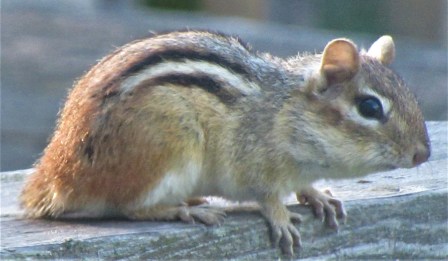
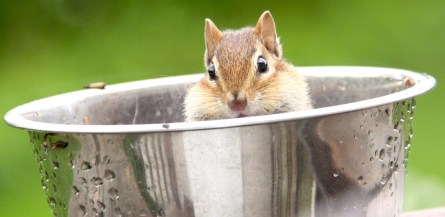
Yesterday, my beloved placed seeds on the back porch, and a chipmunk, her pet chipmunk, came and sat on her foot as he chomped the seeds. Today, this first chipmunk was followed by a second chipmunk. Patience my friends. Keep writing. Keep striving. Keep experimenting. Keep your faith and your creed. Your words will one day reach out, like seeds to chipmunks, and will sow themselves in the mind’s of your readers. And those readers will beget other readers, much as one chipmunk plus one chipmunk will eventually equal many more than two chipmunks. Oh the joy of words, the loving search for le mot juste and the meaning of meaning. In the words of the immortal Cervantes: Paciencia, y barajar / patience, and shuffle your words. The results will creep upon you one morning, unaware and, like the chipmunks, they will catch you by surprise.

The Origin of the World

IMG_0265

The Origin of the World
Gustave Courbet:
L’Origine du monde

The origin of the world and where I came from,
her deep, moist cave that cast me from dark to light.
She loved me, she said, depriving me of her warmth,
leaving me to go back to her lover, loving him more.

Was it guilt that drove her to drinking whisky?
A forty-ouncer a day at the end, sometimes more.
She would wake in the night, wander the house,
banging against chairs, tables, walls, and doors.

She ran up bills in local shops, and the keepers
would dun me for the money she owed. She also
borrowed cash and some days her fingers were bare.
She left pawn shop IOUs on the table and I drove

 into town to redeem her rings. Once, in a drunken
frenzy, she cursed her only child. A mother’s curse is a
terrible thing. A living albatross, it claws lungs and heart.
Its weight drove me to the bottle. I too sought oblivion.

Reborn each day, mornings cast me back from dark to light.
Joy came when blackness descended, the albatross flew,
amniotic waters rocked me in warmth and comfort,
and my body’s boat floated once again on an endless sea.

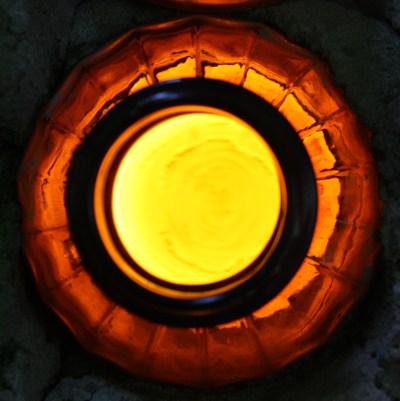
Comment: The photos show light shining through bottles in The Bottle House on Prince Edward Island. There is something very special about sunlight shining through stained and colored glass. Color distorts, speckles hands and face with a pointillistic magic, and the circular framework becomes a sun in its own right. As for Courbet’s painting, it still has the power to shock the viewer as it sets the eternal conundrum of the power relationship between the viewer (male) and the viewed (female). And remember: El ojo que ves no es ojo porque lo ves, es ojo porque te ve  / the eye you see is not an eye because you see it, it is an eye because it sees you, as Antonio Machado tells us. As for the poem, it stands or falls on its own, as does the painting. Visual shock or verbal shock: take your pick, but I hope you do not walk away unmoved.

IMG_0251


Still Life with Hollyhock

IMG_0206

Still Life with Hollyhock
Geoff Slater

How do you frame this beaver pond,
those paths, those woods? How do you
know what to leave, what to choose?
Where does light begin and darkness end?

Up and down: two dimensions. Easy.
But where does depth come from?
Or the tactility, the energy, water’s
flow, that rush of breathless movement
that transcends the painting’s stillness?

So many questions, so few answers.
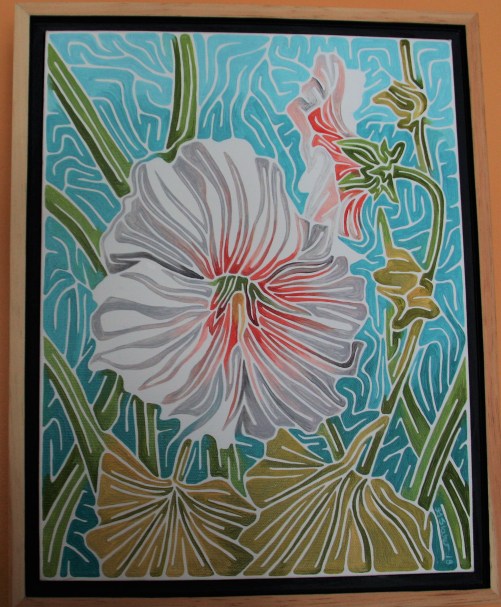
The hollyhock that blooms in my kitchen
is not a real hollyhock. It is the painting
of a photo of a genuine flower that once
upon a time flourished in my garden.

A still life, then, a nature morte, a dead
nature, portrayed in paint and hung alive,
on display in this coffin’s wooden frame.

Comment: I love the way language changes the way we look at life.  A still life painting becomes nature morte in French and naturaleza muerta in Spanish. Still life becomes dead nature. Fascinating. I also love the way in which the camera captures nature and the natural world. We think it is an accurate depiction, but really it isn’t necessarily that accurate. Filters, light and shadow, mood: they all fluctuate and sometimes we capture that which we never saw and sometimes that which we saw is never captured. Oh the subtle enigmas of creative art.

IMG_1005 (3)

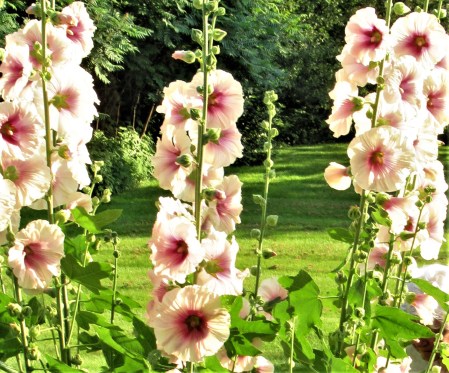
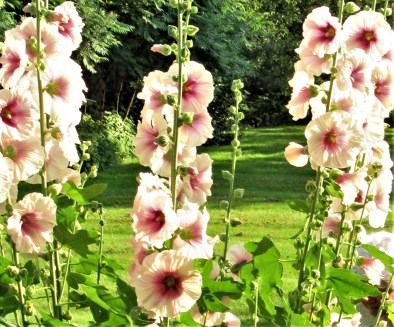
And it is the same with the hollyhock, my hollyhock, Geoff’s hollyhock. At the top of the page is Geoff’s painting of my hollyhock. The above is a photo of my hollyhock. Which bloom did Geoff capture and reproduce in paint? Language: and what do I mean when I say ‘my hollyhock’? My indicates possession, ownership. How and in what way does one own a hollyhock? How does one possess a garden, a flower bed, a tree? Are they not free, living, beings with a life and maybe even a mind of their own? Does one hollyhock talk to another hollyhock as the trees are said to converse with the trees? Do the trees in the garden possess a soul and if they do, in what sense do they possess one? And what is a soul anyway? I guess it depends upon the church and creed to which you belong. Certainly the garden has a life of its own and we discover that every spring when the grass and flowers grow back and the dandelions return.

image5

Questions: dangerous things, questions. Several of the questions posed above could have landed me in an Inquisitional institute in Spain in the 1500’s and 1600’s. That is a frightening thought. Alas, the philosophy of all that is way too deep for this poor poet and apology for a philosopher. One thing I do know, though: I love the garden going on outside my window and it is a privilege to be allowed to watch it, admire it, and follow its progress as the sun returns and the draws the birds back with it.

IMG_0198

¡Vale! Hail and fare thee well.

Bird’s Nest

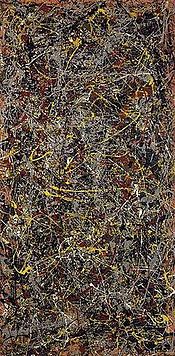
No.5 1948 Jackson Pollock.jpg

Bird’s Nest
Jackson Pollock No 5 (1948)

This bird’s nest starts with a startling tweet
that wins a trilled, thrilled response. A flutter
of heart-string wings, creator, viewer, join

with the creation. Thin threads of life mix
and match their tangled weave, existential
tapestry, fathered in a feathered nest.

World without end, this labyrinth without
an entry point, without a beginning,
with a spaghetti-thread middle that meets

not in a breath-catch of the mind, but in
a brush-flick of coloured rain, a cycle
recycled of circled paint, circular

in its circumnavigation, its square
eight by four-foot globe of a new world whirled
in stringy whorls, reinvented beauty

drawn haphazardly from the bicycle
tour de force of this artist’s inner mind.

Comment: In my latest poetry book entitled The Nature of Art and the Art of Nature, I explore the relationship between art and the natural world. I have always been fascinated by what we see, how we see it, and how it affects us. The tiny print above is scarcely representative of the eight by four-foot world that the artist creates, or re-creates. And what is modern art? Is it a re-creation of the world as we see and feel it or a representation of a new internal world glimpsed by the artist’s mind and hand-turned into a new reality, the work of art? I guess it depends on the artist, his or her way of life, the way they approach the macrocosm, and how they view the microcosm of their own inner lives.

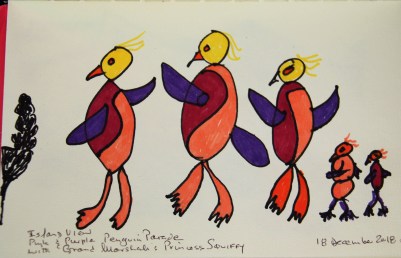
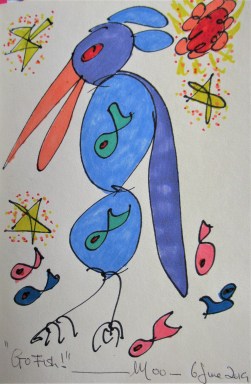
Creation: such a lovely word. Such joy generated as we create something new, be it something verbal, visual, or tactile. For me, it is more a verbal world than a visual one. My forays into art are wonderful, enjoyable, but very personal and artistically limited, even though I love taking a line for a walk or allowing the marker to trace images on the page. Dreams and a dream world: we need them. Sometimes reality is too much for us and we have to shut out the noise of the world and, in Antonio Machado’s words, ‘saber estar solo entre la gente‘ / know how to walk alone among the crowd. The loneliness of the long-distance runner. The isolation of the loving heart trapped within its cage of flesh and bone. The solitude of the spring nest on the pillars at Long’s Creek, overlooking the head pond at Mactaquac, as it waits for its restless occupants to return from their long journey back to the north from the south and start the rebuilding process, each twig, each straw, a minor miracle. And then the hatching and the fledglings and the return flight south that gifts the empty nest such loneliness as it waits for the cycle to begin again once more.

IMG_0824 (2)

Memory Loss

Time-Spirits

Memory Loss

A carton of eggs
abandoned in the supermarket.
Her cousin’s face, her daughter’s name,
the parking spot where she left the car.

Forgotten phone numbers.
Birthdays of family members
never remembered.

“What day is it today,” she asks,
for the third or fourth time.

Her programs no longer work.
Many files now inaccessible,
are written in coded jabberwocky.
I show her photos but to her they are
blank spaces, gaps in her photo album.

“I recognize your face,” she says to me,
but I can’t remember your name.”

Comment: Towards the end of her life, my grand-mother started to lose her memory. I penned this poem a long time ago, then recovered it from my poetry discards. Some years ago, a virus entered my computer system and destroyed many of my files. I had backed them up, but I never really accessed them all when I bought this new computer. Now, in this time of much sitting and screen viewing, when friends no longer knock on the door to share a cup of coffee or tea, time weighs heavy, and I can look at those old files again. This also what I have done with my chess, breaking out the first travelling chess set I bought back when I was nine or ten years old, and re-playing favorite games with its red and white pieces in their cardboard box. I haven’t played serious chess since I came to Canada and, as a result, I have forgotten the openings, mislaid the combative combinations of the middle game, and can now plot only the simplest of endings. This too, in its own way, is a sort of memory loss. Yet as I replay the Fischer-Spassky series of 1972, so much comes flooding back. Memory loss: some things do return, but as I age, I wonder if that other memory loss, the more fatal one, will one day grip me, as it gripped my grand-mother, and leave me damaged and un-repairable. I wake up some mornings, confused from sleep, and wonder whether this is what awaits us all.

Biopsy

UNADJUSTEDNONRAW_thumb_2788

Biopsy

Driving home
from the hospital
after the biopsy,
thinking of the indignities
inflicted on my body,
cold, exploratory fingers,
the insertions,
the ardent desire
to say
“Enough,
no more!”

Oh God,
I am so cold.

Fierce winds
push me
along a snow-packed road.

I dream of sunshine
of summer flowers,

IMG_1005 (3)

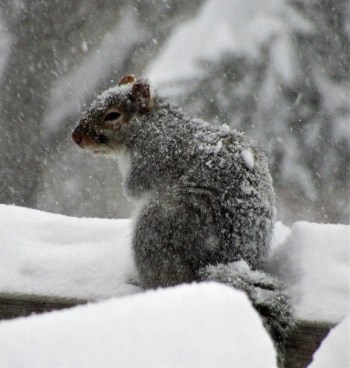
of chipmunks and squirrels,
of bird seed scattered
so others may survive.

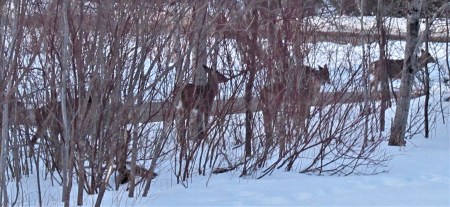
I dream of five deer
walking at midnight
through my garden.

IMG_1740 (2)

Magic,
their shadows
under moonlight
on the snow.

I skid into a snow bank
and my world shakes in shock.

A thirty-wheeler slithers by:
there are so many ways to die.

IMG_0266

Comment: Was it really only five years ago that I wrote those lines? I hadn’t even started this blog back then. So much melted snow, so much water under so many bridges. I look back at my journal and read that on April 1, 2020, in the USA, there were 3,800 dead from Covidis and 300,000 people affected. This morning, when I got up, those figures were higher, much higher: 63,019 dead and 1,070,032 affected. What a difference a month makes, let alone five years.

Affected, such a silly word when each individual person that these figures represent is, or was, a living, thinking, loving, human being, with an extended network of family and friends, each one of whom is in turn affected by the loss or sickness of a group member, be it a brother, a child, a sister, a mother, a father, a son, a daughter, or just a friend …  just a friend, another silly thing to say, as if just friends were not important, collateral damage, so to speak … and now, throughout our world, in macrocosm and in microcosm, we are, each one of us affected, in one way or another. Here in New Brunswick, Canada, we wash our hands, we wear masks, we stay home as much as possible, we maintain distancing when we go out on essential errands … I know it is different in other parts of Canada, and of the world, but we are all affected, and some so much more than others.

So, wherever you are, whoever you are, be strong, be brave, dance when and if you can, sing to yourself, sing for your family and friends, reach out to others, and above all take care of each other and survive. 

IMG_0171

My heart and these words go out to you: Byddwch lawen a chadwch eich ffyd a gwnewch y pethau bychain mewn bywyd / be joyful, keep your faith, and do the small things in life as Dewi Sant, St. David of Wales, a real person, is said to have said, almost 1500 years ago.