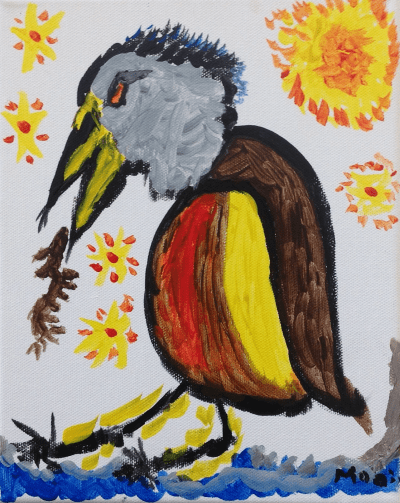
Painting

untitled


Kingsbrae 10.4
10 June 2017

Painting
for
Geoff Slater

I took a line for a walk.
It was
as disobedient as
an untrained puppy on a leash,
as crazy as a kite
in a wind-filled sky,
as joyful as
a schoolboy when they cancel school,
as easy as
pie when the R is squared.

The dog walks round in circles,
gets my legs caught in his leash.
The kite, all twisted strings,
comes tumbling down a ladder of sky.
The apple pie is a pulled-up sheet,
folded double, and I am a child again,
trapped in my boarding school bed.

“Color me now,” my painting cries
and I fill the spaces between the lines:
blue for happiness, blue for hope;
yellow for the lion mane of the sun;
red for the redbreast;
brown for the worm;
and green for schoolboy freedom
at the end of term.

Journal: I had the great pleasure of working with Geoff Slater this afternoon. He sat me down at his painting table, alongside all the children, and gave me a palette, brushes, water, cleaning paper, and a rainbow of paint. Then he placed an easel and a canvas before me and put an apron on me to protect me from the paint. “Go for it,” he said. I looked at a field of white … and I remembered … “Drawing is taking a line for a walk” … so I drew a line, first a beak, and then a head and an eye, then I added wings, and legs … it was wonderful. The children were laughing with me and I was slapping the paint around with great delight. “Let me see, let me see,” they cried. And then, when they saw it: “What is it?” It was even more fun when I started to fill the spaces between the lines. This is, or was, the first time I have ever placed paint upon a canvas. In my old age, I have started to paint. “Is it a worm or a fish?” they asked. “Is the bird going to eat it?” “Is the bird spitting it out?” Such curiosity … and even I didn’t know the answers. “What’s the bird’s name?” asked one little girl. “Eagle-eye,” said the other. “And the worm’s called Squirmy,” added a third. “Are they talking?” another chimed in. “Yes,” I said. “I think they’re friends and they’re having a chat.” What fun. We left the painting out in the sun to dry … and now I don’t know where it’s gone. Let me know if you see it, anyone.

Mist

fundy 05 mist+wolfepipers 077

Kingsbrae 10.2
10 June 2017

Mist

Tisty-tosty ,
this morning mist,
white wisps
blindfolding bushes,
draping our world
with silent birds.

Eyes out of focus,
we squint
at shape and form,
mystery in the magic
of movement,
the air a-shimmer,
spider webs glistening.

Long lost sailors
return from distant seas,
dead warriors wake,
our ancestors walk
backwards in time
to greet us
in this mythical
dreamland that swathes
our senses,
wrapping us
in the mystery of mist.

Pan pipes:
a melancholy melody ,
memories
moving among the reeds.

Word Blooms

img_0165

Kingsbrae 10.1
10 June 2017

Word Blooms

Snow
a blank page
below it
dormant bulbs
paint box colors
waiting to awake

Watchful
the gardener’s eyes
eager her helping hands
rainbows the flowers
pushing into bloom

Words
also wait for the sun
to warm them
to pluck them
from their word beds
and give them shape

Light
and delightful
the word seeds
blown across the world
implanted their ideas

Words
taking root
their blossoms
blooming sudden
in the reader’s mind


Word Blooms Voice Only

Word Blooms Music

Scent and Touch

img0137_1

Kingsbrae 9.4
9 June 2017

Scent and Touch

A feather upon the cheek,
this fern frond held
fragile, hesitant
between fine fingers.

Touch and smell:
two senses engaged.
A paint brush sounds,
brush-brushing lightly
the expectant skin.

Faint the taste tested
suggestive
on tongue tip.
No sight, just insight.

I have a sense of senses lacking.
My words reach out like fingers,
but they can neither retain
nor explain the meaning of it all.

Comment: “Built in cooperation with the Canadian National Institute for the Blind, the Scents and Sensitivity Garden is dedicated to the memory of St. Andrews’ resident Albert McQuoid. The garden features raised beds that allow handicapped, sight impaired, and wheelchair bound visitors the opportunity to enjoy the feel, and scent, of the plants and flowers right within arms’ reach.”

Poetic Process: Thursday Thoughts

img_0186


Kingsbrae 8.3
8 June 2017

Poetic Process: Thursday Thoughts

The end result of the poetic process, however we define it, is the poem. Whether the poem be good, indifferent or bad, depends on a set of critical value judgments of which the poet may or may not be aware at the time of writing. The end product must be allowed to look after itself. But what about the process?

The question is simple, but the answer is more difficult, because the actual nature of the process will vary with each one of us. If the end point is the poem, how do we write the poem, what is its starting point? Is it when we sit down to write? Is it when the pen nib (yes, I still write the old-fashioned way) makes contact with the paper? Is there a pre-writing starting point and if so, where does that begin? Is it in the poet’s head, or the poet’s eyes? Does it reside in touch or scent? Good questions: no answers other than the failsafe … it depends.

One thing that has emerged from this KIRA retreat is that above all we need time to be artists. Art and poetry take time, and artists, whatever their medium, need time to think, time to practice, time to splash paint on canvas, time to sit down and put their head in their hands and meditate … “What is this life,” writes W. H. Davies, the great Welsh poet, “if full of care, we have no time to stand and stare.”

Elise Muller came up with an interesting exercise for developing self-expression. “Write down a question with your dominant hand,” she said. “Then answer it by writing with your less dominant hand.” I tried this. “What do you mean by writing process?” my right hand asked. My right hand held the pen about half an inch from the page and made me stop … and think. I thought about the critical analyses, usually ultra-academic,  that I had written and read over the years. Then I started to organize them into do’s and don’ts. The thoughts of certain serious writers sprang to mind … then I switched my pen to my left hand.

Uncontrolled, uncontrollable thoughts came tumbling out and spilled off the end of the pen on to the empty page that rapidly filled with visual and verbal images: evening falls and the stars grow into flowers in the darkness … three deer enter an empty field and dance on the dandelions … the sky fills with snowflakes that erase, one by one, all the objects in the yard … the tide flows back in and the bay recovers its memories of silver fish beneath the waves … the half -empty / half-full glass becomes meaningless: its essence is to filter the sunshine and to sparkle with light … clouds gather into small, wooly herds and the wind chases them across the sky …

To be filled with poetry and creativity we must first be emptied of the cares of the world. Then, when our heads are empty and free there is space for them to fill with the most beautiful images and ideas. This creative process needs time. Time to download and forget our worries. “Time to stand beneath the boughs and stare as long as sheep and cows” (W. H. Davies again). Time to be ourselves. Time tobe. Time to become one with nature.

To gain this state of freedom, we need to be free of financial cares and woes. We need to escape from domestic duties. We need to be alone (when we need to be alone) and among friends of a like mind (when we need company). “The time to see when woods we pass, where squirrels hide their nuts in grass” (W. H. Davies, yet again). So, in the poetic process, we need that freedom to create, to cut the ties that bind so tightly, to walk and watch and stop and stare. When that old, tired head is empty, the poetry will flow back in. And it will be a poetry not of grinding ideas but of dancing metaphors and sparkling words. “A dull life this, if full of care, we have no time to stand and stare.”

KIRA has gifted me with this time, this quality time. Clare and the WYPOD and my Fictional Friends and the Thursday Grunts and my fellow New Brunswick writers have encouraged me to take advantage of it. The process is in process. Some of the results are already being seen on these pages.

My thanks to all those who made this adventure possible. I would also like to thank all those who now facilitate this process every day.


Words

IMG_0167.JPG


Kingsbrae 8, 2
8 June 2017

Words

Here, on the seashore,
the whisper of waves,
splashed with a flash of sun,
wind fingering the hair,
the light a delight,
and wordless this world
though its beauty be
configured in words.

The scything of the sea,
the land seized in snippets,
grey stones, red rocks,
gelatinous mudflats
blue on white striations.

Seagull wings
snipping celestial ribbons,
salt caked keen on lips,
sea weed scents sensed
yet never seen.

Captivated we stand here,
unattached our single wings,
save to this singular beauty:
peregrine the falcon soul,
so solitary as it soars.

Comment: So many of these new poems are just that, “new” and “raw”. Words, for example, is just a couple of hours old. That is the gift of time that I have been given. The writing process is so rapid that there is little time to digest the last thought and image sequence, before the next comes tumbling along. I guess it’s just a question of rolling merrily along and we’ll see later what we still think is fit for survival. The selecting of these poems will be an interesting task … and who will select the selectors …

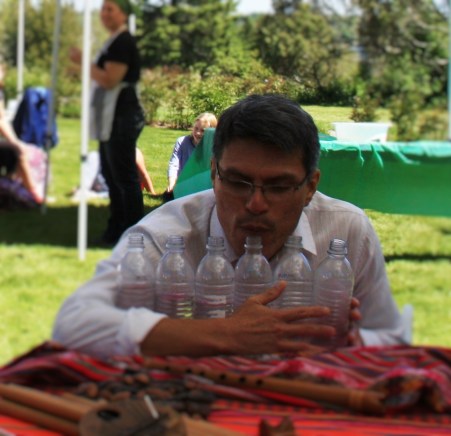
Flute

IMG_0134 (2)

Carlos Carty Making Magic

Kingsbrae 8.1

Flute
(for Carlos Carty)

Songs without words:
a black alpaca rolling on green grass,
two deer dashing across the lawn,
three Indian Runner Ducks actually running,
four tents, canopies billowing beneath the sun,
Passamaquoddy stretched out before me,
a dark island stark in the bay,
sunlight descending a ladder of cloud.

Song without words without end:
music of wind through rock,
waves lapping against stones,
a breeze tapping rhythm from river reeds,
plucked and pierced, the reeds:
the world’s first flute.

Life and breath are one.
The young man opening the water bottles,
sipping the right amount, pursing his lips,
blowing into the bottle neck,
making sweet music:
a song of joy.

Absences

Avila 2008 006

Kingsbrae 7.3
7 June 2017

Absences

Pigeons flapping
across abandoned squares.

Clothes peg dripping
raindrops from a deserted line.

Ile Ste. Croix,
lonely in the bay,
longing for Champlain’s
return.

Endless rock and roll
tide after tide
water without end.

A whole day goes by
without putting
pen to paper.

The blank page
waits for the pencil’s
resurrection.

Visitors


img_0180


Kingsbrae 7.1
7 June 2017

Visitors

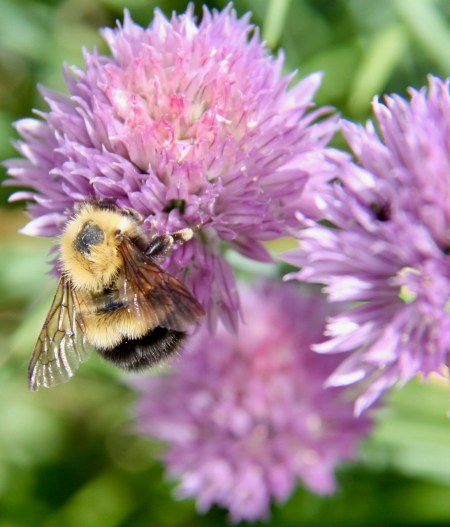
Bees to flowers,
they come to visit,
their sojourns just as brief.

Hummingbirds hovering,
they push pointed noses
here and there.

How much and what
will they understand?

Perhaps they retain
an impression of raindrops
falling, or dust motes rising
to dance in the sunlight.

Maybe my words
will sting like tiny blackfly
and leave small red bites
that will burn with a wild
itch to hear more words.

Petroglyphs

F1040022

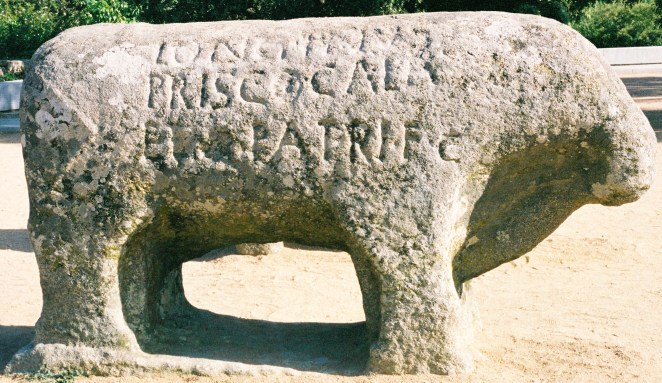
Un Verraco
a Celtic Stone Bull
One of the four
Toros de Guisando
700 BCE (?)

Kingsbrae 6.3
6 June 2017

Petroglyphs
&
Other Myths

(for Elise)

Writing on rock,
the words carved in stone,
imposed on earth’s bones,
sentenced for meaning.

This wise woman,
gifted with second sight,
looks deep in the rock
where stone spirits dwell,
sees with unearthly eyes
the stone soul in its residence.

She carves and shapes,
plucks out rare beauty
holding it up
for those of us who have eyes,
but cannot see.

Gentle her fingers,
harsh the rock,
troublesome the birth
that is beauty
drawn from the entrails
of our earth.

Proud mother,
birthing the soul-stone
from its amniotic
sea of rock.

Comment: The four Toros de Guisando are pre-Christian stone bulls, carved by the Vettones, the local Celtic tribe of the Spanish Province of Avila, north-west of Madrid. The Vettones carved sheep, pigs, and horses as well as stone bulls. The carvings were probably used as route markers, land markers, and markers for pasturage rights. In addition, they are often associated with burials and deaths and may have been used as grave markers. There are many such carvings in the Province of Avila, and the squares, streets, and parks of the capital city abound with them.

There is something about the texture of their stonework, especially on a warm summer’s day. Place your hand upon them and they seem to be filled with a secret life, flowing like blood beneath the stone’s surface. Graffiti were plentiful in the Roman Empire, and here the pre-Roman Celtic carvings were defaced by one of the Roman legions as they passed through. The following video will give some idea of the bulls. Alas, there was no orchestral music when I visited the bulls: we were surrounded by a stony silence.