Writing Memories 4

image2 (6).jpeg

Writing Memories 4

Module 2.1 : Accidents

Like it or not, accidents happen at our age. We trip on the rug, slip on the ice, fall in the bath, so many little things can happen, none, hopefully, serious, but every one of them annoying. In my case, my beloved traveled to Ottawa to visit our family then and I stayed to look after the cat (and have my favorite chair vomited on by the monster). I played contact sports for years, no stitches. My beloved goes away and two or three days later, I slice myself up sharpening a kitchen knife. Everything is fodder for creation. Here’s the poem.

Triage
A stitch in time

1

Banality, stupidity, or just old age:
how did the knife slip from its intended path
and end up slicing through my finger? Blood

everywhere, oozing then pumping, flowing
freely, deep ugly, red, between fleshy
cliffs, the wound’s edges. Chaotic, shrill pain,

short, sharp shocks, cold water flowing, flushing
out the sudden gulley, cleansing, thinning
my life’s liquid. Little finger, left hand,

right down to bright bone. Instant recall, first
aid course. Sheet from paper towel, staunch, press
down, pressure, find gauze, bandages, scarlet

ink, my blood, not royal blue. Take bathroom
towel, run down corridor to garage,
leaving fresh blood spoor, the cat following,

sniffing, licking my blood fresh off the floor,
one hand clumsy on steering wheel, the other
held high as I drive to emergency, fast.

2

Three nurses attend me. The first completes
the triage, stops the bleeding, bandages
my hand, gauze pads press down, sends me to wait.

Second nurse inserts needles, kills the nerve,
cleans the wound, sews my little finger up.

Six stitches. A tubular dressing. Time
now for third nurse, anti-T-jab, checks me
for PTSD, smiles sadly, sends me home.

Commentary: The poem summarizes the instant well. I think the most horrible and outlandish thing of all was looking over my shoulder and seeing the cat following me, licking up the blood trail that I left spotted across the floor. I remember her squatting there, licking her lips: little horror. So, for Sunday’s session, I turned that moment into prose.

Triage [Pose 1]
A stitch in time

1

Banality, stupidity, or just old age: how did the knife slip from its intended path and end up slicing through my finger? Blood oozes, then squirts, then flowing freely, deep ugly, red, between fleshy cliffs, the wound’s edges. Chaotic, shrill pain, short, sharp shocks, cold water flowing, flushing out the sudden gulley, cleansing, thinning my life’s liquid. Little finger, left hand, right down to bright bone. Instant recall, first aid course. Sheet from paper towel, staunch, press down, pressure, find gauze, bandages, scarlet ink, my blood, not royal blue. Take bathroom towel, run down corridor to garage, leaving fresh blood spoor, the cat following, sniffing, licking my blood fresh off the floor, hand clumsy on steering wheel, horn tooting, driving to emergency, fast.

2

Three nurses attend me. So many questions. The first completes the triage, stops the bleeding, bandages my hand, gauze pads press down, sends me to wait. Second nurse inserts needles, kills the nerve, cleans the wound, sews my little pinky up to the sound of thread pulled through flesh, then knotted, and snipped. Six stitches. A tubular dressing. Time now for third nurse, anti-T-jab, checks me for PTSD, smiles sadly, sends me home.

Commentary: Nothing wrong with that. From poetry to prose poem. But is it lacking something, some bite, the feeling of panic, a sense of shock? Alas, it is missing so much. “Every attempt / is a wholly new start, and a different kind of failure / because one has only learnt to get the better of words / for the thing one no longer has to say, or the way in which / one is no longer disposed to say it.” And that is so true. What was true for me then, battered, bruised, bleeding, in shock, no longer comes through the words I left on the page. I wondered if I could warm them up a little. Here goes.

Triage [Prose 2]

A stitch in time
1
Banality, stupidity, or just old age: how did the knife slip from its intended path and end up slicing through my finger? Blood oozes, then squirts, then flows freely, ugly, red, between deep, fleshy cliffs, the wound’s edges. Chaotic, shrill pain, short, sharp shocks, cold water flowing, flushing out the sudden gulley, cleansing, thinning my life’s liquid. Little finger, left hand, right down to bright bone. Instant recall, first aid course. Sheet from paper towel, staunch, press down, pressure, find gauze, bandages, scarlet ink, my blood, not royal blue. Take bathroom towel, run down corridor to garage, leaving fresh blood spoor, the cat following, sniffing, licking my blood fresh off the floor, hand clumsy on steering wheel, horn tooting, driving to emergency, fast.
2
Three nurses attend me. So many questions. The first completes the triage, stops the bleeding, bandages my hand, gauze pads press down, sends me to wait. Second nurse inserts needle, kills the nerve, cleans the wound, sews my little pinky up to the sound of thread pulled through flesh, then knotted, and snipped. Six stitches. A tubular dressing. Time now for third nurse, anti-T-jab, asks me questions, gazes into my eyes, checks me for PTSD, smiles sadly, sends me home.

Commentary: Not much has changed yet now I seem to have lost the thrill, the shock, of that moment. I never even mentioned the feeling of achievement that warmed me when I got home, the knowledge that I had hurt myself and had got myself repaired without having to call my neighbors or emergency. I didn’t add that the first nurse tossed the blood-soaked kitchen towel into the garbage can and that she was unable to stop the bleeding. The second nurse managed that, after he injected me. He also gave me extra bandages in case the cut re-opened during the night. It didn’t. Looking back now, and remembering, I recall the hospital smells, the sense of the needle slipping into my flesh, the gradual loss of all feeling, the smell of the surgery, the scent of the anesthetic, the taste of the saliva in my  mouth. Revisiting the scene, so much later, I can begin to see all that I missed. As a result, Eliot’s words ring out truer than ever. Clearly, I will have to revisit this poem, this prose, this memory sketched into my life. This commentary, written on the spur of the moment, may help me do just that. Clearly I need to move from visual expression to visceral experience and taste and smell may just do that. Yes, I tasted my blood (so did the cat), and my saliva, and  I remember how the taste changed, oh so subtly, with each injection (there were three). I also remember the smells, all different of each of those rooms. Oh dear, so much work still to do.

Suggestions for the writing exercise included in each module:

Write a prose memoir, just reminiscing.

Use 1st, 2nd, or 3rd person narrative.

Choose 6-12 words from the reading and expand on them using associative fields.

Write from an image or a metaphor.

Journal style: automatic writing, but try to select the gems.

Letter style: write to a friend.

image2 (7).jpeg


Writing Memories 3

image5 (6).jpeg

Writing Memories 3

Module 1.2 Disasters:

Last Sunday, the first module was titled Triumphs and Disasters. I have separated them here. My first thought for Disasters came in the form of a poem.

Age of Spillage

Fingers turn to butter, permit cups to slip,
flying saucers to take off, to stall and crash,

their broken bodies resting in peace and pieces
on kitchen floor, waiting to be picked up and buried.

Worse: bottle tops screwed up tight refuse to open.
Plastic wrapping, flagrant in its defiance,

wages its guerrilla war against ageing,
uncoordinated arthritic fingers.

Tongue-twisters twist tongue and tones and speech,
filling mouths with glottal stops and threadbare words.

The rib cage is a cupboard barren and bare.
So many slips between palate, teeth, and lips.

So many precious things dropping to the floor.
I cannot always bend and pick them up,
not even with my new mechanical claw.

Commentary: Nothing wrong with this as a poem. It’s fun to experiment, though, and poetry takes up more space than prose. This is the prose poem, or prose passage, or flash fiction piece, take your pick.

Age of Spillage [Prose 1]

Fingers turn to butter, permit cups to slip, flying saucers to take off, to stall and crash, their broken bodies resting in peace and pieces on kitchen floor, waiting to be picked up and buried. Worse: bottle tops screwed up tight refuse to open. Plastic wrapping, flagrant in its defiance, wages its guerrilla war against ageing, uncoordinated arthritic fingers. Tongue-twisters twist tongue and tones and speech, filling mouths with glottal stops and threadbare words. The rib-cage is a cupboard barren and bare. So many slips between palate, teeth, and lips. So many precious things dropping to the floor. I cannot always pick them up, not even with my new mechanical claw.

Commentary: I liked this transcription. The changes came easily and are very few. A little expansion there and there, but not much. The challenge for me then became the desire to reach out from my private world to the world of the workshop. I felt that to do that, I needed to add some material, specifically I wanted to highlight and intensify some sensations.

Age of Spillage [Prose 2]

    Fingers turn to butter but taste of nicotine, garlic, and soap when I bite my nails. My fingers encourage cups to slip, flying saucers to take off, to run out of energy, stall and crash, their broken bodies resting in peace and pieces on kitchen floor, waiting to be picked up, one by one, and buried in the waste bin. Arthritic fingers grown clumsy now struggle with bottle tops and glass containers screwed up so tight they refuse to open, even when soaked under the hot tap. I stick those jars in door jambs, lid first, closing the door with one hand, and twisting the jar with the other. Sometimes jars slip and crash to the floor, often with a portion of the contents spilling out. I hate these onion style plastic wraps, gathering together in layer after layer of wrapping. Flagrant in their defiance, they wage a guerrilla war against these ageing, uncoordinated fingers. I am often forced to use a knife, but a knife can slip or twist so easily. Occasionally, blunt, it will not even penetrate indomitable, multi-folded Saran wrap. On the telephone, names and numbers turn into tongue-twisters that twist tongue, tone and words, filling my mouth with glottal stops and threadbare speech. At times like these, my rib-cage becomes a Mother Hubbard’s cupboard, barren and bare, empty of all feelings, save panic. I reverse my numbers, putting them the wrong way round, calling by mistake so many unknown people. So many slips between plate, teeth, and lips. Multiple precious items drop to the floor. I cannot always bend to pick them up, and I cannot easily grasp them, not even with my new mechanical flexi-claw.

Commentary: This is the version I read on Sunday. I quite liked it at the time, but I now find the telephone passages at the end to be intrusive. I may  well cut them out and concentrate on touch. I wanted the telephone ‘in’ to exemplify sound, but on second thoughts it should probably be a fresh piece on its own. I could easily incorporate sound, the crash of the jar, the splintering of breaking glass, and even smell, the rich scent of the jar’s contents, into the touch section.

“We have no time to stand and stare” but true art demands that we sit, stare, look, listen, think, re-think, write, re-write. Remember too that some results are delayed and that impatience is the worst enemy of art. Don’t transport your paintings while the pain is still wet and don’t pull your carrots up early to see if they are actually starting to grow.

Addendum: Participaction … don’t think about it, do it.

Fingers slip across the telephone key board, pressing the wrong numbers or punching them in in the wrong order. Strange voices reply from the other end. This morning a woman spoke to me in a language I didn’t understand, Then a man came on the line and yelled at me in broken English to “Go away! Go away! Leave alone!” I imagined him tearing the telephone from his wife and berating her for this call from a foreigner. Often, I am too clever for my own good. I think I recall the right number for a friend, but when  punch it in, I find I have reversed two of the figures. I hear other people doing that when they call me: “Sorry, I say. I think you have the wrong number.” “Is that 472 …?” they query. I say that it isn’t and they say sorry and end the call. Then they call me back immediately and get the same answer. I hate running through my list of callers to get to the name that I want to call. But that’s what I have to do most days now. At least I don’t run into so many wrong numbers. And as for answering the phone … well … I am tired of robot calls, especially around election time. I am fed up with telephone surveys. I am driven crazy by the little men, I assume from their voices that they are little, who call me in the middle of the night or wake me early in the morning to tell me that my computer needs repair. “Suh, suh, we have discovered a werry nasty wirus [sic, or should that be sick] on your computer. Give me your password and let me in to your computer and I will repair it instantly. ” I have had calls from the telly-phony tax men who tell me the RCMP are about to knock on my door and arrest me if I don’t immediately give them my VISA Card number, passwords, and send them, right now, the $7,200 I owe them in taxes. I have grown to loathe the harbor boat hooter that announces I have won a cruise from Florida to Mexico on a super cruise ship …. that is probably a rusty tug boat that will take me twice around the harbor, be declared un-seaworthy, and leave me stranded miles from anywhere and paying a fortune to get myself home … and all I have to do is … Click! I think it’s the marketing surveys that really get my goat though. I am no expert, but I have read up on surveys and designed some myself. What I love-hate about telephone surveys is the lack of real choice, the forced direction in which they push you, the pre-determined result on which the designers are fixated. I know it’s a waste of time, but I occasionally indulge: “On a scale of 1-5, where 5 is good and 1 is poor, how would you rate … ” I explain that the question and the ratings do not work, but they are adamant that I must answer from 1-5. Yes, they understand that it can’t really be done, but yes, it must be done, because that’s what they are paid to do. O tempora o mores … “O tempora o mores” is a Latin phrase that translates literally as Oh the times! Oh the customs! but more accurately as Oh what times! Oh what customs! or alternatively, Alas the times, and the manners (Wikipedia). Oh boy, what an enjoyable rant. “Enough, no more. It is not as sweet now as it was before.” (Shakespeare).

Commentary: And that is another way to create. You find the splitting point in an already written narrative and, realizing that you have two narratives, not one, you divide the passage, rewrite the offending portion, and come up with something equally original, slightly different, and, in this case, hopefully funny. I leave that to the reader to judge the effect of the humor. The writing technique, however, is well worth recognizing, studying, and pursuing. One further point: sometimes it is necessary to be cruel to be kind. Splitting the earlier piece (oh cruel world) leads to the creation of two quite neat pieces (oh happy days).

By all means use these pieces and ideas as a prompt for your own memory writing. If you do, remember the suggestions I made earlier (and copy below). And, above all, have fun.

Suggestions for the writing exercise included in each module:

Write a prose memoir, just reminiscing.

Use 1st, 2nd, or 3rd person narrative.

Choose 6-12 words from the reading and expand on them using associative fields.

Write from an image or a metaphor.

Journal style: automatic writing, but try to select the gems.

Letter style: write to a friend.

image3 (6).jpeg

Writing Memories 2

image5 (5).jpeg

Writing Memories 2

Thoughts and exercises on the role of memory as we grow and age.
“We are not just writers, we are re-writers.”

“Every attempt
is a wholly new start, and a different kind of failure
because one has only learnt to get the better of words
for the thing one no longer has to say, or the way in which
one is no longer disposed to say it.” (T. S. Eliot, East Coker)

Module 1.1: Triumphs

I began this section with a poem, quiet short. When I wrote it, I liked it. I revised it a couple of times. Here it is.

Triumphs

Waking to birdsong in the morning,
making it safely to the bathroom
without tripping on the rug in the hall,
shaving without cutting my face,

getting in and out of the shower
with neither a slip nor a fall,
drying those parts of the body
that are now so difficult to reach,

especially between my far-off toes,
pulling my shirt over wet and sticky
patches still damp from the shower,
negotiating each leg of my pants,

tugging the pulleys of the plastic mold
that allows my socks to glide onto my feet,
forcing swollen toes into undersized shoes,
hobbling to the top of the stairs

and lurching down them, cautiously,
one step at a time … on guard for the cat,
the edge of the steps, the worn patches
where my stick might catch or slip …
one more step, and I’ve made it down.

Commentary: Triumphs in our daily lives. That is the theme for this first module. For many of us, at our age in life, just surviving from day to day is a triumph. I welcome each dawn. I am happy to get out of bed. I love my early morning sit at the computer, my first cup of de-caffeinated green tea, my breakfast. However, I did not know how many of you, if any, wrote prose rather than poetry, so for the purpose of this workshop, I turned my poem into a prose poem by eliminating the line spacing and running the lines together. This is the result. At first it doesn’t seem that different, but really the pieces are now miles apart.

Triumphs [Prose 1]

Waking to birdsong in the morning, making it safely to the bathroom without tripping on the rug in the hall, shaving without cutting my face, getting in and out of the shower with neither a slip nor a fall, drying those parts of the body that are now so difficult to reach, especially between my far-off toes, pulling my shirt over wet and sticky patches still damp from the shower, negotiating each leg of my pants, tugging the pulleys of the plastic mold that allows my socks to glide onto my feet, forcing swollen toes into shoes now much too small, hobbling to the top of the stairs and lurching down them, cautiously, one step at a time … on guard for the cat, the edge of the steps, the worn patches where my stick might catch or slip … one more step, and I’ve made it down.

Commentary: In many ways, it’s the same piece. However, I have eliminated a word or two and expanded on a couple of things. “The olde order changeth lest one good custom should corrupt the world.” (Tennyson, The Idylls of the King, I think. Memory sometimes fails me). Does the poem function as a prose piece? I didn’t think so and I decided to change it.

Triumphs [Prose 2]

    Waking to moonlight in the middle of the night, making it safely to the bathroom without tripping on the rug in the hall, managing to pee without splattering the floor, the seat, the wall, or my pajamas, climbing back into bed, staring at the stars’ diminishing light until I manage to fall back to sleep. Waking to birdsong in the morning, walking to the bathroom without bruising my left arm against the door latch, shaving without cutting my face, getting in and out of the shower with neither a slip nor a fall and without dropping the soap, drying those parts of my body that are now so difficult to reach, especially between those far-off toes that I no longer see with regularity, pulling my shirt over those wet and sticky patches of skin still damp from the shower, negotiating each leg of my pants hanging on to the arm of the rocking-chair so I won’t fall over,  tugging the pulleys of the plastic mold that allows each sock to glide onto my feet, hoping my toe-nails, uncut for so long, will not catch in the wool and that the heel will end up in the right spot, forcing swollen toes into shoes now much too small, hobbling to the top of the stairs and lurching down them, one step at a time, with my stick in one hand and the balustrade in the other, … always on guard for the quick, unsuspected rush of the cat, the edge of the steps, the worn patches where my cane might catch or slip … one more step, and I’ve made it down. The first of today’s tiny triumphs.

Commentary: Which version is best? Does each version improve upon its model? I think that the answer to those questions will vary with each writer / reader. The author of this piece must choose between poetry and prose, between a brief prose version or a longer one, between a fairly straight-forward version and one that employs layered rhetorical techniques.

The most important thing is for the writer to be aware of the possibilities inherent in each of the three versions. Equally important is for the writer to know that s/he can experiment, write, revise, rewrite. In the workshop, I read the third version and invited the participants to write about triumphs in their own lives. I also suggested that they experiment with different forms of writing. Here are some examples.

Suggestions for the writing exercise included in each module:

Write a prose memoir, just reminiscing.

Use 1st, 2nd, or 3rd person narrative.

Choose 6-12 words from the reading and expand on them using associative fields.

Write from an image or a metaphor.

Journal style: automatic writing, but try to select the gems.

Letter style: write to a friend.

It is easy to experiment with pieces such as these. I have used first person singular [I]. Try using the second person [you]. Try using the third person [he or she]. Change the person, change the point of view. Each writer will say something different and add something different when observing from a different position. And it’s fun to take out the personal and add in things that are more objective.

“You awoke to moonlight in the middle of the night. You made it safely to the bathroom without tripping on the rug in the hall. You manged to pee without the sound of floor splatter. When you came back to bed, your pajamas were still dry. When your head hit the pillow, you went straight back to sleep and  started to snore. I lay there staring at the stars, hoping to be visited by sleep.”

The observing “I” creeps in at the end, but it doesn’t have to. Different story, different people. But remember: Plus ça change, plus c’est la même chose. And remember, too, that writing is fun. If there’s no fun, there’s no future.

image2 (5).jpeg


Writing Memories 1

image5 (3).jpeg


Writing Memories 1
Saint John Free Public Library
10 March 2019

Subtitle: Thoughts and exercises on the role of memory as we grow and age.

Remember: we are not just writers, we are re-writers.

About Words:

Words strain,
crack and sometimes break, under the burden,
under the tension, slip, slide, perish,
decay with imprecision, will not stay in place,
will not stay still. (T. S. Eliot, Burnt Norton)

About Effort:

That was a way of putting it—not very satisfactory:
a periphrastic study in a worn-out poetical fashion,
leaving one still with the intolerable wrestle
with words and meanings. (T. S. Eliot, East Coker)

About Revision:

Every attempt
is a wholly new start, and a different kind of failure
because one has only learnt to get the better of words
for the thing one no longer has to say, or the way in which
one is no longer disposed to say it. (T. S. Eliot, East Coker)

Introduction:

As promised, I will present here, over the next week, my thoughts and comments on the writing workshop that took place in Saint John on Sunday, 10 March 2019. The workshop began with the above words from T. S. Eliot. They can be used for contemplation about the difficult art and craft of writing. They can also be used as prompts from which writers can develop their own creative and poetic philosophy.  There is more indeed, much more, than the simple splashing of ink upon the page. Yet we all begin with that first splash of ink, that first letter drawn with finger from the computer keyboard, or thumbed on the I-Pad.

Where do writers go next? That is the question. In this workshop, with its series of thematically linked writing models and prompts, I will try and answer some of those questions. More important, perhaps, all participants will have time to think, time to write, and time to read what they have written to a sympathetic audience.

The workshop’s structure is simple: five modules of 30 minutes each. After the third module, there will be a ten minute break. The last two modules will be followed by a question and answer session that can be prolonged for as long as participants wish.

Alas, I am not familiar with the writers in this group and therefore have not prepared individual exercises for each person’s needs. Forgive me for this lapse. What I have done is to draw up some generic hints and some typical models from which participants are free to select what suits them best. But first some notes on the writing you will be asked to do.

Suggestions for the writing exercise included in each module:

Write a prose memoir, just reminiscing.

Use 1st, 2nd, or 3rd person narrative.

Choose 6-12 words from the reading and expand on them using associative fields.

Write from an image or a metaphor.

Journal style: automatic writing, but try to select the gems.

Letter style: write to a friend.

Writing Levels:

Since I am unfamiliar with you as individual writers, here are four generic writing levels. Choose one and write from within that level. By all means work your way through the levels, if you wish to do so, one level per module.

Beginning Writers: Just write, using the prompts to help you get your own words and experiences and memories on the page. Don’t be afraid to ask me, or more experienced writers in the room, for help.

Intermediate Writers 1: Try and concentrate on writing about one or two senses within each exercise.

Intermediate Writers 2: Try and combine two or three senses within each exercise.

Advanced Writers: Use the prompts as you will and concentrate on imagery, metaphors, letting the language doing the work, and combining or mixing the senses. Also, please share your experiences (positive and negative) with other writers in each mini-group.

Reading and discussion:
         NB Change tables and seek new people in mini-groups after each module. Ideal size of mini-groups is 3-4 people.
We need to learn how to share, and how to accept very diverse opinions, some of which may be good and some of which may be bad.
Don’t just talk to old friends: discover and make new ones.
Listen to the comments and accept them or reject them after you have thought about them. Don’t argue. Don’t explain. Don’t defend your writing. Just listen and see how others read and see and understand your work.
As you read and listen, learn from the other writers, how they write, how they read, how they express themselves.
We are all in search of our own very personal and elusive voice: you won’t find your voice unless you use it. Remember: use it or lose it.

Invitation and Reminder:

By all means comment on this workshop and its modules. Module 1, with some polishing and though, will appear tomorrow.

image3 (5).jpeg


Impact

IMG_0017.JPG

Impact

This photo comes up from nowhere, springs into your half-awake mind, diminishes your reality. W5: who, what, why, when where? But there is no who, save the person bearing witness to this moment in time, and you, the double witness who also contemplates and is therefore complicit.

Do you recognize this scene? Is this a moment in your life? Are you the one who struck the match and lit the flames in the lower corners? And are they even flames? Or are they moments of glory, flashes of fireworks, the world coming alive in a moment of combustion when light and dark are mingled until, fiat lux / let there be light, and the world is reborn, light and form, drawn from darkness, and earth and sea divided into separate realms. In principium erat verbum / in the beginning was the word and the world was born / reborn in this verbal-visual instant between sleeping and awakening, when dreams gain substance and ideas take on form and shape and grow in the observer’s mind until creation sparks into life.

Who now knows what will be, what might be? We see. We bear witness. We paint, draw verbal pictures, take snapshots, unfold our souls, placing them on paper and canvas capturing them by camera in snapshots … but What’s it all about, Alfie? Do you remember the film? The suspension in space, the knowledge that all is absurd, that this is a jigsaw puzzle of the worst kind, with no solution, no answer, and every path bifurcating before us, and each of us wandering in a maze, a labyrinth, with an entrance, but no exit.

Do you think up or down, when you’re floating in a space without gravity, where nothing is substantial and all the rules you ever learned no longer hold? The roller-coaster rolls on and you hang on, and sometimes the sun comes up and sometimes the sun goes down, and is that the first light of morning or is it the last light of day, and how can you be sure?

And where is it anyway? Have you ever been there? And if I told you where it was , what time of day it was, or what time of night, would you believe me? And if not, why not? And who and what am I? And why do you trust what I say? And why would you trust me, when you have never met me, and you do not even know who I am, or where I am, or what I am, and even I do not really know who I am or why I am, and why does any of this matter?

It matters because we need faith, we need substance, we need hope, we need to believe in something other than ourselves and beyond ourselves. We still want to wake in the morning and see the dawn. We want to grasp it in our hands, not just in our minds, and know that there is light beyond this darkness, there is hope beyond this gloom, there are better things ahead. See that forgotten candle? Pick it up. Take that match. Strike it against the box. Now light that candle. Take it out. Show it to other people. Encourage them to light their own candles.

Sometimes we need to enlighten the world, to turn it round, to reject it as it seems to be and to recreate it in our own image.  But take care: the image of the candle is not that of the laser beam or the searchlight. One by one, the small people, we must join together, and like tiny stars and light up the firmament. I cannot do it alone. But together, you, and you, and you, and you, if you walk with me, we can do our best. And that is the best we can do, in this, as Voltaire’s Candide once called it, the best of all worlds and the only one we have.


My Favorite Pen

IMG_0395.JPG

My Favorite Pen

This is my oldest Mont Blanc fountain pen. I must have bought it in 1986 when I traveled to London to attend a Spanish Golden Age seminar at one of the university colleges. I can’t remember which, though I do remember the seminar was on someone called Francisco de Quevedo. We met like spies, my pen friend and I, on the steps of the British Museum. I had never met him before, so he carried a specific book under his arm, one of Quevedo’s I think, by which I would recognize him. We lunched together at an Italian Trattoria, whose name also escapes me, and we discussed the ways of that ancient Hispanic world and our own research upon it. I paid for our lunch from my travel funds. I had a sabbatical that year and had arranged a short tour of four or five British universities in my search for knowledge. After lunch, he took me back to his London college and I sat and absorbed wisdom from 2:00 until 5:00 pm.

After the seminar, walking back to the nearest tube station, I passed a shop that had this Mont Blanc in the window. I went in and bought it. On the spot. No second thoughts. Then I caught the tube to Paddington station. While waiting for the train back to Cardiff, I sat in the station bar and ordered a pint of beer. A well-dressed man, slightly older than me, asked if he could join me. I said yes. He sat down and began to talk. He told me how to commit suicide by slashing my wrist with a knife.  There were many incorrect ways to do it, he explained. But only one right way, if you wanted to be successful. He rolled up his sleeve and showed me his collection of scars that ran crisscross and welted over his left wrist. Failed attempts, he said. But I’ll get it right next time. I wouldn’t want you to make the same mistakes as me, if you decided to try it.

Must go, I told him. My train’s about to leave. I left the remains of my pint on the table, looked back, and watched him finishing my beer. Good job I didn’t spit in it, I thought. Then I realized that I probably had, one way or another. I boarded my train and 90 minutes later I was back in Cardiff. No more post-war, coal and steam engines, a diesel this, powerful, fast, and smelly. It reduced the former four hour journey to much, much less than two. Cafeteria style, the train carriage offered a table top for every four seats. I opened my new pen and wrote in the pocket journal I had bought for the trip.

So many memories. But I don’t remember the names of either of these two men. I do recall those scars, though, deep and ridged, crisscrossing like railway tracks. Every time we clicked over a junction or a cross track I shivered and my writing wiggled on the page.

IMG_0396

Forgetfulness


IMG_0225.JPG

Forgetfulness

a lone dog tied out in the rain
a lost German Shepherd barking at stars and moon
grass growing through plastic flowers on a grave
a name eroded by the sand paper wind
a solitary sea bird carving its name on a cloud
a sea gull slicing the sky with its wing
unwashed dishes sunbathing in the sink
a knife and a fork side by side not speaking
the bike with a flat tire growing dust by the door
the kite’s face locked in the prison of the tree
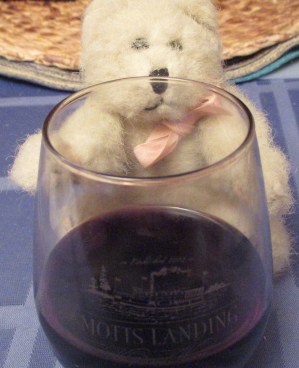
a teddy bear sitting by a forgotten glass of wine

Forgetfulness is also me and my blog. I have been writing elsewhere all week, preparing two manuscripts for a competition. It’s been a long slog: gathering the material, organizing it, structuring it, revising it, polishing it, cutting unwanted material, searching for valid replacements.

Tuesday I had the honor and the pleasure of working with a local high school in their  creative writing program. I am no longer a part of the Writers in Schools Program (WiSP), so this was a freebie. I came, I sat, I talked. And then I drove home again. I answered questions from the students on my life as a writer. It was very interesting for me as some of the questions were sharp and pertinent. How do you deal with writer’s block?   Do you write by hand or on the computer? Where do you get your inspiration? Hopefully my responses were of some interest to the students who gathered to listen. The one question I expected to field was never asked: “How much do you earn as a writer? The answer of course is very little, if anything. I write for pleasure, not for money, and I have never been published by a major press.

According to TWUC, the Writers’ Union of Canada, the average earnings of a writer in Canada are $12,500. Subtract the millionaire big earners (e.g. Margaret Atwood, David Adams Richards, et al) and most writers earn considerably less. Poets are traditionally at the bottom of the pay scale and I am principally a poet. The transition from print to digital also has everyone running in different directions. Personally, I like writing. I don’t like the marketing, advertising, selling of myself and of my books.  In fact, I now self-publish and give my books away. There’s very little money in it, but I enjoy myself and my friends seem to appreciate the gifts I give them.

Unless you are a ‘top draw writer’, working with a large, established company, you are unlikely to earn much money from your creative writing. In fact, many writers make their money from workshops, fellowships, grants, residencies, retreats, and things like that. I took a different direction. I chose to be an academic / teacher / researcher (full time) and a writer on a part-time basis. The academy kept food on the table for my family. The writing was always in addition to the mainline job. Retired now, I can dedicate myself to writing full-time, and that is just what I am doing.

Writing: so many meanings, so many ways to write. I blog, I maintain a journal, I write e-mails, I post to Facebook, I write poems, short stories, and I have written three unpublished (and probably unpublishable) novels. Also on two separate occasions, I have run a weekly sport’s column (athletics and rugby) in local newspapers. I have written academic books, translations, book reviews, peer-reviewed articles, and I have maintained, with the assistance of my beloved, an online bibliography and an online searchable data base. I have also helped edit some fourteen academic journals during my time as an academic. In my editing career I have been an editor, a co-editor, an associate editor, an assistant editor, an editorial assistant, and a book review editor, as well as sitting on the editorial and / or advisory boards of a handful of magazines. I have managed to do this in three languages (English, French, and Spanish). So, what exactly do I say when people ask me “What do you write?”

I am also a fan of the following statement, though I cannot remember where I first heard it. “We are not writers, we are re-writers.” This is certainly true of my editorial roles in academic magazines, for I have done a tremendous amount of rewriting and revisions for the people who have submitted their work to the magazines I was helping. So, there it is, in a nutshell … except for one thing, I have been involved in so many writing experiences, that I have forgotten many of them. Forgetfulness: the theme of today.


Sox

IMG_0230.JPG

Sox

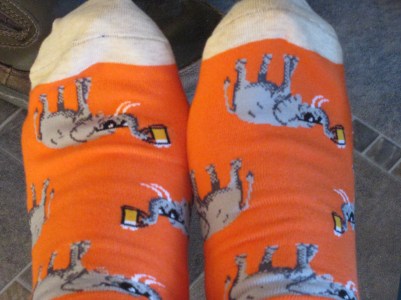
My birthday parcel arrived this morning. No, it’s not my birthday. That was last month. Is the glass half full or half empty? Well, if it’s half empty, my birthday parcel arrived two weeks late. BUT, if the glass is half full, then it arrived fifty weeks earlier. It was packed with goodies, like sox that have upon them an elephant bearing a pint of beer in its trunk: irresistible, as the sender said. I also have a green pair with a parallel theme. I wanted to wear one of each pair, in an orange-green mis-match, but a certain someone would not let me have anything to do with that. Ah, the voice of sartorial authority. “Orange and green / should not be seen / without a color / in between.” White, perhaps, as in the Irish flag, except white is apparently not a color.

I used to get lots of sox for my birthday, but suddenly they went out of fashion along with ties and hankies. I got some of my daughter’s banana bread too. She makes a delicious fruity bread loaf and I am always thrilled to get one or two of them. They are wonderful for breakfast with a thin layer of butter and a cup of tea or coffee. I am not meant to drink the coffee but a cup every now and then doesn’t appear to affect me. And I make my own, so it’s always fresh and doesn’t sit around for hours waiting to gobble up the inside of some poor unsuspecting victim.

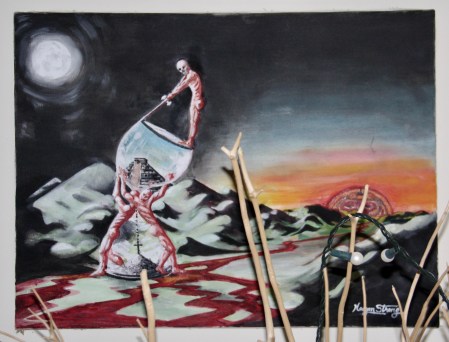
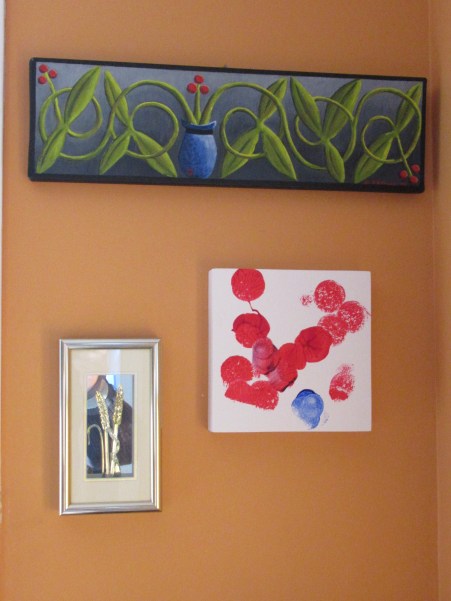
Vis brevis, ars longa: I have on my wall a painting, given me by a former student of mine who didn’t want to write an essay. She painted a painting instead and explained it to the class in the language she was learning. She left our university and attended an art and architecture program and she went with my blessing. Look around the walls of my house: I have several paintings, at least three by former students. However, not a single essay has been nailed to the walls in memory of academic excellence. Now there’s a meaning in there somewhere. If only I could find it.

img_0297


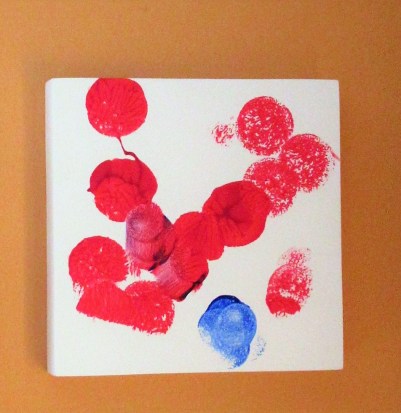
One of my other presents was a painting by the budding artist in our family, Finley, age four. I unwrapped that and put it straight up on the wall so that it could represent the glories of morning sunshine and bright early life. I guess it will outlive me both me and my sox. Here are two photos: one of the wall with two other artifacts and the other of the painting itself. AS Picasso once said (more or less) “I spent most of my life re-learning how to see and paint like a child.”

IMG_0229.JPG

Ooh! That’s me in the mirror. That artifact is a souvenir of the Glass Wheat Field that I brought back from Regina the last time I visited there. I forgot it had a little reflecting mirror that multiplied the central image and look, there I am: I’ve accidentally done a selfie. Wow: now I am cool and with it. It must have been a birthday gift from the gods: deus ex machina, the machina in this case being the camera. Here’s the other painting, in all its glory, courtesy of the artist, and my birthday parcel. Oh to be young again, to think, and see, and paint again, like Picasso … or a child.

IMG_0228 (2).JPG

Friends

IMG_0136.JPG

Friends

When good friends get together they can talk and walk and hug and hold and discuss so many awkward and difficult things, like how the body fills with spirit and the reader can be swept away in the magic of voice and how time and space can be suspended in the majestic act of creation that spins a web of forgetfulness around us and makes us forget who and what we are as we forge new worlds and the duende (Lorca’s dark earth spirit of love, want, and creation) holds us captive and drives us onward and inwards until we give birth to that which was waiting to be born, even though we never knew that the seed had even been planted, and “What is this?” we ask as we survey the new born entity fresh on the page, held in the hands, suddenly full of life and breathing on its own, a thing of beauty in its own right, that made complete sense as we struggled to hold it as it grew and transformed and transitioned from internally ours to externally and eternally theirs, a product of mind and body now belonging no longer to us but to the world beyond us, and we long to know its fate, to watch it as it walks along its path, its destiny now in its own hands, and “What is it?” people ask as we stand still and know not what to tell them, or else they say “Nice”, sigh, and go back to their two-thumbed clicking and their imaged devices, bereft of the imagination to see and explore that which has just been placed before them, this babe in swaddling clothes, this new creation, “Here, have some,” they say, thrusting our way the chips on which they are munching, or the curly French Fries they are crunching, or the pistachios, or whatever, and their coffee cools on the table, and their eyes are locked on the text that moves between their fingers across the electronic page, and this is life, as they know it, this shifting screen of shadows, this black and white stage that moves across the wall of the man-cave, woman-cave, in which they have immersed themselves, their noses close to that shifting screen, their minds elsewhere, trapped in the instantaneous insanity of the hyper-cyber-space that inhabits the void behind their eyes and between their ears, as they try to judge the price of everything never understanding the value of anything, let alone what we have created, and “Take away his grant,” “Let her wither on the vine,” “They’ll soon forget to be creative when we chain them up face to face with harsh reality,” and was that what they said to Goya, to El Greco, to Leonardo, and what exactly did they say to Lorca, before they shot him dead and rolled him into that common grave along with all the other murdered men and women, teachers and artists, poets and thinkers, and we, poor parents, holding our precious precocities in their swaddling clothes and wondering why we ever set out on this adventure, and why we are creators in the first place and “Watch out, here it comes again!” the tsunami, the tidal wave that sweeps us away and drives us into the black holes of our inner lives where a dark sun shines and shadows dance and lead us on and on until we have caught our dreams, squeezed them dry of their nothingness, and turned them into the weavings of an actuality stuffed full with new life, a new reality, a new creation, something that is truly ours, yet outside ourselves, and we gaze at it for a moment then position it in its cradle of reeds, place it in the river, push it out into midstream and eyes fill with tears and heart with hope as we watch it float away to make its own life, sink or swim, on this sea of sorrows, where someone, downstream, may bend to the waters and say “Holy Moses: what on earth is this?” or “How are we going to judge and assess it?”

Take These Chains


IMG_0196.JPG

The Great Chain of Being … Happy

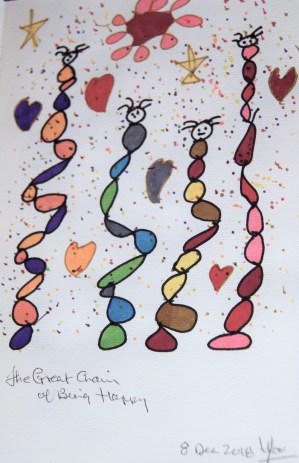
The Great Chain of Being, a concept applied to Medieval Literature by Arthur Lovejoy, suggested that all beings are related in hierarchical structures that link them from top to bottom in an ordered chain. I have always liked that idea and see myself as one among many voices, past, present, and hopefully future that feel and write about the joys of living on this wonderful planet that we inhabit. This thought immediately poses the question: do we write from joy or sorrow? Obviously, it depends upon the individual. Equally obviously, we can write from joy at one stage of our career and from sorrow in another stage.

Antonio Machado phrased it this way: En el corazón tenía / la espina de una pasión. / Logré arrancármela un día: / ya no siento el corazón. I felt in my heart a thorn of passion. One day I managed to pluck it out. Now I no longer feel my heart. Machado is a seemingly simple poet, but that simplicity is oh-so difficult to translate and imitate. So: what happens if we write from that interior passion and then, one day, we wake up and the passion has gone? Good question. Some people stop writing. Others take to drawing. Others take photographs. In my case, I have sat in a south facing window just gazing at the sunshine reflected off the snow and pottering through my favorite poets.

Francisco de Aldana is one of my favorites and I am drawn to reflect on these lines: Hallo, en fin, que ser muerto en la memoria / del mundo es lo mejor que en él se asconde, / pues es la paga dél muerte y olvido. I finally discover that to be dead in the world’s memory is best of all, since the world’s wages are death and forgetfulness. While these words will seem gloomy to some, to me they express the joys of retirement, the wonders of just sitting and looking out of the window, the escape from the necessity to produce, to achieve, to be ambitious, to grow a career, to drive myself on and on. “What is this life if, full of care, / we have no time to stand and stare?” Words of wisdom from the Welsh poet, W. H. Davies.

When I sit and stare, I also think, observe, and remember. And I see things I have never seen before: how light changes the world, how sunshine falls on the petals of flowers, how texture is changed by changing light, how light slips through the fingers like water or sand. The end result is an inner peace that accepts things for what they are and the world for what it is.

IMG_0187.JPG

In my privileged case, and I realize just how lucky I am and how fortunate I have been, I have grown to appreciate the tiny things, the small achievements. And small things now satisfy me: the completion of a crossword puzzle or a jigsaw, the nature of light, the beauty of an orange, peeled and tasted, its life blood still fresh upon my fingers and gracing the air, words prancing in lines and chains across a page, the dance of shadow on wall.

IMG_0173.JPG