Gifts

IMG_0206.JPG

Gifts

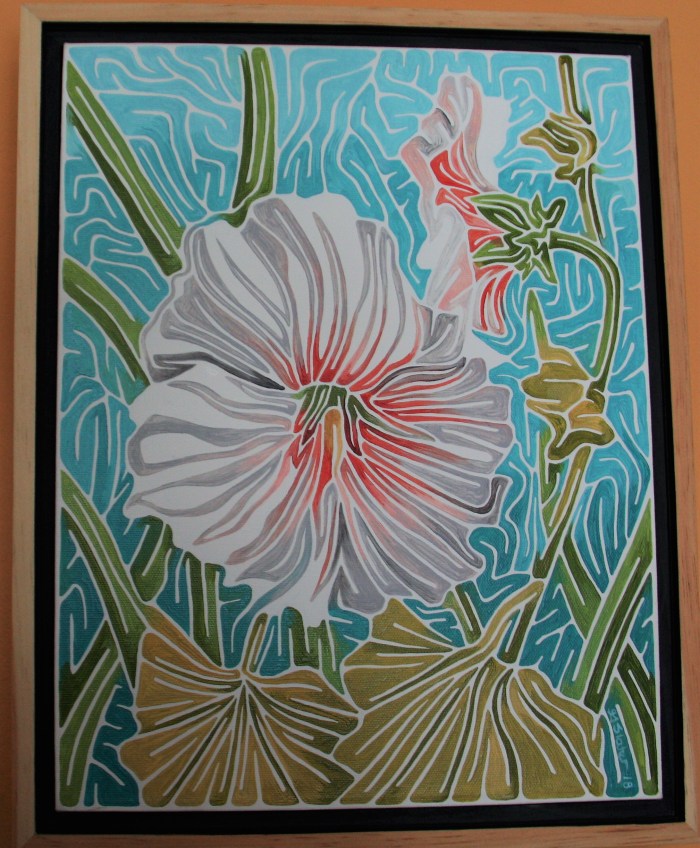
What greater gift for Christmas than one person giving themselves to another? On 24 December, 1966, 6 days after she arrived in Canada, my beloved and I were married in Kincardine, Ontario.

How fitting, then, that today, 52 years later, my beloved and I, still together, should celebrate with this other gift, a portrait of a hollyhock, gifted to us by Geoff Slater, the art director at Kingsbrae / KIRA. This gift is also a gift resulting from a gift, for in the summer Geoff visited us, saw our beautiful hollyhock, photographed it, and carried away some of its seeds to sow in his own garden when he got home. Little did we know, in the summer, that those small seeds would have grown into this fabulous, timeless painting.

Geoff is known for his line-paintings and to have one hanging on display in our kitchen in a place of honor is to celebrate creativity, art, the role that flowers play in our lives, and the friendship that goes with gifting and re-gifting that which is beautiful and most precious to us.


image1 (2).JPG

Here is my poem for Geoff and his beautiful wife Andrea. It is based on one of Geoff’s analyses of this painting (Studio 1, October 2018) and is my verbal gift from me to them, from poet to painter and painted.

No Exit
for Geoff and Andrea Slater

Where is the entry point, where the exit?
This labyrinth of lines, straight, not circular,
baffles the eye, confuses with a negative space
that lightens colors and begs more darkness.

Mystery surrounds the sitter’s form: the board walk,
no Dutch kitchen this, the chair on which she sits,
the locket she wears, the landscape, seascape
against which she is framed. White noise, perhaps,

but noise that turns to a single voice, a single line,
that of the paint-brush tip-toeing, delicate its thread
through interior, exterior meaning, just beyond

the viewer’s grasp. Yet walking past, each person stops,
stands still, as the painting draws them in, ties them up,
binds them with an ineffable thread, stronger than words,

mightier than the eye that traces its way along paths
that deceive, baffle, disturb, throw us from the high-wire
created by a mind that turns linear into circular space.


Twits, Tweets, and Twitter

img_0281


Twits, Tweets, and Twitter
aka
Bits and Bytes

After a very cold and snowy December, with low temperatures, way below average and dropping at times to -24C, with snow on the ground almost all month, and all this in the fall, aka autumn, since winter didn’t officially begin until 6 pm yesterday, December 21, it was a real shock and surprise to listen to the rain fall and high winds batter the windows all night as the overnight temperature rose to +14C and we received 40 mms of rain. As a result, we awoke to warnings of flash floods from melting snow and an influx of rain as winter has begun with a more of a whimper and a watery splash rather than with a flash freeze and a bang as your bottom hits the ice. I wonder what the deer think as they paddle through the puddles on their way to and fro from the water-logged feeders. I know what I’m thinking: ‘thank heavens we don’t have to shovel it’, but it will be a totally different story when it all freezes over, the road are like bottles, and we descend the hill in first gear with an ever-present fear of a much too welcoming ditch.

I have just read an interesting article on how, accustomed as we are to Twits and Tweets, many of us are no longer capable of unravelling a long interesting sentence that rambles on and on and refuses to make an immediate Twitter Point, usually underlined by the use of CAPITAL letters for KEY WORDS and all of this for a sound byte audience that is becoming less and less literate as social media proliferates and news is telescoped into tiny jam jars of meaning that are spread around with an illiterate spoon and many exclamation marks. There: you have just read a 96 word sentence. I wonder how you did with it? Did you persevere? Did you give up half way through?

In my former life, when I encouraged young people to read Miguel de Cervantes’s Don Quixote from cover to cover (and they did), I was surprised to discover the difficulties they had with his long sentences, some so long that they continued for a whole paragraph or a full page. I was also surprised to discover that many Spanish speaking people are now incapable of reading Don Quixote in the original Spanish as it is too complicated for them and too difficult in meaning and structure. I have cartoon versions of Cervantes’s master-piece, but have always found them to be simplistic and undignified. I have read the original, in Spanish, twenty-seven times, usually in the Martin de Riquer edition, and have never found the language to be a problem. Indeed, it is refreshing to enter the labyrinth of a long sentence and to struggle for a little while with the exact meaning of a complicated structure that offers so many multiple readings that no single meaning can easily be extricated, if at all, and so the mind wanders on and on in the Cervantine maze spun by a spider-web pen and a brilliant mind, now no longer accessible to the multitudes: a paradise now closed to so many, a garden open to a only a select few / Paraíso cerrado para muchos, jardines abiertos para pocos.

The spirit of Cervantes, the creator, appeared to me last night in a dream. ‘Rogelio,’ the master said. ‘Spare me and spare my creation.’ ‘Don Miguel,’ I mumbled sleepily, ‘here sit beside me on my bed. Welcome to my humble home.’ ‘I am not don Miguel,’ Cervantes replied. ‘I never was a don and I never will be one. I am humble Miguel, writer, poet, and son of a vagabond surgeon who, like father, like son, often entered the debtor’s prison’. ‘That same debtor’s prison where the history of your hero was engendered,’ I replied. ‘So they say, but I am not here for that. I have come for you to save me.’ ‘How, my Lord, how can I save you?’ ‘Rogelio, I am not a Lord, but a rumor has reached me in my after-life, that they have modernized my knight, given him a car, not a horse, set the Civil Guard against him, ridiculed him with condoms that he blows up like balloons, sent him to Salamanca, and Galicia, where he never went, continued his adventures, reborn, in a foreign language that I loathed …’ ‘That is bad, my Lord, I mean don Miguel, I mean Miguel …’ ‘Worse is to come.’ ‘Worse? How can it get worse?’ ‘Indeed, it arrived at my ears, you might say a little bird told me, that they are releasing my book in a series of 240 word tweets on a thing called Twitter that speaks like a Jesuit with false flickering words.’ ‘But you were brought up by the Jesuits …’ ‘That’s how I know of what I speak. This cannot be, the history of my knight reduced to episodes of 240 words, the whole 124 chapters, 1000 pus pages of finely scrawled ink, reduced to tweets on twitter by some poor twit … you must stop this nonsense. I and my knight depend upon you.’ ‘How can I stop it, don Miguel?’ ‘Charge the windmills of Twitter. Attack the falsehoods of Tweets. Stand up for the long, soulful sentence that will withstand the winds of time …’ ‘As your book has withstood, until now, the literary storm that is about to engulf it in an Alfred Hitchcock swarm of wild birds that is poised to twitter and tweet you to your doom?’

The ghost of Miguel de Cervantes vanished with a howl, only to be replaced by that of Pierre Menard, Borgian author of the renewed Quixotic page. ‘To tweet,” the ghost whispered in a thin, shrill voice, ‘or not to tweet, that is the question, and therein lies the Cervantine rub.’

Umbrella

IMG_0144

When it rains, everyone needs an umbrella.

IMG_0170


Umbrella

Black clouds overhead,
yet I walk dry
beneath a black umbrella.

Pitter-patter of falling rain:
my ears strain to catch
a nearby robin’s song.

I have mislaid his voice
and can no longer
translate his liquid trills

nor transform them
into a sunlight that will glisten
through dripping leaves.

Frogs in the summer pond
explode light bulbs in my brain.

A rainbow glistens in the pools
beneath my feet.

I want to see my garden reborn,
with words and my world renewed.

I thirst once more for life’s
sweet, fresh water.

Here below is the voice recording of my poem Umbrella.

An old song …

img_0448


An old song … 

            … words wrapping themselves around your neck, the tune a loose scarf, brilliant in the sunshine, and so warm, flapping as you walk the street … people see frayed ends … wave back at you … the sun picking out gold spots in your hair … all’s well with the world … a marching song … the world walks over the hills … and far away … you march to work or play … every day is a new day … blood stirring with this call to arms … to alarms … everything up for grabs … tunes in your head … words wrapped around you  … warming you …

            … a sad song … rain drops falling … mist or mizzle … you walk through damp, low clouds … you are sad … but comforted … wrapped warm in a verbal comforter … the sun breaks through … throws its arms around you … hugs you …. until raindrops radiate … gathering on eye-lash … at leaf’s end … twinkling on an abundance of radiant flowers …

            … a Nor’easter … snow in the air … on the trees … on the ground … a steady accumulation … you know how it is, East Coast Canada … down by the Fundy …  a fire in the fireplace … warm heart … warm hearth … no travel today … books and computer beckon … a time to read … to write … to remember the old ways … the old days … those memories … a warm scarf wrapped around the neck … and the comforter … so comforting … so much to wrap around you … so much to wrap your head around …

Safety Blankets

IMG_5811_2


Serendipity, really, that the links below should appear so close together. First, Meg Sorick’s post on drawing toys  and childhood memories. Some of us can draw (well done, Meg, congratulations). Others can’t, and must take a line for a walk, or must color or crayon or live with their black and white memories. Yet we never forget these early comforters, these early friends.

Traumatic, sometimes, the separation of us from our childhood beloveds and then the substitution of wool and cotton, of Teddy and struggle from the flesh and blood that never quite fulfilled the hollowness within us.

“Grow up,” the grown ups said. And offered us a world of cynicism and misery.

I remember when I asked the priest (I was about 4 years old at the time) if I would see my dead dog when I got to heaven.  He told me that dogs didn’t have souls and I’d never see him him again. Tough luck. I was lucky. The dog wasn’t. Apparently that particular priest had never heard of the Rainbow Bridge.

‘You must grow up,’ he said.

“If that’s your reality,’ I said, echoing the words of Atahualpa, ruler of the Incas,  “I don’t want to go to your heaven, and I don’t want to grow up. Ever.”

“So what will you do, who will you be?”

“I’ll be Peter Pan,” I said. I think I was four, but I might have been five.

At an international conference, a few years ago, while I was still recognized, before the age of 65, as a real, productive human being, a young lady, hearing my strange, outlandish accent, asked me “Where did you grow up?” “I don’t think I have,” I replied.

Why do we have to grow up? Picasso said that he had spent most of his adult life learning to see the world once more through the eyes of a child. And why ever not? Metaphors, beliefs, myths, acceptance, understanding, friendship, openness, willingness to learn  … things that are gradually worn away as hierarchy, authority, obedience, socialization are taught to us by those who think know best.

Are these the ones who also brought us so many things that are wrong with our world? The inability to think for ourselves, fear of authority, the need to fit in and be accepted, fear of the mob, the crowd, of those who believe in what they are told to believe. The fear of the other. The need to destroy that which we don’t understand.

Advertisements? I love them and sing them all day long. Tee-shirts with slogans? Wonderful. I wear them and show them proudly to my friends. Sound bytes? I never question them and I circulate them to my friends. For ‘whether I think for myself or no, I’m sure is only touch and go’. You may or may not recognize the poet, but I do. I was born less than a mile down the road  from him. You’ve probably never heard of him, but I have.

Accept my poet-neighbor and reject what modern society throws at me? It’s a difficult choice, isn’t it? How do we choose and why? What do we think and why do we think it? Or do we just follow the mob, the herd instinct, the sheep?

“If there were five sheep in the field, and one got out, how many would be left? Mary.”

“None, miss.”

“What do you mean, none? What’s one from five, Mary.”

Mary was the local farmer’s daughter. She didn’t think like that.

“No, miss,” said Mary. ” Sheep don’t think like that. If one got out the field, the rest would follow. There’d be none left.”

Terrible mathematics. Wonderful sheep psychology. A young creative mind thrown on the rubbish heap of ‘true’ knowledge at five years of age. Dismissed as an ignorant fool. What a pity.

And what’s wrong with Teddy Bears and childhood toys? I love them. I still have my daughter’s Paddington Bear beside my bed. Yellow Sou’wester, yellow welligogs, for those who know what they are. Here’s Meg Sorick’s take on my folly:

https://megsorick.com/2018/12/09/the-year-of-drawing-adventurously-week-49-toys/

Who is Meg Sorick? In my own mind, she is a bright, intelligent human being, who looks upon our ageing and cynical world with childhood in her mind, and intelligence in her paint-brush and her pen.

As for the real world? What’s it all about, Alfie, Bertie, Cecily, Dewi?

Living in my own world, with a creative Joey in my Kangaroo pouch, not really Roger the Ripper Roo, I honestly don’t know. A Marsupalian view of the universe? Why ever not? If you can believe in the koala, and the marsupials, and the kookaburra, and the platypus duck, you can believe in anything. Read the linked article below about childhood teddies … if you dare … I did … many won’t.

https://www.theguardian.com/society/2018/dec/12/still-have-childhood-teddy-psychological-power-toys-we-keep


Rejection

IMG_0023.JPG


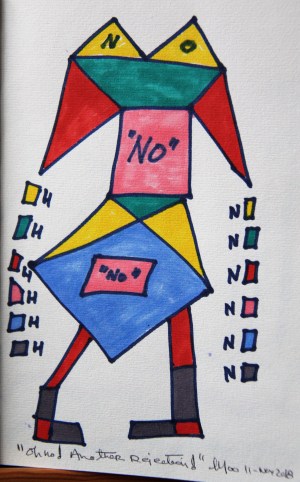
“Oh no, another rejection!”

“And rejection equals dejection, or doesn’t it?”

“Only if you let it get you down. I wait until I am in a foul mood and ready to tear things to pieces because my mean streak is surfacing. Then I go to my rejections pile, re-read the rejection letters, then read again the pieces that have been rejected.”

“Why on earth would you do that?”

“Above all to work out why the work was rejected. What did the editors see that I didn’t? When I write, I wear rose-tinted glasses and all my little babies are the prettiest, the strongest, the fairest in the land, especially when I give them the ‘mirror, mirror on the wall’ test.”

“I’ve never heard of that.”

“It’s simple: you look in the mirror and ask ‘Who’s the fairest writer of all?’ and the mirror answers ‘Why, you are, of course.’ If you believe that, and as writers, we often do, then rejection becomes a hard realistic rock, shattering both Ego and Id. The immediate response is to deny the editor’s taste and judgement. It is amazing how many stupid, dumb, and uncultured editors there are out there. They hate us and don’t understand us.”

“That’s true.”

“No it isn’t. The fault, dear Brutus, lies in ourselves, not in our editors, that we are not great writers. Understand that, and you have a chance to succeed and to improve. Re-reading allows me to try and understand what went wrong, why the mirror lied, how the rose-tinted glasses distorted the actuality of the written page. Understand the other and how the other perceives what and how you write and maybe, just maybe, you can condition yourself to improve. Many budding writers are dropped on stony ground and fall by the wayside. Others land in the desert and their things of beauty bloom where nobody sees them. Some fall on seemingly fertile ground and earn an immediate immortality that fades in a season when the fad wears off. A few writers, an occasional few, go back to the drawing board and water their flowers with the sweat of their brow. Eventually, if they are lucky, their work may be accepted.”

“You always preach the bus story, Julius.”

“Of course I do. Get off the bus early, and you’ll never finish your journey. Remember Sir Walter Raleigh: ‘it’s not the beginning, but the continuing of the same until it be thoroughly finished that yieldeth the true glory.’ He didn’t sail the Golden Hind around the word by setting up house in Cadiz and living in luxury on a beach in the south of Spain. He continued on and on, always forward, until he arrived back in his home port.”

“So we must just keep going, then?”

“Of course. But never blindly. Take criticism to heart, remembering that it comes from another’s heart. Learn from your mistakes. Correct them when you find them. Never give up.”

“You’re always happy, Julius. I bet you never get rejected.”

“Oh I do, Brutus, I do. And each rejection is a dagger to the heart. But I keep going. For example, last week I received my fifteenth consecutive rejection. So much work, so much genius, and all denied.”

“But you’re still smiling.”

“Indeed I am. I have just received my second acceptance in two days. I no longer feel betrayed by my editors.”

“I’ll never betray you, Julius.”

“You will, Brutus, you will. Never fear, et tu, Brute.”

Coat of Arms

coatofarms.png


I’ve never yearned for a coat of arms. All those advertisements for this and that, DNA tests to prove your ancestry, where your family name comes from, how many famous people were in your past, how many convicts … and the convicts were often poorer family members, wallowing in poverty and forced into theft, money, a loaf of bread,  a chicken, a lamb, some eggs, something to feed the children, to pay the bills … the possibility of blue bloods and royalty outweighed by the probability of some dark skeletons swinging on gallows somewhere in the distant past.

Yet when I got my online advent calendar this year, there was the coat of arms game … make your own coat of arms. So I did. The choices were very limited, not too original, and came with a ‘clan history’ that has absolutely nothing to do with me. A bear and a dog … I can live with those, especially as the bear is apparently my Canadian spirit animal. A Welsh dragon draped round the top of the frame … wrong color and definitely not Y Ddraig Coch, the blood Red Dragon of Wales, but still a symbol I can happily live with. Down below, we have Sun and Moon, the symbol of Oaxaca and title of the first book in the Oaxacan Trilogy (first published in 2000). Unfortunately, I have reversed the symbols to give us Moon and Sun. Oh dear. Such things happen.

Then we have a snowman and a beer tankard. Sounds good to me. I have now lived in Canada for more than fifty years in Canada and I know all about snowmen, and the taste of beer, sometimes mulled, to take away the cold. I am not so sure about ‘my clan’ as I don’t really think that I have one. I feel it is a very foreign term  like Hi there, gang. I can take Robin Hood and his Merry Men, but Roger and his Merry Gang, no thank you, that’s not for me. Sorry. As for ‘throughout the land’, I wonder which land they are referring to: Wales, England, France, Spain, Mexico, Canada … I don’t really feel that any of these stand up as my ‘land’ … except possibly for Canada, and as for Canada, well, this land is enormous. I have certainly visited some of it, but by no means all, and there is so much more to see and hear.

‘In Battle’, well, I have never been in a battle. I dislike violence and fighting, and I cannot imagine how a phrase like that got in there. ‘Fierceness’ same thing, I am as mild as milk and very easy-going. ‘Loyalty’, yes: that’s what the bear and the dog are famed for. ‘Us bears never forget’, or words like it, from the Chronicles of Narnia. Oh dear, there I go … I can hear mother bear now … ‘Stop sucking your paw’.

Seize the day is goodCarpe Diem … but never in battle … in poetry, maybe, or else in gathering old age where every moment of every day seems more and more precious. I wold have preferred Horas non numero nisi serenas, but they didn’t have that one, even though, nowadays particularly, it is the happy hours that I count, and not all of them spent in a local bar, or home alone, with my own beer mug.


Siege Perilous

IMG_0168.JPG

Siege Perilous

           My second name begins with G … G for Galahad.

         Siege Perilous: the chair calls me, sings out my name, craves my body warmth and blood. I move towards it, hear it groan to me in greeting. I feel it sink beneath my weight, feel its heat and comfort, sense the heart-sound of its old, carved, polished wood. My father sat here before me and his father before him, and his father … and so on down the ringing halls of time.

           Siege Perilous welcomes me as it welcomed them. It cherishes me, nourishes my flesh and blood, my sense of belonging within a great chain of being whose links vanish backwards into forgotten, far-off mists. The chair understands that we are weaklings. It accepts us are we are, strengthening our strong points, filling in for our gaffes, gifting us with the ability that allows us to see ourselves as we truly are, willing spirits in an all too flimsy flesh. Impervious its wood to words or tears, it strips away our masks, dismantles our disguises, meets our inner being face to face, seat of wisdom carved from the tree of knowledge of good and evil.

           The chair rarely rejects us, though sometimes it senses the rot within and moves us on. More often than not, it brings light to our darkness, pierces our clouds of unknowing with its beam of sunshine, illuminates our darkest nights. It cares for us, wraps us in the warm wings of its radiance, carries us onward when we are alone, shapes our own heart-wood with its hand-carved arms that cling and clutch and cleanse of impurities. Blood warms its veins, the blood of the generations that have climbed here as children, sat on the elders’ laps, listened to their tales, then shared their inheritance, before sitting here themselves.

           A sense of entitlement wraps its veil around Siege Perilous and the Forgotten Table. It shuts out doubt and fear. We feel its power transmitted through us, fear, fire, foes all defeated. Power: the power of good to defeat evil, of truth to conquer lies, of my people to survive. They may seem to be crushed, and yet they will rise; defeated, they will overcome; victorious, they will be magnanimous in their victory.

           King Arthur: the Once and Future King … King Arthur and his Knights of the Round Table … Siege Perilous … the Vacant Chair … the Holy Grail … Excalibur: the Sword in the Stone … Arthur himself … Galahad, Geraint, Percival, Gawain, Lancelot … all equal … all pure, honest, innocent, celibate … Camelot …

Merlin the Magician and Wondrous Wizard, conjurer of truth and falsehoods … the historian-poet adjusts his rose-tinted spectacles, smiles, clacks the false white teeth that spin-doctored so much verbal magic, so many mystical myths, fabulous fables, phenomenal falsehoods … and started, pen on paper, to create yet again another set of nonsensical, downright gut-jarring lies.

Happy Hours

IMG_0126 (2).JPG


As the inscription on the old Roman sundial announced: Horas non numero nisi serenas / I count only the happy hours. And, of course, the sundial is right. When the skies are cloudy and the rain and snow are falling, the sundial sleeps and refrains from marking the passage of time. But when the sun prances brightly through those heavenly meadows and casts shadows across the numbers on the clock, then the sundial counts the hours, precisely because they are happy.

I try to do the same. I try to avoid the shadows that are cast across our planet and I try not to count them. Alas, like the grains of sand on the beach and the countless stars in the sky, they are innumerable, though the latter are being named, numbered, and counted, much to their chagrin.  Who wants to be called Welsh by foreigners, with all the negative connotations they associate with the epithet, when our real name is Cymraeg? And no, we don’t live in Wales, we live in Cymru, or better still, in Canada when we (e)migrate. Canada: I wonder what the real name is for this huge and wonderful land? And what about the local indigenous peoples? I can accept that they are First Nations. No problem. But who are our hosts and neighbors when they call themselves Wolastoqiyik (or Maliseet) and we call them Aboriginals (or worse)?

What’s in a name? North, South, East, West … simple, eh? How about Upstream, Downstream, Away from the River, Towards the river? Think names of the months, names of the days of the week. Now think guidance, think signposts, think culture, think separate cultures, think different ways of living, think different ways of life. Think possessive pronouns: my book, my house, my cat, my dog, my son, my daughter, my Wifi, my wife.  Or as le grand Charles de Gaulle expressed it, in Le Canard enchaîné: “Ma France, mon coup de frappe, mon Europe … mon Dieu.” Maybe we would be better off without possessive adjectives. But then …

“Taffy was a Welshman,
Taffy was a thief,
Taffy came to our house
and stole a leg of beef.”

Taffy: a generic name for the Welsh. Any male person from Wales is automatically a Taffy from the moment he opens his mouth and speaks with anything like a Welsh accent. Taffy, from the River Taff that flows through Cardiff,  aka Caer Dydd, the fort on the Dydd. There are many rivers in Wales, many regions. Men from the Isle of Mona, Llanberis, Caernarfon, Brecon, Abertawe, Aberavon, Castell Nedd, Caerfryddin, Pen-y-pont, Caer Isca, Usk, Cas Newydd, Pen-y-Bryn, Sgetti, Uplands, Trebanog, Llanelli, Llanfairpwllgwyngilldrawbwllchllantiisilioggogogoch, Cwm Parc, Trebanoc Cwmbwrla, Cwmrhyddiceirw  … Taffies one and all, even if they were born miles away from the River Taff and rarely visited Cardiff, the very name of the river and the city anathema to them.

I once had a friend, a very good friend, or so I thought, educated in Harrow, Oxford, secret member of the ultra-secretive, fabulously expensive, well-endowed and super-privileged, ultra-elite Bullingdon Club. He had a triple barreled name of course: Somerset-Trilby-Frisbee or something like that, I forget now. Whenever I arrived at a reunion or a meeting, he would greet me with a bullhorn, bullfrog chorus that reached into the far corners of the room: “Lock up the silver spoons, the Welsh have arrived.”

Humor? His laughter would rock the rafters and shake the room once more. Racism? What racism is there in mocking the Welsh when you are English? Bigotry? No man with a three part surname, an English public school background, and a list of ancestors longer than your arm could possible be a bigot.  Idiot? He was very intelligent, slightly unbalanced, and totally oblivious to any social norm or indignity, unless he was the threatened person, and watch out for vicious mousetraps if you made him the butt of your own humor and he took umbrage at the slight. Criminal? No way: the Welsh were always the criminals, for back in the legendary mists of time they had stolen a leg of beef and now they were here to steal the precious plastic spoons and knives and forks that masqueraded as silver …

… what’s really in a name? What’s in a grey day or a blue day? What’s in a cloudy day or a sunny day? What’s in our hearts when we denigrate our friends and doubly degrade our enemies and those we declare to be our enemies, sometimes on a gut feeling or a whim? Horas non numero nisi serenas … Time to look on the bright side, to walk on the sunny side of the street, to reject the shadow and live in the sunshine. Time, in fact, to turn the whole day into a succession of Happy Hours. Study the cartoon above. Now that is a portrait of someone who really enjoys a Happy Hour. And not a glass or a bottle in sight.

Turds

IMG_0188


I love the sales shows on the telly. The sales lady comes and and starts talking and you can’t stop her once she gets going. My golly, once they start talking they’d sell you anything from snake oil to …. well, I heard a good sales pitch today. It went like this.

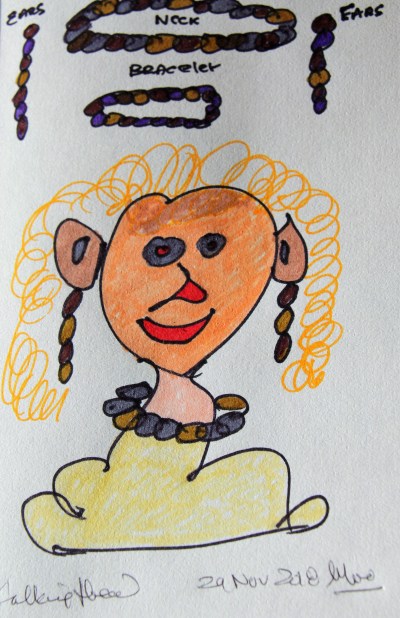
“See how delicately the necklace is carved? Then it is highly polished in a new process that leaves it bright and shiny, like a brown diamond.”

The model whirls and twirls, showing off her best points,  not to mention what she is encouraging viewers to buy, the bracelet, the ear-rings, the shiny necklace. Television and online sales. No sense across the screen of touch, of taste, of smell. Just a temptation to enter a vision that the sales girl is selling. The model whirls, the music rings out, the camera focuses on the band in the background. The lead singer wears exactly the same jewelry as does the model: identical necklace, ear-rings, bracelet.

I struggle to catch the words, but you know how modern music distorts the lyrics, twists the sounds. Later, I put the words of the song back together. I recognize snippets, portions, and then the whole verse clicks. Intertextuality, I think, verse responding to verse across cultures and the ages. No wonder that I recognize it and can put the words back together with the help of the original.

“Only twenty left,” the sales lady says. The model smirks, wiggles, shows off her multiple gems, and smiles. “Call this number now,” the sales lady points to a number in the corner of the screen. “Nineteen, eighteen left, be quick. You don’t want to miss out on one of these.”

“Remember,” the sales lady says. “these are original dog turds. They say you can’t polish a turd, but you can. In fact, with today’s new freeze dry technology you can collect dog turds, freeze dry them, and then carve, shape and polish them. No more doggy bags and doggy waste. It’s one of the best forms of recycling.” The sales lady smiles at the camera and the show band breaks once again into that snappy song and chorus. While the lead singer sings, the camera focuses in on her necklace, her ear-rings, and then her bracelet. And I piece together the words:

“Gather ye dog turds while ye may,
for time it is a’flying,
and that fresh dog turd, dropped today
tomorrow you’ll  be drying.”

“Looks like a dog turd.
Smells like a dog turd.
Feels like a dog turd.
Tastes like a dog turd.
Thank Dog we didn’t step in it.”