Revisions

img_0128

Revision
“We are not writers, we are re-writers.” I do not remember who said this, but it is extremely well said. We write, yes. But then we rewrite, sometimes obsessively, again and again. But how does that rewriting process take shape? Why do we rewrite? How do we rewrite? And what do we do when we re-write? These are all vital questions.

Mechanical revisions and rewrites
This, for me, is the search for typos, punctuation errors, mis-spellings, grammar corrections, that sort of thing. Yes, we can rely on a (reliable?) editor and a not so reliable spell-check, but the editor usually costs money. Or we can learn to do it ourselves, which is what I recommend very strongly.

Grammatical revisions and expression checks
These are usually a little more difficult to deal with. Do the verb tenses check out? Are subject and verb clearly delineated? Does the wording make sense, not just to us, but to the outside reader? A second pair of eyes is always useful at this point. Also, a sense of distance from the text is useful. Leave it a day (or two) and come back to it later when he creative rush has fled the system.

Structural revisions 1
Whenever we do a structural revision, it is essential to check that the revision ties in with the rest of the piece and that we maintain consistency throughout. A simple example: I decide, on page 77 of my novel, to change my main character’s name from Suzie to Winnie. Clearly, her name has to be consistent, both backwards (1-77) and forwards (77 onwards). While this is obvious, other changes, taste, color of hair, color of eyes, height, weight, tv program preference, may not be so easy to check and double-check. But it must be done.

Structural Revisions 2
This is where we must pay attention to the vision in the re-vision. We must ask the question, what does the poem / story / chapter / text want to say? What is it actually about? Often, in the flush of creation, we write words (actions, thoughts, emotions) on the page and they flow like water from a fountain. It’s a wonderful feeling. Later, during the re-vision process, we must ask ourselves, again, deep down, what do these words mean, what are they trying to say? This is actually a slightly different question from what am “I” trying to say?
The speaking / writing voice may want to say something, but the words (and characters and actions) themselves may want to say something else. Now we are faced with a dilemma: do we write what we want to say or do we follow the intricate word-path growing from what we have written? As a beginning writer, I did the former. As a more mature (and I hope, a slightly better writer) I now do the latter.
The result is often a piece that is radically different from it’s starting point. When you listen to what the story / poem / text / characters etc are telling you and when you follow words and characters, then structure changes, paragraphs switch places, thoughts move around, expressions change. We are no longer forcing words into our meanings, we let the meanings grow out of the words. This is particularly important in short story telling and the writing of poetry. It is vitally important to the novel where any inconsistency must have a relevance to the development of action, plot and character. It is also a totally different approach to the meaning of re-vision.

Summary
I realize many writers may have difficulty accepting these points. Those trained originally in the academic world, in particular, will respond negatively to the idea of the words ‘not being forced into the correct academic shape by the quasi-omnipotent academic mind’ aka Constable Thesis Editor. However, the more creative a writer is, the more that writer will respond to the creativity that lies within both the creator and the creation that has appeared on the page and, as writers, we must never lose sight of that creative act, for it is one of the most truly wonderful things that we can do.

Comment

This is a golden oldie. However, it is still worthy of being reconsidered. Why do we revise? How do we revise? I hope this article is of use to the many out there who are looking for help and encouragement.

Aliens

IMG_1663 (2).JPG

Aliens

“I’ve got photos,” I said.

“Fake,” they replied.
“Doctored in photo shop.”

“I’ve got witnesses.”

“Bribed,
and equally deluded.”

“I’ve got letters.”
‘Forged,
handwriting and words.”

“Look,” I pointed.
“They’re out there now.
Looking at you through the window,
dancing, changing color, waving.”

“I can’t see them,” one said.
The others all shook their heads.

And now, they’re going to take me away.
There’s nothing left to say.


Writers’ Block

IMG_0182

Writer’s Block
(For Kentucky Blue Angel)

This is a golden oldie that I am re-posting. Today, several people talked to me abut writers’ block. Here are my thoughts on the topic.

Every day, well, almost every day, I meet people who tell me that they cannot write anymore. They have abandoned their current project. They sit in their work space and stare at blank screens or empty walls. They have come face to face with the dreaded Writer’s Block.

While some consider Writer’s Block to be an actual illness, others flaunt it like a flag or a badge of honor:

“Don’t touch me — I’ve got Writer’s Block: I wouldn’t want you to catch it.”

“I’m having a bad week: I’ve got Writer’s Block.”

“Sorry, I can’t make the writer’s meeting, I’ve got Writer’s Block.”

According to Wikipedia, “Writer’s block is a condition, primarily associated with writing, in which an author loses the ability to produce new work or experiences a creative slowdown. The condition ranges in difficulty from coming up with original ideas to being unable to produce a work for years. Throughout history, writer’s block has been a documented problem.”

We have probably all experienced the sensation of being unable to write, unable to think, unable to continue. As an academic, I found that something similar happens frequently in examinations with young students whose minds suddenly go blank when faced by a white page and an awkward question. This form of Writer’s Block comes at the most unfortunate times. Students need to be switched on just when their minds switch off. And something similar happens to writers.

Examination Block can be overcome. In many cases careful preparation for an exam will reduce or eliminate examination block. These preparations may well include correct note-taking and relevant revision procedures. There should be no last minute all-night study the night before the exam and a good night’s sleep, proper food, and water are essentials. Appropriate physical exercises before the exam starts are also useful as these make the heart beat and the blood flow. All these things prepare both body and mind and free the student for that most important task: the struggle with the blank page and the awkward question.

Will a similar set of preparations work for those who suffer from Writer’s Block?

In order to answer this question, I would rather take a different approach. Instead of seeing Writer’s Block as a physical / mental presence that stops us writing, why not look at it as an absence that can be overcome? What can we call that absence? Personally, I look upon it as an absence of creativity. If the creativity isn’t there, then writing creatively won’t happen. So what do we do?

Let us define creativity. For me, creativity is the expression of the creative principle that dwells within all of us. It is there, within us. We may suppress it or we may let it be suppressed. We may ignore it or we may deny it: but it is still there. It is always there. Sometimes it is beaten out of us; or we think it is. But it is still there, beneath the surface, waiting to be called on. The Roman poets spoke of it as Deus est in nobis … the god that dwells within us.

Creativity, for me, is like a river that vanishes underground and then reappears: it will be back.

The most important thing in my opinion is what you do when you’re not writing, what you do when you’re faced with that wall of blackness, what you do when you stare at that blank screen and nothing makes your fingers dance on the key board.

Here’s what I do. I make up my mind not to force myself to be creative. Forget about writing. Do something else. Ignore all idea of Writer’s Block, or the End of the World, or the Imminent Disaster of not being able to write. It may take a mental effort, but forget about it.

Now do something else, something positive. Different people respond to different stimuli. Here’s what I do.

(1) I read books
I read other people in their creative moments. I love reading people who write in other languages that I speak and read, because my own mind tries to recreate their images, their stories. This re-creation is a form of creation in itself. New words, new ideas, new combinations, rise to the surface of the mind, like bubbles on a river.

(2) I color and draw
As any who have seen my drawings know, I cannot draw. However, I can take a line for a walk. And that’s what I do. Then I color the spaces I create. My friends thought I was wasting my time and I believed them until I read one of Matisse’s sayings: “My ambition: to liberate color, to make it serve both as form and content.” Voilà: I have my raison d’être. Nature abhors a vacuum. When you create a space, color and meaning rush in.

(3) I take photos
The capturing of a moment: a sunset, a new bird at the feeder, deer wandering through the garden, a black bear visiting, rain on a spider web, sunlight through a prism, a cat made out of cherry stones … the re-creation of the moment is the creation of the memory. More bubbles flow on the surface of the stream.

(4) I go for a walk, look at nature and the world around me, people too
It is incredibly important to do this. A visit to the local coffee shop, a walk around the super-market or corner store, a seat in the park on a sunny day … just be yourself, believe in your existence, watch things as they happen, relax, look and listen, empty yourself, let the world flow back in … look at the ducks on the lake or the goldfish in the tank … more bubbles on the water, more ideas floating down the stream …

(5) I listen to music
De gustibus non disputandum … we can’t argue about taste. Where music goes, each person must make their own choices. The music I like fills my mind, relaxes me, flows out when it ends, takes my mind for a walk and leaves … a vacuum … into which dreams and colors, words and ideas, build like clouds …

(6) I cook
Cooking has always relaxed me. Sometimes the repeating of an old recipe helps clear my mind. Sometimes I have a need to invent something new. Hands and mind occupied, the secret, sacred underground river of creativity flows on …

(7) I sew
Last summer, an unexpected event led me to join a quilting group … oh what fun … a man quilting among a dozen women … I learned so many things … so many different ways of looking at the world … so many concepts that I would never have dreamed of on my own … Sewing runs in the family: I still have my grandfather’s sewing kit … darning and sewing needles that served him for two years before the mast … that darned his socks as he survived in the trenches of the First World War … it bears his name and I use it with pride … and what memories arise in my mind as I choose the needle … his needle … the one that will lead me into the next adventure, be it quilt, button or patch …

(8) I keep a journal
… and come hell or high water, I write in it every day and have done so since 1985. That’s 31 years during which I have scarcely missed a day. The writing maybe banal, it may be nothing but a note on the weather or a comment on a sporting event … but it’s there … a vital challenge to the idea that Writer’s Block can take me over and stop me writing. This journal is 95% drivel … maybe more … but bobbing along the stream of words are ideas, verses, rhyme schemes, choruses, stories, flashes of inspiration, jokes, memories, magic moments, falling stars, … the secret is to catch these falling stars, to recognize these rough diamonds and to return to them and polish when the moment is ripe … and it will be, sooner or later … for bubbles are buoyant and will lift you to the stars.

(9) Free Writing and the Creation of Metaphors
I also use the journal for free writing and automatic writing. These techniques, drawn from the Surrealists, allow the mind to wander at random. While wandering, the mind creates an interior monologue or a stream of consciousness that in fact turns up a series of delightful metaphors that can be polished and re-used at will. When I use this style of writing, I am reminded of Dalí’s saying (again and as always, from memory): “I don’t know what it means, but I know it means something.” My own theory of metaphor is that the metaphor is defined by two (sometimes more) points and rather than settling on one or the other (as in a simile), the mind moves and flickers sub-consciously between the two extremes so that meaning is sensed, but rarely can be grasped or stated in definitive terms. Thus, the marvelous line from André Breton, quoted by Mr. Cake,  “The wolves are clothed in mirrors of snow” has, according to my theory of metaphor, four defining points, namely, wolves … clothed … mirrors … snow. All four of these defining points creates an image, a very personal image, in the reader’s mind. The mind moves quickly between each defining point and meaning is lost in the rapid shift from image to image. Quite simply, “the hand cannot grasp it, nor the mind exceed it.” This means we have to return, as readers, to the unconscious level where the metaphors were first created. Then: “when we no longer seek it, it is with us.” This same analytical exercise can be performed for each line of Breton’s poem. When we indulge in free writing, much of what we write can be abandoned. The secret is to recognize and rescue the little gems we so often find.

(10) I believe
Through all this runs a thread of belief … belief that the black cloud of despair will not win. The Writer’s Block will go. Creativity will never be not lost. It is there, beneath the surface, always ready to be contacted, waiting to rise and take you over again. And all too soon and quite unexpectedly, one form of creativity slips into another and the creative writing (it never really went away because of the journal) comes back.

Writer’s Block: it does exist. It’s how we deal with it that’s important. Creativity rules: forget Writer’s Block and let creativity and the multiple ways back to creativity grow and flow. Sooner or later the clouds will lift, the sun will return, the block will unblock and the words will flow again.

Remember the words on the Roman sundial: Horas non numero nisi serenas … I count only the happy hours. And remember: the clouds will lift, the sun will return.

Trust me.
And believe.
A Gift

IMG_1652 (2).JPG

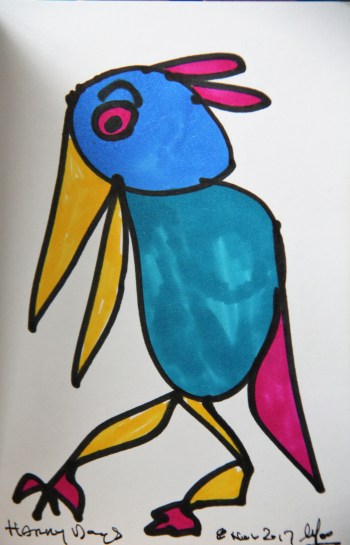
A birthday gift, hand made, by my five year old grand-daughter, in case I go gaga and forget who I am. I have no intention of doing so deliberately … but at my age … who knows? It can happen so quickly and so easily.

Robin Red Nest

That little red nest,
my heart,
hearth and home
to a galaxy of winged gods
who nest there,
year after year,
migratory spirits
blessing me with
hope renewed
in their spring nest’s
tangle of feather and twig.

Old now,
you thump to different rhythms
and schisms sprung from my body

Age winds you up like a watch spring
stretching my lifeline egg-shell thin.

When the wind of change
blows me away,
what will replace you
and your offer of sanctuary
to those you daily nourish?

So sad I will be
to abandon you,
your visions unfulfilled
as winter winds unravel you,
twig by twig,
until nothing remains
but the bare
white-boned cradle
in which I carried you,

so lovingly.

Grandpa

IMG_5811_2

Grandpa

Going back in time,
to a better time,
an innocent time,
when we believed
in frost and rime,
and Santa Claus
and Christmas.

Stockings hung
with hope and joy
and filled with
tiny things and toys,
an apple, an orange,
a chocolate bar,
small things
brought in
from afar.

My grandpa, who
had not been good,
with a carrot,
an onion, coal,
and wood,
but a smile
on his face
and his red
underwear.

I often see him
standing there,
beside the fire,
beneath the tree.
He still means
oh so much to me.

Reyes

IMG_1318 (3)

Reyes

The Spanish Christmas comes on the Twelfth Day after our traditional Christmas: January 6, today. 32 years ago, we spent Reyes in Madrid. We arrived in time to see the Christmas Parade and what a sight that was, with the three Wise Men, los reyes magos, riding on their camels at the end of the parade. It had just snowed and the city, streets and squares, shone white.

It’s funny what we remember and how we remember it. “Mira, mira, mira!” “Look, look, look!” Then, in the distance, descending from the Puerta de Alacalá, the Three Wise Men. Behind us, a little boy screamed at his mother. “Don’t you want to see los tres reyes magos?” she asked him. “No,” he yelled. “I don’t believe in the three wise men. I want to go home and watch soccer on the telly!”

I wore a white sweater that evening. When I got back to the hotel, I discovered that every inch of sweater that had emerged from beneath my coat was now grey. Even the air was filthy and pollution lay in ambush everywhere. “Every time I cough, I get a mining souvenir,” Max Boyce used to sing. Well, after a couple of days in Madrid, I too was coughing up souvenirs, but they didn’t come from coal dust underground. They came from the very air I was breathing out in the city streets.

Later that week, we took the train out to the Casa del Campo to see those same three camels in the zoo. In the distance, the Guadarrama stood out clearly against the sky. The zoo welcomed us and we enjoyed breathing in the fresh air and seeing the animals in the wide open spaces behind the invisible bars that allowed us to view them in a more natural habitat.

Christmas / Reyes: a magic time for remembering things that seem to have vanished, yet that sneak up on you and shake you awake when you least expect it.


IMG_0124

Butterflies

IMG_1053 (2).JPG

Butterflies

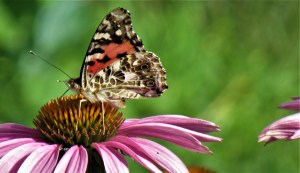
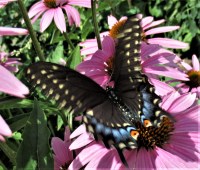
Here today and gone tomorrow. Ephemeral. Like all of us ‘poor creatures, born to die’ (as Dylan Thomas once wrote in Under Milkwood). It seems strange to look back on last summer’s photos and to remember that yes, they were here, those butterflies. Outside the window. Perching on the flowers. Showing their varied colors. Alive. Vibrant. Raising and lowering their wings.

Once upon a time, a long time ago, when I wore a grey suit and lived in a concrete, four-walled cell that they called an office, I was asked if I would edit a new journal for one of the institutions with which I was involved. ‘Sure,’ I said. ‘That would be great.’ ‘We’ll need you to submit a title and a theme,’ they said. ‘Sure,’ I said. ‘Of course I will.’

I thought about many things: titles, themes, topics, writers … Then I thought about other journals with which I had been involved in various capacities. Then I considered walking in the footsteps of the Journal of Higher Education with all of its cutting-edge articles and high-powered inspiration. I breathed a sigh of frustration, then of relief. ‘Got it,’ I said, and the Journal of Lower Expectations was born.

Alas, it was a butterfly that never spread its wings. ‘Your services will not be needed,’ came the curt reply when I submitted the title.

Think about it: a couple of years back, there were no bees in the garden: CCD (Colony Collapse Disorder). Last year, there were no birds. The feeders stood empty, and bird flu was the cry on everyone’s lips and the plague on every bird’s beak. Ephemeral. Butterflies on a rock. Australia burns and people are rescued from the beaches where they have taken refuge in the sea. Everyone, everywhere, now needs to live with lower expectations.

IMG_1058 (2).JPG

Butterflies and birds and bees: will they be back next summer? Who knows? I certainly don’t. But then, I am a true agnostic. I have no scientific background worth speaking of and neither ax no knife to grind on this topic. I genuinely do not know where we are heading. But I believe least those who protest most, especially when they bluster and bluff and try to pull the cocoon of disbelief over my eyes by shouting loudly their point of view. I have eyes. I can see, even if there are no butterflies, birds, or bees to be seen. Alas: I can still see and suffer their absence.

Please
will ye no come back again?”
Poor kangaroos, kookaburras, koalas,
wallabies and platypus ducks.

IMG_1047 (2).JPG

We will miss you so much if you any of you,
let alone all of you,
along with the butterflies, birds, and bees,
go AWOL.

Black and White

IMG_1519.JPG

Black and White

There is a moment in winter photography when the world of color turns to black and white. Color is still there, but today it travels incognito, anonymous. The world is formed by shapes, trees draping their branches, snow weighing them down, dressing them in wedding gowns for their marriage with the new year spirits that haunt sunlit, moonlit snowbanks and dance across the snow. Even the clouds exist to give a soft, quiet dramatic touch to the winter beauty that visits the garden. And yes, it will always be there, even if we are not here to see it because it will carry on without us. As for us, we are secondary, mere witnesses to winter’s beauty and the nature that surrounds us.

IMG_1554.JPG

Amateur photographers can sometimes capture this effect in a moment of luck (or occasional inspiration). Great painters have always known this art of the minimal. El Greco drew light from darkness, his portraits often finding their own fire and lighting up from within.  Caravaggio, too, knew the values of chiaro-oscuro, light and dark, black and white. Velasquez was the master of the spotlight that highlighted the eggs frying in the pan, the hand of the water-carrier. Goya, in his etchings [The Disasters of War, The Caprichos] and dark paintings, drew mood and anguish from this contrast between light and dark, black and white.

image1-1.jpeg

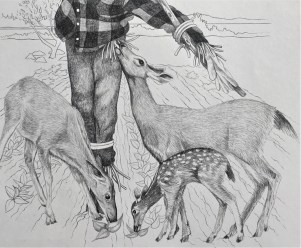
My friend Geoff Slater has caught such a moment in his sketches for Scarecrow. Above he catches the precise moment when the scarecrows, male and female, reach out to each other, and beneath a Van Gogh planetary sky, dare to dream of mobility and love. The dream world: so important to us all and especially to the creative artist who dwells in each of us. Deus est in nobis, the Latin poets used to say, it is god within us. The god of black and white who transforms the world into color and light.

image3 (10)

Black and white, light and dark, winter trees, Clare, two scarecrows, deer and crows: labors of love that reach out and catch us unawares, blowing our hearts wide open, letting in the sun and the wind and the ever present joy of seeing things, seizing them, sizing them up, in black and white.

image2 (15)