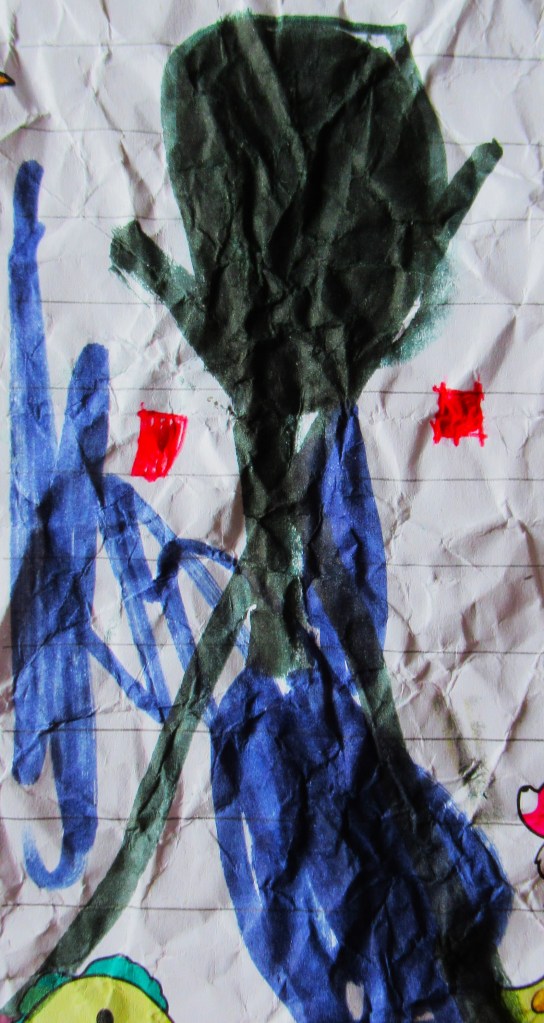
Suit of Lights


Suit of Lights

I am a man of straw
shivered by raw winds,
frosted by the cold
enveloping this enigmatic body,
dry bones set rattling.

I walk with two sticks,
a stick man then,
not just a sick man,
as broken as this broken body,
old sack of out-muscled blood.

When the magic hour
descends, earth glows
with a different light,
and my world is transformed,
translucent, bright.

A touch of the almighty,
this beauty suddenly
surrounding me,
blessing me,
and all my doubts,
with this suit of lights.

Click here for Roger’s reading on Anchor.
Suit of Lights


Clichés

Clichés

I buried myself in an ice-cube.
I dug in so deep that nobody
could find nor touch me.

“Hurt yourself,” I told myself,
“hurt yourself
so badly that nobody
will ever be able to hurt you
again.”

Clichés:
cutting off your nose
to spite your face,
shooting yourself
in the foot, arm, or leg,
self-destructing
in so many ways,
and all clichés.

And me, alone,
everything cut off,
torn down, worn away,
visible, some days,
yet untouchable,
locked away
in this frozen land
where warmth
never flows
and winter
holds sway.

Click here for Roger’s reading on Anchor.
Clichés

Quilting

Quilting

A man among many women,
I sit silent, feeling their eyes
explore my flesh, my stitches.

I need glasses now for delicate
needlework. To thread a needle
the workshop leader has a gadget.

It passes from hand to hand,
ties the perfect quilter’s knot.
My grandpa’s canvas sewing kit,

World War One Vintage, served him
before the mast and in the trenches.
From it, I take a small looped wire.

I remember when I could see and he
could not, hence his need for me
to thread the needle and knot the knot
that he could no longer knot.

Now I choose my tiny patches,
join them, stitch them into a square
and, ironed out, into the quilt.

We must sign them, and I do.
My name and little sayings
in Spanish, Latin, and Welsh.

The leader asks me to translate them
then writes the meanings down.
“Beautiful work,” she tells me.

“Where did you learn to sew?”
I close my eyes, sew my lips tight.
Some secrets I’ll never let go.

Click for Roger’s reading on Anchor.
Quilting

Comment: I wrote this after reading the section entitled Quilt in M. Travis Lane’s book A Tent, a Lantern, An Empty Bowl (Windsor: Palimpsest Press, 2019). Poems that could double as paintings, proclaims the paragraph on the back cover. I have no such talent. My own poem is more of a memoir in the form of a narrative sequence. To each his or her own, or, in the modern parlance, to all their own. And a poet must do what a poet can do, each of us adding our own little offerings to the great sea that is poetry.



Do Not Keep Count

Do Not Keep Count
On reading Keeping Count
poems by M. Travis Lane


Poems to be picked at
like a bunch of verbal grapes,
muscatel, perhaps, purpling,
seedless, their only off-spring
flowing through your mind.

Pluck one at random.
Hold its silken surface to the light.
Admire sunlight caressing
the unwrinkled skin.
Now taste it.
Savour it slowly,
tongue-held in your mouth.

Watch the world around you
changing as you see things
in so many different ways.
Everything moves into a new orbit.
Your world – born anew.

Just one?
No.
You cannot stop at one.
Taste another. Then another.
Do not keep count.

Click here for Roger’s reading on Anchor.
Do Not Keep Count

Comment: Sitting at my kitchen table, picking at Travis’s poems as I would pick at grapes, or flowers, I wrote this poem. Yesterday, Travis gifted me with her poetry book Keeping Count (Guelph, Gordon Hill Press, 2020). I hope my admiration for the poetry of M. Travis Lane – who has received less attention than she deserves (according to Maisonneuve) – shines though the words and images in this poem of mine.

Red Sky

Red Sky
After a long conversation
with my hero:
Travis Lane.


Red sky at night,
shepherd’s delight.
Red sky in the morning:
sailors take warning.


But I am not a sailor,
nor will I ever be one.
Nor a tinker, nor a tailor, nor
part of any nursery rhyme.

So easy to follow the sheep,
and graze where they may graze,
in safety, and the shepherd’s crook
all too close at hand, with both
hands and shoulder all too ready
to save, comfort, and carry
home to the security of a safe place.

Better by far to float along,
guided by sun, stars, and tide,
choosing your own route as you go,
or going with the eternal flow,
going where it takes you,
red skies at night, storm warnings
in the morning, and everywhere
the give and take of creating
new things, new paths, wherever
you may choose to go.

“Red car at night,
wifey’s delight.
Red car in the morning,
hubby take warning.”


Click here for Roger’s reading on Anchor.
Red Sky


Losing Language

Losing Language

To lose your language
is to lose your dignity and your muse.

It’s to lose the power of self-expression
and to frustrate the longing soul
that flutters like a butterfly
striving to reach for the beauty of light
yet frustrated by the weight
of its now useless wings
unable to rise.

So much the soul sees at night,
wandering in dreams among the stars.
Memories of former rooms
where the old inhabitants still dwell,
shadows among the shadows,
some still gifted with limited
powers of speech,
but others, tongue-tied and silent,
and our chatter reduced
to a net of butterfly buzz words.

Oh for the freedom of flight,
for the liberty of my language found anew
and capable still of shaping and recreating
the world of silence in which I now live.

Based on a Welsh Poem by Harri Webb
Colli iaith a cholli urddas.

Click here for Roger’s reading on Anchor.
Losing Language

Tangled Web

Tangled Web

“Oh what a tangled web we weave
when we first practice to deceive.”


But who are we deceiving, us or them,
ourselves for believing our own propaganda
or them for being deceived by what they hear?

Propaganda, properly goosed,
and the goose wrung by its neck
and strung up to dry before
we pluck it, season it, and cook it
in its own grease
for a heavy Christmas dinner
so much cheaper than a chicken
or a turkey, unless
we breed them ourselves.

Or would you rather duck?
What’s that flying over there?
I don’t know.
Here comes another one.
Flying low.
“Duck!”

Or, as the duck said at Christmas:
“Peace on earth:
but put an end to peas,
please.”

Sound of Absence

Sound of Absence

It’s a lonely walk round the animal park,
the petting zoo with its animated young,
goats, sheep, llamas, alpacas, all of them
greedy and alert, ears pricked, eyes open,
munching away, hand-fed by the visitors.

Only the wind moves the swings today.
We walk in silence, but don’t stay long.
That little body that swung the swings,
those little feet that raced from place
to place at such a bewildering pace…

they are not here. We watched them board
the plane, fly up into the sky, head west
and home, and now we, the old folk,
abandoned, hold hands, and walk alone.

Click here for Roger’s reading on Anchor.
Sound of Absence