What is good about having a pet?

Daily writing prompt
What is good about having a pet?

What is good about having a pet?

Good heavens – what a strange question. Here in New Brunswick – Nouveau Brunswick, Canada’s only bilingual province, I guess it depends on whether you are Anglophone or Francophone. Nothing like a nice, healthy ‘pet’, if you are a Francophone, though you have to be wary, very wary, of them at my advancing age. And nothing like some ‘pets de ma soeur‘ for breakfast, with a nice cafe au lait, unless you would rather ‘un bon bin de beans‘.

On the other hand, if you are Anglophone, then the term takes on a different series of meanings, doesn’t it, my pet, I ask my wife. Happily, she neither woofs, nor woofs her cookies in reply. And if this is all double-Dutch to you, don’t worry. It’s all tied up with discourse analysis and the meaning of meaning. Don’t be so mean! What do you mean by that?

I suppose we are all talking about cats and dogs, and budgerigars – not budgie smugglers – and other two and four-legged friends, along with sliding ones, like baby boa-constrictors, that can – like pythons in Florida, grow to an enormous size. Such an enormous size, in fact, that you end up being the pet when the monster rules, and your flush your once-a-baby, now a problem, alligator down the New York toilet to grow even bigger and become a danger to the men and women who patrol the subterranean sewage systems.

And don’t forget Julius Caesar, the pet parrot who told the burglar, in an Irish accent, that “Jaysuss” was watching him” as the burglar tried to burgle the house. Alas, Julius Caesar failed to warn the house-breaker that Jaysuss was in fact a huge, pet Rottweiler that was standing – we stand on guard for thee – right behind the unfortunate man. Who needs a burglar alarm and an AI system, when you have two or three pet, and not petits, Rotties patrolling the house 24/7? Mind you, I wouldn’t call them pets, those Rotten Rotties, though they may cause them in certain people, and very generous ones at that.

What was your favorite subject in school?

Daily writing prompt
What was your favorite subject in school?

What was your favorite subject in school?

I never had one. I hated every school I attended with a passion. I hardly passed an examination during my school days and I remember, in Mathematics, dropping from Level I, to Level II, to Level III. I failed the first exam in Level III and earned this comment on my school report “Now I know why he descended to Level III.” I still have those school reports, incidentally, complete with the signatures of the Masters of my – limited, very limited – universe. How I appreciated Pink Floyd’s The Wall, when I first heard it. “We don’t need no education, we don’t need no thought control, no dark sarcasm in the classroom, hey, teacher, leave those kids alone. You’re just another brick in the wall.” And yes, I built walls around me, many of them. But I survived.

Another comment from that report: “He has read widely and indiscriminately – I do hope it has done him some good.” That reading included the complete works of Jean-Paul Sartre and Albert Camus, lots of Andre Gide, the theatre of Jean Anouilh – some of which I saw live in Paris -, an immersion in the Existentialist philosophical movement, the complete plays of Corneille, Moliere, Racine, Beaumarchais, a variety of French Poets, including Apollinaire and Jacques Prevert, a selection of Spanish poets, novelists, and playwrights, and a series of modern-(ish) British poets, including John Manley Hopkins, Wilfred Owen, Dylan Thomas, Vernon Watkins, and ‘indiscriminate others’! I wrote a great deal of poetry at that time, some of it in imitation of Francois Villon and Gilbert Chesterton (of whom I read many works as well).

Alas, my enthusiasm was not appreciated, especially as I scorned many of the texts that I was forced to read for my examinations. I should add I also scorned the limited, authoritarian interpretations of them that were forced upon us. The slavish imitation of ‘teacher’s remarks’ gained an A+. Any attempt to think outside the authoritarian boxes built oh so carefully for us, earned an F-.

But, if I had to choose one subject, it would be Myself. Protecting that self, developing that sense of self, growing into myself, understanding myself, and finally, having left those schools, those ideas, and that country far, far behind me, becoming the self that I am – and have always wanted to be. “What do you want to be when you grow up?” “I just want to be me.” And I am, thank heavens. And it’s a good job too, for, as Oscar Wilde once said “Everyone else is taken.”

Bronze Ribbon

Bronze Ribbon

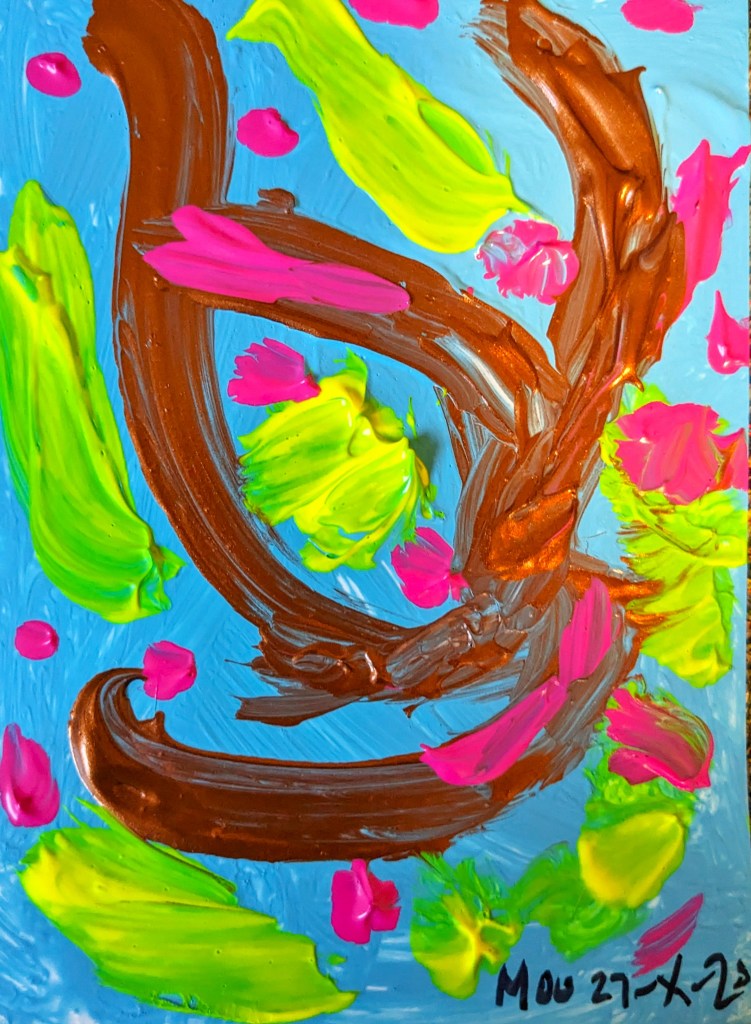
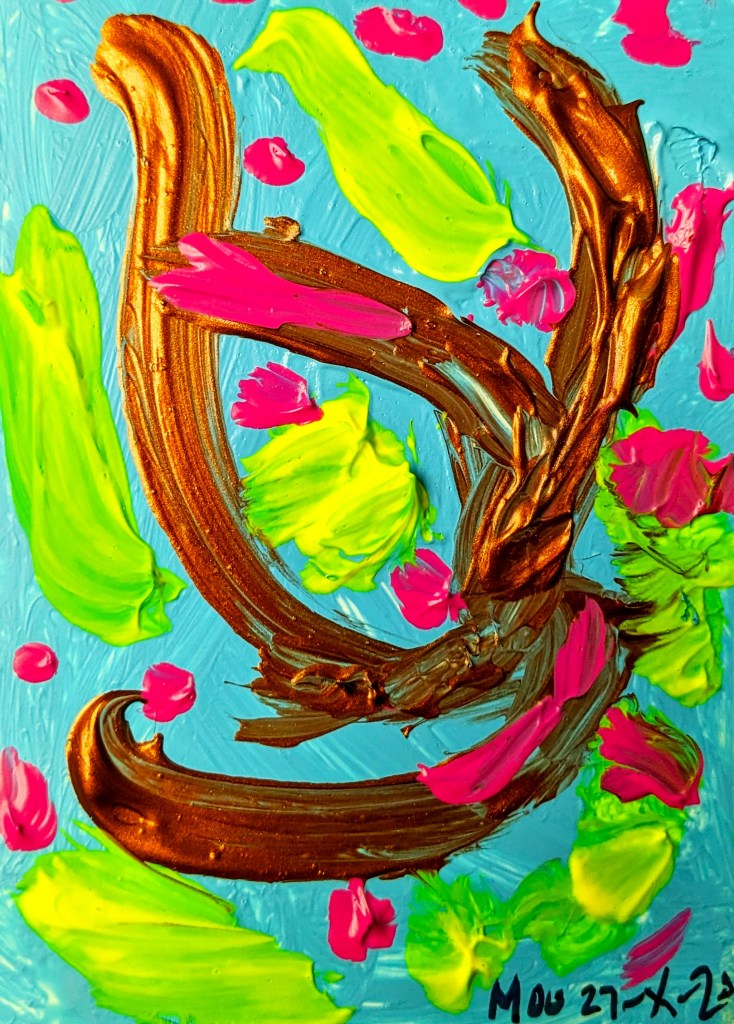
And time has ticked a ribbon round the stars.” Dylan Thomas, sort of, but a perfect title for this painting that I completed this morning. The acrylic paint is still wet! I brought it downstairs, looked at it in the light from the kitchen window, and the colors had all changed. I angled the painting, then re-angled – it was a chameleon changing color in the shifting light. Then I turned the large ceiling lights on – and this is what I saw.

Exactly the same painting – or is it? When I was studying in Madrid, a long time ago, I visited the Prado every afternoon. Each day I would visit a different room and stay there for the duration of my visit. The tourists who flitted in and out amazed me with the brevity of their visits. A minute or two to see all the paintings by Hieronymous Bosch, for example. I sat in front of just one of them for half an hour – and I could have stayed longer.

When I visited Las Meninas, it stood in a room by itself. It had a full size mirror opposite it, on the far wall. I should add that this was long before it was cleaned and renovated. I looked at it from every possible angle. I drew close and squinted at the lace and wondered at the quality of the brush-strokes. I lay on the ground in front of it. Stood at the side. Watched it change as I changed my position. I discovered art as a living being, not a static moment in time. Imagine me, for a moment, kneeling on the ground, watching the young prince’s horse soar over the top of me, as it would have done, if it had occupied its original spot, angled above a doorway. Change the angle, change the perspective, change the painting, and watch it come alive.

I will never forget my days with Goya. His Disasters of War – wow – such an incredible sequence – took up several afternoons. And the Pinturas Negras – the Black Paintings – they still haunt me, as do the Disasters. Man’s inhumanity to man – not a dead set of etchings but living portraits of an evil that goes on and on. “This I have seen!” “And this!” Indescribable scenes. Words cannot do justice to the depth’s of the feelings generated by such works of art. When will we ever learn? I taught a great variety of students for most of my life and I know all too well that some lessons can never be learned. Like an endless loop on a news tape, people are doomed to repeat them, again and again, and again.

As the BBC Lion said as he finished his supper – “That is the end of the gnus.”
TWTWTW.

What major historical events do you remember?

Daily writing prompt
What major historical events do you remember?

What major historical events do you remember?

Interesting question, but very problematic. How do I define a “historical event”? What exactly do I mean when I say “I remember”? Max Boyce had a lovely song in which the chorus was “I wuz there.” If everybody who says they saw Llanelli defeat New Zealand in 1973 at Stradey Park had been there, there would have been 300,000 people pressed into a ground that held about 15,000. But, as Max Boyce sings, “I wuz there”. Well, in spirit, anyway, and I have seen the film several times. I also remember watching Jim Laker’s 19 wickets in the 1956 cricket Ashes. I watched that match on B&W TV. Does that count as an historical event that I remember?

How about the Battle of Hastings, 1066? In 1966, I ran in a road relay that led from Bristol to Stamford Bridge, where Harold defeated Harald Hadrada, down the main highway to The Trip to Jerusalem, where we stopped for a pint, down to Hastings, where we re-enacted the battle that saw William the Conqueror take the throne. Several of the runners wore Saxon uniforms, a couple even had long, blonde hair. We re-enacted two battles. Does that mean I remember that historical event?

Let us talk about Stonehenge. I first went there when there were no railings, no fences, and when sheep and cows could safely graze. I remember it well. And I remember creatively re-constructing, with my grandfather, the digging of the post-holes, the raising of the stones, the transportation of them, by ship and log rollers, from the Prescelli Mountains in Wales to their current resting place. As Max Boyce says, in my own mind, I was there. I was there too at the destruction of Maiden Castle. The first book I ever bought, age about six, was Sir Mortimer Wheeler’s autobiography, Still Digging. I can still feel that Roman ballista arrow going through the victim’s backbone. Does that count as a memory, as a presence, as a moment of reality?

The Conquest of Granada, the Expulsion of the Jews from Spain, the later expulsion of the Moors, the Adventures of Don Quixote, the mixing of truth and reality, the questioning of authority, the inquiry into the meaning of meaning, my mother’s sister phoning me after 9-11. “What’s all the fuss about, Roger? There were only three planes. We had them every night, over here, during the London Blitz, for two long years.” What impresses itself upon the human consciousness. How do we remember things and why? The Spanish Armada -there were actually three of them -, the Peninsular wars in Spain, the battles of Trafalgar, Vimeiro, Salamanca… Then we can move on to Vimy Ridge, Ypres – Wipers, as my grandfather called it, his days in the trenches, recounted to me, in the kitchen, day after day, in vivid, lived language that still remains with me. And he would sing – “If you want the whole battalion, I know where they are, they’re hanging on the old barbed wire.” Yes, I was there with my grandfather. I remember it well. The Battle of the Atlantic, the Hunt for the Bismarck, the Battle of Britain – I sat in the cockpit of a Spitfire, a long time ago, during the Battle of Britain celebrations, and I climbed into and walked around the interior of a Lancaster.

Memory and the reconstruction of historic events, some we actually lived, and some we just dreamed of, and some we saw at the movies. What is memory – an actual happening or a creative reconstruct? What is the meaning of meaning? And read Bertrand Russell’s book on the subject before you answer that one. As for me, I was there, standing beside Max Boyce, witnessing the game, though, as he says, “a hundred thousand in the ground, and me and Roj outside.”

The Dying of the Light

Rage, rage against the dying of the light.

The world has become such a dark place over the last three weeks or so. At times, I have despaired, lost hope, lost my faith, lost my creativity. Words have not come knocking on at my door. The eyes in my head have seen nothing to paint. Darkness, bleakness everywhere. And yet, light breaks where no light shines, as Dylan Thomas once wrote, and last night I started a painting. This morning I finished it and gave it a title: Rage, rage against the dying of the light.

Yesterday I managed to complete a couple of poems. I attribute this new found creativity to moving my muse out of my office and placing it in my bedroom where it can inspire me at night. It seems to have worked. My muse is a small carving placed between four pyramids. Pyramid power and the muse’s inspiration have brought light back into my world, the light of creativity.

We must band together, we creatives. We must inspire ourselves and then go on to inspire others. We must let the light of our creativity, our faith, our belief spill out into the darkness that surrounds us. Together we must stand united and our light will be a lantern that will enlighten the world, not with chants, slogans, and cults, but with the inner faith and the total belief that genuine creativity brings to the world.

Creatives of the world, unite. Rage, rage against the dying of the light. United together, we can, and will, restore that light.

When you think of the word “successful,” who’s the first person that comes to mind and why?

Daily writing prompt
When you think of the word “successful,” who’s the first person that comes to mind and why?

When you think of the word “successful,” who’s the first person that comes to mind and why?

What exactly does “successful” mean? I googled it and here are some of the answers – successful – well that’s a good answer. Successful means successful. It reminds me of my geography master in school – “The earth is geoidal, i.e., earth-shaped.” The earth is earth- shaped – I guess that leads to a successful education. Slightly better alternative meanings are – effective and productive. Taken literally, both have their problems, of course. The spud-bashers of WWI, sitting, peeling their potatoes at the cookhouse door, they were productive, but were they successful? Did they even survive the war? Do any names spring to mind? I am not so sure about that. But how about efficacious, another proffered meaning? Well, that certainly turns me on.

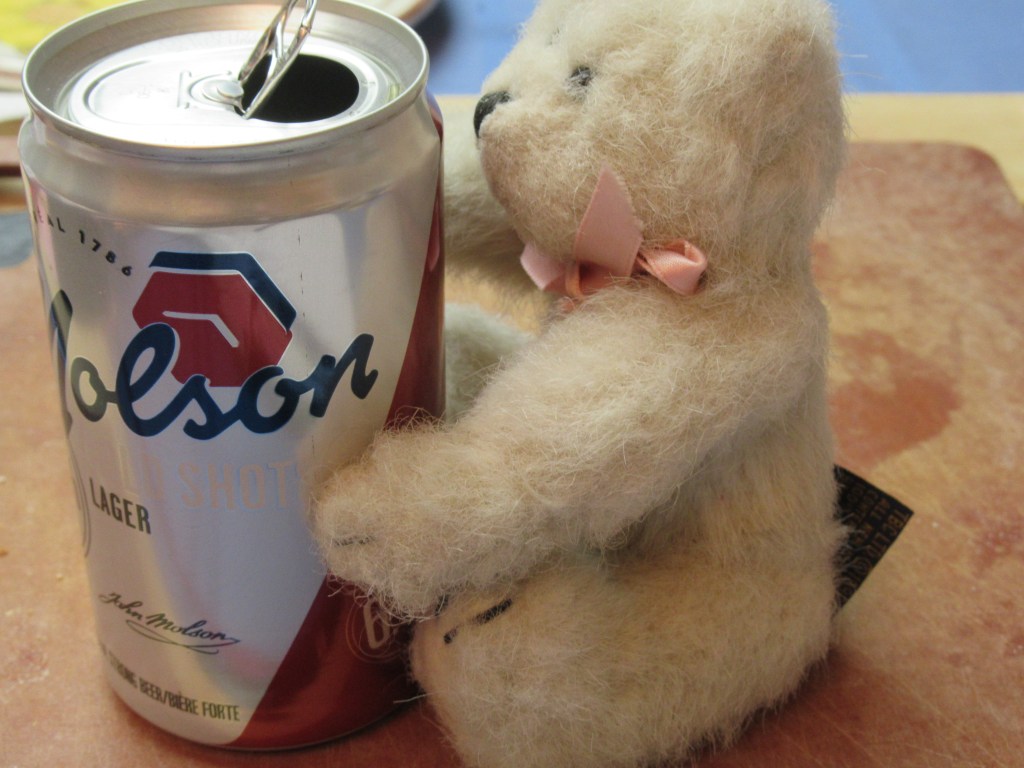
Basil, the Teddy Bear in the photo above, is embracing a can of Molson’s Lager. I didn’t know Teddy Bears liked lager until I saw him doing this. Caught in the act, all sticky-pawed. I asked him what he was doing and he replied that he was taking his medicinal compounds. When I asked him why, he started singing “most efficacious in every case.” “Who do you associate that with?” I asked. He started whistling the tune of Lily the Pink. “And was she successful?” I asked. “Of course she was,” Basil replied. “She’s the Savior of the the Human Race.” Wow!

So, I hereby nominate Lily the Pink, the Savior of the Human Race as both successful and nameable. And remember – “when Lily died, she went up to heaven. You could hear the church bells ring. She took with her, her medicinal compounds, hark the herald angels sing.” Now that’s a true life success story. And what an ending!

What was the hardest personal goal you’ve set for yourself?

Daily writing prompt
What was the hardest personal goal you’ve set for yourself?

What was the hardest personal goal you’ve set for yourself?

Oscar Wilde once wrote – “Be yourself. Everyone else is taken.” The Ancient Greeks had a similar phrase – “Know thyself.” Well, to know myself, and then to be myself, are two of the hardest personal goals I have ever undertaken.

Why? Because I was educated in a system that wanted young people, boys and girls, to look alike, and think alike, and dress alike. That’s why school uniforms were designed. That’s why we marched into chapel at the same time every day, and sang the same hymns every day, and said the same prayers every day. Rote learning was a key element in this. I remember, age four, chorusing my two times table: “1 x 2 is 2. 2 x 2 is 4. 3 x 2 is 6. 4 x 2 is 8.” Very little room for thinking. Nobody would ever answer the question “Why is 2 x 2 4?” “What makes this so important?” “Why do we have to learn it?” The stock answer: “Little boys should be seen and not heard.” Or “Shut up and just do it.” Or “Why can’t you be like other children?”

This type of early school life, with anyone who stepped out of line, getting punished, often physically, was not conducive to lateral thinking or freedom of thought. Anyone who moved aside from the prescribed patterns was moved back into them, very quickly. The WWII convoy theory – the class moves at the speed of the slowest ship. No stragglers permitted. This later morphed into the slogan “No child left behind.”

But they were. And they were left outside, looking in. And if they didn’t buckle down, they suffered the shame of expulsion from the herd or the flock or the convoy. And once expelled, and branded as stupid or a trouble-maker, it was very difficult to get back in.

At what stage did I become myself? I am not really sure. First there was the phase of knowing I didn’t belong. Then there was the phase of realizing that my mind didn’t react like the minds of other people. Why not? Well, for one reason, on IQ tests, even the simple ones, I often saw multiple answers. But there was only ever one correct answer. Say what the Inquisitor wanted to hear and it was “Good dog, have a biscuit”. Give an answer other than the one he (or she) was looking for, and it was “Bad dog.” Then your nose was rubbed in the dirt.

Here’s a simple example from this year’s Farmer’s Almanac. Which is the odd one out? Tennis, pickle ball, badminton, squash… ” Oh dear, I think there were five, but I have forgotten the fifth. The correct answer – pickle ball, – it’s the only one played with a paddle not a racquet. GOOD DOG. How about badminton – it’s the only one played with a shuttlecock. BAD DOG. Or squash – its the only one played without a net between the players. BAD DOG. The Farmer’s Almanac was fun, but being judged sub-standard at age 11, and again at age 15, for coming up with creative, and perfectly logical alternative answers, was not much fun.

So – the most difficult personal goals – 1. to know yourself. 2. to grow into yourself. 3. to appreciate the wonderful, unique nature of who and what you truly are. 4. to then rejoice in the creativity of your own individuality.

What’s something you would attempt if you were guaranteed not to fail.

Daily writing prompt
What’s something you would attempt if you were guaranteed not to fail.

What’s something you would attempt if you were guaranteed not to fail.

Well, I remember when Arthur Lydiard was coaching Peter Snell, this was back in the early sixties. He ‘allegedly’ said – and I write from a decaying memory – that anyone could be trained to run a mile in under four minutes, using his methods. Next day, it is rumored that a fifty year old man, overweight, smoking a cigar, turned up at training and asked Lydiard to fulfill his promise.

Well, maybe it was Percy Cerruti training Herb Elliott. Same time frame. Different memories. Great coaches and great athletes. So here am I, at eighty (well, nearly), and I have always wanted to run a mile in under four minutes. My fastest time was 4:07 – downhill, with a following wind, during the Bristol University Rag Run (1966 – Bristol – Stamford Bridge – Hastings – Bristol). So, I am guaranteed not to fail, eh? I also hope you will guarantee that I do not fall, eh? And can I use both my canes, or only one, eh?

Okay, so this is how we’ll do it. You load me on the back of a flat bed truck. It has one of those walkways on it, with handrails on both sides, like they use in the rehabilitation centers. I won’t need my canes then. The truck drives a measured mile, in 3 minutes and 59 seconds exactly, and I “run aka speed walk aka speed lurch” all the way, hanging on to the handrails, thus covering a measured mile, in under four minutes, and achieving a life-time goal, attempting which I am guaranteed not to fail.

What was that line from Man of La Mancha aka DQ (and I don’t mean Dairy Queen) – “to dream the impossible dream.” And now, tired from my exertions, I will take a brief siesta and see if, in my impossible dreams, I can bring that time down a little bit lower. New world record, anyone?

What would you do if you lost all your possessions?

Daily writing prompt
What would you do if you lost all your possessions?

What would you do if you lost all your possessions?

When I look at the growing number of refugees across the world, I wonder what would happen if such a disaster fell upon me. Then I look at the forest fires, out in Western Canada, in BC and Alberta, and wonder what we would do, what we would we pack, how would we manage, if the order to evacuate our home came suddenly upon us. When the Bocabec fires burned in New Brunswick, I felt the stress and distress of several of our close friends who were forced to evacuate. Then I thought that, really, it’s not a question of if, but of when. And this was my dream.

            … with my angel … face to face … the one I have carried within me since the day I was born … the black-one … winged like a crow … the one that hovers over me as I lie asleep … the one who wraps me in his feathered wings when I am alone and chilled by the world around me … the one who flaps with me on his back when I can walk no further and who creates the single set of footprints that plod their path through the badlands when I can walk no more …
            … ‘the truth’ my black angel says to me … I say ‘he’ but he is a powerful spirit, not sexed in any way I know it … and yet I think of him as ‘he’ …awesome in the tiny reflection he sometimes allows me to glimpse of his power and glory … for, like Rilke, I could not bear meeting his whole angelic being face to face … as I cannot bear the sun, not by day, and not in eclipse … not even with smoked glass … when earthly values turn upside down and earth takes on a new reality … wild birds and bank swallows roosting at three in the afternoon … and that fierce heat draining from the summer sky … I remember it well … and the dog whimpering as a portion of the angel’s wing erased the sun until an umber midnight ruled … a simple phenomenon, the papers said … the moon coming between the earth and the sun …but magic … pure magic … to we who stood on the shore at Skinner’s Pond and sensed the majesty of the universe … more powerful than anything we could imagine … and the dog … taking no comfort from its human gods … whimpering at our feet …
            … I saw a single feather floating down and knew my angel had placed himself between me and all that glory … to protect me … to save me from myself … and I saw that snowflake of an angel feather bleached from black to white by some small trick of the sunlight … and knowledge filled me … and for a moment I felt the glory … the magnificence … and there are no words for that slow filling up with want and desire as light filters from the sky and the body fills with darkness … and I was so afraid … afraid of myself … of where I had been … of where I was … of what I might return to … of my lost shadow … snipped from my heels …
            … I don’t know how I heard my angel’s words … ‘the time of truth is upon you’ … ‘all you have ever been is behind you now’ … ‘naked you stand here on this shore … like the grains of sand on this beach … your days are numbered by the only one who counts’ … I heard the sound of roosting wings … but I heard and saw nothing more … I felt only midnight’s cold when the chill enters the body and the soul is sore afraid …
            … ‘it is the law’ my angel said … I saw a second feather fall … ‘and the law says man must fail … his spirit must leave its mortal shell and fly back to the light’ … ‘blood will cease to flow … the heart will no longer beat … the spirit must accept and go’ … ‘do not assume… nobody knows what lies in wait’ … ‘blind acceptance … the only way … now …  in this twilight hour …  now when you are blind … only the blind shall receive the gift of sight’ … ‘all you have … your wife … your house … your car … your child … everything you think of as yours I own … and on that day … I will claim it from you and take it for my own … now I can say no more’ …
            … the sea-wind rose with a sigh and one by one night’s shadows fled … the moon’s brief circle sped from the sun … light returned, a drop at a time, sunshine flowing from a heavenly clepsydra filled with light …
            … birds ceased to circle … a stray dog saw a sea-gull and chased it back to sea … and the sun … source of all goodness … was once again a golden coin floating in the sky …
            … on my shoulder a feather perched … a whisper of warmth wrapped its protective cloak around my shoulders … for a moment, just a moment, I knew I was the apple of my angel’s eye … and I hoped and still hope that one day I might meet him again and understand …

How often do you walk or run?

Daily writing prompt
How often do you walk or run?

How often do you walk or run?

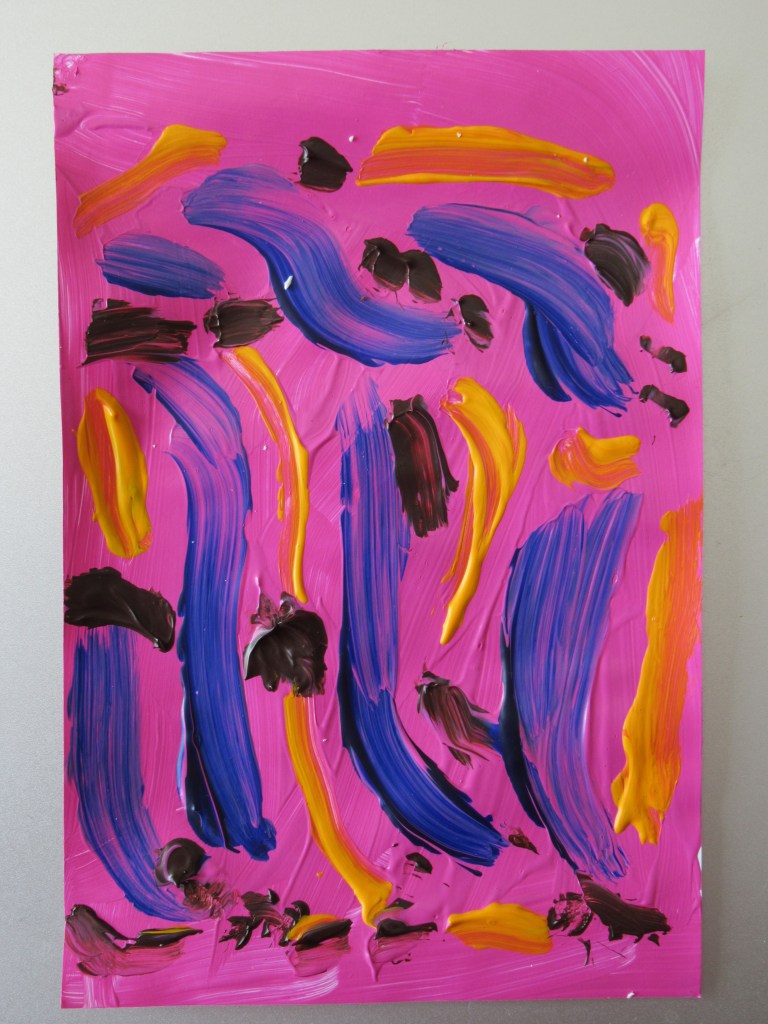
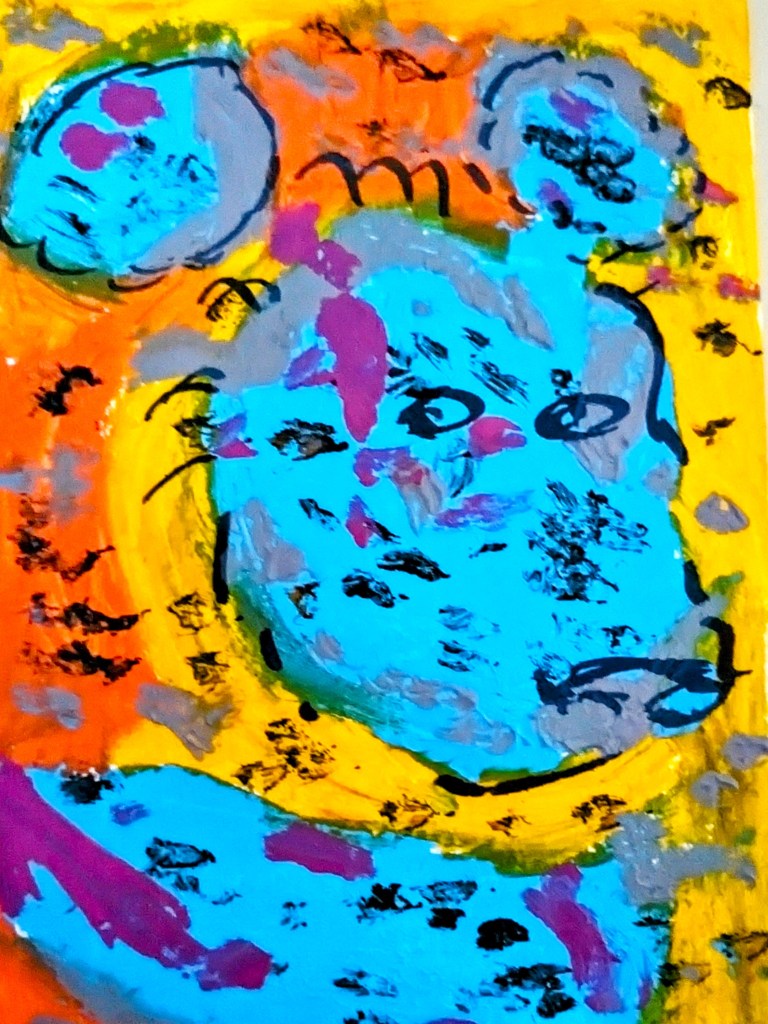
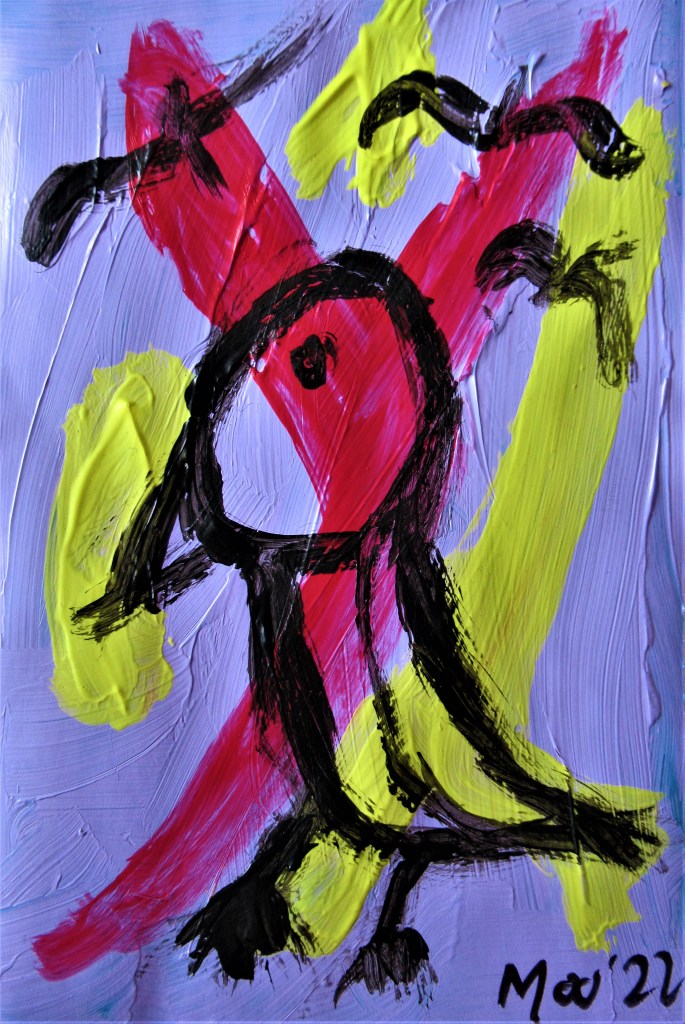
The painting above tells the whole story (thank you, Moo). On the left, the deer head (or is it a sheep’s head? Moo didn’t tell me) represents my hip and knee joints. On the right, the wolf’s head (or is it a bear’s head, look at those teeth) represents the osteo-arthritis that is sinking its own teeth into me and removing much of my movement. So, how often do I walk or run?

Walking, every day. I use two sticks in the outside world, or one stick and the furniture at home. The sticks are fun. I use them like chop-sticks to pick up fallen objects. And I have discovered that if I drop one of the sticks, I can stand on its rubber tip and raise the handle enough either to grasp it, or to secure it with the other stick. Wow!

Some days it is a positive circus act. Yesterday, the very thoughtful grocery store had placed the 1% milk on the top shelf, where I couldn’t reach it. I held on to my trusty shopping cart with one hand, reversed my stick and, with the handle, pulled a carton of milk to the edge of the shelf. I let go of the cart, flicked the stick, and sent the milk carton tumbling into my other hand. It took some concentration and I was surprised by the applause that came from several watchers, none of whom offered to help me. I do the same with out of reach beer cans, too. Bags of sugar on the lower shelf are much more difficult. my chopsticks aren’t designed to pick up a 3lb bulky bag of sugar.

As for running, well, my nose runs, my eyes water and run, my tummy rumbles and runs, and I move at a slowly increasing four-legged plod to the bath room, hoping against hope to get there in time. I usually do. My premonitions have become very accurate over the last few months. However, do nose, eyes, and tummy runs count? If not, well then, running rarely happens nowadays.

With the walking, though, in spite of everything, I aim for 2000 steps a day. I usually make it to 3,000, especially when I go shopping, and occasionally make it to 4,000. And that, ladies and gentlemen, is the best I can do.