What makes a teacher great?

Daily writing prompt
What makes a teacher great?

What makes a teacher great?

When Moo descended from Mount Academia, he brought down with him the ten tenets to which great teachers, knowingly or unknowingly, commit. He asked me to transcribe them here, since they were in danger of being neglected and / or forgotten.

  1. Mastery of the subject – great teachers know their subjects inside out. They do not read their graduate school notes to their students, heads bowed, chins on chest, droning on in a low, boring mumble. They encourage questions and are open to debate with their students about the subject that they know so well and openly love.

    Master thy subject.

  2. Humility – great teachers are humble. They know that they are not omniscient. They also know that knowledge changes across time and that they too must change and follow new ideas. They also know, perhaps instinctively, that some of their students are as intelligent as they are. They never dismiss their young charges as idiots, fools, or lunatics to be beaten and forced into the required shape.

    Be humble.

  3. Flexibility – great teachers are flexible, not rigid. They can bend the rules, reshape the syllabus, change pace and tone to match the needs of their students. In addition, they ask their students about their needs and try to address those needs in a personal way, sometimes on a one on one basis.

    Be flexible.

  4. Reaching out – great teachers reach out to their students as a group and as individuals. They never paint themselves into the know-all corner where they alone know best, and they know, with absolute certainty, what’s best for their students. Great teachers know, above all, that one size, in great teaching, neither fits nor benefits all.

    Reach out.

  5. Equal treatment – great teachers treat their students equally. They do not fawn on the best and scorn the worst, nor do they teach by the WWII convoy system, teaching only at the speed of the slowest. By extension, great teachers try to create an atmosphere of love in learning and joy in the subject.

    Practice equality.

  6. Honesty – great teachers are honest, fiercely honest. They know their own strengths and weaknesses, their own limitations. They work on their weaknesses, striving to turn them into strengths. They also push the boundaries of their limitations, striving always to keep up with the ever-changing frontiers of knowledge.

    Be honest.

  7. Human beings – great teachers know that they are human beings and they recognize early on in their careers, that while they are teaching a subject, they are also preparing fellow humans for a life beyond the ivy-covered walls of academia. By extension, they emphasize the humanity of their students and try always to develop and sustain that humanity.

    Be human.

  8. The meaning of meaning – great teachers reach out beyond their subjects to teach the meaning of meaning. Why is the subject important? What can each individual use this hard-earned knowledge for, in their own lives? How can they reshape their own lives and create better ways of learning and living? This teams up with reaching out and enters the realm of learning for learning’s sake and love of learning and love of knowledge.

    Love thy learning.

  9. Creativity – great teachers are creative. They open their students’ minds to new ideas, fresh knowledge, better ways of doing things. They never use phrases like ‘thinking outside the box’ and they do not build better boxes, one or two sizes larger than current boxes, inside which their students must now sit, work, and think. Creative teachers tear down the walls of medieval academia and open their students’ minds to the winds of change and fresh knowledge.

    Be creative.

  10. Life long learning – great teachers teach students how to think for themselves, how to teach themselves, how to self-assess, how to check and double-check the knowledge (all too often nowadays, fake news and / or false knowledge) handed down to them from a multitude of sources, far too many of them unreliable. Great teachers teach their students to know themselves. They also teach them how to work out whether a source is a reliable fount of information, or not. In short, they teach life long learning and neither they, nor their students, ever give up hope.


    Teach Life Long Learning.

What’s the most delicious thing you’ve ever eaten?

Daily writing prompt
What’s the most delicious thing you’ve ever eaten?

What’s the most delicious thing you’ve ever eaten?

No single item of food stands out. That said, eating is a cultural thing – does one eat on one’s own, or does one eat with family and friends? What role does food play in one’s life? For me, for example, food is cultural, an occasion, not a meal. For example, a fresh, Spanish croissant, for breakfast, a late breakfast, at the bar in the Rincon, Avila. Before me, the daily newspaper, open at the page with the daily chess problem. The coffee, freshly brewed, a cafe con leche, and the croissant, waiting to be dipped in the coffee, and the resulting delight transported to my mouth. Sometimes, there are no croissants left. Then, one of the world’s best kept secrets, un sobao pasiego, a small sponge cake, from the Vega de Pas in Cantabria. It holds together when dunked and can be eaten moist or dry.

By extension, when younger, after an afternoon’s soccer on the beach – la Segunda Playa del Sardinero, in Santander – cool red wine from a porron, and selected seafood in the form of tapas, nibbled with the other players, as thirst is quenched, and the appetite that comes from running on warm sand under a hot, summer sun, is slowly sated. Seafood – this includes octopus – pulpo a la gallega – or squid – calamares rellenos en su tinta – or caracoles de mar – sea-snails – or oysters, fresh, with a squeeze of lemon – or mejillones en salsa de tomate – mussels in tomato sauce – gambas a la plancha, roasted shrimp – or gambas al ajillo, pan fried shrimp in garlic – or almejas a la marinera, clams, Spanish style – the point is to ganarse el puchero / to earn your food, by dint of hard work, and to share it with your friends.

When I think of Welsh food, once again, it is the family gatherings and the love around the table that dominates. Under these circumstances, a simple boiled egg – not everyone can boil an egg properly – with hot toast and fresh salt butter, can be an overwhelmingly delicious meal. Eggs – so supple, so creative – scrambled eggs, creamy and lightly curded – an omelette aux fines herbes, with a lightly tossed green salad – a tortilla espanola, easy to prepare, but incredibly difficult to prepare to perfection. Free range eggs, fresh from the hen house, sea salt prepared locally, olive oil from a local terroir, potatoes, also local, onions from the garden. Each of these contains within it the taste of the same earth, the same air, the same rain.

Speaking of which, to travel to the high hills in the Province of Avila, and to smell the herbs that grow in the sheep pastures, thyme, rosemary, and to know that the flesh of the spring lamb will be flavoured by the herbs it has been eating – even the lechazo, a lamb still on its mother ‘s milk, tender, so tender, and so small that it broke my heart to see it. A lamb so small that I couldn’t eat it. I watched it appear on the family table and vanish in a couple of mouthfuls, washed down by a specially selected wine. I enjoyed the company and the rest of the meal. But I’ll never forget that tiny lamb.

However, it’s never just about food – it is about the cultural content of the room, the family, the table, the friends, the joy of sharing and caring. Oh dear, and I never got around to telling you about the paella I made, the ones that appears in the lead photo!

If you were forced to wear one outfit over and over again, what would it be?

Daily writing prompt
If you were forced to wear one outfit over and over again, what would it be?

If you were forced to wear one outfit over and over again, what would it be?

Oh dear – such a difficult question. I have seen so many people puzzling over which dress they would choose, which blouse matched the skirt, which tie best highlighted the shirt, what color hanky, suitably folded, best suited the little breast pocket of the suit. Why do we have to have outfits? Couldn’t we have infits.

Now that’s a great idea. The one infit that I wear, every day, regardless, is my birthday suit. I have worn it, day in, day out for 80 years and it still (in)-fits me and, quite honestly, I have never spent a day without out it. Of course, it has worn a bit over the years. And no, I will not show you any photos.

However, I can say that the six pack that I once sported has become a rubber tire. There are bruises and scars where once the skin was white and tight, or bronzed and shining bright. Muscles have shrunk. Back has bent. Arthritis kicks in, now and again, but my birthday suit adapts to everything. It really was a wonderful invention.

And, guess what! Every day is my birthday now and today I am 29,370 days old. Not everyone can say that. And yes, I can also tell you, in all confidence, that I wear my birthday suit every day now in celebration of each passing birthday.

In Spain everybody has two birthdays – the day they were born and their saint’s day. The saint’s day is the day on which the saint after whom they are named is celebrated. Two birthdays is lovely – but to have 365 birthdays a year, to wear my birthday suit for every one of them, is spectacular. And it’s even better to have 366 birthdays in a leap year.

I know you know that a leopard cannot change its spots, but did you know that a leopard had 365 spots on his coat – one for every day of the year? Now that’s a fact that not everybody is aware of. What about a leap year, you ask. Well, on the 29th of February, every four years, to find that extra spot, you just have to lift the leopard’s tail. And don’t ask me how I know, because I am not going to tell you.

Which food, when you eat it, instantly transports you to childhood?

Daily writing prompt
Which food, when you eat it, instantly transports you to childhood?

Which food, when you eat it, instantly transports you to childhood?

That’s an easy one – diolch yn fawr / thank you very much – and the answer is Bara Lawr / laverbread of course.

What does laverbread taste like? I must thank Wikipedia for the answer below.

Welsh Laverbread (PDO) | Business Wales - Food and drink

Welsh Laverbread is made from cooked laver (seaweed) which has been plucked by hand from the Welsh coastline. It has a unique texture and salty flavour which provides a taste of the fresh, Welsh sea. Laver or Laver porphyra umbilicalis is the only seaweed which is only one cell thick.

And click on the link for a video from YouTube on the Traditional Welsh breakfast.

Laverbread could be found all around the Gower Peninsula in my childhood. When I was very young, you could buy it at Swansea Market for three pence a pound. Later, the price went up to sixpence a pound. When I lived in Cardiff, back in the early sixties, it sold at a pound per pound. Later, as the coast around Wales became more and more polluted, the sea weed had to be imported from the West of Ireland, and that certainly drove the price up – five pound a pound in the eighties.

But laverbread has two histories – the scientific / culinary one, and the personal one. Laverbread, on the plate, looks suspiciously like a cowpat. So much so, that when the cows visited the bungalow field where we had our summer home, the cowpats were called laverbread. “Don’t step in the laverbread, dear.”

Field rolling was a childhood joy. Start at the top of the slope and roll all the way down to the bottom. Born and bred in a laverbread field, we would plot our route between the patties before we rolled. Alas, our London cousins, with their cockney accents, were city and street wise, but not laver bread wise. Down the field they rolled, without looking, right through the laverbread patches. I leave the ensuing scene to you imaginations – and remember that the bungalow had no electricity in those early days, and no running water.

I remember the first day my beloved came to visit us at home. My mother served her fresh hot laverbread. Of course, she had never seen anything like it, except genuine Somerset cowpats. She picked around her food, left the laverbread on her plate until it cooled and – “Hold on a moment,” said my mother, “your laverbread’s cold. Here – I’ll warm it up for you.” Poor Clare. I am ashamed to say, I ate her helping while my mother was looking elsewhere – just devoured the extra portion, enjoying every moment, and Clare was so happy to see it disappear.

Here, in New Brunswick, while Clare was away one weekend, Becky and I decided to make laverbread from dulse. We followed the recipes and they worked. The laverbread was delicious – but – ah yes, there’s always a but – but the house stank of the sea shore at low tide and the first thing Clare said when she got home was – “What is that awful smell?”

I remember, opening a closet to get a clean shirt, about six weeks later, and that familiar whiff of the seashore immediately assaulted my nostrils. Alas, Becky and I love our laverbread, but -there’s that word again – but making it in our house long been banned.

How do you waste the most time every day?

Daily writing prompt
How do you waste the most time every day?

How do you waste the most time every day?

Answering stupid questions like these – now that would be a great response. But there are other ways to waste time – like mousing around on the computer – some call it surfing, which sounds like fun – but acting like a mouse that’s chasing its own tail / tale, well, that is most surely a waste of time. Playing verbal cat and mouse games is a good way to go too.

Most devilish of all, sitting in a car, beside a lollipop person, who has just stepped out and stopped you from joining the car, ten yards ahead of you, that is now the last car in the latest convoy to be held up, while you are now the first car waiting to go next time. You sit, and sit, and wait.

Then – INSPIRATION – I turn my disc player on and lo and behold – Pete Seeger sings The Abraham Lincoln Brigade, from the Spanish Civil War. What’s special about that, you ask? Well, how about the chorus? – “No pasara’n! No pasara’n!” / “They shall not pass! They shall not pass!” sang the Abe Lincoln Brigade as the battle for Madrid thundered on. I open the car window, turn up the volume, bellowing it out loud while waiting to count the cars coming from the opposite direction.

It was a very long wait. And then the first of 109 cars, trucks, and various other vehicles appeared. Bored now with The Abraham Lincoln Brigade, I changed quickly to Viva la Quinta Brigada, kept the volume up high and “No Pasara’n! The pledge that made them fight” rang out as the official truck with its magic sign “Follow me!” crept up in front of me, turned, and started to crawl, snail mail style, down almost two kilometres of highway at 10 KPH.

When we got to the end of the road works, he turned into someone’s driveway, and I, and the next two cars behind me, followed him. I learned a few choice words to add to my vocabulary – “Like WTF do you think you are doing?” “It says follow me! on your truck.” I replied. ” I just did.” And off he went again on a long, four letter rant. Then, on foot, he stood in front of the convoy that had stalled anyway, now having nobody to follow, and guided his three black sheep out onto the road that led to freedom.

Well, that was an adventure and an absolutely total waste of time. As the court case will be, when I appear before the magistrate next week. Believe you me, if you believe all this, you would believe anything. And, congratulations, you have just successfully wasted another five minutes of your precious time and I have wasted ten of mine writing this piece.

Who do you spend the most time with?

Daily writing prompt
Who do you spend the most time with?

Who do you spend the most time with?

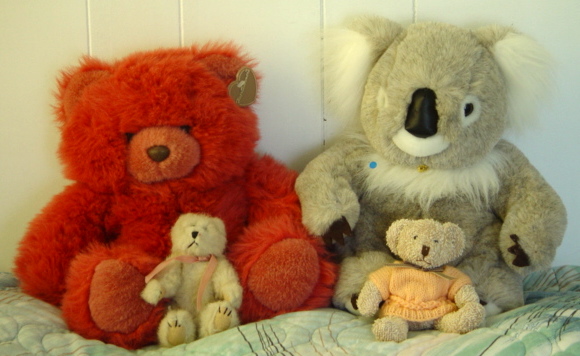
My Teddies. I know, I know. Most of you will say “A Teddy Bear is not a real person. You can say what, but you can’t say who.” And most of you would be wrong. Teddy Bears are trained confessors – they listen to everything you tell them – in silence – and they never condemn you. They are a great comfort too, and are just as good and effective as a comfort dog. Also, they are very, very obedient. Tell your Teddy Bear to sit and wait, and s/he does, very patiently.

I sleep in the same room as my teddies. And since I am in that room for 8-10 hours almost every night, that doesn’t leave much time for spending with other people. Besides which, while Rose and Teddy, the big ones, Mother and Father Bear, so to speak, usually stay in the bedroom, while Basil Bear, the small pocket bear with the pink ribbon, often travels with me, in my pocket, and usually sits on the table with me at meal times and when I read and write.

And remember – Teddy Bears don’t eat your porridge, so you never have to look at your Teddy Bear and say “Who’s been eating My porridge?” I hate porridge, by the way, “Porridge, porridge, thin and brown, waiting for breakfast when I come down. They clean the table of every dish, eggs and bacon, cheese and fish. But however early, however late, porridge is always sure to wait.” Sometimes I wish my Teddy would devour my porridge, especially when it’s burnt. I wounder if I could train him?

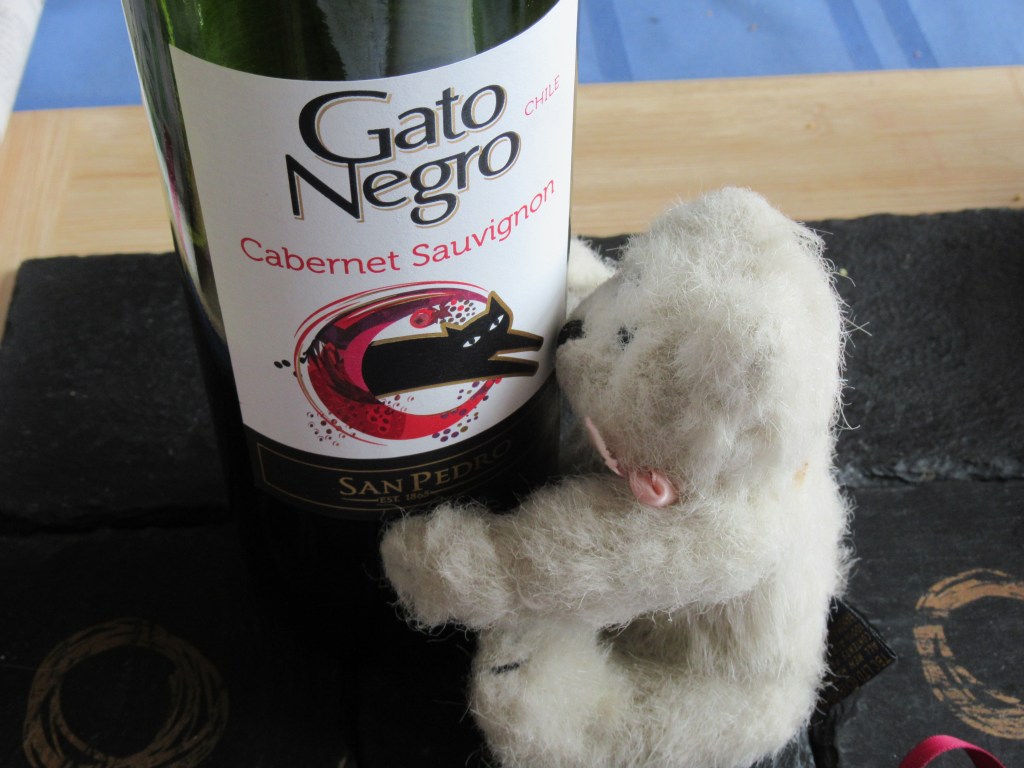
Here’s Basil Bear, on the table with me, helping me to choose my wine. He reads the label, very carefully, and then tells me which one it is. Now that’s what a Care Bear does – cares for and looks after his human. And look at that Black Cat – I do think he’s envious of Basil, four green eyes filled with the light of jealousy. I hope he doesn’t scram my Basil – a gath wedi scrapo Basil fach.

I also talk to that friend , who always walks with me. As Antonio Machado says – “El que habla solo, espera hablar con Dios un dia.” “He who talks to himself hopes to talk to God one day.” Let’s hope that particular chat is delayed a little bit longer. I enjoy writing these prompts. So, happy thoughts, and may you all share a Teddy or two who really care.

If humans had taglines, what would yours be?

Daily writing prompt
If humans had taglines, what would yours be?

If humans had taglines, what would yours be?

I really only want a one word tag – poet, and that’s the name of my blog – rogermoorepoet.com.

An award-winning teacher, researcher, poet, and short-story writer, I was born in Swansea, the same town as Dylan Thomas, the famous Welsh poet, whom I emulated in my youth. I wrote poetry throughout my childhood, but I never took lessons, nor was I known as a poet.

Early in 1962, I sent a sonnet to the poetry competition of the Stroud Festival of Religion and the Arts. I left school and was studying in Paris, when the results came out and I discovered that I had won first place in that competition. In my absence, a deserving boy from my school was sent to pick up the award, a book of poetry, signed by Ursula Vaughan Williams. The poem was published in Trydan and I have a copy of it somewhere.

Throughout my undergraduate career (1963-1966), I wrote poetry. Much of my early work appeared in my university’s student arts review, The Nonesuch Magazine – the Flower of Bristol that giveth great light. Alas, I was not studying English, and only the English students seemed capable of being called poets, so I was always called something else. I wrote a lot about nature, back then. One day, when I hand delivered my poetry submission, the editor of Nonesuch, an English student, asked me if I was a pantheist. “Good heavens, no,” I told him. “I’ve got a girl friend.” This answer did nothing in university circles to affirm my wanna be status as a poet.

Some of these poems survived and a couple appeared in Stars at Elbow and Foot. Here is one from Last Year in Paradise.

St. Mary Redcliffe

Time and Temple Meads
have begrimed your wand-thin spire,
the tallest in England.

You waved goodbye
to the Cabot boys,
Nova Scotia bound,
as they set sail.

Starlings lime your belfry,
gift and inspiration
of Merchant Adventurers,
that gentlemen’s company.

Worms wriggle and gnaw
at your ship’s figure-head,
harbored now, bare-breasted,
sturdy in your oak-beam nave.

Rust rustles and creaks
at the Edney Gates,
wrought to last centuries
by Bristol ironmasters,
themselves apprenticed
to learn time’s laws.

I call myself a poet. I think of myself as a poet. In Santander, Spain, I was known as the mad Welsh poet! What an honour it would be to have Roger Moore Poet as my tagline. I’d rather leave the ‘mad Welsh’ out.

But why stop at one tagline? I am also an award winning teacher and researcher. And a long-term rugby coach. How would they be as tags? Roger Moore Coach? Roger Moore Teacher? Roger Moore Researcher? Not quite the same thing. No resonance and I can produce no links to attach to those names. They are much more run of the mill. Anyone can be a coach, a teacher, a researcher. Not everyone can be a poet, let alone a famous poet, like Dylan Thomas. Besides which, I live in Idlewood, not Milkwood.

There is one other alternative, however. Roger Moore 007. Alas, that one belongs to someone much more famous than me, even though we share the same name. But I might go one step further. How about 3M-007? That would do at a pinch – pretty unique – there aren’t many of them about! I love it. So there we go – a choice of two taglines, either of which fit – Roger Moore Poet and Roger Moore 3M-007.

Which one would you choose for me? “A rose by any other name would smell as sweet.” But remember, I ain’t no rose. So please don’t tread on the tails of my all-disguising, multi-colored 3M-007 poetry coat.

Describe one simple thing you do that brings joy to your life.

Daily writing prompt
Describe one simple thing you do that brings joy to your life.

Describe one simple thing you do that brings joy to your life.

Painting.

I was always told that I couldn’t paint. “You don’t have a clue. Give it up now. You’re wasting your time, and ours.” Same with drawing and any other form of visual and creative art. I tried to build model aircraft – Spitfires and Hurricanes, Gloucester Gladiators, SE5s -. They were ugly, lumpy, had crooked wings, and never flew properly. The few that I managed to launch often fell apart on landing. Same with model kites. The one I did manage to build took off in a half a gale and got stuck in a tree.

Failure!!!!!

Much later in life I re-discovered Henri Matisse. “I make meaning out of shape and color.” Then I stumbled across Salvador Dali’s famous statement: “I don’t know what it means, but I know it means something.” From there I started to take lines for a walk, and moved into cartoons – you will find some earlier on these pages *click here* – or – *click here* – or just explore these early pages for yourself.

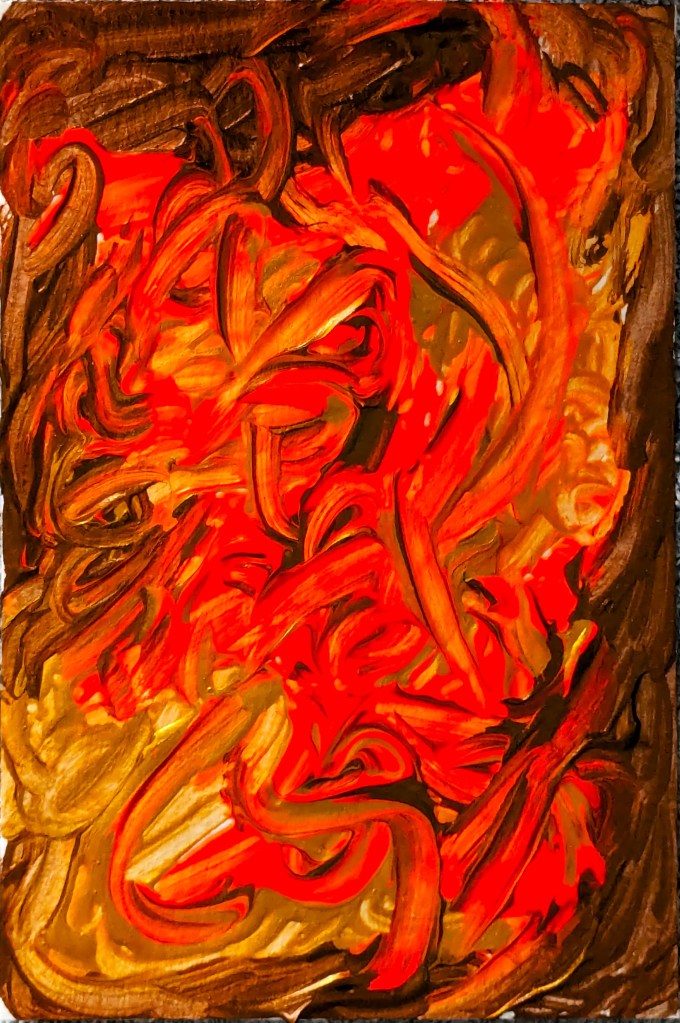
From these cartoons, I moved, with the encouragement of Geoff Slater, the Art Director at Kingsbrae International Residencies for Artists (I was the first writer in residence, June 2017), to actually painting, for the first time, with acrylics on canvas. This led me to my Pocket Paintings / Peintures de Poche, made with acrylics on 4″ x 6″ postcards. What fun. I now have well over a hundred of these and, guess what! – just like my books, I give them away to my friends for free.

These simple, linked acts – writing – painting – gifting – bring me great joy.
Long may it continue.
Pax amorque.

Coming Soon ….

Coming soon ….. to a Rollator near you.

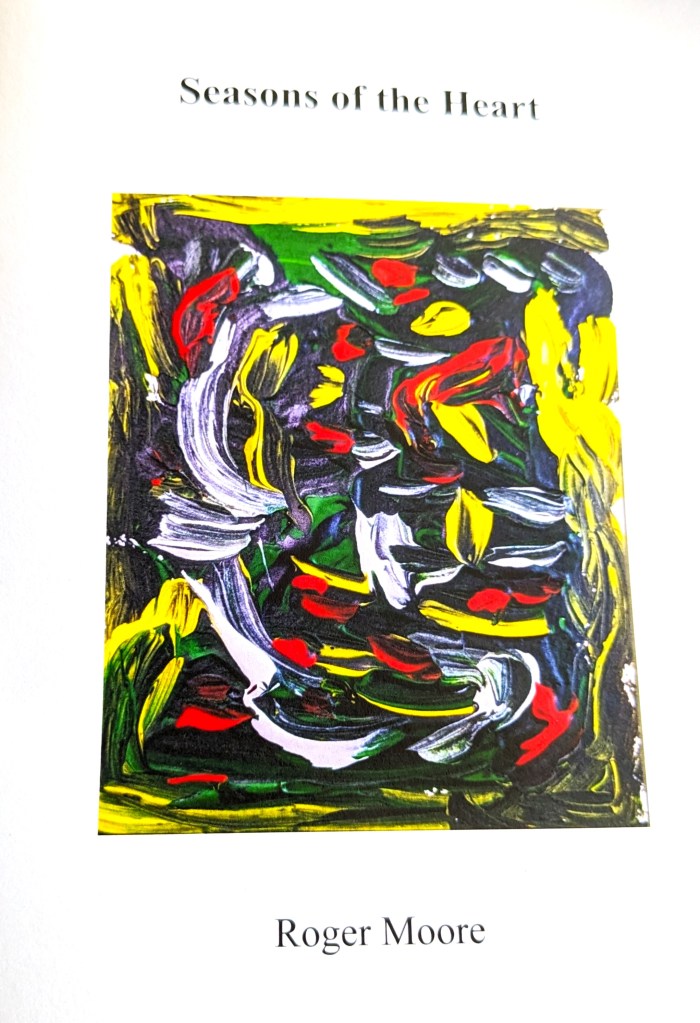
Yesterday I checked the galley proof and all seems well. The distortion on the photo above is all mine (!) and the original cover is much clearer, better, straighter, and brighter.

I have not posted for two weeks, and yet some of my faithful followers have still clicked on this site to see how I am doing. Thank you so much.

Several things happened last month. (a) I started a stretching and exercise program. (b) I upped my walking to 4000 steps a day. (c) I used a combination of Rollator [Nexus 3] and shopping cart to build up, slowly, to an hour a day of aerobic exercise.

That’s all good news for the physical body and the mental state, but not such good news for the creative cycle. Blog postings have suffered and my online social presence has been greatly reduced. On the good side, I have been out and about, around the garden and around the block, and have re-established contact with neighbors, friends, and the local canine newbies and golden oldies.

I also managed to edit and correct and revise Seasons of the Heart and this chapbook of poems, based on my meditations on Anam Cara (by John O’Donohue) will soon be available to gift to my closest friends.

As you probably know by know, I do not sell what I call my “Covey Collection” of self-published chapbooks and books. If you wish to support my efforts as an artist, you can do so by clicking on this link and seeing if there is anything that fancies your tickle, sorry, I mean tickles your fancy.

B & W

“Slim words couched
in the empty whiteness
of the page.”
John O’Donohue,
Anam Cara

black words
          white page
thoughts
          floating in space

airs and graces
          whirlwind words
blowing through
          freshening
cleansing

cotton clouds
          silky sky
that one word
          waiting
to be spoken

that one thought
          soon to be word-borne
out from the dark

a new existence
          to brighten us
blind us with light

What sacrifices have you made in life?

Daily writing prompt
What sacrifices have you made in life?

What sacrifices have you made in life?

Oh dear, so many, many sacrifices. Here, let me count the ways. This morning, for breakfast I sacrificed a banana, followed by an orange. Last night, for supper, I sacrificed a lobster – and it was lovely. I thanked its spirit for allowing me to nourish myself upon it. Then, for lunch, I sacrificed three eggs and cooked them in an omelet. You know what they say “You can’t make an omelet without breaking eggs”. Nor can you be a robber baron without breaking legs. Sorry. Wrong post. That belongs under “Have you ever broken any bones?” To which my answer is – “Only those of other people.” Maybe I’ll write that one later. But for now, two poems for your entertainment!

Squeezed Orange

Clock greets the hours
with hammer blows,
on a quivering anvil.

Rooster crows
his thick, rich cocoa rico:
morning provides
smells of roasting beans.

Squeezed orange –
glass fills with a golden liquid,
as fierce and sweet
as sunshine on a branch.

A wasted globe,
this orange bath robe,
spent and exhausted,
soon to be transubstantiated.

Breakfast

Yesterday,
I sacrificed a chicken.

Unborn,
it lay within
it’s calcium cocoon,
dormant,
a volcano sleeping
beneath thick snow.

Tap, tap, tap,
the silver spoon
bounced off
the hairless skull:
a sudden crack,
a spurt of orange blood.

Note: This poem is taken from my poetry collection Obsidian’s Edge – From Morning to Night: A Day in Oaxaca