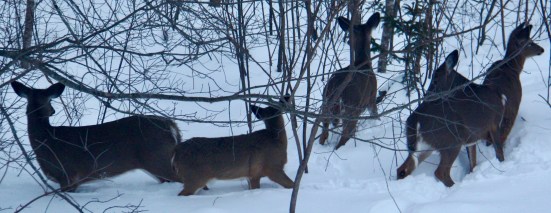
Three Deer

img_0351


We spotted them very late and by the time I had found my camera they had walked past the kitchen window and my only shot of them was through the bars of the back porch. Not a great photo, but better than nothing. We see them regularly in the winter, but usually at dawn of dusk. We have never before seen them at mid-day, not that we are looking for them ‘out of hours’ so to speak.

We speculated on why they were there, what they were looking for, but we could come up with no answers. Hungry? But this was an early snowfall and there would be plenty of food out there. Confused, perhaps, as were were, by the early snow? That is a possibility, but we’ll never know for sure. What I do know is that they haven’t been back. With the snow down they would leave tracks, but we have seen no tracks in the snow.

Maybe, without the photo, I would have forgotten about the and thought that maybe I was mistaken. But I have photographic evidence and no, it isn’t photo-shopped or forged. In spite of all my doubts and misgivings, they were there, in the early snow of Snovember. They passed through the garden last night for their first nocturnal visit. I heard a cough and a snuffle at the feeders, but didn’t get out of my warm bed to take a peek. This morning, they had snaffled all the seeds in the bird feeders and they left tracks leading up from the trees, then back into the woods again. The chickadees had a rough time of it as there was very little breakfast for them, early this morning. We have re-filled the feeders now, and life goes on.

img_0344

Here is a link to an earlier blog post that contains more pictures of deer in the yard.
Five Deer.

img_0436

Snovember

IMG_0133.JPG

The snow came early this year, hence the above cartoon: Snovember. The deer came early too, and we saw three of them wading through the bottom of our garden, about fifty feet from this tree, where the now-bare trees separate our lot from our neighbor’s. It was just after lunch, and quite the surprise, as the deer usually arrive just before dawn or just after dusk, and much, much later in the year.

So it’s clearly a season of firsts and readjustments. Yesterday, we went wild and invested in an early Christmas tree. It’s a six foot tall white birch (plastic and ever-lasting) with 120 led lights and we will plug it in the corner of the dining room by the computers.

In the short dark days of winter, we are affected by Sun Absence Depression (so SAD) and keep a set of lights burning in the corner of the dining room by the computers. These lights are particularly effective in the early winter mornings, before sunrise, when the world is dark and we need warmth and comfort. Turn the computer on, and on come the lights shedding joy to welcome us as we read the enormous amount of bad news that seems to be circulating through our world right now.

Light in the dark: I think of it as a pair of rose-tinted glasses that allow us to reject the bad news and to look for the bright side, the silver lining that blesses every seeming cloud. That’s why the snow falls in bright flakes in my cartoon. The tree appears to be bare, but a couple of birds and some scrag ends of leaves adorn the branches.  The days may appear to be dark, but the bright lights on the tree are a silver lining to the cloud of unknowing that hangs in the air like a black umbrella.

The cloud of unknowing, the dark night of the soul … so much mystery, so much joy and despair, in life around us, yet it is a mystery to be grasped and savored, to be tested and tasted … and what is life without uncertainty, challenge, faith, belief, and lights, colored lights, a festival of lights, and humor, even in this darkest of all seasons?


Rain / Il pleut

IMG_0144.JPG


I remain fascinated by Guillaume Apollinaire’s Calligrammes. I first met them when, as a  teenage flâneur in Paris, I wandered the quays along the banks of the Seine, entranced by the literary treasures of the bouquinistes. Eighteen years old, I had just been released from a twelve year sentence to a boarding school education (6-18 years of age). I loved the freedom of Paris and the joys of choosing my own poets and my own poetry books will always stay with me. Apollinaire was not a set text. He was a personal discovery and a true  joy. I remember the light blue cover and the worded rain drops inscribed upon it when I bought my first Livre de Poche, the poems of Apollinaire.

Caligrammes are out of fashion now, their virtues taken over by the joys of concrete poetry. I still write some, drawing them out by hand. I find this much easier than planning them on typewriter or computer, though I have done both. The cartoon – poem hybrid, printed above, is my intertextual reflection on Apollinaire’s original Rain / Il pleut which can be found on page 62 of the above link from Le Mercure de France.

I look at the snow steadily mounting outside my window and I hope that we will not see rain for a long, long time. Not until Easter and the welcome warmth of spring. That said, I miss the rain. It was a constant part of my childhood and I remember spending day after day, head pressed to the window pane (yes, I do know how to spell it), watching the raindrops sliding down while behind me, the old coal fire threw out enough heat to warm me in my daily loneliness.

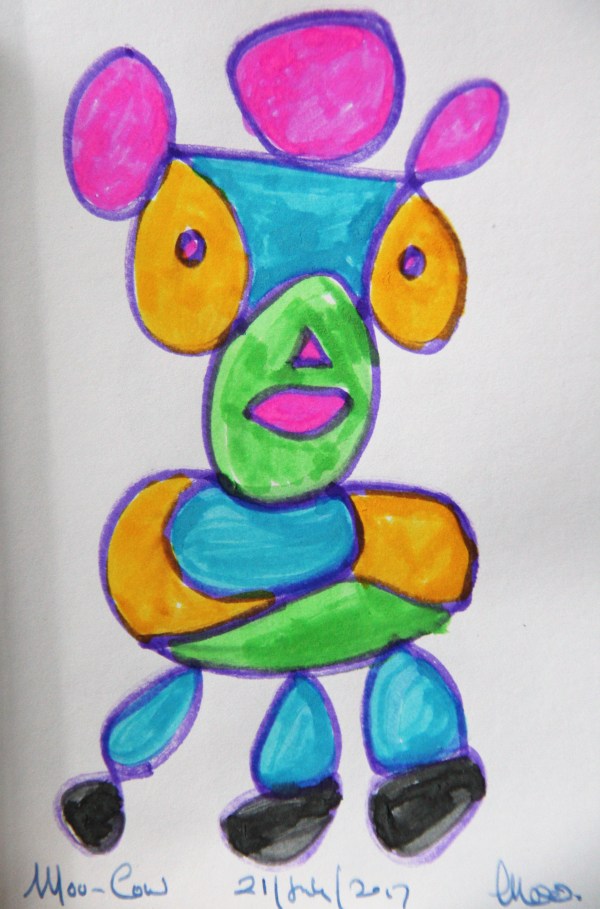
Moo Cow

IMG_0080.JPG

Moo Cow
for Geoff Slater

It’s his story to tell, not mine, but I’ll tell it anyway, since he told it to me.

We were talking after lunch, de sobremesa, as they say in Spain, sat around the table. Chewing the fat, or the cud. The subject turned to farming in Wales and how Welsh farmers were sometimes trapped in the stall with the bull and crushed against the wall when the bull leaned its great weight upon them.

“It nearly happened to me,” he said. “But it was with a cow, not a bull. I was nine years old. One of our cows got into the manger and couldn’t get out. My father sent me in, hoping that I could shoo it out, but instead of leaving, the cow turned and trapped me against the wall. I couldn’t move, couldn’t breathe,” he paused.

“Go on.”

“I carried a pocket knife at the time. I had just enough room to pull out the knife, open it and … ”

I watched him shrink, grow younger. He returned to nine years of age. In his hand, he held an imaginary knife. The room shrank around us until it became the size of a manger. The cow loomed large, filled the room.

” … I stabbed, stabbed, stabbed … ”

His eyes tightened. His face grew grey. A sea-change came over him: white-caps whipped over his flesh. Storm clouds threatened. I watched his clenched hand stab … stab … stab … at empty air.

” … I stabbed it again and again and it turned and moved away … and finally I could breathe. I was lucky.”

He relaxed, started to breathe again. The room returned to its normal size. The cow vanished. The sun shone through the kitchen window, high-lighting us as we sat there, breathless,  in silence.


Heart Dance

IMG_0147

Heart Dance: This is what the heart does when you have a good friend around for lunch and you spend an hour or two discussing art, creativity, meaning, change, artistic development, moving on, changing one’s style, and welcoming and creating new artistic visions. Heart Dance is about possibilities, about opening things up, seeing the interior self more clearly, watering the creative soul and encouraging it to grow outwards until it fills the whole person.

Heart Dance moments happen at different stages in the artistic life. They are urgent moments, impulsive moments, moments when you can suddenly hear the music of the spheres and see the universe dancing for you, before you, and with you. They are magic moments when the heart becomes one with the universe and heart and soul join mind and body in a universal heart dance where the dancers are one and the dance is not just for one, but for all sentient and creative beings who can hear the music and feel the rhythms pounding through arteries and veins.

The dull, grey, concrete life of the nine to five desk-bound existence fades away to be replaced by a flowerbed of activity, full of light and sound and color and music. Usually, this happens to the individual in the privacy of his or her own mind. Occasionally, we can share the event with a friend who is going through the same, or a similar, change at the same time. A unique experience to feel and witness the music with another person and to be bound into the circle of dancers, treading where other artists, great and small, famous and less important, have all danced before.

We talked of the joys of visiting great museums and of staying in one room, before one painting, and of spending the day there. This I did with El Greco’s El entierro del Conde Orgaz / The burial of Count Orgaz, with Picasso’s Guernica when it was housed in the Mesón de Guernica, with Hieronymus Bosch’s The Hay Wain, with Velásquez’s Las meninas, and with Goya’s Desastres de la Guerra, not one picture, but a series of etchings taken in, day by day, over a period of a magical month spent in Madrid.

In poetry it happens when I return to poems that I love. I read and re-read them, again and again, finding new nuances, new meanings, new depths. I think of the anonymous Poema de Mio Cid, of Góngora’s Polifemo, of Quevedo’s Canta sola a Lisi and his Heráclito cristiano, of Octavio Paz’s Piedra de sol, of Lorca’s Romancero gitano and his Poeta en Nueva York … the wonderful original poems of Fray Luis de León and of St. John of the Cross … and this is just scratching the surface of an exterior world that I have interiorized until it has indeed become a part of me.

Heart Dance: my heart dances and sunshine floods my soul as I write these words, words and thoughts that I have just shared with a good friend, as he shared similar words with me and we joined together in a heart dance during which the sun shone brightly and the whole creative universe sang and danced with us.

Cooking

img_0385

Cooking

My Welsh grandmother, not my Irish one, taught me how to cook. At the time, I was the only grandchild. Whenever she cooked and I was in the house, she would take me into the kitchen, stand me on a stool by the gas stove, and encourage me to stir as the mixtures swirled and bubbled in pan or pot. I also helped her shell the peas, slice the carrots, whatever. When the preparation was ready, she would set aside a small portion that was mine. This might be a cake in the oven, a pair of biscuits shaped awkwardly by my own hand, or a small side pot of soup. “There’s nobody else,” she would whisper to me. “The old ways will die if I don’t teach you.” She was the one who taught me the exact moment when Welsh Cakes were ready to be molded, and there’s only one way to learn: place your hands in the mix. The right texture, as they say in the cookbooks, is ‘fine grain sand’ but you have to experience it to be certain what those words really mean.

I was a latch-key kid, as they now call them. Both my parents worked all day, leaving the house at 7:30 in the morning and not returning until 4 or 5 at night. Being able to cook meant that I never starved and I remember cooking soups, Cawl Mamgu among others, at a very early age. When I started traveling to France and Spain, I often ended up in various kitchens where I listened to the women as they prepared the food. Language and cooking went hand in hand and I learned how to roast coffee beans in a cast-iron frying pan, how to vary my range of soups, how to prepare casseroles, how to scramble eggs the continental way.

When I studied in Santander, Spain, my landlady left me, every night, one onion, one potato, and one egg. This was for the Spanish omelette that I ate most evenings. She cooked the first one for me, supervised me as I cooked the second one, and then abandoned me to my own devices. I often heard her snoring as I lit the gas, warmed the pan, and started to prepare my tortilla española. I still make Spanish omelettes, and they are delicious, but here in Canada they are never quite the same as they were in Spain. The ingredients look the same, olive oil, egg, salt and pepper, potatoes and onions … but the eggs are not Spanish free-range eggs from country hens and the oil, the potatoes, the onions, the salt … everything looks the same, but tastes vastly different.

Two days ago I bought a pound of fresh hake, merluza in Spanish. I cooked it in butter, half poached, half-sautéed. We ate half that night. Next day, I struggled with my thoughts: should I make fish cakes from the rest of the fish, or should I make a fish soup / sopa de pescado? Fish soup won. I put some truffle flavored olive oil into the frying pan, sliced small a tomato fresh from the garden, added a finely chopped onion, spiced it with sea salt, and added a small pinch of pimentón picante / hot Spanish paprika from La Vega in Spain. I let this simmer for a few minutes, then added some sherry. Into this mixture I put the rest of the hake together with the butter sauce that remained from the night before. The dish looked inviting, was very colorful, but appeared to be small and insufficient for the hungry eyes that followed the process. I added four large shrimp, sliced into four pieces each, a large scallop, thinly sliced, and sufficient water to thin the gathered liquids. Then I chopped up some sugar peas and added them as well. My sopa de pescado had undergone a sea change and become a sopa de mariscos / a sea food soup. The colors amazed: reds, yellows, oranges, and touches of green. On the spur of the moment, I named it New Brunswick Autumn Foliage. I tested it regularly as it simmered and it was ready when the sea food was done. Delicious.

I don’t know when my grandmother was born, or where, other than somewhere in Wales. I celebrate her birthday every time I cook something special, and my last two meals were very special. I don’t know where you are, Nana. You left us a long time ago. But wherever you are, thank you so much for the gifts you gave me. And Nana, I love you. You have traveled with me from Wales to Canada, and I celebrate you and your birthday every time I cook.

Ruins

IMG_0040

Ruins

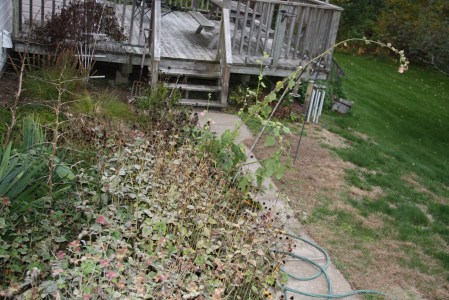
There are many types of ruins, ruined castles, ruined churches, ruined monasteries, old stone circles fallen into ruins, barns alongside the highway, backs broken, roofs caved in, old people beg, still clean and proud, outside the supermarket, proud, yes, but still more or less ruined. And then there are unkempt gardens that fall into ruin when summer crawls to the burnt out embers of  its heat.

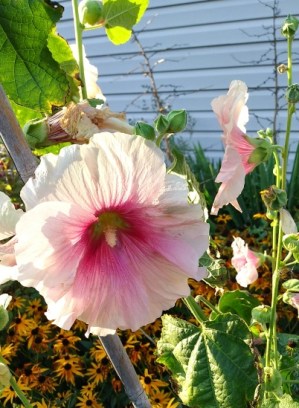
When I came back from my week’s creative retreat in KIRA, our garden lay in ruins. The hollyhock still stood, but it was on its last legs, drying up. It didn’t imitate the dead sticks of the yucca plant, four flowers this year, nor the dried up foliage of summer flowers. Nevertheless, wind and rain have now brought him close to his end, poor thing. I want to remember him in all his glory. I want to see beyond this bent, withered stick of a plant that slowly bows its head to look down at its roots. My hollyhock, please, in all his glory!

20180916_182952_HDR-1_resized

All our glories! I too am in decay and falling into ruin. I dug out an old photo of myself. Bristol University, 1964, running for the First Cross-Country VIII on the Bristol – Weston road relay. Hugh Arnold was just handing off to me and I was setting out on my 5 mile leg of the race. Young, fit, no grey hairs, no wrinkles, no limp, no stoop: it was a five mile leg that I would complete in about 25 minutes. Alas, slow is me: it takes me that long now to walk 400 metres. And I need rests and a stick to help me on my way.

Standing amidst he ruins of my life, yes. But I stand proud, my head held as high as I can hold it. I can honestly say I have done my best. And what more can anyone do? Athletics, rugby, coaching, research, publishing, teaching, facilitating workshops and retreats, travelling, editing, creative writing … it has been a crazy life, packed with fun and adventure and no, I do not regret a moment of it.

Come to think of it, unlike many people, I have actually lived many lives. My first took place in Britain and Europe. Then in September, 1966, I was reborn as a Canadian. Each subsequent Fall, at the beginning of September, as each new academic year began and the year’s cycle turned round to freshness and intellectual renewal, I was born again. Teaching, coaching, working with young people: what wonderful things to do. Now, I look at the ruined garden and remember the joys of summer. They will return. My hollyhock will also be back. He has sown his seeds throughout the flowerbeds and sooner or later he will return. I too have sown seeds: the seeds of joy, knowledge, learning, creativity. I too will live on in the many virtual children whose minds I have inhabited and helped to shape.  Winter is drawing near. The cold and the dark encroach: but, like my garden, I will be back.

Green

39948917_706398923049634_3046174897211441152_o (1).jpg

Green
KIRA Day 3

Where has the time gone? Don’t answer that question. The Retreat has settled into a structure of its own and outside time no longer has any meaning. The internal time of the retreat runs smoothly as clockwork, a wooden, self-oiling clockwork, of the most delicate kind.

08:00 – 09:00 Breakfast. We gather in the kitchen and the conversations begin over breakfast. We talk about the previous night’s readings, the plans we have for the day, or whether we want to workshop of just retire to our studios and write.

09:00 – 10:30 Workshop time. Each morning we have a topic and we illustrate it and discuss it fully. Each workshop also comes with ideas and prompts for writing. At the end of  each workshop, we plan the rest of the day. We hold regular Blue Pencil Cafés in which facilitators and participants discuss submitted work. We suggested about 20 minutes for the BPCs, but my first one last over an hour and we managed to get through half a poem. Jeremy’s first one lasted an hour and a half (prose) and he covered more ground than me. My second one was marvelous: we spent an hour or more on one paragraph, three lines.

What happens in the BPCs is unbelievable. It’s not just the revision of the poem or the piece of prose, but a wide-ranging discussion on theories, ideas, prompts, the nature of writing, directions a piece may take, the nature of creativity, where inspiration comes from, how it may be channeled, how writing occurs, where it can lead … incredibly exhausting at times, yet energy fills us and we are always ready to write, re-write, revise, and talk again.

14:00 – 16:00 Art School. On Tuesday, Geoff Slater sat us down with paper and paint and we experimented with color, the creation of color, the basics of primary colors, how to make secondary colors, how to create the color wheel. Geoff enthralled us: never will the color wheel ever look the same again. Never will I use a color again without thinking in depth about it’s composition and meaning. Green no longer means Green: it means so much more. I read Lorca’s Romance Sonámbulo, this morning, and it took on all sorts of different and very new meanings. Verde, que te quiero verde. Green, for I love you green … green wind … green branches … green flesh … green hair … 

I sat opposite Geoff this morning. Behind him, green bushes, green trees, green leaves, green grass, green foliage … Yesterday, I paid little attention to all that green-ness. Today it fascinated me and I was able to distinguish between the amount of yellow, the amount of blue, the lightening factor, the darkening factor, the tinges of red and brown and oh to be able to capture it all, all that green-ness, all that certainty, blurred into a sea of green.

16:00 -17:30 BPC time. We pair up facilitator / participant and share our work. Each day a different piece, a different conversation, an advancement of yesterday’s talks, another step or two forward. Sometimes we take tiny steps. Other times we make gigantic leaps. Time and space lose meaning. We have been gifted with something different and we are truly blessed.

18:00 – 19:30 Dinner. This is a sumptuous meal provided by the Garden Café, our very own award-winning Kingsbrae Garden Café. The group is open. The man who provides us with desserts, he makes them in our kitchen, specially for us, joins us as we sit at the table and we add culinary art to the poetry, prose, and painting that we are always discussing.

19:30 – 21:30 Readings. We read what we have written during the day and facilitators and participants share together. I try to choose work of mine that reflects the day’s themes. Linking theory (morning) to practice (evenings) is also a fascinating procedure. We finish the evening by planning the next day’s work. The key to the retreat is flexibility. We respond to each others’ needs. Colors are important? We concentrate on colors and read about them in our evening sessions. Today we talked symbols. Tonight I will offer a reading in which symbols play an enormous role.

Alas: my free time is over. Now I must descend and return to the joys of BPCs, discussion, dinner, and the evening’s read. Farewell for now: I will be back as soon as I can.


Holly-Hock

IMG_0026

Holly Hock Hangs on …

I keep calling my Holly-Hock ‘he’, but I am beginning to think that if Holly Hobby was a lady, then this tough old plant is a lady too. A limpet lady. She has gone through three quite hard frosts now, one early, and two back to back, earlier this week, followed by two days of heavy rain. The rest of the garden is withering or withered. Clusters of dry blackened stems surround this old lady, but she still stands tall and proud. Not only that, but she casts more and more flowers out to greet us.

We have kept lots of seeds and will sow them soon, some are in the ground already, in the hopes that she and her offspring may flourish. For this lady is a symbol of hope. Hope in the face of frosts, cold winds, heavy rains. Hope in the seeds that she produces and scatters. Hope in the generation and the regeneration of a beauty and a strength that, if lost, may never be found again. Hope in old age that our children will survive and lighten our countenances with their love.

So go, you Holly-Hock seeds. Bury deep, send out roots, sleep for a while if you need to, and when the spring sun peeps over the horizon after a hard, long winter, be ready to bloom again. We, your faithful followers, will be waiting for you, with hope in our hearts.

Seeds

20180916_183415-1_resized

Seeds

As creative artists, we seek to leave seeds and plant seeds. Just one idea, seeding elsewhere authenticates us as artists and creators. Some seeds fall on stony ground, we know that. Others do not take immediately, but lie dormant for some time. Some, a few, a very few, a happy band of siblings. drop, root, and grow into the flowers we always wanted to create.

We must always have confidence in our seedlings. We must believe that they will survive, somehow, somewhere, in spite of the random nature of the universe. Write with that belief. Create with that belief. Be strong. believe. Even when others doubt you and, what is worse, you doubt yourself. Never doubt yourself.

My Hollyhock doesn’t doubt. It came from nowhere and gifted itself upon us. Now it has gifted us with pod after pod of wonderful seeds. Some will be lost. The squirrels, chipmunks, and mourning doves, not to mention the passerines, will get others. But some will survive, take root, and flourish, just like this one did.

Believe, my friends, believe. And never stop creating.