when we two came together we closed an ancient circle becoming one with the standing stones that measure seasons and time
now we harvest the summers lilies lupins fox gloves blue bells a surfeit of wild flowers plucked from the maze of our days
we wait and watch the slow snow settling white on sarsen stone as time weaves crow’s feet into the corners of our eyes
2
i listen with my eyes to the words and thoughts of long-dead writers.
age-old and wise they walked alone along the hidden ways to set themselves free
they fled the royal courts where power and jealousy plotted twisted ways
cruel means justified by brutal ends. mindless quarrels bitter strife
i also ran away and slowing down i found an enviable life
enriched i live harvesting a wealth of goodness
days lived far from fear envy resentment distrust in wooded seclusion
Comment: I was invited to attend KIRA as writer in residence this month. However, a weakened immune system and a series of setbacks over the late summer made this impossible. That said, KIRA and the early morning light seen from the Red Room live on in my heart and I will try to complete my planned project, here in Island View, over the next month or so. Wish me luck.
What do we say when friends have birthdays, what can we say? The conventional Happy Birthday seems so inadequate.
It is even less satisfying to send a meme of cake with candles, or gift-wrapped boxes in colored packages tied with balloons.
How, in this age of instant communication, do we reach out with sincerity and grasp the importance of passing time when electronic time and distance are meaningless?
I sit here at my computer contemplating what words of joy and comfort I can send to an online friend, that I have never met, to help her celebrate her special day.
My mind is blank. My screen is blank. I have so many questions, so few answers, but I will reach out anyway and hope she understands my tongue-tied silence.
This is buy a book by a New Brunswick Author time, sponsored by the Writers’ Federation of New Brunswick (WFNB). Alas, so many New Brunswick authors are almost faceless to the wider world beyond the Province and the Maritimes. It gives me great pleasure, therefore, to highlight one of the books that I dearly love from a New Brunswick author, Jane Tims.
Here is my review of Jane’s book, first published (the review) on Brian Henry’s Quick Brown Fox (14 March 2021). Thank you, Brian, for the work you do in assisting and developing writers all across Canada – and beyond – and a special thank you for all you have done to help me over the years.
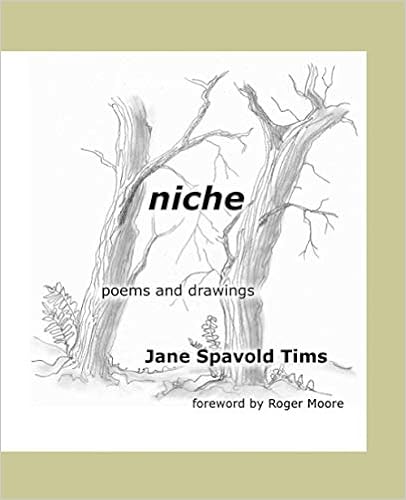
Niche, poems and drawing by Jane Spavold Tims, reviewed by Roger Moore
Independently published. Available from Amazon here.
Niche, the fourth poetry book published by Jane Tims, is a neat configuration of six segments that elaborate and illustrate the poet’s original definition of the multiple meanings of her title word niche.
It is difficult to separate the author from the act of narration as her keenly observed and skillfully executed drawings, together with their verbal representation on the page, are so autobiographical and so much an extension of her artistic and professional abilities that the objective separation of writer and text is scarcely possible. It is hard to forget that Jane Tims was, and to a great extent, still is, a highly competent professional botanist. The harnessing of the professional botanist, with her unique drawing skills and scientific knowledge, to the poet and auto-biographer is a key factor in the reading and interpretation of this text in which acute observation blends with an intimate knowledge of the observed botanical world, both flora and fauna, and this allows the poet, in her role of poetic narrator and lyrical voice, to weave a network of poems that are, at one and the same time, objective and intensely subjective.
The author emphasizes this when she writes in the Preface that “In biological terms, the niche is the quality of a space occupied by a living thing, the sum total of physical, nutritional, biological, psychological and emotional needs gathered together in one place.” She also reminds us that in human terms “niche can be a metaphor for home, community or personal space” and it is within these metaphoric spaces that the poetry text is elaborated. The text becomes a linked mixture of visual drawings, iterative thematic imagery and associative fields, all centred on the multiple meanings of niche. These terms are both biological and human in nature and the poet’s named world meets at this juncture between the human and the natural.
The section occupying space (1-19) bears the subtitle satisfying need and begins with a setting out of what this means in the following 12 poems and 4 accompanying drawings. The poem ‘apples in the snow’ with its companion drawing stands out for me.
The section strategy, subtitled solidifying position (21-43) outlines in poetic terms, how plants, animals, and humans ensure their own survival.
The section praying for rain, subtitled, avoiding danger and discomfort (45-68), offers views on discomforts and dangers. It also opens the discussion—relocate or stay where we are?
The section mapping the labyrinth or places I have occupied (69-83), which contains the wonderful sentence “When I get lost on the road ahead, I look to the road behind me,” throws open the multiple meanings of home.
The section new ways for water, subtitled coping with change (85-98), offers a double landscape, first, external, the things seen, touched, examined, remembered and described, and then the internal landscape that reflects upon them and is reflected in them.
Finally, forgetting to move, with its subtitle getting comfortable (99-111), presents an autobiography that links observer (the twin personage of author and narrator) to observed (nature, both flora and fauna, and the added element of autobiography and self) via the symbiotic relationship of botanist to botany.
Two moments stand out for me. (1) Sadness is in seeking the space that is never found. (2) Loneliness is in trying to return to a space once occupied but no longer available. The whole concept of the Welsh word hiraeth is summed up in these two lines. Carpe diem, Jane Tims’ poetry indeed seizes the day and, with its minute, intense observation, it preserves so many precious moments. It also pays attention to that which has been lost, those moments that are irretrievable. They will vary for each reader, but hopefully, like me, you will take great pleasure in discovering them for yourself.
Jane’s interview with Allan Hudson, another excellent NB author, can be found by clicking this link – South Branch Scribbler. The work of all NB authors should be celebrated over the first weeks of this month. Allan, thank you for supporting us – and you, too, Brian Henry. Living in NB, we need all the enthusiastic support we can get.
My friend Allan Hudson re-posted this blog entry yesterday. It is always wonderful to be remembered by my friends. Allan does a great job with the South Bank Scribbler – and he is one of the best. Long may he and his blog work continue to support New Brunswick writers.
I look forward to working again with both Allan and Jane. Best wishes and many thanks to both.
Click on the link below for Allan’s interviews with Jane and I. And don’t forget to go down all the rabbit holes that appear in Allan’s articles. There is a great deal of information within those little burrows.
I have reached the stage in life when grudges belong to a distant past. Some of that past I still regret, but I have come to accept most of it as the normal rites of passage through which human beings must pass, if they are to grow and develop. This acceptance also comes from the understanding that the steps that led me to my current life and situation, were beneficial, even when I didn’t think they were at the time.
Garcilaso de la Vega once wrote: Cuando me paro a contemplar mi estado / y a ver los pasos por do me ha traído, hallo, según por do anduve perdido, que a mayor mal pudiera haber llegado. The Wikipedia translation offers us this – When I stop to contemplate my state and see the steps through which they have brought me, I find, according to where I was lost, that it could have come to a greater evil.
That said, I have learned to see the lesser evil in things that actually happened and the greater evils into which I might have fallen. I remember bearing grudges, but I feel that I have now set them aside. Reading John O’Donohue’s book Anam Cara, for the fourth or fifth time, has helped me to achieve that state of mind.
Some things do annoy me though. Speed reading is one of them. Well, not speed reading but the application of speed reading to any and all situations. In today’s Guardian, for example, I read that – “A lot of people, myself included, complain that they don’t have time to read but everyone has time to read a poem. You can read Ozymandias, for example, in just 17 seconds.”
One of the first things that I did in Grad School at U of T was to take a speed reading course. I found it absolutely essential in order to read and process the quantity of new material that was thrown at me by my profs. In my undergraduate education (Bristol University) I was told that “It is better to read one poem a hundred times than to read a hundred poems once.” As a poet, and a student of poetry, I prefer to dwell on a poem, to absorb its essence, its meaning, its subtleties, its associative fields, rather than to gulp it down in 17 seconds, for example, and then move on to something else. The poet and dreamer who live within me need that time to re-create, poeticize, and dream.
“What is this life if, full of care, we have no time to stand and stare, no time to stand beneath the boughs and stare as long as sheep or cows,” wrote W. H. Davies, author of Autobiography of a Super Tramp.
I realize just how much our lives have speeded up, how we are inundated by information, how we drown in sound-bytes, memes, and mini-clips. I also know that, however fast we read, we will never take it all in, not in one lifetime. Sometimes, less is more, slower is faster, we need to take time, to make time, to stand and stare. Seamus Heaney expresses it well – “Some time, take the time…” I don’t hold a grudge against those who can’t, or won’t, make and take that time. But I truly believe that many, many people would benefit by doing so. I also believe that a benevolent society would allow many more people to do just that.
Meanwhile, I will agree with the Guardian columnist that reading a poem in 17 seconds is much better than reading no poetry at all. So, some time, take the time….
In the gathering autumn shadows summer flares as bright as the berries adorning the Mountain Ash.
Beads of blood, they hold late evening light, as do the Black-eyed Susans growing wild beneath my window.
Rain wet, wind swept some nights, yet still they glow with their bottled sunshine.
Fairy lights, Christmas garlands, ash rosaries will circle another tree, enlightening wrapped presents, lighting up the vacant crib waiting for that little child, soon to be still-born.
Comment: Poetry is where you find it. The inspiration for today’s poem came from the Poem of the Week in The Guardian. Inspiration, I found it in two places – 1. the photograph at the head of this blog and 2. in the analysis of the poem, not in the poem itself. The twilight of this autumn world is indeed wonderful.
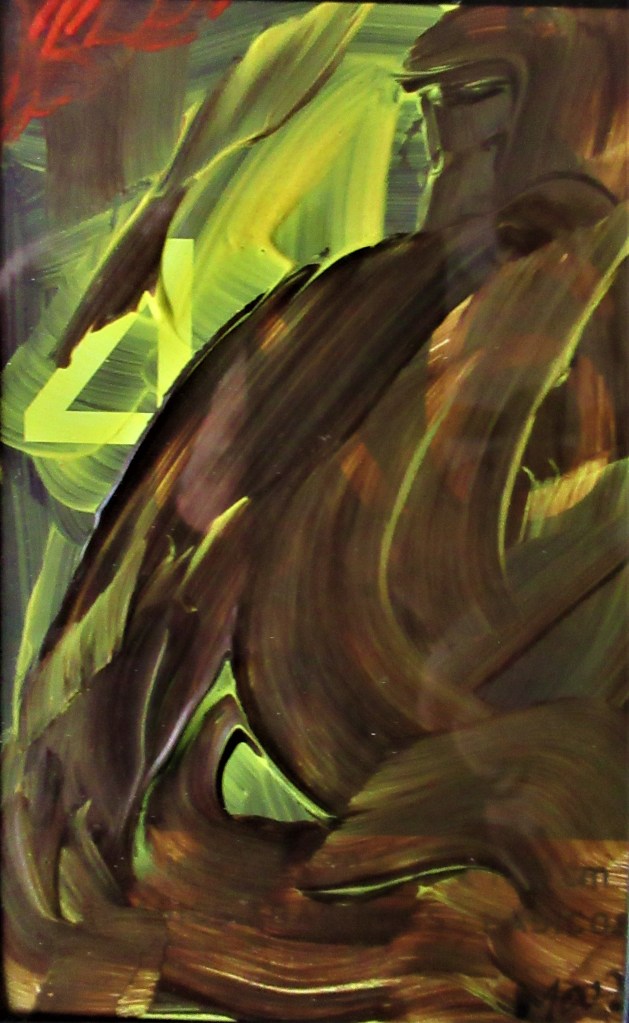
I blog to make the world a brighter, healthier, happier place. I also blog to keep my readers aware of the existence of poetry, beauty, truth, love, and creativity. If I didn’t blog, those readers might never see the painting that I have attached above, painted by my friend Moo, of course – wrth gwrs. In fact, if I didn’t blog, you might never know that Moo is my friend, as is Sparkle. And if I didn’t blog you would never read the interview I had with Sparkle.
Who are you? I am Sparkle.
What are you? I am a fairy.
What??? I am a fairy. More important, I am your house fairy.
What on earth is a house fairy? Well, when your granddaughter built a little fairy house and placed it where I could find it, and when I saw it and entered it, at her invitation, I became your house fairy.
Why did you choose that particular house? Because it was built by a kind, loving young lady who didn’t want you to be alone. She built the house and outside the door she wrote Welcome Fairies. So I knew I’d be welcome. More important, perhaps, she built another fairy house in her own home and my friend Crystal lives there. Crystal told me there was a fairy home vacant, and she also told me where to find it. And she said that her human had told her that you might need a fairy friend to keep you company and stop you from being lonely. So, here I am.
I didn’t know that fairies could talk to humans. They can’t, normally. But you are not a normal human being.
What do you mean by that? You are a poet and a dreamer. Both poets and dreamers already have one foot in fairy land. Sometimes we call it la-la-land. It is a very special place and the people who can go into it are, in many ways, almost fairies. These are the ones we can talk to.
How do you know I am part-fairy? Because I can see your wings.
But I don’t have any wings, not that I can see. Quite. “Ah would some power the giftie gie us to see ourselves as the fairies see us.” That poem was written by a friend of mine, a long time ago. He was a poet and I could talk to him too. When the time comes for poets and dreamers to cross the rainbow bridge, their wings become visible and their spirits can fly again. That’s when they are able to return to fairy land. Socrates was another friend of mine. He too was a poet and a dreamer. He dreamed that humans originally had one wing in the middle of their backs. When they found their soul-mates, they could join together and then, with two joined wings, they could fly to the heights of the spirit world.
Socrates? What did he know? He thought the world was flat. He didn’t know everything, of course. But he was right about some people having a single wing and needing a partner to fly. You are very special – you have found one of those. Socrates just didn’t know that other people could have two wings, although they couldn’t be seen here, on earth, in this dream world where they dreamed they were wingless people.
So, am I dreaming that I am a wingless person? Of course you are. But you will wake up to the truth one day. My task here, as your house fairy, in this house built for me by that cute young lady, is to help you realize your dreams. I will help you release the poet within and I will help you to reach out and make the world a brighter, kinder, more loving space, for other people who lack what you have – the power to dream and to create.
Oh dear. This is a little bit too much for me, Sparkle. I’ll have to sit down and think about it. It’s too much to take in all at once. I know. But I have been chosen and I have been given the power to choose you. I have done so and I am here. And remember – I will never leave you nor forsake you.
Thank you so much, Sparkle. And thank Crystal and that little girl for me. I will. Now I must go. It’s September and I have some fall sparkling to do. But don’t worry – I am here. I’ll be back. We’ll talk again.
My ideal home looks exactly like the one I am living in right now. In the country, surrounded by trees, with blossoming crab apples in the front garden and a mountain ash in full view from the kitchen window, what more could I ask for? Blossoms in the spring, a gradual flowering throughout the summer, and now, as fall approaches, the fruit ripening.
Verde, que te quiero verde. – Green, for I love you green. But what exactly is green? I sit on the front porch in the cool of summer, and look out on a sea of greens – green grass, green leaves, light green, medium green, dark green, and all kinds of shades and hues as the sunlight filters a subtle dance of colors through the leaves. The eye distinguishes so many different shades of green. Alas, I do not have the vocabulary to distinguish verbally what I see visually. Ah, poor poet, linguistically damaged, and writing with one hand tied behind my back, I suffer from an ability to feel and an inability to express. Terminological inexactitudes, Winston Churchill called them. But in my case, they are the lies I must create when the truth overwhelms me with its beauty.
And in winter, when the cold winds blow, and the leaves lose the safety of their trees to be blown hither and thither at the wind’s will, what then? A blanket of whiteness, shadows shifting beneath the moon by night, and a million brilliant sparkles beneath the sun by day. And the visitors, every night the deer come, stay awhile, then vanish, only to reappear the next day. At midnight, in the moonlight, I watch them from my window as they dance on their hind legs and nibble the hanging fruit that the mountain ash reserves, just for them, so that they will survive, as they have done for millennia, in this paradise that surrounds my ideal home.
Pictures and memories play hide and seek. They hunt the slipper that hides in the words that slither and slide across my page.
They long to emerge, fully formed, and to step, without effort, into your mind. They want to linger there, to baffle, taunt, and haunt you.
Digging through the verbiage, a thought, a metaphor, a grouping of words will join and rejoin. This is the grit that the oyster slowly shapes into the pearl of great price that glows so bright.
Consider the opal. Plain at first sight, yet changing color, shimmering in sunlight, a chameleon adapting to mood and shadow, its moon dance hovering, a butterfly over burgeoning blossoms.
Who could ever forget, once seen, star light illuminating the bay, the moon gilding the sea, those summer nights, our secret love flowering.
The veiled will unveil itself and tease its way, its path over the sparkling waters of the bay. Knock and it will open. Seek and you will find.
Comment: I had a specific, named place in mind when I first wrote this poem. Then I realized that my secret place was not necessarily the remembered place of other people who had undergone similar experiences. So, I removed the specific and made it generic.
I know you have been there, to your own special place. A warm summer night. Star light over a bay. Or maybe it was an estuary, or perhaps a river bank? The moon appearing, lighting up the waters. Walking, perhaps, hand in hand. Or sitting, as I remember it so well, in a late-night café, watching the night lights on the fishing boats, as the moon spread its golden carpet over the bay.
Such a miracle: those first steps to flight taken by the cormorant over water. That first one heavy, creating ripples, the second one lighter, and the third one scarcely touching the water.
The need to take flight lies deep within me. Fleeing from what? Flying towards what? Who knows? All I know is that the future lies ahead where my bird’s beak points and the past, a rippling wake, lies behind me.
That white water, trailing its kite’s tail, tells me where I have been. Machado’s voice calls out from the past: “Traveler, there is no road, just a wake across life’s sea.”
Comment: The photo is a golden oldie, one of the first I ever posted on this blog. The poem is part old, part new. In reality, it is a revision, completed today, of the earlier poem associated with that old blog post. It is interesting to compare the two visions – with those seven extra years of creative experience between them. Let me know what you think!
A special thank you to my long-time friend, Dale Estey, for commenting and suggesting an improvement for the fourth line. Spot if if you can!



 rogermoorepoet