Empty Nest

fundy 05 mist+wolfepipers 153

Emptiness
is an
Empty Nest

The wind at the window
scratches tiny notes.
I can no longer hear the tune
nor read the words.

Who walks beside me
as I pace my lonely path,
abandoned
in this empty house.

My self-portrait
stares back at me:
a splintered selfie,
framed in a sliver
of silvery glass.

Above me,
the monkey-faced moon,
that itinerant tinker,
walks a fractured way
over broken glass.

The knapsack on his back
is cobbled together
from a finery of cobwebs
and clumsy clouds.

IMG_0039

Her Shadow

IMG_0063

Her Shadow

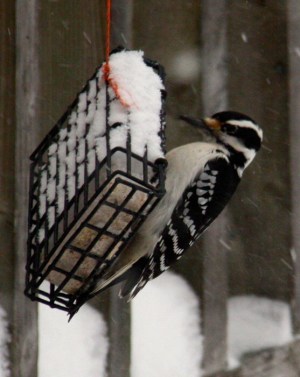
“Birds, birds,” she shrieked with delight.
“The drab one is a girl like you,” I told her,
“but the bright one is a little boy.”

“Yellow,” she cried again with joy, “Yellow.”
Tiny hands plucked at air, catching nothing.

I can still see her standing there, her nose,
all wet and runny.  She left damp, snot-stained
marks, a sort of signature, on the cold wet glass.

She’s long gone now, way back home, but still
the window stays unwashed and her shadow
often comes between me and the morning sun.

Triumphs

Avila 2007a 105 (2)

Triumphs
Luis de Góngora

Waking to birdsong in the morning,
making it safely to the bathroom
without tripping on the rug in the hall,
shaving without cutting my face,

getting in and out of the shower
with neither a slip nor a fall,
drying those parts of the body
that are now so difficult to reach,

especially between my far-off toes,
pulling my shirt over wet and sticky
patches still damp from the shower,
negotiating each leg of my pants,

tugging the strings of the plastic sleeve
that helps my socks to glide onto my feet,
forcing swollen toes into under-size shoes,
hobbling to the top of the stairs,

lurching down them, cautiously,
one step at a time, on guard for the cat,
the edge of the steps, the worn patches
where my stick might catch or slip …
one more step, triumph, I’ve made it.

Comment: “Cada pie mal puesto es una caída, cada caída es un precipicio / Each ill- place footstep means a fall, every fall is a precipice.” Luis de Góngora (1561-1627). I have reached the age of fragility and futility: every day that passes without an accident or a fall is a triumph. I re-read Luis de Góngora with increasing pleasure, the Polifemo (1613), above all, but also the later poems about the difficulties of ageing. When I read them I realize that I am not alone, that others have aged before me, and then I think of Jorge Manrique dead at the age of 39. And what poems he wrote, as did Góngora with a whole poetry movement named after him.

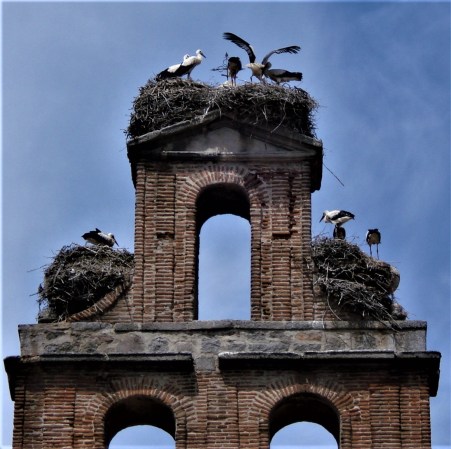
As for the photo: young storks in Avila, Spain, ready to fly. The one at the top is bouncing up and down, waiting for the breeze to get under his wings and lift him to sun and stars. High in the sky above him, almost unseen, his parents wait, ready to swoop down and assist him when he gets lift off. Uncertain he may be in those first few triumphant wing strokes, but down they come, place their wings below his wings and show him how it’s done. For him, it is the world that awaits him.

For me, and people my age, the world shrinks, walls close in, the daily process of living becomes more difficult. My joy: not in the lift off, but in the painstaking processes, getting up, getting washed and shaved, getting dressed, going downstairs, the early morning taste of fresh-brewed coffee, each sip a pleasure … and out in the garden, spring robins calling, a phoebe whistling, rose-breasted nuthatches, American Goldfinches, and the wondrous joy of just being here, sitting in the sunshine, lapping up the warmth, and every moment of every day a triumph renewed.
IMG_1060 (2)

Still Life with Hollyhock

IMG_0206

Still Life with Hollyhock
Geoff Slater

How do you frame this beaver pond,
those paths, those woods? How do you
know what to leave, what to choose?
Where does light begin and darkness end?

Up and down: two dimensions. Easy.
But where does depth come from?
Or the tactility, the energy, water’s
flow, that rush of breathless movement
that transcends the painting’s stillness?

So many questions, so few answers.
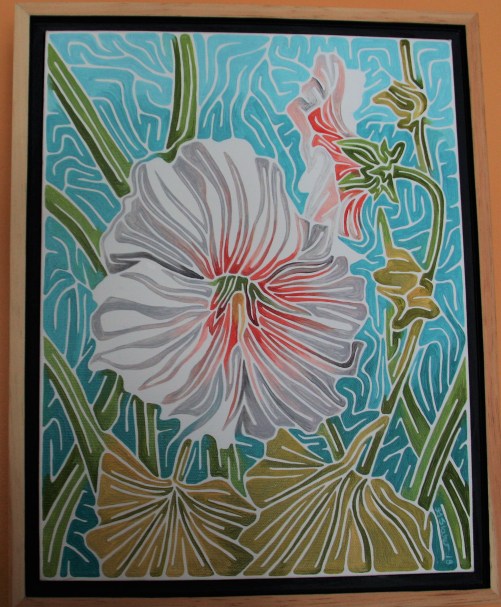
The hollyhock that blooms in my kitchen
is not a real hollyhock. It is the painting
of a photo of a genuine flower that once
upon a time flourished in my garden.

A still life, then, a nature morte, a dead
nature, portrayed in paint and hung alive,
on display in this coffin’s wooden frame.

Comment: I love the way language changes the way we look at life.  A still life painting becomes nature morte in French and naturaleza muerta in Spanish. Still life becomes dead nature. Fascinating. I also love the way in which the camera captures nature and the natural world. We think it is an accurate depiction, but really it isn’t necessarily that accurate. Filters, light and shadow, mood: they all fluctuate and sometimes we capture that which we never saw and sometimes that which we saw is never captured. Oh the subtle enigmas of creative art.

IMG_1005 (3)

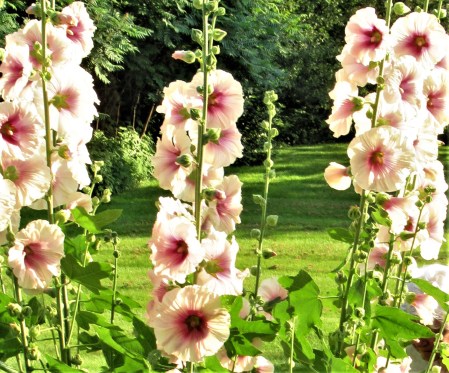
And it is the same with the hollyhock, my hollyhock, Geoff’s hollyhock. At the top of the page is Geoff’s painting of my hollyhock. The above is a photo of my hollyhock. Which bloom did Geoff capture and reproduce in paint? Language: and what do I mean when I say ‘my hollyhock’? My indicates possession, ownership. How and in what way does one own a hollyhock? How does one possess a garden, a flower bed, a tree? Are they not free, living, beings with a life and maybe even a mind of their own? Does one hollyhock talk to another hollyhock as the trees are said to converse with the trees? Do the trees in the garden possess a soul and if they do, in what sense do they possess one? And what is a soul anyway? I guess it depends upon the church and creed to which you belong. Certainly the garden has a life of its own and we discover that every spring when the grass and flowers grow back and the dandelions return.

image5

Questions: dangerous things, questions. Several of the questions posed above could have landed me in an Inquisitional institute in Spain in the 1500’s and 1600’s. That is a frightening thought. Alas, the philosophy of all that is way too deep for this poor poet and apology for a philosopher. One thing I do know, though: I love the garden going on outside my window and it is a privilege to be allowed to watch it, admire it, and follow its progress as the sun returns and the draws the birds back with it.

IMG_0198

¡Vale! Hail and fare thee well.

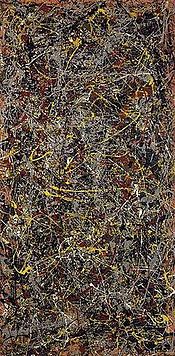
Bird’s Nest

No.5 1948 Jackson Pollock.jpg

Bird’s Nest
Jackson Pollock No 5 (1948)

This bird’s nest starts with a startling tweet
that wins a trilled, thrilled response. A flutter
of heart-string wings, creator, viewer, join

with the creation. Thin threads of life mix
and match their tangled weave, existential
tapestry, fathered in a feathered nest.

World without end, this labyrinth without
an entry point, without a beginning,
with a spaghetti-thread middle that meets

not in a breath-catch of the mind, but in
a brush-flick of coloured rain, a cycle
recycled of circled paint, circular

in its circumnavigation, its square
eight by four-foot globe of a new world whirled
in stringy whorls, reinvented beauty

drawn haphazardly from the bicycle
tour de force of this artist’s inner mind.

Comment: In my latest poetry book entitled The Nature of Art and the Art of Nature, I explore the relationship between art and the natural world. I have always been fascinated by what we see, how we see it, and how it affects us. The tiny print above is scarcely representative of the eight by four-foot world that the artist creates, or re-creates. And what is modern art? Is it a re-creation of the world as we see and feel it or a representation of a new internal world glimpsed by the artist’s mind and hand-turned into a new reality, the work of art? I guess it depends on the artist, his or her way of life, the way they approach the macrocosm, and how they view the microcosm of their own inner lives.

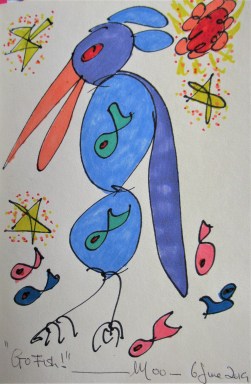
Creation: such a lovely word. Such joy generated as we create something new, be it something verbal, visual, or tactile. For me, it is more a verbal world than a visual one. My forays into art are wonderful, enjoyable, but very personal and artistically limited, even though I love taking a line for a walk or allowing the marker to trace images on the page. Dreams and a dream world: we need them. Sometimes reality is too much for us and we have to shut out the noise of the world and, in Antonio Machado’s words, ‘saber estar solo entre la gente‘ / know how to walk alone among the crowd. The loneliness of the long-distance runner. The isolation of the loving heart trapped within its cage of flesh and bone. The solitude of the spring nest on the pillars at Long’s Creek, overlooking the head pond at Mactaquac, as it waits for its restless occupants to return from their long journey back to the north from the south and start the rebuilding process, each twig, each straw, a minor miracle. And then the hatching and the fledglings and the return flight south that gifts the empty nest such loneliness as it waits for the cycle to begin again once more.

IMG_0824 (2)

Rain


Fundy 2004 003

Rain

rain
song-birds
trilling liquid notes
spring songs
flooding gardens

oh!
competitions
ritualistic rivalries
staking out territories
winter stalwarts
versus
nouveaux venus
with their summer wealth
of well-fed health

everyone competing
for their garden niche
males en garde
guarding each square inch
their earthly paradise
carved in my yard

Comment: They lit up the Mountain Ash as if it were a Christmas Tree, American Goldfinches, twenty-four of them. The rain ran down the window panes and all the photos blurred and distorted. One at each end of the garden, two robins sang. Two pair of Purple Finches, the bright male and the dowdy female, pecked beneath the feeder as the chickadees, siskens, and juncos flitted in and out. The red squirrel scattered the ones in the tree and the grey squirrel ran at and over the ones on the ground. Chaos. And the rain, rain, rain came down, down, until the garden was empty and birds and animals had taken shelter.


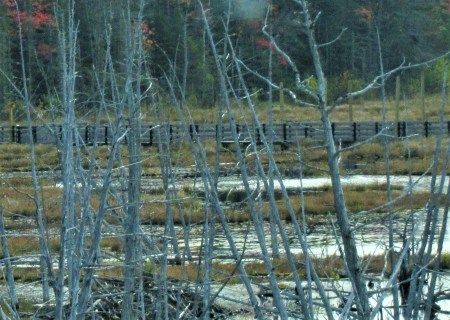
Beaver Pond

IMG_1304 (3).JPG

Beaver Pond at Mactaquac
for my beloved 

Beaver Pond, Mactaquac, on a fine spring day:
so sad to sit here knowing you can no longer
walk the trail. I remember the sun on your hair,
white, a flag of surrender to old age besieging
your mind and body. It cannot be seen on the board
walk where you stopped to commune with newts,
frogs, birds, fish, ducks, and the great blue heron
you disturbed. Remember? He rose from the reeds
with an anguished cry and a crack of mighty wings.

The wind in Island View is chill today, not a day
for walking in the wild. Monday: men arrive in a truck
and haul our garbage away. So much detritus,
such a mess at the roadside as winter ends and spring
brings thoughts of freedom to roam beyond spells
of ice and snow. Memories: I pack them into a green
green plastic bag and stuff them in the dustbin.

I want to be free. I want you to be free. I want to sit
and watch you wander, like you did last summer
contemplating the multiple meanings of grass, sun,
bird-song, herons, ospreys, beavers, their lodge,
this dam they constructed, this pond in which
they swim, nocturnal creatures, who live far away
from this lock-down and from our silent visits banned.

IMG_1318 (3)

Funny Old World


UNADJUSTEDNONRAW_thumb_2731

Funny Old World

It’s a funny old world,
this word-world of mine,
where one day
I am whirled off my feet
and the next
my toes seem to be set
in concrete.

Meaning?
I throw the question out,
a bone to the dog,
wet food for the cat,
sun-flower seeds for the chipmunk,
but there’s no reply.

Only the crows,
black-winged monarchs
destined to wear
a weighty crown,
cry out their anguish,
longing for the day
when they’ll come back to earth
and rule again.

Comment: A golden oldie, really. What indeed does it all mean and is survival the only thing that matters? For many of us, including the cats and the dogs and the birds in the garden “munchies in and munchies out, that’s what life is all about.”  And indeed it is. Some days I just look at the crow’s feet on the lawn or those growing beside my own and my beloved’s eyes and “What’s it all about, Alfie?” I ask myself.  It’s certainly a time when I question so much: my values, my life-style, my memories, the whole of my life, where I have been, where I might be going, the things I have done and left undone. My thoughts err and stray like lost sheep and then I realize that really, deep down, it doesn’t matter. Whether I am here, or not, the crows will continue to fly over the garden. The crows will leave their little footprints in the snow, and whether they like it or nor, crow’s feet will continue to grow in the corner’s of the old folks’ eyes, in spite of all the beauticians and all the rejuvenating lotions in the snake oil promises of this oh-so-beautiful world.

Losing It

IMG_1478 (2)


Losing It

When you lose it
whatever it is
your fingers pick at seams
hankies skirts shirts jeans
or strip a label from a bottle
or crumble bread or

there are so many things
you can do
personal things

on the table
a vacant cereal bowl
a silver teaspoon in a saucer
an empty teacup
returning your round moon stare

your hands
twist and pull
your nails
click together

blunt needles knit
then unpick stitches
trying to unravel
then to repair
this ball of empty air

Crows

UNADJUSTEDNONRAW_thumb_2788.jpg

Crows

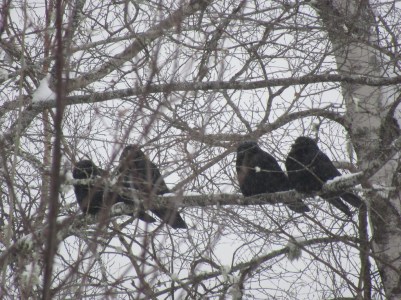
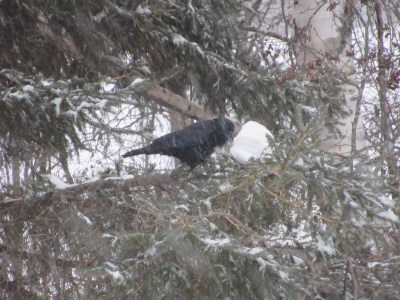
A family of crows lives  and nests close to our garden. Here are four of them together on the same branch. Two years ago, there were five of them. Last year there were seven and this year ten flew in the other day. They are such beautiful flyers. All weather conditions, too, summer and winter, all year round visitors.  I wish I could photograph the sound the air makes through their pinions as they swoop low over the roof on a warm summer’s afternoon.

UNADJUSTEDNONRAW_thumb_2741.jpg

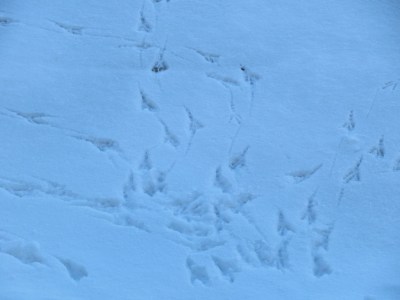
And they leave such gorgeous tracks in the snow. It is always fun to have them around and totally raucous when they find something worth eating.

UNADJUSTEDNONRAW_thumb_2731

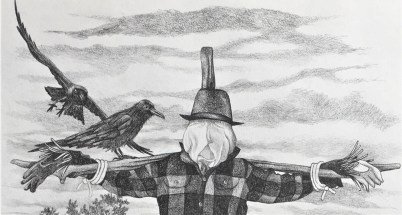
Geoff Slater has captured them to perfection. He’s better with his pencil than I am with my camera.

image3 (10)