Myth Magic

IMG_0486

Kingsbrae 13.3
13 June 2017

Myth Magic

This old world, born again,
renewing itself before my eyes.
My hands reach out to touch it
and I feel it grow beneath my fingers,
so soft, so sensitive,
and my memories as wild
as the delicate deer that tumble
and run to enter the gardens
and plunder red roses
from the holy of holies.

Some days, the warm earth
trembles as those old gods walk again,
Orpheus, Pan, Diana by moonlight,
Narcissus perishing by the pond.

 In our Secret Garden,
Robin song still haunts and enchants me.
Echo calls back from a not-so-distant past
and her voice lingers among birdsong,
soft and long.

Chronotopos

IMG_0066 (2)

Kingsbrae 13.1
13  June 2017

Chronotopos

plant a plant
deep its roots
rooted in fine soil
potting soil in a pot
firm the fingers
the spot well-chosen
in a flower bed
in a pattern
in an empty space
in a growing garden
within a larger garden
in an old estate
in a small town by the sea

Russian doll puzzle
garden after garden

(one a secret
with its birds and voices
lost in the hedgerow
and the echoes
of secret meetings
watched only by the guardian
the robin that watches)

planted and replanted
unfolding flowers
in a sunshine world
in a state of grace
hope and handicraft
hand in hand
with faith and belief
and everything planned
to take advantage
of this time and this space

these words so simple
these thoughts so complex

Comment: I began this poem on  10 March 2017. It formed part of my initial poetry sequence with Kingsbrae unseen, save for videos and photos of the gardens and their history, viewed on the Kingsbrae website. As I have grown into the KIRA experience, or perhaps I should write ‘as the Kingsbrae experience has blossomed within me’, so I have found these words prophetic, yet strangely inadequate, in the way all words are inadequate when tides flow, days flourish, and ideas blossom, sometimes in that formless world between sleep and dream where reality is something for which the writer reaches out but finds it is beyond the fingertips and just out of reach. As my Judo instructor told me, a long time ago:

“The more you strive,
you cannot reach it.
The hand cannot grasp it,
nor the mind exceed it.
When you no longer seek it,
it is with you.”

Carlos Carty

IMG_0134 (2)


Journal: Carlos Carty addressed the group of resident artists tonight. Carlos is from Lima, Peru, but he has lived for the past few years in Brazil. He told us how, at the age of 15, he had discovered music while still in school. It was, he said, love at first sight. However, musical instruments were expensive and not easy to obtain, so he learned to play rhythms and music on throwaway things, empty boxes, plastic and glass bottles, material that could be re-cycled. He was self-taught and has had few lessons. However, his explorations have led him to the Pan Flute, the Andean flute, the Chinese (or sideways) flute, and to many of the myriad flute-like instruments that are played in the Andes in general and in Peru in particular.

Carlos is interested in all types of music and would love to be a full-time musician, dedicated exclusively to his music. However, he has a family to look after and music alone will not keep food on the table. This was a problem shared by all the artists in residence. He then told us of some of his difficulties. He also told of his preference for his own people’s traditional music. This music existed before the Incan Empire and long before the arrival of the Spanish conquistadores who laid his land and his people to waste. Part of Carlos’s musical experiments have centered on restoring a melodic happiness to a Peruvian traditional music that is, by nature, sad. Add to this his ability to create music from all types of recyclable material, and you will see Carlos as an innovator. His own compositions demonstrate this innovative spirit and he happily blends any and all types of music to the traditional music as he searches for new ways in which to express himself, his moods, and his emotions.

With regards to KIRA and the Kingsbrae experience, Carlos stated that six months ago, while thinking about his application to KIRA, he realized how important it was to write down his ideas and focus on the elements that made him the musician that he is. From these cogitations arose his ideas on the eclectic nature of music and the necessity to recycle not just music, but the means by which music is made. Music, for Carlos, comes as an imitation of nature. It is the sound of water, of rocks knocking against each other. It is the sound of the wind through grass and reeds, the beating of wood on stone. He also spoke of the various waves of immigrants who came into Peru. The African slaves, in their moments of leisure, expressed themselves in sound, sounds made from the very materials with which they were laboring. This too became a part of Peruvian music.

One of the reasons why Carlos loves the flute is that it is one of the world’s most ancient instruments coming after the percussion of wood on rock and taut animal skin or shells. Flutes go back many thousands of years, to ancient Greece, among other places, and they are the world’s original instruments and bind all cultures together via the international language of music.

Many questions followed Carlos’s presentation. Most of them centered on a clarification of one thing or another. However, thanks to Anne Wright, a very productive theme was introduced: the relationship between North American aboriginal music (especially the first nations peoples of Canada) and the traditional music of other aboriginal American people. This theme merged into the question of identity, loss of identity, and the attempt to recover that lost identity, especially in the current age when so many differences are so easily erased. Language, culture, identity, music … they are all tied closely together. Carlos is an excellent ambassador and has the personality to explore and develop such links as these. Perhaps there will be further room to develop these contacts at a later date.


Fête / Fate

img_0181

Fête / Fate

Clowns are clowning,
playing up to the crowds.
The stilt walker in his top hat
climbs up to the clouds.
The man on the unicycle
tips his hat, winks his eye
at all the little girls
as they pass him by,
one on a white horse,
one with a teddy bear,
and one who’s invisible
and is no longer there.

 The tight-tope walker
walks his plank
trying not to fall
on wondering,
upturned faces
and open eyes
that watch it all.

The seals do their sea-side thing,
balls balanced on their noses,
tossing beach balls upwards
to the little girl who poses,
then juggles them so cleverly
while the clowns start to sing.

The magician conjures rabbits
and covers them with flowers.
Everyone is happy, though they’ve
been sitting still for hours.

On the trapeze, a little slip:
the artiste falls through the air.
She doesn’t have a safety net.
The silent crowds just stare
at her body twitching there:
yellow sawdust, golden hair.

Comment: This poem was written in Kingsbrae, but I don’t think it will be part of the Kingsbrae Sequence. I wrote it this morning after reading in the online Guardian about the developments circling around Brexit in the wake of the recent UK election and Naomi Klein’s article, also in the Guardian, on The Shock Doctrine. Life is indeed like a circus, as the old song says, but we’re in grave danger of falling off the trapeze.

Painting

untitled


Kingsbrae 10.4
10 June 2017

Painting
for
Geoff Slater

I took a line for a walk.
It was
as disobedient as
an untrained puppy on a leash,
as crazy as a kite
in a wind-filled sky,
as joyful as
a schoolboy when they cancel school,
as easy as
pie when the R is squared.

The dog walks round in circles,
gets my legs caught in his leash.
The kite, all twisted strings,
comes tumbling down a ladder of sky.
The apple pie is a pulled-up sheet,
folded double, and I am a child again,
trapped in my boarding school bed.

“Color me now,” my painting cries
and I fill the spaces between the lines:
blue for happiness, blue for hope;
yellow for the lion mane of the sun;
red for the redbreast;
brown for the worm;
and green for schoolboy freedom
at the end of term.

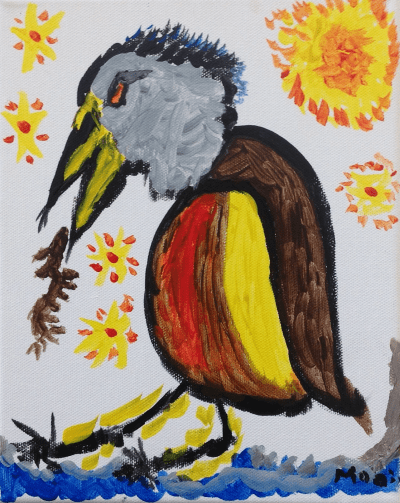
Journal: I had the great pleasure of working with Geoff Slater this afternoon. He sat me down at his painting table, alongside all the children, and gave me a palette, brushes, water, cleaning paper, and a rainbow of paint. Then he placed an easel and a canvas before me and put an apron on me to protect me from the paint. “Go for it,” he said. I looked at a field of white … and I remembered … “Drawing is taking a line for a walk” … so I drew a line, first a beak, and then a head and an eye, then I added wings, and legs … it was wonderful. The children were laughing with me and I was slapping the paint around with great delight. “Let me see, let me see,” they cried. And then, when they saw it: “What is it?” It was even more fun when I started to fill the spaces between the lines. This is, or was, the first time I have ever placed paint upon a canvas. In my old age, I have started to paint. “Is it a worm or a fish?” they asked. “Is the bird going to eat it?” “Is the bird spitting it out?” Such curiosity … and even I didn’t know the answers. “What’s the bird’s name?” asked one little girl. “Eagle-eye,” said the other. “And the worm’s called Squirmy,” added a third. “Are they talking?” another chimed in. “Yes,” I said. “I think they’re friends and they’re having a chat.” What fun. We left the painting out in the sun to dry … and now I don’t know where it’s gone. Let me know if you see it, anyone.

Word Blooms

img_0165

Kingsbrae 10.1
10 June 2017

Word Blooms

Snow
a blank page
below it
dormant bulbs
paint box colors
waiting to awake

Watchful
the gardener’s eyes
eager her helping hands
rainbows the flowers
pushing into bloom

Words
also wait for the sun
to warm them
to pluck them
from their word beds
and give them shape

Light
and delightful
the word seeds
blown across the world
implanted their ideas

Words
taking root
their blossoms
blooming sudden
in the reader’s mind


Word Blooms Voice Only

Word Blooms Music

Scent and Touch

img0137_1

Kingsbrae 9.4
9 June 2017

Scent and Touch

A feather upon the cheek,
this fern frond held
fragile, hesitant
between fine fingers.

Touch and smell:
two senses engaged.
A paint brush sounds,
brush-brushing lightly
the expectant skin.

Faint the taste tested
suggestive
on tongue tip.
No sight, just insight.

I have a sense of senses lacking.
My words reach out like fingers,
but they can neither retain
nor explain the meaning of it all.

Comment: “Built in cooperation with the Canadian National Institute for the Blind, the Scents and Sensitivity Garden is dedicated to the memory of St. Andrews’ resident Albert McQuoid. The garden features raised beds that allow handicapped, sight impaired, and wheelchair bound visitors the opportunity to enjoy the feel, and scent, of the plants and flowers right within arms’ reach.”

Love Spoon

039

Kingsbrae 9.1
9 June 2017

Love Spoon

Celtic the Knot
binding heart and soul
the love spoon
carved
by caring hands

Sharp moon blade
honed by the wind
white
wooden clouds
flowing against
dark sky grain

Sweet surge
time and tide
tied together
knotted
our heart strings
twisted our love
forever in this
Celtic Knot

Comment: Celtic Knot is the name of one of the more formal gardens at Kingsbrae. It is also one of the symbols carved into Welsh Love Spoons and signifies eternal love. Carving the love spoon was one of the traditional tasks given to the young man when he asked for the hand of his beloved in marriage. In addition to showing craftsmanship and woodcarving skill, the task of carving the wood spoon kept the young man’s hands occupied while he was courting. Parents would then be able to check on the progress of the love spoon and ensure that their daughter’s virtues were in safe and trustworthy hands.

Poetic Process: Thursday Thoughts

img_0186


Kingsbrae 8.3
8 June 2017

Poetic Process: Thursday Thoughts

The end result of the poetic process, however we define it, is the poem. Whether the poem be good, indifferent or bad, depends on a set of critical value judgments of which the poet may or may not be aware at the time of writing. The end product must be allowed to look after itself. But what about the process?

The question is simple, but the answer is more difficult, because the actual nature of the process will vary with each one of us. If the end point is the poem, how do we write the poem, what is its starting point? Is it when we sit down to write? Is it when the pen nib (yes, I still write the old-fashioned way) makes contact with the paper? Is there a pre-writing starting point and if so, where does that begin? Is it in the poet’s head, or the poet’s eyes? Does it reside in touch or scent? Good questions: no answers other than the failsafe … it depends.

One thing that has emerged from this KIRA retreat is that above all we need time to be artists. Art and poetry take time, and artists, whatever their medium, need time to think, time to practice, time to splash paint on canvas, time to sit down and put their head in their hands and meditate … “What is this life,” writes W. H. Davies, the great Welsh poet, “if full of care, we have no time to stand and stare.”

Elise Muller came up with an interesting exercise for developing self-expression. “Write down a question with your dominant hand,” she said. “Then answer it by writing with your less dominant hand.” I tried this. “What do you mean by writing process?” my right hand asked. My right hand held the pen about half an inch from the page and made me stop … and think. I thought about the critical analyses, usually ultra-academic,  that I had written and read over the years. Then I started to organize them into do’s and don’ts. The thoughts of certain serious writers sprang to mind … then I switched my pen to my left hand.

Uncontrolled, uncontrollable thoughts came tumbling out and spilled off the end of the pen on to the empty page that rapidly filled with visual and verbal images: evening falls and the stars grow into flowers in the darkness … three deer enter an empty field and dance on the dandelions … the sky fills with snowflakes that erase, one by one, all the objects in the yard … the tide flows back in and the bay recovers its memories of silver fish beneath the waves … the half -empty / half-full glass becomes meaningless: its essence is to filter the sunshine and to sparkle with light … clouds gather into small, wooly herds and the wind chases them across the sky …

To be filled with poetry and creativity we must first be emptied of the cares of the world. Then, when our heads are empty and free there is space for them to fill with the most beautiful images and ideas. This creative process needs time. Time to download and forget our worries. “Time to stand beneath the boughs and stare as long as sheep and cows” (W. H. Davies again). Time to be ourselves. Time tobe. Time to become one with nature.

To gain this state of freedom, we need to be free of financial cares and woes. We need to escape from domestic duties. We need to be alone (when we need to be alone) and among friends of a like mind (when we need company). “The time to see when woods we pass, where squirrels hide their nuts in grass” (W. H. Davies, yet again). So, in the poetic process, we need that freedom to create, to cut the ties that bind so tightly, to walk and watch and stop and stare. When that old, tired head is empty, the poetry will flow back in. And it will be a poetry not of grinding ideas but of dancing metaphors and sparkling words. “A dull life this, if full of care, we have no time to stand and stare.”

KIRA has gifted me with this time, this quality time. Clare and the WYPOD and my Fictional Friends and the Thursday Grunts and my fellow New Brunswick writers have encouraged me to take advantage of it. The process is in process. Some of the results are already being seen on these pages.

My thanks to all those who made this adventure possible. I would also like to thank all those who now facilitate this process every day.


Words

IMG_0167.JPG


Kingsbrae 8, 2
8 June 2017

Words

Here, on the seashore,
the whisper of waves,
splashed with a flash of sun,
wind fingering the hair,
the light a delight,
and wordless this world
though its beauty be
configured in words.

The scything of the sea,
the land seized in snippets,
grey stones, red rocks,
gelatinous mudflats
blue on white striations.

Seagull wings
snipping celestial ribbons,
salt caked keen on lips,
sea weed scents sensed
yet never seen.

Captivated we stand here,
unattached our single wings,
save to this singular beauty:
peregrine the falcon soul,
so solitary as it soars.

Comment: So many of these new poems are just that, “new” and “raw”. Words, for example, is just a couple of hours old. That is the gift of time that I have been given. The writing process is so rapid that there is little time to digest the last thought and image sequence, before the next comes tumbling along. I guess it’s just a question of rolling merrily along and we’ll see later what we still think is fit for survival. The selecting of these poems will be an interesting task … and who will select the selectors …