Wednesday Workshop: Attending a Reading

weir 2

Wednesday Workhop
Wednesday, 04 April 2018
Attending a Reading

            Number one piece of advice: don’t arrive late. I thought last night’s reading at the Oromocto Public Library began at 7:00 pm. I used Google maps to locate the library and I left plenty of time to get to there early. The Oromocto Public Library is just off the main road, tucked sideways on, so you are driving past it before you see it. I didn’t see it.

            I drove to the first roundabout, went straight through that, looked again: no library where the library ought to be. So I drove to the second roundabout. Still no library, and now I was running out of road space and the highway beckoned. So, I went right around the second roundabout, scanning both sides of  the road for the library as I drove. Still no library. I returned to the first roundabout, went right around it, drove back to the second roundabout … I was becoming fixated on driving in circles … then back to the first again.

            Just past the first roundabout, I spotted a gas station. I pulled over to ask the way to the library and there it was, just in front of me, right beside the gas station, facing the new Japanese restaurant, and sideways on to the road. There was one parking spot left and I took it.

            When I got inside, the library was very silent. I asked directions to the reading room and was directed to the back of the building. The reader stood before the audience, with the podium at his back, and was already talking. It was 6:50 pm. “Wow,” I thought. “He must have started early.”

            I have known Chuck Bowie, the invited reader, for several years and we share the same writer’s group, a group which he organized. He invited me to join it and we meet regularly (there are seven of us), once a week, on Tuesdays. Regularly: this is Canada … regularly, when it isn’t snowing, when there’s no icy rain, when the temperature is above -30C, when the wind doesn’t threaten to blow the car off the road … regularly, you know what I mean. There are usually three or four of us at each meeting.

            “There’s Roger,” Chuck announced my presence as soon as he saw me.  The audience turned round and several people whom I knew gave me a smile and a wave. There were no vacant chairs. A lady at the back gave me hers and went to fetch another one for herself. I found out later that she was the organizer and I thanked her profusely for her generosity.

            Chuck, as I found out later, had started at 6:30 and was well into his stride. He mixed anecdotes from his stories with advice about writing. As I was settling, he was explaining how much research he had done into wine and wine growing for the winery scenes in his four Donovan novels (the series is called Donovan: Thief for Hire). I love wine and I have visited several excellent vineyards in Rueda and La Seca (Spain). Chuck’s deep knowledge of the vines impressed me. “Roots,” he told us, “sometimes going down twenty-one to twenty-four feet.”

            I thought of the Spanish wines with their denominations of Old Vines, Reserva, Gran Reserva as Chuck dragged me from the outside world to the inside world of the winery laboratory where the crime had taken place. Then he read an excerpt from his novel, four or five pages that illustrated the use to which he had put his knowledge of the vines (Book Four of the series, Body on the Underwater Road).

            Chuck then talked about writing from memory (Rumania) and emphasized that memory alone was not enough. Memory gives atmosphere but accurate details come from many places, including the ubiquitous, omnipresent, and virtually omniscient Google search. Thus, as he explained, cum grano salis, the churches in Rumania are circular, constructed that way “so the devil may not corner you.”

            From memory and Rumania, he moved to Manchester Gangs in the 1980’s (Book Three: Steal It All), a simple anecdote about how the neighborhood protection racket protected the local families who in turn protected the criminals, while all crime was committed outside the area. Chuck’s ability to turn a table-top conversation into the idea for a story, or in this case, a full novel, is exemplary. How many creative seeds are scattered on stony ground, never to come to full fruition?

            Violence can play a meaningful role in the crime thriller but it has to be meaningful, and it must be accurate. Chuck spent some time explaining how he had researched guns and armaments so that the right weapons would always be carried by the right people and used in correct fashion at the right time. He talked a little about entry and exit wounds and I had visions of Rumpole, in the Penge Bungalow Murders, stabbing a ketchup filled sponge in the kitchen of his suburban home on The Gloucester Road, to see how the stains spattered, much to the disgust of She-who-must-be-obeyed.

            Chuck’s next book, the fourth in the Donovan series, Donovan: Thief for Hire, is called Body on the Underwater Road. Much of this story takes place in St. Andrews, New Brunswick, and Chuck explained how he had scouted out the local area and, in particular, the ‘underwater road’ from the mainland to Minister’s Island. The Fundy Tides, the highest in the world, cause the roadway to disappear at high tide, thus making the island inaccessible for long stretches of time. It also makes the underwater road a natural fishing weir for dead bodies. This research work involved live interviews with the local RCMP and others on the movement of bodies in the Fundy Tides, where would they end up if they were inserted into the water at place A, B, or C. That sort of thing.

            Chuck ended with a request for questions and the audience announced their own engagement by asking questions on how to develop characters, how to name characters, how to thread narrative arcs, and on how much rewriting is necessary if an arc goes wrong. The answer: “Lots. Sometimes you need to abandon the arc completely; other times, you must rewrite it from top to tail. But cave scriptor / writer beware: if you make a change on page 272, make sure that it checks out all he way backwards, page by page, back to the book’s beginning on page 1.”

            The use of humor within a thriller series serves to illustrate the layers of complexity that the characters manifest. The insertion of this element serves notice that genre writers who are serious about their craft write with the intention of elevating words, their sense, and their impact on the discerning reader. It also serves to layer the novel with additional meaning. Such layers of complexity spark joy in the writer.

            An interesting evening, then. With some old friendships renewed and some words of wisdom cast before an appreciative audience by the Atlantic Provinces Director of The Writers’ Union of Canada and local Fredericton author, Chuck Bowie.  I attach his web page. Do some research: check it out.  http://www.chuckbowie.ca

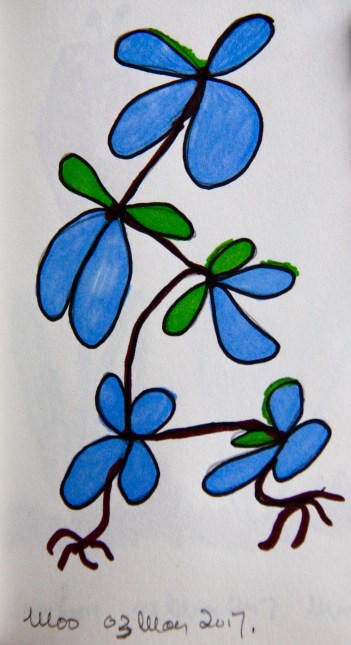
Painting credit: Roger Moore. Fundy Weir Poles (acrylic), St. Andrews, NB.

Why I Write

IMG_0055

Why I Write

In the online creative writing course that I am currently taking, we were invited to read two articles on why I write, one written by George Orwell and the other by Joan Didion.  Both articles set me thinking: why do I write? My response to these articles, borrowed from my course notes and suitably doctored for my blog, follows. Note: this is the first of three planned statements. The second, on Joan Didion, will appear tomorrow on my next Wednesday’s Workshop.

George Orwell … where do I begin?

Homage to Catalonia is, in my opinion, one of the great personal memoirs written about the Spanish Civil War. Orwell fought on the side of the Republic, the legally-elected government, but fell foul of the Russian-backed Communists as they tried to unify the left under a banner of total Communism. The other side in the Spanish Civil War was, of course, the solidified right of the Spanish Falange and the Fascist Party. Orwell was targeted by the Communists and, wounded at the front, escaped across the French border with falsified papers. As he himself says in Why I Write, the political realization of the nature of totalitarianism led him to his stance as a writer. Animal Farm borrowed heavily from his Spanish experience, as did 1984.

Orwell sets out four reasons for writing. (1) Sheer egoism; (2) aesthetic enthusiasm; (3) historical impulse; and (4) political purpose. I personally identify most strongly with #2. Above all, in my case, I write my poetry in praise of nature and in sorrow for how I see us failing the natural world around us. However, I must admit that I also write out of sheer egoism (#1) and yes, I enjoy thumbing my nose at all those who have in one way or another slighted me and upon whom I want literary revenge, even if it be posthumous. Several of my older friends also write this way, though many of the younger ones seem to be more interested in money than in art for art’s sake. I guess retirement and a small but relatively reliable pension added to the gradual onset of a blighting old age make me realize that there is not much time left in which to amass a fortune. This in turn also makes my professed credo of art for art and not for money more acceptable.

Having come to the conclusion that I never have, and never will, make any money through my writing, although publish or perish has walked side by side with me throughout my academic career, I now embrace the fact that I do not write for money. In fact, I usually give my independently published books away to my friends. Nor do I want the sort of fame that causes the paparazzi, with their microphones and videos, and camerasto flock to my doorstep, like starving sparrows or winter’s chickadees, in search of the breadcrumbs that fail to sufficiently nourish. To be appreciated, in my own small corner, like a well-loved local cheese or a craft beer, welcomed on a cool night for its fragrance and body … that is enough for me, although I must admit, that for one of my metaphors or images to be sniffed at, as if it were a glass of rare liqueur or specialized port or a welcome New Zealand Pinot Noir, also has its attractions.

This doesn’t mean that I am satisfied with who I am and how I write … I am not. I hope I never will be. I do want to be the very best that I can be. That’s why I keep writing and why I keep taking courses and workshops on writing. It’s also why I read and re-read, and why I keep reaching out to you and my other friends, and why I am so over-joyed when you, in your turn, reach out to me with the occasional word of praise for one of my stories or one of my poems.

However, warm as is the friendship of the beginning, failed and faltering writers’ support groups to which I belong,  most, if not all, writing is done in isolation: me and my memories, me and my invention, me and my keyboard, me and my blank page, me and my pen, me and a-penny-for-my thoughts as I refill that pen with Royal Blue ink in the hopes that something regal will actually fall from the nib and grace one of my pages, even though I am really wondering yet again whether I should start that first paragraph all over, just once more.

Alas, me and the cat and the keyboard do not share a healthy working relationship, especially when she walks across the keys, sticks her kitty-littered rear end in my face, scratches her itchy chin against the computer’s sharp edge, and purrs wildly for kibble while adding oft-repeated letters and deleting so many of the wonderful words that I have so carefully accumulated.

Apologia

weir 2

Apologia pro vita mea
(for Ana)

          Late last night, I opened Alistair Macleod’s book The Lost Salt Gift of Blood and I re-read the first story. I was soon dabbing my eyes with a tissue and blowing my nose.

This morning, I want to destroy everything I have written. I know I don’t possess the verbal and emotional genius of the great writers and I sense that I cannot write like them. Graduate school taught me to be passive, not active, and to write impersonally, choking every emotion when I write. Academia also taught me how to kiss and how to run away with my thirty silver pence. “Never challenge the status quo,” my professors told me. “Learn the rules and disobey them at your peril.”

But here, in this private space where I create and re-create, there are no rules. The enemy is not clear any more and the fight is not one of black against white. It is rather a choice between diminishing shades of grey, and all cats are grey in the gathering dark that storms against my closing mind. Should I destroy all my writing? I won’t be the first to do so; nor would I be the last. And I won’t be the first or the last to destroy myself either. Intellectual, academic, and creative suicide: as total as the suicide of the flesh.

I carry on my back the names of those who have gone on before me as if they were a pile of heavy stones packed into a rucksack that I carry up a steep hill, day after day, only to find myself, next morning, starting at the bottom once again. But this is not the point: the point is that if I cannot write like the great writers, how can I write?

I think of Mikhail Bakhtin and his cronotopos, man’s dialog with his time and his place. I have no roots, no memories, and that is where my stories must start: in the loss of self, the loss of place, the loss of everything. I was uprooted at an early age, soon lost my foundations, and only survival mattered.

I look at the first page of one of my manuscripts. My writing manifesto is clear before me: “And this is how I remember my childhood,” I read. “Flashes of fragmented memory frozen like those black and white publicity photos I saw as a child in the local cinema. If I hold the scene long enough in my mind, it flourishes and the figures speak and come back to life.”

I am aware of the words of T. S. Eliot that “every attempt / is a wholly new start, and a different kind of failure / because one has only learnt to get the better of words / for the thing one no longer has to say, or the way in which / one is no longer disposed to say it” (East Coker).

Are these stories an exercise in creativity or are they a remembrance of things past? How accurate is memory? Do we recall things just as they happened? Or do we weave new fancies? In other words, are my inner photographs real photographs or have they already been tinted and tainted by the heavy hand of creativity and falseness?

The truth is that I can no longer tell fact from fiction. Perhaps it was all a dream, a nightmare, rather, something that I just imagined. And perhaps every word of it is true.

I no longer know.

Velásquez

IMG_0486

Portraits by Velásquez

 Velásquez sought asylum in Canada.
He set up his studio on the shore at Glace Bay.

He photographed short, stunted people
miners who worked underground
mining Cape Breton coal.

He waited while they shook or coughed,
had patience till they were still, then click.
When he had captured their spirits,
he blew up their photos to NHL size.

Slack jaws, puffy eyes:
“Man’s greatest sin
is having been born,”
one sighs.

Another seeks himself
through inner darkness.
He probes dark galleries
with Davy Lamps for eyes.
He finds no gold,
just seams of coal
that cling and clot his lungs.

Velásquez waits
for his cough to stop
and click he’s got him.
Sally Ann Second Hand clothes
lay siege to his tortured flesh.

“Life is a snap,”
Velásquez cries.
“And every photograph
a lie.”

Plagiary: Wednesday Workshop

img_0177

Plagiary
Wednesday Workshop
9 August 2017

No, plagiary has nothing to do with the plague, though it might do in certain circumstances, especially if a plagiarist is plagued by lawsuits from others who think that the thief has benefitted financially or unfairly from the theft.

What is plagiary? The Merriam-Webster dictionary suggests the following, and I quote, with references:

Plagiarius, the Latin source of “plagiary,” literally means “kidnapper.” “Plagiarius” has its roots in the noun “plagium,” meaning both “kidnapping” and “the netting of game,” and ultimately in the noun plaga, meaning “net.” The literal sense of “plagiarius” was adopted into English; in the 17th and early 18th century, a kidnapper might be referred to as a “plagiary,” and, in the legalese of the time, kidnapping was “plagium.” But “plagiarius” also had a couple of figurative meanings – “seducer” and “literary thief.” It is the latter that has made the most enduring contribution to the English language. A “plagiary” could also be one who commits literary theft (now usually referred to as a “plagiarist”) or the act or product of such theft (now, more commonly, “plagiarism”).

https://www.merriam-webster.com/dictionary/plagiary

From the above definition, we can conclude that plagiary is theft, the stealing of another person’s work, and, above all, the presenting of that work as if it belonged to the plagiarist. In other words, creators create: they are not meant to steal and misrepresent.

Does plagiary matter? Of course it does. By its very definition, theft, it is one of the Ten Commandments, and therefore something to be avoided: Thou shalt not steal. However, as with all things, the gravity of the crime depends very much upon the circumstances. In academia, where creativity and original thought is the ‘name of the game’, the theft of intellectual property is considered by the gatekeepers of the purity of knowledge to be a very serious offence. That is why so many universities so carefully define plagiary / plagiarism and place such stiff academic penalties on the plagiarists who offend. By extension, certain professions, such as journalism and science (in the broadest sense, the creation, protection, and distribution of knowledge) must hold to very strict rules on the subject of intellectual theft.

The article on plagiarism in Wikipedia [ https://en.wikipedia.org/wiki/Plagiarism ] opens several horizons. It stresses that academia (with its spin off into scientific and industrial research) and journalism (with its theory of scooping) are the two biggest areas in which plagiarism is considered offensive. Plagiarism, the article stresses, more than anything else, is re-quoting other people’s material while claiming it as one’s own and without citing the sources from which it was taken. This quickly leads to the infringement of copyright and this is a much more serious and complicated legal matter, as the article points out.

As for literary and artistic plagiary, this is a very different kettle of fish as artists seem to borrow from each other in the most curious of ways. Molière, for example, proudly announced that, as for his artistic material, “Je le prends où je le trouve.” This roughly translates as “I take it from wherever I find it.” In his day and age, imitation was a favorite rhetorical device, and the imitation of other people’s work was considered more like flattery than theft. Miguel de Cervantes, in the Don Quixote, that most original of novels, took the first sortie of the famous and ingenious knight almost word for word from an earlier entremés (short play to be performed in the interval between the acts of a longer play) entitled El entremés de los romances. This is not so much ‘Homer nods’ as Homer ‘carries a gun and holds up a local bank’. Do we cry plagiary or imitatio when the similarities between the play and the novel’s opening are such that for a long time people attributed the Entremés de los romances to Cervantes and referred to it as his early work?

I follow the Spanish tradition and often use lines and words from other authors in my own work. However, I think that what I borrow is in most cases well enough known for it not to need quote marks, nor to need identifying. Though Lovers Be Lost and Broken Ghosts, two of my book titles, come directly from Dylan Thomas’s poetry. However, I quote the verses in the opening pages of each book and Dylan Thomas’s name is clearly attached to them. If, however, I write “Rage, rage against the dying of the light” … or “Rage, rage … ” against anything, I think personally that the attribution should be clear as should the literary dialog that I am starting within the text. Similarly, if I write that “July is the cruelest month, because we expect the sun and it is always raining”, then surely the reference to T. S. Eliot is clear as well, and so is the attribution and twisting of his ideas. I have used the phrase “Jack Pine Poems” before now, without referencing Milton Acorn, but most Canadian poets will be aware of the origin of the term without my writing “following in the footsteps of Milton Acorn and his Jack Pine Sonnets” ….

To further complicate the matter, plagiarism is a hydra, and its many heads may take a multitude of forms. Wikipedia suggests that there may well be a whole epidemic of what might be called ‘literary borrowings’ that verge on plagiarism; there is, for example, a touch of ‘literary theft’ about all of these: “plagiarism, literary theft, appropriation, incorporation, retelling, rewriting, recapitulation, revision, reprise, thematic variation, ironic retake, parody, imitation, stylistic theft, pastiches, collages, and deliberate assemblages.”

However, as the Wiki points out: “There is no rigorous and precise distinction between practices like imitation, stylistic plagiarism, copy, replica, and forgery. These appropriation procedures are the main axis of a literate culture, in which the tradition of the canonic past is being constantly rewritten.” The quote marks show that this list is lifted bodily from the Wikipedia article.

What I would underline most strongly is that “the canonic past is being constantly rewritten.” Literature is, to a large extent, a writer’s dialogue not only with (in my case) his own times, but also with the way other writers have seen the world and written about it. And not just written about it: think of the geometric expansion of oral literature. We hear so much, so much is repeated, words and phrases slip in and out of common usage. There is usually a prime over, an original author, but when a word r a phrase slips into what might be called ‘common usage’, then plagiarism takes a turn in a different direction.

“To borrow from one author is plagiary, to borrow from many is research,” as Oscar Wilde is rumored to have phrased it. As a result, what is considered to be a can of worms in academia, science, and journalism, may turn into an interesting and not necessarily a dishonest practice in the artistic world. How about the erotic cowboy novel that I am thinking of writing? I am going to call it Fifty Shades of Zane Grey … how many copyright laws am I breaking with that little joke? None, in my opinion, yet given a competent lawyer and two or more clients greedy for money, and virtually anything can be turned into a fertile battleground for legalistic dispute. Hopefully, the pitiful pennies that I own and the innocent and innocuous literary discourse that I exchange with other authors, many of them long dead, will not bring on a flurry of lawsuits.

“Where there’s muck, there’s money,” as a famous Yorkshire millionaire once said. So quit mucking about with even the possibility of plagiary, check your sources, and, if in any doubt at all, make sure that you add those quote marks and those references. And remember, it’s better to be safe than holding up your hand in court and saying “I’m very, very sorry, M’Lud.”

Photos

Books

Photos

After eight years of retirement
I still have most of my books.
I keep them in the basement,
where no lights shine on the shelves.

Every day, when I come down to read,
I find more books than the day before.
I think they copulate in the dark.

At night, when I turn the lights off,
I can hear them all chattering,
and clattering away. At first, I thought
they were faking it, like human beings.

Now I am not so sure. What are they doing
as they lie there beneath their covers?

Books, a generic term:
I fear the dictionaries are worst,
lining things up in alphabetical order.
Then I wonder about the mysteries,
the philosophies, the religious tracts
that are hell-bent on controlling others,
but are notorious for not controlling themselves.

Whatever are they up to, I wonder,
as they rustle their pages and mutter
to each other on their shelves.

I have a collection of art books
with pictures of unclothed statues ,
not to mention real, naked people.
I am afraid to look at the photos.

Mont Blanc

IMG_0026 (3)

Mont Blanc
(for Chuck Bowie)

“But what is that stick-like thing
between notebooks and mouse?”

“That stick-thing by my mouse,
as you so elegantly phrase it,
is my Mont Blanc fountain pen.

It’s also a metaphor app.
You stick the blunt end in your ear
to wind up your brain,
then you carefully clean
the tip on a piece of paper.

If it leaves suitable marks,
you read them like Runes
and use them to create metaphors.

You can also use it to conduct music
or to take a thin, blue line for a walk.
It’s very useful for poets who don’t like
staring at computer screens, and with one
they rarely suffer from writer’s block.”

Return to KIRA: Thursday Thoughts

IMG_0087.JPG

Return to KIRA
Thursday Thoughts
27 July 2017

“You cannot step in the same river twice,” according to Heraclitus. And he was perfectly correct. Yesterday I returned to KIRA. But it wasn’t the same. How could it have been?

Geoff, Hanna, and Cherry met me at the door. Geoff shook my hand, Hanna gave me a big hug, and Cherry pushed her wet nose into my crotch. Some things don’t change and one of them is a favorite doggy’s greeting. Mary sat at her desk just inside the door and she got a big hug too.

One Small Corner, the book that I wrote while at KIRA in June was in my hand. I had a signed copy for each of them. They also had a present for Clare and I: lunch at the Garden Café, courtesy of KIRA and a trip there on KIRA’s latest acquisition, a new golf cart, driven by Hanna. We were early for our lunch booking and Geoff suggested a quick tour of the gardens since Clare hadn’t seen them.

We all climbed into the Golf Cart, Mary and Hanna in front, and Geoff, Clare and I on the back seat, looking back as KIRA slowly vanished behind us. Another quote: “History,” said Marshall Macluhan, “is like looking at the past through the rear-view mirror of a rapidly advancing car.” This is a wonderful metaphor for my feelings at the time.

I had just met the young lady who had inherited my room, the Red Room, and my studio, #1. Neither the room nor the studio belonged to me anymore. They were now closed spaces, occupied by another. It didn’t hurt. It didn’t drive a spear through my still suffering heart. It did, however, underline that the waters of the stream had moved on and were not the same.

The gardens had changed too. Gone were the splendiferous rhododendrons of June, present were the multitudinous colors of Late July. The tiniest alpaca, born just before I left at the end of June, was now a sturdy one month old, larger and much more self-contained. Moe was a month older too as he sat on the roof of his shelter and nickered away at the world in general. Our lunch table was reserved for 12:30 and we would see them all later, parading on the lawn.

The gardens were fuller now than they were in June: more flowers, more blossoms, more color, more people, more children, more hazards for Hanna to slow for as we made our way back to the Garden Café, past the Sensitivity Garden and the Therapy Garden, past the Labyrinth and the Maze, past the Dutch Windmill, past all those magnificent sculptures … new sculptures had appeared … the blue piano wasn’t there earlier … this month’s artist had erected a new piece in the Secret Garden … change was all around me … and I viewed it from the backward-facing seat of a slowly advancing Golf Cart.

We had lunch in the shade beneath the apple tree. I looked around for Carlos, certain that he and his shadow were both close by … but I could hear no pipes. I spoke to Clare in Spanish, just to hear that language once again, but Carlos still didn’t appear. How could he? The river had flowed on and he was back with his family in Brazil.

Friends dropped in at the table to chat: Brad, Tim, Stefan, Mikah …lunch came and went speeded on by reminiscences and plans. After lunch, we visited the exhibition put on in the Garden Café by the latest group of resident artists. We admired the pencil drawings, loved the paper-maker and her art, and were wowed by the rug hooking and the photographs …

I thought of our own exhibition, held in the same place in June. We had our paintings, courtesy of Anne and Ruby, our sculptures, thanks to Elise, but the silence of July’s exhibition had been broken by the sounds of Carlos’s pipes and the viva voce reading of my own poetry. We were not a silent group, but a noisy, head-banging, drum-beating, piping, singing set of selfie-videophiles … the river had flowed on.

Ghosts of our voices clung to the back porch when we returned to KIRA. Hanna and Mary returned to their duties. Geoff, too, had things to accomplish. We met with two more of the new resident artists and complimented them on their skills. Then we slipped silently away to join the river of traffic that flowed down Water Street and up and away and back again to Island View.

Yes, I enjoyed myself. Yes, I will return again in August for I have promised to do that. But each trip will be different and no two trips will ever be the same, for old man river … well …he just keeps flowing along …

IMG_0080

IMG_0087 (2)

IMG_0092


Yesterday

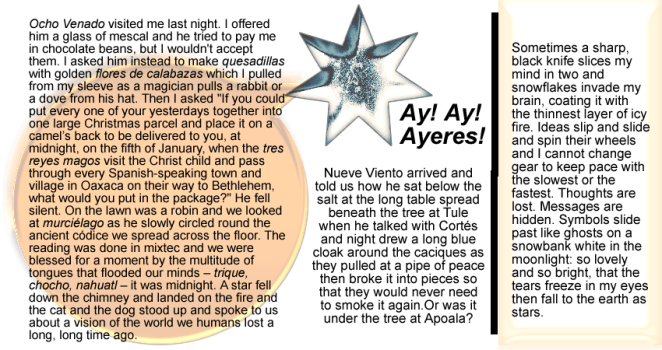
Ay Ay Ayeres

Digging around in the photo files that I transferred from my old computer to my Google drive, I discovered this golden oldie composed of my words and Clare’s images. What a revelation: I had completely forgotten that this group of work existed. I’ll dig them out ne by one and post them from time to time. Ayer is the Spanish for yesterday, hier in French. The title “Ay! Ay! Ayeres!” with its multiple plays All our yesterdays and its reference to the old song “Ay, ay, ay, canta no llores” draws together a series of memories, some in the past and some in the future. ‘How can we have a memory in the future?’ you ask. By recognizing a present moment, or one that lies just ahead in a future that ill become soon enough a present, as one that has already occurred in the past, thus confirming the circularity of our lives and the idea that all time is time present, one of T. S. Eliot’s recurring themes.

Ocho Venado: Eight Deer is a central figure (war leader) in the Zouche-Nuttal, a pre-Columbian Mixtec Codex. He is the war leader in the Conquests recorded in the codex (circa 1050-1100).
Quesadillas: Oaxacan tortillas filled with cheese and flores de Calabaza, gourd flowers.
Reyes Magos: the three wise men or kings who visited the Christ Child on January 6, the traditional Spanish Christmas.
Murcielago: the bat and a symbol of death in Oaxacan mythology.
Nueve Viento: Nine Wind descends from heaven to separate the sky from earth and its waters. Nine Wind at Tule meeting with Cortes is mythical not historical, though the meeting of Cortes with the Mixtec chiefs (caciques) did happen.
Apoala: The Mixtec nation was born form a cave (sometimes a tree) in Apoala, Oaxaca.
Spinning the wheels in the snow: a reference to Jean Chretien and one of his famous images.

The piece is written in a surrealist style that mixes historical fact with creative writing. The distant past is recalled (1050-1100), then the middle past (1525-1530), and finally the present appears. This mixing of time and place (Mexico and Canada) is also related to the surrealist movement. Surrealism creates a dream world in which images float and change shape within a time-space conundrum where dream is more real than reality and creates its own new meanings that are individual to each reader.

Any comments on this rediscovered piece will be warmly welcomed.

Residency: Thursday Thoughts

Chaos

Residency
Thursday Thoughts
29 June 2017

Application:
I would not have applied for the residency at KIRA had I not have been encouraged to do so by my writing group friends and by a friendly voice on the Kingsbrae phone.

Acceptance:
I was surprised to receive notification of my acceptance. It arrived on 2 March 2017. On 3 March 2017, I started to peruse the Kingsbrae web page and make the first drafts of poems that I would later complete on site.

The Red Room:
I was lodged in The Red Room in the KIRA Residence and I had a small desk at a window overlooking Passamaquoddy Bay. I spent a whole month looking out of that window and writing at that desk … or was it the other way round?

Community Commitments:
These were multiple, but they were always art orientated and therefore most enjoyable. They included working with school children, attending various unveilings and openings, and being present in our studios and discussing our art with visitors. On 26 June we had an exhibition in which each one of us either showed our work or produced a live performance.

Evening Salons:
Most evenings we had a literary / artistic salon in which we discussed various aspects of our art. These lasted two to three hours and some were summarized while others were video-taped. These quick-fire exchanges provided a backbone to our daily work.

Trips:
There was time for local trips and we travelled, individually or in groups, to many places including Deer Island, Passamaquoddy, Campobello, St. Stephen, New River Beach, Holt’s Point, Greenlaw’s Mountain, Jarea, Minister’s Island, Ile Ste. Croix, and several other locations. The photographic records enabled us to build our creativity.

Artistic Development:
This was individual to each of us, but we all remarked on a widening of our perspectives, a new commitment to narrative and theme, and a broadening of our artistic horizons.

Returning Home:
On my return home, I turned to my everyday life in which art, in my case writing, was of secondary, not primary, importance. The need to cook, to shop, to do normal household duties suddenly conflicted, once again, with my need to be a writer.

24/7:
24/7 is indeed a cliché. But for 28 days it became the pattern of my writing life. It was indeed a fertile time. I wrote some 100 poems, 25% of which will be rejected, with a possible thematic structure and three revisions already completed. Sooner or later, I will produce a book about this experience..

Conclusions:
This type of time commitment turns us from budding /artists into the real thing. We must strive to re-create these last 28 days in what remains of our creative lives. There can be no lesser or secondary choice, if we are to be serious about our art.

The Journey:
If we wish to travel from Halifax to Vancouver by bus, we must make several decisions.
1. We cannot get off at Moncton.
2. We cannot get off at Montreal, nor at Toronto.
3. Winnipeg, Regina, and Calgary are beautiful; but we mustn’t get off the bus.
4. If we do, we will never get to Vancouver.

Conclusion:
Art is a life-time journey: don’t get off the bus.