Sentence

SENTENCE

IMG_0279

Never underestimate the importance of the sentence, the power and placement of each word, the dynamism of the parts, the wisdom of the whole. I could write about this at length but, much more important, others have done so. My thanks to my friend and fellow artist, Jan Stoneist, for choosing the above sentence from my book, Stepping Stones, and carving it in Old Red Sandstone, from Wales. Cymru am Byth.

This article, attached below, illustrates the theory much better than I can.

THE SENTENCE


KIRA & so much more


IMG_0052

KIRA & so much more

KIRA & Kingsbrae Gardens are so much more than an outdoor adventure. They offer a journey into yourself, an exploration of your inner depths, a Jules Verne voyage into the interior of the world that you are: the artist, the creator, the truly spiritual person that you are capable of being.

How do I know? Because I have been there. I have walked those beaches, explored those shores, got my feet dirty in the Passamaquoddy mud, climbed those hills, viewed those islands from both sides. I have been out to sea to see those whales, have crossed the Old Sow from side to side, have imagined myself as a pirate for the shortest of times, crawling my sailing ship around the whirlpool, listening to its sucking sound, watching the seals as they rose from the depths, the sea gulls as they dropped from the skies.

Within the gardens, I have touched those secret places, grasped the flowers, crushed the leaves of herbs between sightless fingers and raised those perfumes to blind nostrils. I have also breathed in the scents of salt borne on a sea wind caressing the cheek, smoothing the brow, bearing away the cares of city and suburb.

Renewal is here and now. It is the sea wind’s kiss, the suck of mud, between the toes, barefoot, the rise and fall of tides, the ocean’s life forced into our lives and floating our cares and despairs away. Nothing of the city lurks here to ambush us, unless you bring it with cell phone, computer, texting, and the dull, grey air that will soon be vanquished and whisked away by the breeze, terns, gannets, the seal’s nose breaking through the sea’s surface, the deer crossing the road, demanding their right of way.

At the end of my own residency in KIRA (June, 2017), I tried to summarize my thoughts about the experience. To read them for yourself, click on this link: Residency, June 29, 2017. I was invited by the Writers’ Federation of New Brunswick to write about my stay. To read that, please click on this link: KIRA: an intensive creative experience WFNB, August 5, 2017).

To find information about your own potential residency at KIRA, click on this site KIRA – Kingsbrae Garden or this one KIRA Boutique Writing Retreat.

 IMG_0464


Life-Long Learning

IMG_0068 (2)

Life-Long Learning
KIRA & Kingsbrae Gardens

It’s hard to believe I could be back with my friends at KIRA & Kingsbrae by the end of next month. What an honor and a pleasure to be invited to help facilitate the first KIRA Boutique Retreat on Creative Writing. Geoff, Jeremy, and me … we will make a truly creative dream team. We are working out the details as I type this.

My task will be to work with poets and short-story writers. I have just successfully completed two online courses from the School of Creative Writing at the University of Toronto, my  Canadian Alma Mater (MA, PhD). Kerry-Lee Powell offered the first course: Writing Short Fiction II, while the second course, Poetry II, found me studying with Sachiko Murakami.

Life-long learning is so important. Over my life, I am not that old at seventy-four, I have learned that it is the ability to change, to adapt, to learn new things, that marks us out as creative people. Since my escape from imprisonment in the Ivory Tower of Academia (aka retirement), I have ventured into several new worlds, including that of online learning. My two most recent online courses from U of T now stand alongside an online course from Humber College on novel writing. Alas, this course did more to confirm that I wasn’t really a novelist at heart. As we live, we learn. I have now laid aside my three embryo novels to concentrate on my stronger areas: poetry and short stories.

Along with these online courses, I have been through the give (offering) and take (participating) of multiple creative writing workshops. So much knowledge gained. I have also enjoyed several positions as academic editor, associate editor, editorial board member, of multiple national and international publications, in English, French, and Spanish. In each of these new adventures, there was so much to learn.

Now I have the chance to return some of that acquired and accumulated knowledge to others who, like me wish to practice their life-long-learning skills. The unique KIRA combination of conversations, selected workshops, one-on-one talks, round-the-table discussions, evening talks, and readings will open many horizons to writers old and new, and not least to myself. As I live, I learn.

Round-the-table discussions: The Spanish have a wonderful term for this, de sobremesa. This refers to the discussions that take place, around the dining table, when the meal is done and everyone is comfortable in each other’s company and multiple conversations flow.

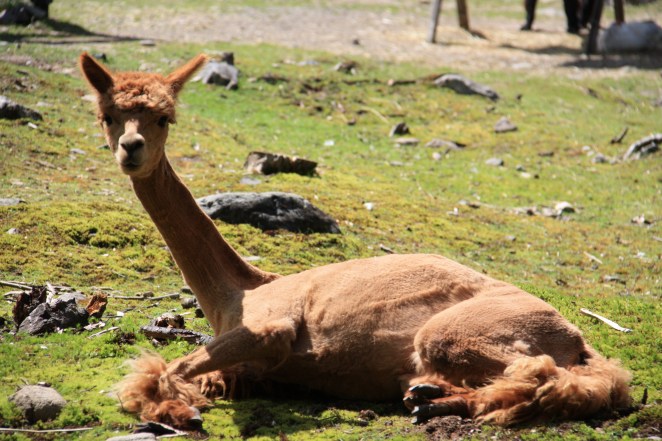
As for KIRA itself, I look forward to returning to my conversations with the land, the sea, the flowers, the birds, the statues, the alpacas … I love talking to them in Spanish … and the rowdy, old peacock who squawks his joy at evening, when the sun goes down. And don’t forget those Indian Runner Ducks: Beatrix Potter talked to them … and so did I … in fact, in Beatrix Potter’s case, one of her own Runner Ducks, possibly a distant cousin to those at Kingsbrae Gardens, became better known as Jemima Puddleduck. Who knows? Between poetry and painting, you too may find your own version of Jemima PuddleduckPaco the Alpaca, perhaps?

IMG_0124

IMG_0084

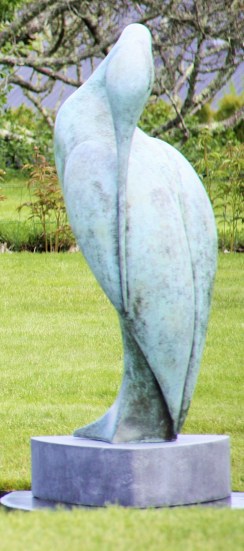
KIRA: The three standing stones, though I think of them as talking statues. I stood in the middle between them, closed my eyes, opened my mind, and listened to the magic as the breeze blew through them and sang secret songs to the music of their stone flutes. They filled me  with the sound of their ancient voices, their poems and stories, the magical mysteries of their myths. Come and visit and I’ll show you how to stand still and listen to what the stones have to say. When you allow that poetry to flow through you, you’ll never suffer from writer’s block again!

Writing at KIRA

39948917_706398923049634_3046174897211441152_o (1)

BOUTIQUE WRITING RETREAT
SUNDAY SEPTEMBER 30 – SATURDAY OCTOBER 6

This KIRA Boutique Retreat invites former KIRA Resident Artists (Roger Moore (June, 2017) and Jeremy Gilmer (July, 2018) to blend their knowledge and skills with those of the Kingsbrae Artistic Director, Geoff Slater, in a unique Artistic Retreat, tailored to the needs of each participant.

KIRA Boutique Retreats offer a series of one-on-one and small group encounters within the glorious surroundings of the KIRA Residence.

The KIRA Boutique experience includes scheduled one-on-one interviews with each of three instructors, Blue Pencil Cafés, small group workshops (according to demand), lively meal time discussions, and evening readings and talks by facilitators and participants.

The secret of these unique KIRA Boutique Retreats is the unbeatable ratio of participants to facilitators within a small, welcoming artistic community.

Your KIRA Boutique Experience may also include the wonders of whale-watching, the award-winning gardens at Kingsbrae, special events at the Kingsbrae Gardens, the beauties of the resort town of St. Andrews, and the outstanding gourmet food of the  Kingsbrae Garden Café.

As a participant, you can enjoy the solitude of your 20’ x 20’ artistic studio or you can join in the artistic discussions launched by our expert facilitators.

RETREAT FEES:

The KIRA Boutique Experience costs $750 for a six night residency.

This includes:

1. 6 nights accommodation in the beautiful KIRA residence.
2. 2 meals a day.
3. Tailor-made writing workshops (on demand).
4. Blue Pencil Cafés, one-on-one interviews with the facilitators.
5. Round-table artistic discussions at meal times.
6. Evening talks and / or open reading sessions.

Facilitators:

Geoff Slater, Artistic Director, Kingsbrae Garden / KIRA.

Roger Moore, award winning poet and short story writer, KIRA (June, 2017).

​Jeremy Gilmer, CBC finalist (short story), KIRA (July, 2018).

Please contact Mary Jones to sign up.

Phone 506-529-8281

PLEASE FEEL FREE TO SHARE THIS EVENT

Click here for the direct link to  KIRA and Kingsbrae.


Butterflies

img_0189

Butterflies

“Poetry gives permanence to the temporal forms of the self.”
Miguel de Unamuno.

That is what my writing is all about,
those temporal forms, fluttering and changing.
Butterflies, they live for a day or two,
perch and flourish, spread their wings,
excel for a moment, catch my attention,
then blown by a sudden gust of wind,
they tear their wings on a thorn
and perish in the blink of an eye.

Reborn in ditches, they cluster and gather,
congregate, black and yellow, on bees’ balm,
smother Cape Daisies and Black-eyed Susans.

Like shadows they shimmer, butterflies by day,
fireflies by night, terrestrial stars, lost, wandering,
floating in their forest firmament, hackmatack,
black oak, bird’s eye maple, silver birch, fir …

Impermanence surrounds us, dances beneath stars,
sings with robins, echoes the owl’s cry through woodlands,
poetry, the elemental soul, our words capturing nothing,
turning it into eternity, holding it for the briefest moment,
then letting it go. Island View, New Brunswick, Canada,
my home in the woods, my dialog with my place and time.

On Reading

IMG_0040 (2)

(Today’s photo: Cherry … she was a very obedient dog and always listened carefully. Sometimes she actually obeyed.)

On Reading

Yesterday, I posted an audio of me reading Monkey Presses Delete. I received some e-mails about this reading and realized that reading into the microphone, alone, without an audience, had crated a ‘new voice version’ of the poem. I thought about it overnight and came to the conclusion that my public readings are dictated by two things: (1) my own mood and (2) audience reception. Audience reception is, in itself, a double thing (a) how they perceive me before I even open my mouth (especially if I am an unknown quantity to them) and (b) how they perceive me as I use my performing and reading skills to manipulate them. And no, I am not a passive reader of my poetry, but a very aware and active one.

So, I rethought my relationship to Monkey Presses Delete, and re-recorded it this morning. The second reading is very different, as you will hear. Virtually the same poem, virtually the same poet, but a very, very different reading. I will be very interested to read and / or hear your comments on these two audio variations.

Monkey Presses Delete
(Take 2, Monday, 11 June 2018)

Wednesday Workshop: Codification

IMG_0068 (2)

Codification
Wednesday Workshop
30 May 2018

For me, it is vital to see how others read and interpret my work … what comes across, what doesn’t, how things are understood and read, sometimes in the same way, sometimes in different ways. It is always easy to pick out some favorite phrases. However, deciphering, interpreting, and then reacting to, a poem’s inner code, is a very different matter.

I love the cut and thrust of dialog … I was at our Tuesday night writing group meeting last night from 7-9:30 pm and we had a great time, back and forth across the table pecking, like wild birds perched on a literary feeder, at each others’ texts. My own texts are thickly layered and highly codified and I have become very interested in the theory of literary codification.

My own ideas are a development of those of Northrop Frye as he expressed them in The Great Code. When we lose our common code, to what extent do we need to explain a private one? This is of great import to Frye’s studies on William Blake, perhaps (in spite of his seeming simplicity in certain poems) one of the most difficult of English poets.

Perhaps the answer lies in Karl Jung’s theories on the racial subconscious: that we all share deep, (human) racial symbols that transcend words and often appear as symbols and images. If this is true, then we communicate, at a non-speech level, through metaphor and symbol, and that is more powerful and outreaching than linear language, however well and clearly codified it may be.

This emphasis on symbol, image, and metaphor leads us, of course, into surrealism, free writing, concrete poetry, sound poetry, and all those efforts to abandon the linear and reach into the subconscious roots of ‘that which binds us together as human beings’ … in my humanistic theories, to find the links that behind is more productive than the reinforce the fears and misbeliefs that separate. Alas, not everyone thinks that way in the literary world, and private codes can easily be used as wedges to force people apart.

We need codes, preferably codes that we can share. The question is, how explicit would we be, as writers, in explaining those codes? How closely should we imitate the writing codes of other people?

The eternal mystery of Aladdin’s Lamp: “New codes for old.” And don’t forget the magic words “Open Sesame.”

Ah, the joys of codification.

Commentary
This is my first post for some time, ten days in fact, 20 May. No excuses other than other commitments: to the WFNB, to my online poetry course, to my physical writing workshops, to my own creative condition … I am creating furiously at present. Codification is something that has interested me for some time: the Biblical Code, The Western Tradition, Courtly Love, the Icy Fires of Petrarchism, Romanticism,  Impressionism, Expressionsim, Surrealism. Modernism, Post-Modernism … the -isms, once started, are apparently endless. All of these -isms spiral round the ideas of verbal codes. In codification, I would like to start a discussion on what these codes are, how they affect us, what do they mean, especially when they can be so totally personal. By all means, join the discussion: what do you mean by codes? How do you use them? How do you interpret the codes of other people?

Wednesday Workshop: Balancing the Books


15 May 2002 Pre-Rimouski 035

Wednesday Workshop
25 April 2018
Balancing the Books

Two days ago, I wrote the following lines to one of the writing groups of which I am a member.
“Today, 23 April 2018, is World Book Day. We not only celebrate the world of books, but also the death date of three great authors. Miguel de Cervantes, William Shakespeare, and the Inca Garcilasso de la Vega. Three great writers, two continents, two languages, three if you include the Quechua from which the Inca Garcilasso translated his Comentarios Reales. The Inca Garcilasso didn’t actually translate the Comentarios Reales, for the originals were part of an oral tradition in a culture that lacked handwriting. Hence they were never written down. His mother was an Incan Princess and his father a conquistador. His mother kept the Incan culture and memories alive and it was from the oral traditions of his family (one side of it) that the Comentarios Reales were born. It was recognized in its day as one of the greatest books to come from one of the first outstanding writers with indigenous roots. Hence his place on the pedestal alongside the other two greats. All three died on 23 April 1613, the same date, but not the same day. Two different calendars were present in Europe: the old Julian and the more modern Gregorian … same date, but thirteen days apart.”
I knew long ago that I did not have the strength and stamina to make a living as a professional writer. I knew too that I could not put my beloved and my family through the strain of maybe, or maybe not, surviving financially on a creative writer’s income. I wanted to be an artistic writer, a poet above all, art for art’s sake, not just a commercial writer, writing adverts for a living, or pandering to the lusts of the baying evening newspaper crowd.
In order to support and care for my family I had to make money and balance the books. Rather than writing full time, therefore, I chose a career in academia. My career as an academic led to 90 research articles, mainly in my specialized field of Golden Age Spanish Literature, 70 book reviews, the publication, in book form, of part of my doctoral thesis, and an online bibliography, prepared initially thanks to the loving care of my beloved, and now turned, thanks to the Harriet Irving Library at the University of New Brunswick, into a searchable data base.

In addition to my normal course load, I also committed to twenty-five years of unpaid, voluntary overload teaching. I did this in order to maintain a small, understaffed program in a tiny Maritime university. I also had a long-term coaching career (Rugby) at club, provincial, regional, and national levels, and a commitment, at various times, to various editorial positions in 14 local, regional, national and international journals. My creative writing career has understandably suffered because of this commitment to research, teaching, editing, and coaching. In spite of that, while researching and teaching full-time, I was still able, with the help of family and friends, to publish 10 poetry books, 11 poetry chapbooks, 12 short stories and 130 plus poems in 20 Canadian (and other) journals. There was very little money in any this, other than my salary as a tenured professor, and I know only too well that to have been a full time, creative writer and to have maintained a house and a family without recourse to a second career would have been impossible.
Now that I have retired from university teaching, I can finally engage full time in creative writing. In my part-time creative writing career, maintained while I worked in academia, I kept a journal and made sure I spent at least one hour a day writing creatively, even if I had to get up early to do so. This resulted in a couple of poetry books with small presses and later a series of self-published poetry books that doubled with various festivals and other writing sequences. My poetry books never sold well, and there is very little money in poetry anyway, so when I started self-publishing, I determined to give my books away to friends and well-wishers who were interested in what I was writing. In retirement, I discovered CreateSpace and I now have thirteen books up on Amazon and Kindle. However, I am a writer and an academic, not a salesman and a marketing manager. As a result, I haven’t marketed myself and no, I haven’t sold many books. Self-promotion does not appear to be my strong point.
Last year, as Canada reached it’s 150th birthday, a birthday that ignores the fact that the country has existed for much longer than 150 years and that our indigenous people have lived here for 10,000 years or more, without any spectacular celebrations, questions were asked to selected writers about our Canadian Culture. What do we love most about Canadian Culture, was one such question. I gave the following brief answer: “Canadian Culture allows a person like myself, born in Wales, and speaking English, French and Spanish, to live and write in Canada about Wales, England, France, Mexico, Spain, and my adopted homeland. However, the literary and cultural industry boasts of our international character while almost totally ignoring me and writers like me. Those who guard the gates of the literary world ignore the self-published (often referring to us as adherents to what they term the ‘vanity press’) and they constantly belittle and put down those who have not progressed in the ways that they, as literary gate-keepers, find acceptable.”
Do I care? Of course I care. That is why I am writing this and why I will continue to write. Will anyone read this and take any notice? I doubt it. Will anyone take any action as a result of this tiny pebble cast into a Great Canadian Lake? I really, really doubt it. I can see the shoulder shrugging now as the eye-brows raise themselves slightly and the reject piles beckon. Will literary Canada keep staring at its own belly button and congratulating itself on its wonderful cultural opportunities for self-expression in writing? I guess it will. Will things change for artists on the periphery, for struggling artists, for artists like myself who with great difficulty have fought throughout their lives to continue with their creative writing while balancing the family books? I doubt it very, very much indeed.
But I am here, as others are here. Together, we have a voice. I would like it to become a  very powerful voice. This voice has long been side-lined by the literary establishment and the institutions. But we are many. And I too have a dream: it is that one day, we independent publishers, we self-publishers, will raise up our voices, and one day we will be heard.

Movie rights to a sonnet

Balloon lady

Movie rights to a sonnet

Meg Sorick wrote on my blog yesterday and suggested that poetry had flown out of our world.  Here are her words: “Poets used to be rock stars. And not that I feel like poetry has fallen from popularity, because Lord knows it’s all over the place in social media and the blogging world. But I cannot think of one famous contemporary poet. And I’m not talking about famous people who also write poetry. How did that happen?”

Meg’s is a very acute observation. My reply follows. I have changed it slightly from my reply on yesterday’s blog, expanding and annotating it.

“You raise a series of major questions, Meg, ones I have been thinking about for a long time. What is poetry? Has it vanished from our contemporary world? Is poetry as important as it was? If not, why not?”

I will begin with one of my favorite jokes. I made it as an author and a poet: ‘I cannot wait to be offered the movie rights for one of my sonnets.’ Movie rights to a sonnet: beautiful. I love it.

Baltasar Gracián, writing in Seventeenth Century Spain, penned the following: “Lo bueno, breve, dos veces bueno.” What is good and brief is twice as good.

I quote Baltasar Gracián for several reasons. Above all, what he wrote in the 1600’s is still true today. Perhaps, in this age of tweets, twitter, and sound bytes, it is more relevant than ever. Poetry: keep it short. Keep it brief. I would add one more piece of advice: make it memorable.

The rhetorical tools of poetry have never really changed. Reduced to their minima, they are metaphor, witticisms, snappy word plays, repetition, rhyme, rhythm, brevity, and cutting, memorable discourse.

Today, this is the language of advertisement, sound byte, twitter, tweets, labeling. Poetry hasn’t vanished: it has descended to its lowest common rhetorical denominators and today it serves a different purpose.

Trump, for example, is a magnificent poet. He relabels and reclassifies the world in oh-so-memorable epithets according to his own world-view and self-interpretation. As a destroyer and re-creator of language, he is magnificent. We may not like him. We may not always understand him, but we doubt and mock, to our peril, his poetic abilities and his abilities to create narrative and myth in sharp, memorable language.

Rap and hip-hop have also revitalized and politicized language. Poetry is not dead: it has taken to the street where it blends with twitter and tweet. Poetry is not dead: it is regenerating.

Poetry, in our contemporary world, has lost many things. Above all it has lost what the academic critics call The Grand Myth or the Grand Narrative. In The Great Code, Northrop Frye’s book on literature and the bible, the Canadian critic shows how English literature is dependent on the bible. The bible: a code, a poetic language spoken by all great poets. I would suggest that we have now lost that great code and we are no longer bound, in poetry at least, by biblical conventions.

We can say the same of other great codes, The Elizabethan World Picture, The Great Chain of Being, Ovid’s Metamorphoses, Courtly Love … codes come and go. They wander the hillsides like lost sheep. They migrate like people.

Migrate like people: a lucky phrase, plucked from the air, yet oh so true. Migrants, emigrants, immigrants: displaced people, we wander the physical world, each with our own set of cultural baggage. Dissatisfied people: we have left one place to travel to another and are unhappy in both. And remember, there are regional migrants, workplace migrants, weather migrants … wanderers all, they have no time to put down roots, to settle into a code of culture.

Ut populi, poesis / as people, so poetry: fragmented poetry, poetry linked to the intensely personal, poetry that reaches out to friend and family but does not extend to a universal code of language, culture, or being … in our current world, how could it?

We few, we happy few, we band of siblings, we cultured poets … we are the forgotten voices of the ivory tower, of an ivy-league academia. We have become immersed in the past, in our own navel-gazing, in the never-never land of things that probably never were and definitely will never again be.

Sitting at our computers, at our desks, at our kitchen tables, we will never connect with the rhythms of the street, of the soup kitchen, of poverty, of bag-ladies, of old men sitting outside the supermarket, their Tim Hortons cups in their hands, hoping for, begging for money. Migrants we may be, but migrating from where, to where, and why? Is my migration similar to your migration? I very much doubt it. Yet, in one way or another, each of us is a migrant. And all migrants pack their own bags carrying with them their memories, their myths, and all too often their native language.

You want poetry? Get out among the gente perduta, the lost people, the garbage cans, the back alleys, the panhandlers. Mix with the migrants. Stand for an hour at the traffic lights with your hand held out to stopped cars whose drivers roll up the windows, lock all the doors, hold their noses, and look the other way.

The nymphs and shepherds of our inner cities wear garbage bags to keep out the rain. They panhandle. They sleep at night in cardboard castles. They lodge in shop doorways. They sleep, poor shepherds and shepherdesses, on park benches. They shoot themselves full of dope with shared, blunt needles. They smoke dope. Drink alcohol from shared bottles. They fight so as not to share that one remaining bottle that they call their own.

Poetry is the voice of the deprived, of the indigenous, of the migrant, of the once-rich toppled from their jobs and left to drown in the gutter. Poetry is the voice of the left out, the abandoned, the depressed, the oppressed. It is the rust of the rust belt, the grind of locked gears, the language of muddled, mixed-up fears.

Poetry uses the same devices as it always did. As it always will. Like water, it flows. It seeks its own levels. It wears away stone. It rises to drown us. It carries our verbal arks, our cultural arks, our Noah’s arks, and it bears us, each and every one of us, into our dreams, out of our dreams, into our realities, into the worlds it creates for us, into the dreams it allows us to dream, into the realities of our everyday nightmares.

Poetry is the rediscovery of ourselves, our voices, our language. Poetry is what gives meaning to our lives, all of our lives. It is what makes us, even now, sit up, and listen, and learn, and live.

Violet

IMG_0004 (2)

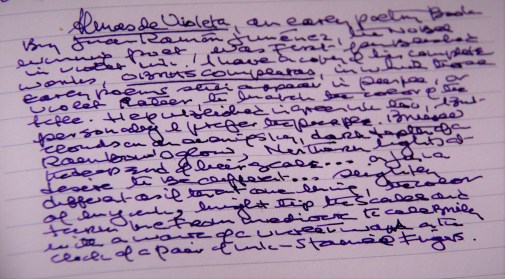
Almas de violeta, an early poetry book by Juan Ramón Jiménez, the Nobel winning poet, was first published in violet ink. I have a copy of his complete works, Obras completas, in which those early poems still appear in purple, or violet, rather, to match the color of the title. He published poems in green ink, too, but personally I prefer purple. Bruised clouds in an evening sky, dark depths of a rainbow’s glow, Northern Lights at the deep end of their descending scale … or is it just a desire to be different … slightly different, as if that one thing, the color of my ink, might tip the scales and turn me from mediocre to celebrity with a wave of a violet wand or the click of a pair of ink-stained fingers.

What else is there to do, other than meditate and walk your fingers across the keyboard, when rain mingles with snow and grey and white streaks fall at faster, slower rates to trace a network across window, trees, and garden? JRJ, Juan Ramón Jiménez, forgotten now by all but the scholars who read and teach him to the few ardent graduate students who clutter the ivy covered halls of academia and blow away the dry dust that settles on unused books when they languish on library shelves. Is that what will become of us, we poor poets of today? Are we to be reduced to the polvo seco de tesis doctoral / the dry dust of a doctoral thesis, as my good friend José María Valverde once wrote?

I guess the dry dust of a doctoral thesis is better than the silence of unturned pages, the empty sands of the voiceless desert, the dunes of forgetfulness shifting here and there along a sea-shore swept by shiftless winds. Forgetfulness: we must first be read … only then can we discarded and forgotten. And who will read us? Who will emerge from their twitter and their tweets to open a book and lift the written word from the page and carry it into their hearts so it can be placed on the soul’s altar and surrounded by incense and flowers?

Purple ink on a purple page, the violence of violet, life with it’s doldrums and purple patches, the cat curled up in its basket, one paw out to test the weather on this rainy, snowy day, when coffee appears at my elbow, as if by magic, and words seek sanctuary in a ritual flow of  song.