Self-Isolation Day 18

IMG_1773 (2).JPG

Self-Isolation Day 18

So we are in the eighteenth day of our Self-Isolation. Yesterday I added a fifth book to my group around the table: The Art of the Middle Game by Paul Keres and Alexander Kotov, translated by Harry Golombek. I have had this book since 1964 when it was first published in Penguin Books. Once upon a time, I played serious chess, was president of a chess club, and read widely about the game. But I have not played any serious, face to face chess since I came to Canada and the last games I played were in 1994, when I visited the Dominican Republic, although I did pay a couple of games in Oaxaca on my first visits there.

I dipped in and out of this book yesterday, playing sample games here and there. It was a joy to rediscover the movement of the pieces and to see how great minds viewed the chess board. Sharpe’s Riflemen are wonderful to watch on YouTube, but they cannot rival the two sixteen piece armies that wage battle on the sixty-four squares of the chess-board!

The Art of the Middle Game uses descriptional notation. This means that when the King Pawn takes two steps forwards, it moves from King two to King four. In descriptional notation, this becomes P-K4. If it is the first move of the game, by white, then it becomes 1. P-K4. If the opposition follows suit, then his move is also transcribed as P-K4. This gives us 1. P-K4   P-K4. And this is where the confusion arises: each side has a K-4, and a Q-4 and every other square is doubled up as well in a mirror image of army facing army. After such a long time away from the game, I found my concentration wavering in places and thus I had pieces on the wrong squares and had to start all over again. Very frustrating.

When I played chess in Spain, also back in the sixties, I was faced with algebraic notation, long in use on the continent of Europe. The eight ranks are lettered a-h, from left to right, and the eight files are numbered 1-8 from bottom to top, with ‘white on the right’ i.e. h-1 always white. This means that each square has a single, plotted designation and it is much easier to follow the game as there is no mirror imaging. In this fashion, 1. P-K4 would become e2 – e4 followed by e7 – e5. None of this changes the nature of the game, but it does change the speed and ease with which it is transcribed and followed.

I remember buying my first pocket chess set, in Boots the Chemist (!) when I was 9 or 10 years old. It is an old cardboard set with red and white squares and pieces. I still have it and I am using it now. The scrawl that I call my handwriting is still unmistakable, after all these years. That same day I bought Harry Golombek’s The Game of Chess, and I taught myself how to play, based on that book. I remember looking at the descriptional notation and not understanding how the system worked, even after days of memorization. Then, one morning, as Dylan Thomas, another Swansea Boy once wrote, ‘light broke where no light shone’ and as all the squares fell miraculously into place, the system of descriptional notation suddenly made sense to me. “Threshold knowledge is a term in the study of higher education used to describe core concepts — or threshold concepts — which, once understood, transform perception of a given subject, phenomenon, or experience” (Wikipedia). The discovery of the key to descriptional notation was indeed a threshold experience, as was the transition to algebraic notation. What a wonderful world we live in.

CV-19 Week 3 Day 3


IMG_1337 (2)

CV-19 Week 3 Day 3
A Change of Scene

Nothing serious happening with this change of scene, but this morning I put Phillip Larkin on one side and turned to a new book, Neil Sampson’s Apples on the Nashwaak (2019). This may be just the read you need in times like these. An excellent foreword locates the text of Neil’s narrative poem(s) in the long line of European narrative poetry. Neil’s introduction places his text in his own life on the land where he lives and wanders in Upper Durham, above the Nashwaak River. The text itself places us, as readers, in the long successions of repeated lives and deaths that mark the early settlements in New Brunswick, Canada. And yes, we have passed this way before, for better or for worse.

This is not a re-statement of ‘mal de todos, consuelo de tontos‘ / shared ill’s are a fool’s consolation. The colored apples on the stark tree that adorns the cover are a statement of hope, long term hope, even among the bleakness of difficulties, tragedies, and deaths. Like it or not, these things happen, and yes, there are survivors. Hopefully, there will always be survivors. And thus we must always live in hope. It is one of the threads that come through Neil’s poetry.

Only four trees are still alive.
The last of that first
generation
ponder existence and being
unable to walk
— no chance of pilgrimage —
have seeded their hope of redemption,
in Self.

Sounds like us, tucked away at home for three weeks and three days now ‘unable to walk’ outside and with no immediate ‘pilgrimage’ in sight or ‘hope of redemption’. Yet we sit here, un-suffering, following the news on television and radio, talking with friends on the telephone, reaching out to loved ones, near and far, on Skype, e-mailing and encouraging fellow un-sufferers, house bound, like us, ‘Children / hugging the chimney, // warm long after / the embers had died’.

Wait! In the orchard!
There’s One who’s come to call.
Those four pioneers
cankered with rot;
bark-skinned, limbs,
thin, draped in swags
of moss —

they know
who He is.

Enough for now, Neil. I shall read your book today and perhaps tomorrow, and then I will move on with head held high and hope in my heart. Thank you for your words. They are doubly meaningful at times like these reaching out to us with comfort, love, and understanding, and warming our hearts.


CV-19 Week 3 Day 2

IMG_1053 (2)

CV-19 Week 3 Day 2
Reading in Multiples

Legend tells us that Francisco de Quevedo possessed a revolving book stand-cum-lectern. He placed this on his table at meal times and he would have four books open at the same time, moving rapidly in his reading from one to another. I have always liked this idea. As a result, I am now doing something similar.

I began by taking out Don Quixote, which I am once again reading in Spanish. The adventures of our Ingenious Gentleman are a delight and this time, the slowness of my 28th reading of the 1605 text allows me to taste every word, to roll the syllables round the tongue, and to savor every word. With CV-19 on the loose, there are no deadlines, no use by dates, and nothing to prevent me from delaying the full enjoyment of each word of the text. Equally important, there is no class preparation, no waiting audience, just me, an old man now, following the thoughts and adventures of an old man as written by an old man, Miguel de Cervantes, way back when.

I have the Collected Poems of Phillip Larkin on the table beside me. What a different world. What depth of insight and observation. What a bearing of witness to the follies and foibles of an England that I left behind so long ago, much of it vanished now, along with the old choir stalls and the hedgerows, the cuckoos and the skylarks. I read and re-read The Old Fools and realize just how close I am to that cliff edge, that precipice, that Alpine peak, beneath which I shelter and seek succour. Then I turn to This be the Verse and I start to laugh at this portrayal of middle-class parental pretensions. This is Larkin’s open wit, but his sly wit, like that of Cervantes, but more bitter, creeps up on you and catches you unawares, unless you know how and where to look for it.

At my left elbow, Juan Ramón Jiménez’s Platero y yo awaits my attention. No children’s book this, but a wonderfully poetic recounting of a poet’s observations of Moguer, a small seaside town in Andalusia. This too is a book to read slowly, to savour, to taste each word, each story. This too is prose poetry at its best. Cervantes wrote that ‘epic poetry can be written in prose’ / la épica también puede escribirse en prosa‘. JRJ might equally well have written that ‘poetry can also be written in prose’ … an edict that I have tried to follow in my own writing.

For my more serious reading, I am dipping into the late Roger Scruton’s A Short History of Modern Philosophy (from Descartes to Wittgenstein). This is heavier reading, in some senses, yet the parallels between Descartes philosophical observations and Cervantes’s literary ones are well worth considering, for Cervantes often offers the practical where Descartes puts forward the theoretical.

I will be adding more titles to my reading as I progress. Needless to say, I am also wandering through the labyrinth of my own earlier writings, and they are so much fun to revisit too. I will add more on this topic, as our enforced enclosure progresses.

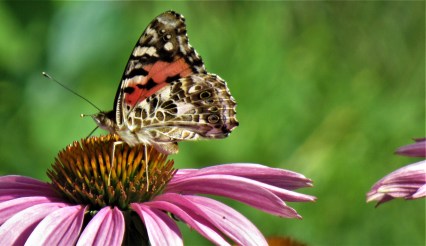
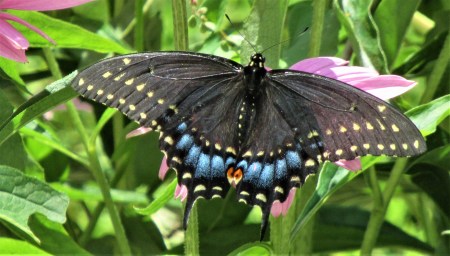
Comment: These visitors came to my garden last summer. It is a delight to offer my photographs of them as a counter to CV-19 for these butterflies symbolize the brevity and the beauty of our lives. Butterflies on a rock: poetry and literature in Canada, and even more fragile in these times of utmost fragility. Keep well, keep safe, and keep in touch with your loved ones by telephone, Skype, Messenger, e-mail, and keep everything safe.

CV-19 Week 3 Day 1

IMG_1058 (2)

CV-19 Week 3 Day 1

So, yes, I am starting the third week of my self-imposed isolation. I am also in the first week of an imposed provincial State of Emergency. What I was doing willingly before, self-isolation, has now become law, self-isolation by edict.

It seems a minor change, but it isn’t. Whereas before I was happy not to go out, now the very prohibition makes me want to go out. Yes: I now want to be out there, wandering the now-empty streets, shopping in the now-closed stores, and visiting the newly locked and barred bars and restaurants.

This situation reminds me of the word-games we used to play as children in which you were given a word which you mustn’t use and then you discovered that you really, really wanted to use it, simply because you had been told not to. One such banned word, in my childhood, was bloody. All the grown-ups used it, but it was forbidden to the little children. Bloody hell, we thought. Or bloody nice weather, we said to friends of our own age. Then, if our parents caught us using the forbidden word, out came the carbolic soap and it was mouth wash time again. Yuck: I have never forgotten the taste and smell of that carbolic soap.

We devised schemes for getting round the prohibition. I guess children of all ages devise schemes for breaking down prohibitions. That’s why so many soldiers in WWI used to ‘break out of barracks’ as they resisted the imposition of nightly curfews with their locks and keys. “Oh we’re breaking out of barracks,” they would sing, “as we have done before.” Then came the other verses. “Take his name and take his number.” “Up before the CO.” “Forty days in prison.” Back to bread and water, as we have done before.”

So, when my mother took us to the butcher’s shop one day, we were all primed. “Look at all that bloody meat” we cried out , shrieking with laughter and rolling all over the saw-dusted floor. My mother was furious, but we were spared her wrath as the butcher, and his other customers, found it so amusing.

But CV-19 (Corona Virus \ Covidis 19) is not so funny and the punishments are much more drastic than a simple carbolic soap mouth wash session. That said, the itch to break the prohibition is so much stronger now that the law is provincially enforced and not self-imposed. That said, these are rules well worth following. Nobody wants to catch this and, much more important, nobody wants to be responsible for passing it on to somebody else, especially if that somebody else is in the target range for a serious, perhaps fatal, bout with the virus.

Funny old world, eh? And some funny old people living in it.

Co-[vidi]-s

15 May 2002 Pre-Rimouski 141

Co-[vidi]-s
17 March 2020

Time has changed with the clocks
and my body clock
is no longer in sync
with the tick-tock chime
that denounces each hour.

Hours that used to wound
now threaten to kill.
They used to limp along,
but now they just rush by
and I, who used to run
from point to point,
now shuffle a step at a time.

Around us, the Covidis
thrives and flowers.
Wallflowers, violets,
we shrink into our homes,
board up the windows,
refuse to open doors.
We communicate by phone,
e-mail, messenger, Skype.

Give us enough rope
and we’ll survive a little while,
fearful, full of anguish,
yet also filled with hope.

15 May 2002 Pre-Rimouski 035

Losing It

IMG_1478 (2)


Losing It

When you lose it
whatever it is
your fingers pick at seams
hankies skirts shirts jeans
or strip a label from a bottle
or crumble bread or

there are so many things
you can do
personal things

on the table
a vacant cereal bowl
a silver teaspoon in a saucer
an empty teacup
returning your round moon stare

your hands
twist and pull
your nails
click together

blunt needles knit
then unpick stitches
trying to unravel
then to repair
this ball of empty air

Poem from the Cree

IMG_1056 (2)


Poem from the Cree

The Cree have retreated from the streets.
Their violinist has taken time out, leaving
his last notes dancing from a street lamp.
Only the Fire-Brave remains, inhaling thick
black oily smoke. He juggles twin balls of fire.

Bones gather together to gather dry dust. Hollow
metal buffalo: a cold wind blew and plucked out
his heart. Five climate controlled pedestrian
walkways cross the prairie, linking building
to building. A glass wheat field shimmers
and tinkles to the rhythm of air conditioning.

The black cow, cast iron hide set free from rust,
ruminates behind its plate glass window.
The night wind whisks white buffalo bones
pale across the sky. Oskana ka asasteki.

With these words, I will leave you, suddenly,
abruptly. A light going out. Now I am here.
Oskana ka asasteki. And now I too am gone.

PEI + bockle 2008 059

Continue reading

Why I Write


Time-Spirits

Why I Write

In the online creative writing course that I took last year, we were invited to read two articles on why I write, one written by George Orwell and the other by Joan Didion.  Both articles set me thinking: why do I write? My response to these articles, borrowed from my course notes and suitably doctored for my blog, follows.

George Orwell … where do I begin?

Homage to Catalonia is, in my opinion, one of the great personal memoirs written about the Spanish Civil War. Orwell fought on the side of the Republic, the legally-elected government, but fell foul of the Russian-backed Communists as they tried to unify the left under a banner of total Communism. The other side in the Spanish Civil War was, of course, the solidified right of the Spanish Falange and the Fascist Party. Orwell was targeted by the Communists and, wounded at the front, escaped across the French border with falsified papers. As he himself says in Why I Write, the political realization of the nature of totalitarianism led him to his stance as a writer. Animal Farm borrowed heavily from his Spanish experience, as did 1984.

Orwell sets out four reasons for writing. (1) Sheer egoism; (2) aesthetic enthusiasm; (3) historical impulse; and (4) political purpose. I personally identify most strongly with #2. Above all, in my case, I write my poetry in praise of nature and in sorrow for how I see us failing the natural world around us. However, I must admit that I also write out of sheer egoism (#1) and yes, I enjoy thumbing my nose at all those who have in one way or another slighted me and upon whom I want literary revenge, even if it be posthumous. Several of my older friends also write this way, though many of the younger ones seem to be more interested in writing for money than in art for art’s sake. I guess retirement and a small but relatively reliable pension added to the gradual onset of a blighting old age make me realize that there is not much time left in which to amass a fortune. This in turn also makes my professed credo of art for art and not for money more acceptable.

Having come to the conclusion that I never have, and never will, make any money through my writing, although publish or perish has walked side by side with me throughout my academic career, I now embrace the fact that I do not write for money. In fact, I usually give my independently published books away to my friends. Nor do I want the sort of fame that causes the paparazzi, with their microphones and videos, and camerasto flock to my doorstep, like starving sparrows or winter’s chickadees, in search of the breadcrumbs that fail to sufficiently nourish. To be appreciated, in my own small corner, like a well-loved local cheese or a craft beer, welcomed on a warm summer night for its fragrance and body … that is enough for me, although I must admit, that for one of my metaphors or images to be sniffed at, as if it were a glass of rare liqueur or a suitably aged port or a welcome Castillo de Monserans, also has its attractions.

This doesn’t mean that I am satisfied with who I am and how I write … I am not. I hope I never will be. I do want to be the very best that I can be. That’s why I keep writing and why I keep taking courses and workshops on writing. It’s also why I read and re-read, and why I keep reaching out to you and my other friends, and why I am so over-joyed when you, in your turn, reach out to me with the occasional word of praise for one of my stories or one of my poems.

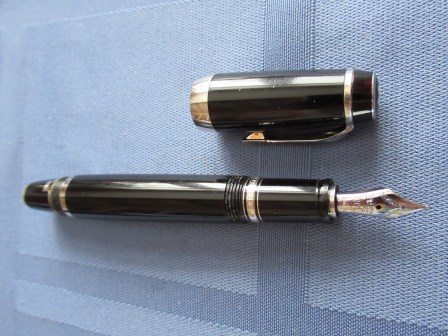
However, warm as is the friendship of the beginning, failed and faltering writers’ support groups to which I belong,  most, if not all, writing is done in isolation: me and my memories, me and my invention, me and my keyboard, me and my blank page, me and my pen, me and a-penny-for-my thoughts as I refill that pen with Royal Blue ink in the hopes that something regal will actually fall from the nib and grace one of my pages, even though I am really wondering yet again whether, like the budding author in Camus’s La Peste,  I should start that first paragraph all over, yet again, just once more.

Alas, me and the cat and the keyboard do not share a healthy working relationship, especially when she walks across the keys, sticks her kitty-littered rear end in my face, scratches her itchy chin against the computer’s sharp edge, and purrs wildly for kibble while adding oft-repeated letters and deleting so many of the wonderful words that I have so carefully accumulated. Last month, incidentally, she also unfriended a dozen of my Facebook friends. Unfortunately, I do not know which ones and none of them have got back to me. Oh dear.

One of the students in my current course asked me when I started to write. The answer is that I do not know. I have always written. I guess I have written from a deep inner urge to understand myself and the world in which I live. Going to a series of boarding schools was also a key part in the relationship between me and my writing. I was six or seven when I first went to boarding school and every Sunday I was plonked down on a wooden bench and ordered to write a Sunday letter home to my parents. Oh the wails and the take-me-aways that issued from my pen only to be deleted by the school censors. As a result, from early on, I shaped letters for the censoring audience. I also wrote other letters and they became a part of my writing style and my need for self-expression.

Mikhail Bakhtin, in his theory of Chronotopos, speaks of ‘man’s dialog with his time and place’ and that is exactly what I do. I hold a dialog with the things happening around me in the particular place I find myself.  Why do I write? To better understand my time, my place, and my own interactions with the world around me. Writing then is a means to an end and that end, for me, is self-understanding, self-betterment, and the better understanding of the world in which we all live.

IMG_0402 (1)

Angel

IMG_0257

Angel

I thought for a moment that, yes,
I was an angel and I was dancing
on a pinhead with so many other
angels, and all of us butterflies
spreading our wings with their peacock
eyes radiant with joy and tears spark
-ling in time to the music that wanders
up and down and around with inscrutable
figures held spell bound in a magic moment
… and I still feel that pulsing in my head,
that swept up, heart stopping sensation
when the heavens opened and the eternal
choir raised us up from the earth, all
earthbound connections severed and all
of us held safe in an Almighty hand.

Comment: an old poem this, from 2015, when I was in Moncton at the Auberge Monsignor Henri Cormier. It was not the easiest of times. However, there was music and dancing every week. The band would start playing, and the room would slowly fill with  men and women. The bravest would dance first and then, slowly, others would join in, all our woes forgotten in an up lifting moment of movement. The ladies: high necklines, head scarves; the gentlemen: some moving slowly, all doing their best.

For a while, I felt warm and safe, protected somehow in a fantasy world where, just for one evening a week, all troubles were forgotten and we could all be normal again in spite of our suffering. That moment together with the warmth and comforting friendship of my fellow sufferers still stays with me.

A Gift

IMG_1652 (2).JPG

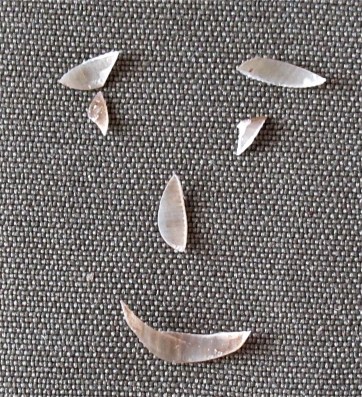
A birthday gift, hand made, by my five year old grand-daughter, in case I go gaga and forget who I am. I have no intention of doing so deliberately … but at my age … who knows? It can happen so quickly and so easily.

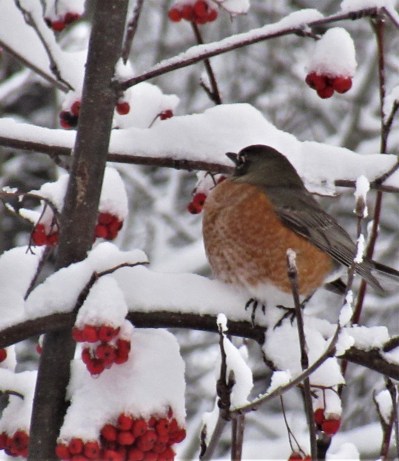
Robin Red Nest

That little red nest,
my heart,
hearth and home
to a galaxy of winged gods
who nest there,
year after year,
migratory spirits
blessing me with
hope renewed
in their spring nest’s
tangle of feather and twig.

Old now,
you thump to different rhythms
and schisms sprung from my body

Age winds you up like a watch spring
stretching my lifeline egg-shell thin.

When the wind of change
blows me away,
what will replace you
and your offer of sanctuary
to those you daily nourish?

So sad I will be
to abandon you,
your visions unfulfilled
as winter winds unravel you,
twig by twig,
until nothing remains
but the bare
white-boned cradle
in which I carried you,

so lovingly.