Pots and Pans


F1020017.jpg

Pots and Pans
St. Teresa of Ávila

A dusty highway. This woman riding
side-saddle on a hard, wooden seat, eyes
turned heavenward for inspiration. Frail,

fragile, she has never been strong, yet has
had enough strength, shoe-less, not soul-less,
to create her order of Discalced Carmelites

and found a hundred convents, safe havens
where woman can live in poverty, peace,
and prayer. Snow falls in high mountain passes.

Rivers rush downhill in springtime spate.
Mules rebel against cold waters. Bed bugs
bite … her God created them, so she suffers

in silence their indignities. Wounded heart
and soul, often doubting, faith always backing
her thoughts, words, deeds, she believes,

and that belief, as strong as this mule, as
solid as the San José corner-stone she laid.
She knows all too well that God often walks

and works his wonders for her faithful nuns
in convent kitchens cooking and washing
doing the small things, among pots and pans.

Comment:También anda Dios en la cocina entre las pucheras / God also walks in the kitchen among the pots and pans.” St. Teresa of Avila (1515-1582). It’s funny how, in times of stress, the little things in life come back back to haunt and help us. I have written of St. David, “Gwnewch y pethau bychain mewn bywyd / do the little things in life,” and here is St. Theresa of Avila saying more or less the same thing, nearly a thousand years later, this time in Spanish, not in Welsh. Intertextuality: in this way, I am able to talk, through my eyes, with Dewi Sant and Santa Teresa. And, through me, you too can indulge in this saintly dialog.
Avila 2007a 035 (2).jpg

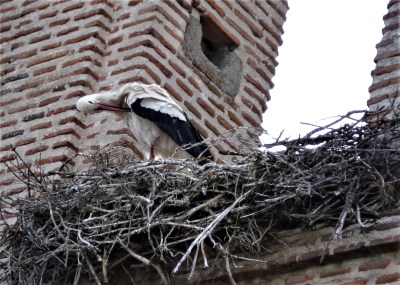
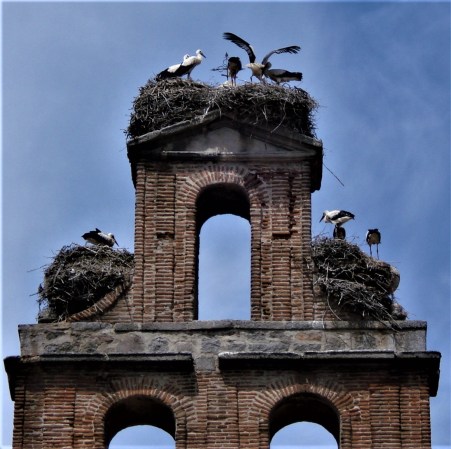
In my blog post, Triumphs, I wrote about how doing the little things in life can be so rewarding and so important for us as we age. No, I will never climb Mount Everest, but climbing up the stairs to my bedroom every night is, for me, a journey to the roof of my world and every ascent is a personal triumph, as is a safe descent each morning. I will never compete in a marathon, even though, back in my youth, I raced over ten miles and completed a half marathon. None of that now matters. What does matter is that I get my daily walk around the house, around the garden, around the block. My Olympic Goal is not to “own the podium”, a phrase I have always found slightly odious, but to win my daily wrestle with myself to just get my exercise done. Do the little things in life. In these troubled times, routine is important. Belief is important. Doing the little things that keep us alive is of paramount importance. And here’s a photo of a magnificent stork, in Avila, doing the little things in life.
Avila 2007a 087 (2).jpg


Triumphs

Avila 2007a 105 (2)

Triumphs
Luis de Góngora

Waking to birdsong in the morning,
making it safely to the bathroom
without tripping on the rug in the hall,
shaving without cutting my face,

getting in and out of the shower
with neither a slip nor a fall,
drying those parts of the body
that are now so difficult to reach,

especially between my far-off toes,
pulling my shirt over wet and sticky
patches still damp from the shower,
negotiating each leg of my pants,

tugging the strings of the plastic sleeve
that helps my socks to glide onto my feet,
forcing swollen toes into under-size shoes,
hobbling to the top of the stairs,

lurching down them, cautiously,
one step at a time, on guard for the cat,
the edge of the steps, the worn patches
where my stick might catch or slip …
one more step, triumph, I’ve made it.

Comment: “Cada pie mal puesto es una caída, cada caída es un precipicio / Each ill- place footstep means a fall, every fall is a precipice.” Luis de Góngora (1561-1627). I have reached the age of fragility and futility: every day that passes without an accident or a fall is a triumph. I re-read Luis de Góngora with increasing pleasure, the Polifemo (1613), above all, but also the later poems about the difficulties of ageing. When I read them I realize that I am not alone, that others have aged before me, and then I think of Jorge Manrique dead at the age of 39. And what poems he wrote, as did Góngora with a whole poetry movement named after him.

As for the photo: young storks in Avila, Spain, ready to fly. The one at the top is bouncing up and down, waiting for the breeze to get under his wings and lift him to sun and stars. High in the sky above him, almost unseen, his parents wait, ready to swoop down and assist him when he gets lift off. Uncertain he may be in those first few triumphant wing strokes, but down they come, place their wings below his wings and show him how it’s done. For him, it is the world that awaits him.

For me, and people my age, the world shrinks, walls close in, the daily process of living becomes more difficult. My joy: not in the lift off, but in the painstaking processes, getting up, getting washed and shaved, getting dressed, going downstairs, the early morning taste of fresh-brewed coffee, each sip a pleasure … and out in the garden, spring robins calling, a phoebe whistling, rose-breasted nuthatches, American Goldfinches, and the wondrous joy of just being here, sitting in the sunshine, lapping up the warmth, and every moment of every day a triumph renewed.

IMG_1060 (2)

Downsizing

image1 (53) - Copy

Downsizing
Francisco de Quevedo

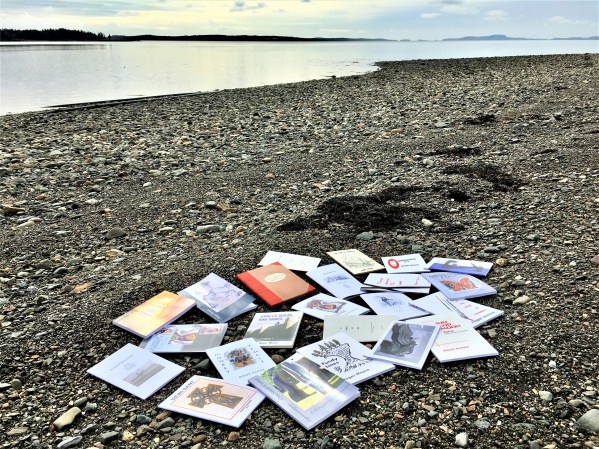
I chose each book, held it in my hands for
one last time, then placed it peacefully in
its cardboard coffin. Old friends, they were
but I broke that friendship and set them
free to fulfill their promised after-me-life
on another person’s shelves. I used to love
to listen to their lilting speech, to hear sage
thoughts with open eyes and mind. I replied
to their wisdom: words penned on each page.

Mind to mind, though they had lived five
hundred years ago, I strove to engage them
in a lively conversation, Bakhtinian dialogues
within our shared time and space, and
that space my basement library with its books.

One day, a man from the university drove up
in a hearse and bore them all away. Released
to a wider world beyond my walls, they will
nourish younger minds than mine. I hope their
new owners will bless them, welcome them,
cherish them, as I have done throughout my life.
Blind now, with tears, my eyes that devoured
their words. Deaf now, these ears of mine that
heard dead men’s words, for I can listen no more.

Comment: “Escucho con mis ojos a los Muertos / I listen with my eyes to the words of the dead.” Francisco de Quevedo (1580-1645). It was a hard thing to do, that disemboweling of my library, but it had to be done. I am grateful to the Harriet Irving Library at the University of New Brunswick for taking pity on my plight and redeeming my books. Hopefully they will have all gone on to a better life. It was sad to walk past them, to watch them slowly gathering dust, like a book on a shelf, as Elvis used to sing. It was even sadder to know that I would ever be able to peruse them all again, let alone read them from from cover to cover, certainly not in this life time.

And is that my own fate, to be reduced to words on a page, to become a dusty book lying forgotten on a shelf? Pobre poetas de hoy,  wrote my friend and fellow academic poet, José María Valverde, destinados a ser polvo seco de tesis doctoral / Poor poets of today, destined to become the dry dust of doctoral theses. So: my thought for today … rise up and resist. Take an old friend off the shelf. Dust him or her off. Open the pages. Settle down for a moment or two. Breathe deep. Begin your conversation with your long lost friend. We may not be close in the flesh, distanced as we are by lock downs and separation, but we can become closer in our minds. Pick up one of my books. Dust me down. Read me. Begin that conversation. Now. Before we too are gone, swept down stream by time’s river and lost in the mists that curtain the sea.

And, just in case you thought that last line was very good and very unique and original, here’s the conversation it came from: Nuestras vidas son los ríos / que van a dar en la mar, /  que es el morir / our lives are the rivers that will flow down to the sea, which is death (Jorge Manrique, 1440-1479). I had that conversation with Jorge Manrique in Santander in the summer of 1963. His Coplas was on the pre-university reading list at Bristol University, placed there, I believe by Salvador Bacarisse who was related to a long line of Spanish musicians and poets. If memory serves me well, our first essay, in our first week, in our first year of Spanish, entailed writing a commentary on the Coplas and how to read and understand them.

Si jeunesse savait, si vieillesse pouvait / If youth knew how, if old age was able to (Voltaire). I wish I knew then what I know now. And I wish I could do now, some of the things I could do back then. Meanwhile, do not despair: pick up one of my books or browse my blog for a poem, and have a short and hopefully profitable conversation with me as you listen to my failing voice with your younger eyes.

Memory Loss

Time-Spirits

Memory Loss

A carton of eggs
abandoned in the supermarket.
Her cousin’s face, her daughter’s name,
the parking spot where she left the car.

Forgotten phone numbers.
Birthdays of family members
never remembered.

“What day is it today,” she asks,
for the third or fourth time.

Her programs no longer work.
Many files now inaccessible,
are written in coded jabberwocky.
I show her photos but to her they are
blank spaces, gaps in her photo album.

“I recognize your face,” she says to me,
but I can’t remember your name.”

Comment: Towards the end of her life, my grand-mother started to lose her memory. I penned this poem a long time ago, then recovered it from my poetry discards. Some years ago, a virus entered my computer system and destroyed many of my files. I had backed them up, but I never really accessed them all when I bought this new computer. Now, in this time of much sitting and screen viewing, when friends no longer knock on the door to share a cup of coffee or tea, time weighs heavy, and I can look at those old files again. This also what I have done with my chess, breaking out the first travelling chess set I bought back when I was nine or ten years old, and re-playing favorite games with its red and white pieces in their cardboard box. I haven’t played serious chess since I came to Canada and, as a result, I have forgotten the openings, mislaid the combative combinations of the middle game, and can now plot only the simplest of endings. This too, in its own way, is a sort of memory loss. Yet as I replay the Fischer-Spassky series of 1972, so much comes flooding back. Memory loss: some things do return, but as I age, I wonder if that other memory loss, the more fatal one, will one day grip me, as it gripped my grand-mother, and leave me damaged and un-repairable. I wake up some mornings, confused from sleep, and wonder whether this is what awaits us all.

Black Angel

img_0178

Black Angel

You cannot hide
when the black angel arrives
to knock on your door.

“Wait a minute!” you say,
“While I change my clothes
and comb my hair.”

But he is there before you,
in the clothes closet,
pulling your arm.

You move to the bathroom
to brush your teeth.

“Now!” says the angel.
Your eyes mist over.

You may know you are there,
but you can no longer see
your reflection in the mirror.

IMG_0003

Comment: Another Golden Oldie from the same dusty manuscript (as if e-files could get dusty), but a little bit more sinister, this one. As long as you can see your reflection and as long as your shadow is still clipped to your heels when the sun shines, you are probably all right. A friend of mine had a nasty turn the other night. He woke up with cramp at 3 in the morning, got out of bed to stretch, blacked out while he was stretching, and came round on the bedroom floor an hour later. It took him 10 minutes to roll over, perform a push up, get onto his knees, crawl to the chair, and pull himself upright. He climbed back into bed and forgot all about it until it was time for him to get up the next morning. Then he lay there worrying until the forces of nature forced him to his feet. Now he says he’s fine … he might be. I checked his shadow and it’s still there and when I talked with him on Messenger, he’d managed to shave.

Last Dance

IMG_0177

Last Dance

The shy lady in the corner,
body withered by cancer,
stands up to dance.

She bows to the band
then floats into movement.

Dancing alone she clings
to the empty air as she
once clung to her man.

Nymphs and shepherds play
sweet music at midnight in this
room turned sacred grove.

Her dance-steps are a draught
of joyous water from the fount
of eternal youth and lasting love.

Comment: Another Golden Oldie pulled out of the magic hat of a forgotten manuscript. Such a joy to rediscover these things. Draught is the English form of American draft, incidentally, as in draught cider. I hate how my spell-checker corrects my spelling, even when it is correct. Wednesday was dance night in the hospice. At seven o’clock a band would arrive and set up at one end of the dining room. Tables were cleared away and chairs placed in rows so that patients could sit and listen or move onto the dance space that awaited them. This one old lady, shy and very much worn down by her treatment, stood up when the last dance was called and floated in an ethereal space that was hers and hers alone. The other patients stood around in a circle and applauded as she danced  and the band played on and on until everyone was dancing and the room was filled with joy and forgetfulness. Such is human strength, even in the face of apparent and imminent disaster. Dance on, my friends, dance on.

IMG_1256 (2)


Empty Nest

IMG_1258 (2)

Empty Nest

The wind at the window
scratches tiny notes.
I can no longer hear the tune
nor read the words.

Who walks beside me
as I pace my lonely path,
abandoned in this empty house.

My self-portrait
stares back at me:
a splintered selfie,
framed in a sliver
of silvery glass.

Above me,
a monkey moon,
that itinerant tinker,
walks a fractured way
over broken glass.

The knapsack on his back
is cobbled together
from cobwebs and clumsy
veils of drifting clouds.

Comment: Another Golden Oldie from that same throw-away manuscript that I discovered a couple of days ago. I wrote this one the year after my mother’s death. My father was in hospital and I had flown back to Wales to visit him. When I was not with him, I wandered alone in a large house, empty of people, but filled with memories. The whole experience was rather surreal, just like the imagery I conjured up to describe it. Early spring, but a cold one. After hospital visiting hours, I wandered an untidy house and an unkempt garden. My mother had departed. My father was on the way out. I was alone with a life-time of memories. “No hay pájaros en los nidos de antaño” wrote Cervantes in the Quixote. “There are no birds in last year’s nests.” With no brothers, no sisters, no close family, and no friends left in Wales, I found that out the hard way. Those days of wandering, ‘upstairs, downstairs, in my lady’s chamber,’ taught me that most difficult of lessons in the hardest of ways.

IMG_0456 (2)

Striations

IMG_0299

Striations

There are striations in my heart,
so deep,
a lizard could lie there,
unseen,
and wait for tomorrow’s sun.

Timeless:
this worm at the apple’s core
waiting for its world to end.

 Seculae seculorum:
the centuries rushing headlong.

Matins:
wide-eyed this owl
hooting in the face of day.

Somewhere,
I remember
a table spread for two.
Breakfast:
an open door,
a window that overlooks
a balcony and a garden.

“Where are you going, dear?”

  Something bright has fled the world.
The sun unfurls shadows.
The blood whirls stars around the body.

“It has gone,” she said.
“The magic.
I no longer tremble
at your touch.”

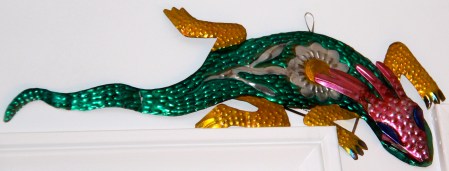
Comment: A real Golden Oldie. The lizard, it’s probably an iguana, came originally from Oaxaca, Mexico, and now sits over the door on the front porch. I had to bend his tail to get him into my carrying bag, poor thing. I found this poem in my poetry discards file, though what it was doing in there is a mystery to me. I think I discarded the longer manuscript in which it was included. Never mind, I have re-found, rediscovered it and it merits a place here, on my blog, along with the iguana. Byddwch lawen: rejoice and be glad.

Lost

IMG_1058 (2)

Lost

My body’s house has many rooms and you, my love,
rule over them all. Your shadow dances on walls.
in mirrors, and your breath brushes my cheek

every time I open doors or windows. That silly cat
looks for you and hisses when I bring her kibble.
I walk from room to room, but when I seek you,

you are no longer here. I knock, nothing opens.
Afraid, sometimes, to enter a room, I know
you are in there. I hear your footsteps on the stair.

Sometimes your voice’s echo breaks the silence.
You whisper my name in the same old way.
How can it be true, my love, that you have gone,

that you have left me here alone? I count the hours,
the days, embracing dust motes to find no solace
in salacious sunbeams and my occasional dreams.

IMG_1774

Comment: A Golden Oldie. I wrote this some time ago while my beloved was in Ottawa visiting our daughter. Separation is such a strange thing: an absence, yes, but also a presence in the tiniest details and the most unsuspected moments. And then there is the dream world where things join together, and then fall apart. This poem has so much more meaning in a time like this when so many people are separated and can no longer be together. Time … I have written about it before … passes. Hopefully, families and friends will be reunited once more, the sooner the better. In the meantime, we’ll meet again, don’t know where, don’t know when. Chadwch eich fydd / Keep your faith, as St. David, the patron saint of Wales is said to have said circa 500, byddwch lawen / be joyful, and gwnewch y pethau bychain mewn bwywd / do the little things in life.
With my angel

IMG_0258

… with my angel …

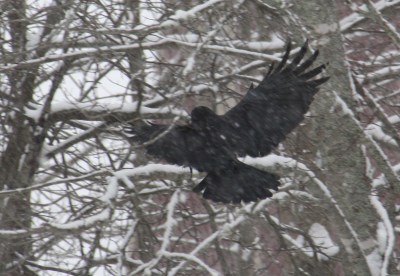
            … with my angel … face to face … the one I have carried within me since the day I was born … the black-one … winged like a crow … the one that hovers over me as I lie asleep … the one who wraps me in his feathered wings when I am alone and chilled by the world around me … the one who flaps with me on his back when I can walk no further … the one who creates the single set of footprints that plod their path through the badlands when I can walk no more …

img_0122

… ‘the truth’ my black angel says to me … I say ‘he’ but he is a powerful spirit, not sexed in anyway I know it … and yet I think of him as ‘he’ …awesome in the tiny reflection he sometimes allows me to glimpse of his power and glory … for, like Rilke, I could not bear meeting his whole angelic being face to face … as I cannot bear the sun, not by day, and not in eclipse … not even with smoked glass … when earthly values turn upside down and earth takes on a new reality … wild birds and bank swallows roosting at three in the afternoon … and that fierce heat draining from the summer sky … I remember it well … and the dog whimpering as a portion of the angel’s wing erased the sun until an umber midnight ruled … a simple phenomenon, the papers said … the moon coming between the earth and the sun …but magic … pure magic … to we who stood on the shore at Skinner’s Pond and sensed the majesty of the universe … more powerful than anything we could imagine … and the dog … taking no comfort from its human gods … whimpering at our feet …
… I saw a single feather floating down and knew my angel had placed himself between me and all that glory … to protect me … to save me from myself … and I saw that snowflake of an angel feather bleached from black to white by some small trick of the sunlight … and knowledge filled me … and for a moment I felt the glory … the magnificence … and there are no words for that slow filling up with want and desire as light filters from the sky and the body fills with darkness … and I was so afraid … afraid of myself … of where I had been … of where I was … of what I might return to … of my lost shadow … snipped from my heels …
… I don’t know how I heard my angel’s words … ‘the time of truth is upon you’ … ‘all you have ever been is behind you now’ … ‘naked you stand here on this shore … like the grains of sand on this beach … your days are numbered by the only one who counts’ … I heard the sound of roosting wings … but I heard and saw nothing more … I felt only midnight’s cold when the chill enters the body and the soul is sore afraid …
… ‘it is the law’ my angel said … I saw a second feather fall … ‘and the law says man must fail … his spirit must leave its mortal shell and fly back to the light’ … ‘blood will cease to flow … the heart will no longer beat … the spirit must accept and go’ … ‘do not assume… nobody knows what lies in wait’ … ‘blind acceptance … the only way … now …  in this twilight hour …  now when you are blind … only the blind shall receive the gift of sight’ … ‘all you have … your wife … your house … your car … your child … everything you think of as yours … I own … and on that day … I will claim it from you and take it for my own … now I can say no more’ …
… the sea-wind rose with a sigh and one by one night’s shadows fled … the moon’s brief circle sped from the sun … light returned, a drop at a time, sunshine flowing from a heavenly clepsydra filled with light …
… birds ceased to circle … a stray dog saw a sea-gull and chased it back to sea … and the sun … source of all goodness … was once again a golden coin floating in the sky …
… on my shoulder a feather perched … a whisper of warmth wrapped its protective cloak around my shoulders … for a moment, just a moment, I knew I was the apple of my angel’s eye … and I hoped and still hope that one day I might meet him again and understand …

Comment: An article on Marcus Aurelius in this morning’s paper made me think of this piece that I wrote, way back when, in the days when I was studying Francisco de Quevedo and the Neo-Stoic movement, courtesy of my good friend and colleague Henry Ettinghausen. “The day we were born we took our first steps on the road to death,” Quevedo wrote in one of his poems. With my angel is my own Neo-Neo-Stoic attempt to come face to face with that very personal reality, one which we all face, and to stare it down, eyeball to eyeball. Alas, in these troubled times, we must confront the knowledge that troubled times have been here before, that other generations have suffered them, and luckily, other generations have survived. We wouldn’t be here if they hadn’t. As another good friend, of mine Victor Hendricken, wrote on this blog just yesterday: “We continue to live on between inhale and exhale; we continue to live on between intake and exhaust, food and faeces. And in this time of self-isolation, we still abide by many of the same personal rules, including morning ablutions, setting and shutting off the alarm. Chin up, old boy. This too shall pass.” I found these words from Victor very comforting. With friendship, solid advice, and the ability to learn from those who have gone before us how to confront difficult times, this too shall pass.