What is your mission?

Daily writing prompt
What is your mission?

What is your mission?

Let us begin, as usual, by asking, what do we mean by ‘mission’? Here are some examples of the meaning of mission. (a) an important assignment carried out for political, religious, or commercial purposes, typically involving travel. (b) the vocation or calling of a religious organization, especially a Christian one, to go out into the world and spread its faith. (c) any important task or duty that is assigned, allotted, or self-imposed. (d) an important goal or purpose that is accompanied by strong conviction; a calling or vocation.

I can happily dismiss (a) and (b) from the start. I do not consider an assignment to be a mission, not in my case anyway. I am not one to wander the world, good book in hand, heart on sleeve, convincing people to believe what I believe. That said, I can work with (c) and (d) because, as a life-long teacher, who was offered, at various time, an array of other jobs, I am happy to say that I was a teacher by vocation, by calling. Teaching was my mission. My mission was accomplished.

I taught, in Canada, from 1966 to 2009. Then I reached retirement age. On June 30, 2009, I was a teacher. On July 1, 2009, I was nothing. The shock was enormous. It took me a long time to recover and discover that no, my life was not over, and yes, I had many other things to do. Thankfully they all involved teaching, in one way or another. I used my teaching / research experience to sit on the editorial boards of various learned journals. I even edited a couple of them. I also translated, usually from Spanish to English, and worked with the translations of other people. I also wrote articles on teaching and on creativity.

Creativity gradually took me over. I offered workshops on prose and poetry, wrote and edited books, penned introductions for other writers, and even published some books by other people, usually my family or close friends.

There was never much money in teaching or in creative writing. I always did it for love – love of the subject, love of learning, love of the students, love of watching them grow and develop. When I work one-on-one with another writer, or with a small group of writers, that love is still there. Alas, as I grow older (much older!), I feel the ability to motivate slipping away. The will, the vocation if you like, is still there, but body and mind are growing weak, and that, my friends, is the saddest thing of all.

Dark Angel

He will come to me, the dark angel,
and will meet me face to face.

He will take all that I own,
for my wealth is only temporary:
health, wealth, possessions are all on loan.

My house, my wife, my car,
my daughter, my grand-child,
 my garden, my trees, my flowers,
my poetry, my works of art.
I use the possessive adjective
knowing full well that these things
are only on loan. I will never be able
to preserve and possess them.

I even rent this aching heart,
these ageing, migrant bones,
this death that has walked beside me,
step by step, every day
since the day that I was born.

My death alone is mine.
It belongs to nobody else.
It will be my sole possession.
It will soon be the only thing
I have ever really owned.

Comment:

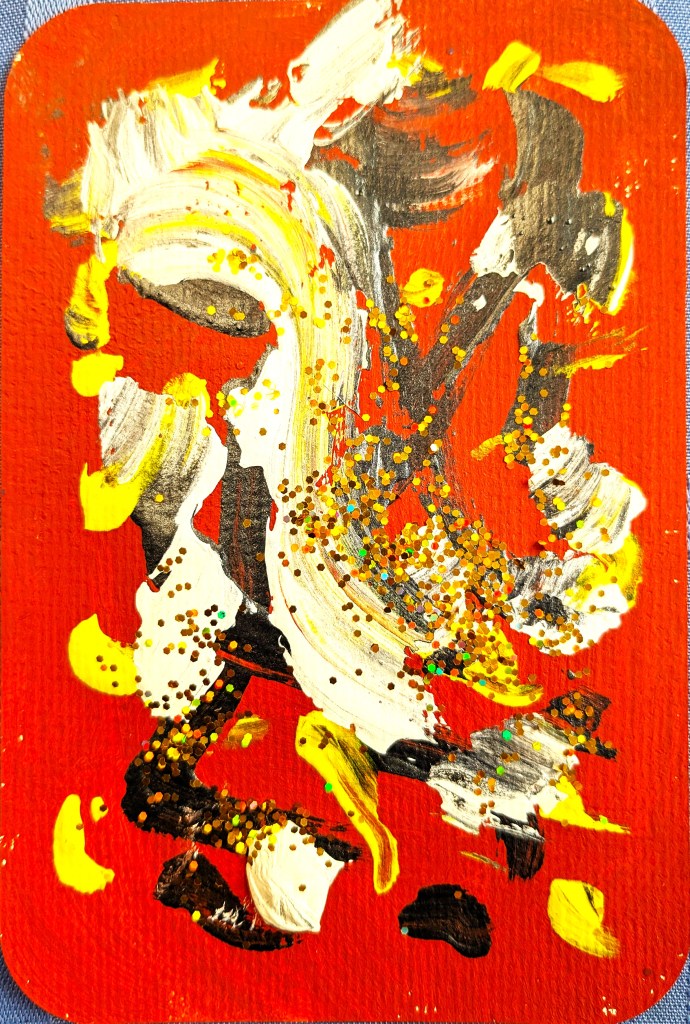
Dark Angel is from my poetry book – Septets for the End of Time / Poems for the end of Time. The lead painting in today’s blog is by my friend, Moo, and he calls it Storm-Me.

Do you play in your daily life? What does ‘playtime say to you?

Daily writing prompt
Do you play in your daily life? What says “playtime” to you?

Do you play in your daily life? What does ‘playtime say to you?

Poesía de juego y poesía que expresa la autenticidad del ser / poetry as play and poetry that expresses the authenticity of being. For me, poetry is play. However, it is far more than just ‘play‘ – because it is a play that expresses the authenticity of my being.

I write in my journal on a daily basis. As I write, I sometimes spot little gems, thoughts or word clusters that can be turned into poems. For me, playtime is when I start to elaborate the words (signifiers) and turn them into thoughts (signified). The meaning may be the message, but the words that carry the message are the building bricks of the poetry of play which sometimes, with a happy Midas touch, turns into the poetry of gold that expresses the authenticity of who and what I am.

But play is also what I do when I paint. And sometimes I sit beside my mirror image friend, Moo, and paint with him. While Moo is great with colours, he is sometimes at a loss for words. Then I help him by playing with words, shuffling them around, until he finds the title that he wishes for his poems. Sometimes I consult, on Moo’s behalf, with other friends, and they are the ones who join in the game, and settle the dispute by agreeing upon the name that Moo will finally choose for his painting.

But, speaking of painting, there is no play better than the game of making meaning out of color [does it really matter how you spell it? ] and shape while taking a line for a walk and turning it into something playful yet meaningful. Mix and match, and stitch and patch, and then add the lines and title that ease the metamorphosis of color into shape and meaning.

There are other games I play to help fill in the daily gaps that have entered my post-retirement life. Online games of patience, crosswords, chess games with their intricate patterns of red and white or light and dark. Then their [now it does matter how you spell there!!!] are mining games when I dig deep into other people’s poetry and search among the gems of Octavio Paz, Antonio Machado, Dylan Thomas, John O’Donohue, Milton Acorn, Valverde, Quevedo, St. Teresa of Avila, Gongora, Sor Juana, Cervantes, or many other friends, their voices now silences, with whom I speak with my eyes, in order to find something that inspires me to play yet another game – hunt the symbol.

Re-reading Rudyard Kipling is a game too. “Do you like Kipling?” “No, I never Kipple.”And in books like Kim, the great game of life goes on and on, and Kipling’s signifiers (words) turn into a signified (meaning) that is warped by my creative mind and changed into my ideas of a new game in which hunt the symbol turns into the game of Brillig where the slithey troves of new words, fresh words, are reborn into my game-world and emerge from their game-whirled into my own word-play conversation with my own thyme and plaice [or should that be time and place?] And long may Moo and I play that game!

What are your thoughts on the concept of living a very long life?

Daily writing prompt
What are your thoughts on the concept of living a very long life?

What are your thoughts on the concept of living a very long life?

A simplistic question in so many ways as so many definitions are needed. How long is long? 100 years? 200 years? Back to 1066 to watch the Battle of Hastings? 1588 to see the Spanish Armada sailing up the channel? 1815 to see the Battle of Waterloo and talk with Wellington and Napoleon – why not? I am Anglo-Welsh and New Brunswick is bilingual, French and English, so why shouldn’t I – or anyone else who wants to live such a long life – have a talk with both of them?

And does living a very long life include the concept of being healthy, and happy, and wise, and not living in squalor or poverty or in a permanent war zone? How about being kept in an incubator, or an iron lung, or on permanent life support? How long is long under those (or similar) conditions. And what about friends and family? In the Celtic myths, men who visit the fairies in Ireland and live and eat with them, come back to reality [now define that word in this day and age] only to find their friends and families long dead and gone. So what would the conditions of the ‘return’ be like if a long life meant watching the passing of everyone and everything you know or returning to a world you no longer recognized?

And change is so rapid nowadays. AI is developing so quickly, how can anyone keep up? I know that as I slow down (mentally and physically) I understand less and less about the machines I use, including my Nexus Rollator. Does a ‘very long life’ include sipping from the Fountain of Youth? Or does it consist of an enlarged old age – post molestam senectutem, nos habebit humus after a troubled old age, the earth will have us. I am sure we all recognize Gaudeamus igitur, in Latin, and its theme of Ubi sunt qui ante nos in mundo fuerewhere now are those lived in this world before us, and if we don’t, then how swiftly we have forgotten the power of Latin is with its memorable phrases and omnipresent seeds of memento mori .

For me the question is a clear one – do you wish for quantity (a very long life) or quality (a very happy and successful one, even if it is a bit shorter)?

A close friend of mine, one of the most honest and courageous people that I have known, suffering in a horrific way from terminal cancer, asked for, and received, MAID (Medical Assistance In Dying). It was a long legal and medical process to get MAID, involving famiy members, lawyers, doctors, and many other things. As the Romans used to say mors omnia solvit death resolves everything. My friend and his family preferred to shorten life – on their own terms – rather than prolong it under such prolonged suffering and torment. My friend, I salute you and your family and commend you for your bravery.

So, define the terms within which that very long life would be lived – and then ask yourself the question once more. Because as it stands right now, with no further understanding, the answer should only be “depends”. And remember, lives are like swimming pools – they have shallow ends and deep ends. All too often when you talk about life and the end of life, so much depends.

Comment:

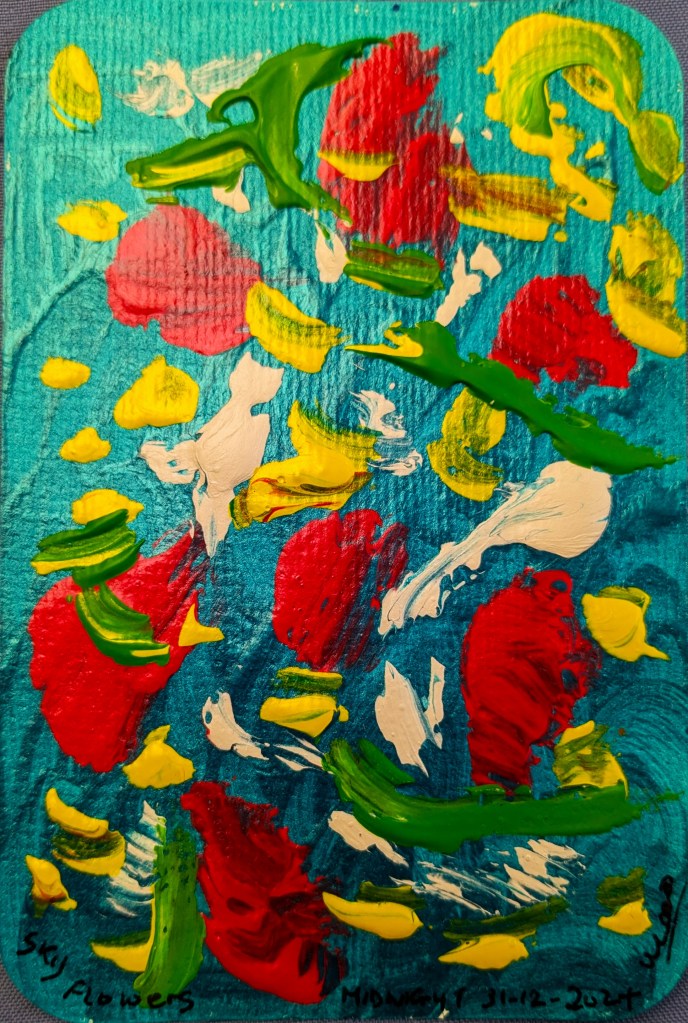
I must thank my friend, Moo, for his depiction of the fireworks from New Year’s Eve. Sky Flowers, he calls it. The fireworks have gone already – but – vis breve, ars longa – his painting still survives.