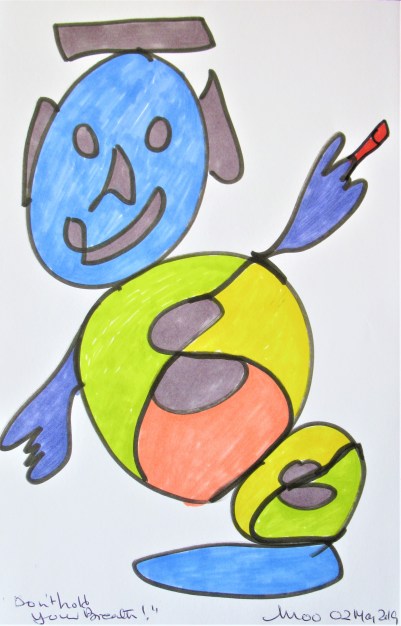
Sheep

IMG_1295 (2).JPG


Sheep

I wear the hide of the sheep
they slaughtered for me
twenty-three years ago
in Oaxaca, Mexico.

Like a sheep led to slaughter
I wait in the waiting room
along with other willing victims.
Heads down, silent, we clutch
open magazines, but do not
lift our heads or make eye contact.

In World War One, French troops
bleated like sheep as they marched
in tight columns towards Verdun.

They were disciplined and decimated,
one in ten shot for cowardice.
Is it cowardly to sit here, shivering,
glum faced, as we await
bad news and an uncertain fate?

I hate this uncertainty,
this inability to know what
is happening to my body.

Knowledge I can face, but
not doubt’s shadow dancing
like a will-o’-the wisp, and
leading who knows where,
keeping me awake as it did,
last night, stoking my fears
into this red-hot furnace
filled with burning coals
of fierce, fired-up doubt.

True bravery is to know fear,
to face it, and to face it down,
and to laugh in its face even
though your heart is breaking
and your gut tells you to run,
now, before it’s too late.



So sad

cropped-img_1047-2.jpg

So Sad

It’s so sad to see the flowers passing. They lose their color, dry up, fade. Seed pods rattle. Squirrels carry away the sunflower heads. Birds migrate. Speaking of birds, we have not seen many this year. Crows, oh yes. We have been invaded by crows. And by Blue Jays. They nest in a neighbor’s yard and have been irregular visitors. While the crows are here every day, the blue jays come sweeping in, four and five at a time, shrieking loudly.

The woodpeckers have been regular visitors, downy and hairy. Not the Greater Pileated though. I have only seen one, very small, later this summer. The chickadees have been regulars, but we have seen very few sparrows and only a couple of mourning doves. No Eastern Phoebes, a few juncos, no Grosbeaks of any kind, Evening, Rose-breasted, or Pine. And scarcely a sign of swallows, martins, night jars, cat birds, cow birds … so many friends missing and passed on. Even the yellow-bellied sapsuckers seem to have neglected us. We had robins in earlier, but just passing through, an occasional American Goldfinch … very few hawks, no starlings … an occasional nuthatch …

I can remember the washing line with sixty to seventy mourning doves hoo-hoo-hooing away. This year: two. So, something is happening. Whatever it is, I don’t like it. Where have all the birds gone? 

A couple of years back. we hardly saw a bee. This year we had bees, and hummingbirds. We also had some wonderful butterflies, the like of which I haven’t seen before. Here’s one that Clare caught, sunbathing. Rear-view, it looks quite frightening. Great orange eyes. Colored fangs. Wonderful. I want our world to heal. I want to see these wonderful creatures returning to visit us. I live in hopes to see them … but, who knows? Have we passed the turning point already? Who knows?

On Editing

IMG_1095 (2).JPG

On Editing

Some editors are really very good. They take the initial idea of the artist and polish it, turning what was an average piece into a great one. Others are not so good and turn an average piece into an automatic rejection.
On my kitchen wall hangs a line-painting by Geoff Slater representing one of last year’s hollyhocks from my garden. He gave it to us as a Christmas present, and I am very proud of it. Finley loved it too. She followed with great glee the white line that starts and ends Geoff’s painting. Then she stared at me.

“What are you doing?”
“I’m writing a story.”
“What’s it about?”
“A thin red line.”
“Oh!”

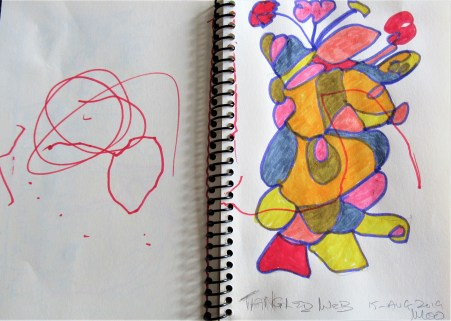
A little bit later, I saw my pens and pencils strewn across the table. My sketch book lay open and I noticed that an editor had edited some of my work. My thin red line had morphed from illusion to reality and there it lay, twisting in and out of the tangled web I had created the day before. Clearly, my average creation needed the touch of a four year old editor and apprentice line-drawer to move from average to genius.

Oh the joy and creativity of a four year old! It took Picasso nearly fifty years to learn to draw like that again. And here’s another painting by this prodigious four year old. I got this one for Christmas last year, too. Alas, it is not signed.

“Don’t you want to add some more?” My daughter asked her daughter.
“No. It’s finished.”
And so have I.

IMG_0228 (2)


Springle Dance

IMG_1258 (2)

Springle Dance

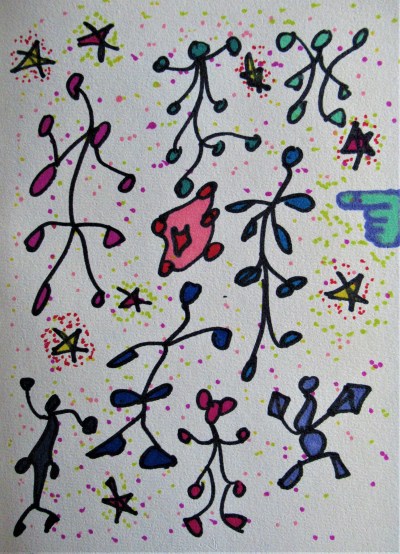
I guess the title comes from Tolkien where the Hobbits begin an energetic dance at Bilbo’s Party. Or something like that. Mine is a Fall Girl Dance. The hand on the right points to the poor misshapen heart as it moves between fall leaves and colorful dancing sprites and spirits that help it on its way. Where is it going? Who knows where the autumn leaves go once they leave the tree? The bodies fall to the ground, obviously. We rake them into dry, crisp piles and our children and grand-children dive into those leaf-piles, scattering them everywhere so we have to rake them up again. Think of them, the children, as forming leaf angels, a bit like snow angels, but, like the broken heart, a great deal more fragmented.

Try as I might with camera and photo shop, the colors are never quite what they were when I splashed them haphazardly, like September rain and wind-blown leaves, across the page. But life is like that: memories are discolored and distorted, old photos turn sepia, old folk turn white and grey and wrinkled and fragile, like withered leaves from the tree of life. And this is life, real life. We live it every day. Each dream, a flower, each moment a leaf, and every moment the only one we ever truly experience.

So savor those moments, both the good and the bad. They are yours and nobody else’s. Your like is what happens to you. Sometimes it is bitter with salt and vinegar and lemon juice. Sometimes it is toxic and poisonous. But it is yours. It is your chalice to drain as you stand in the garden, feeling betrayed. Like it or not, this is you. Then there are the dream moments: sugar and spice and everything nice. On those days, when the sun shines, it’s away with slugs and snails, and puppy-dog tails and hello hollow world, I see you for what you are and I welcome you for what you are. And yes, you can meet with triumph and disaster, and you can treat those two impostors just the same. You are more powerful than the forces around you. Centre yourself. Find yourself. Heal your broken heart as it wanders among the springle dancers sent to bring you peace and comfort.

Look for your self. Find your self. Be your self. You and your self are stronger than any woes that may beset you. Seek the light … and you will find it.

On the beach

On the beach


IMG_0564 (2)

IMG_0565 (2)

Comment:

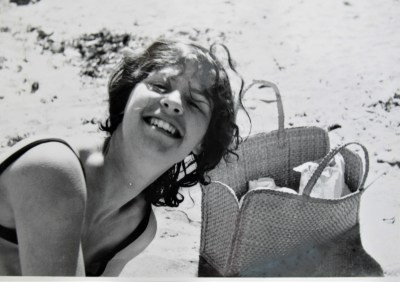
A daylight photo and a moonlit poem: I wonder how that came about? I guess we must have been beach-combing in the moonlight. It’s so long ago that I have forgotten the links between photo and poem. That said, Clare and I had spent a couple of weeks together in Santander (Spain) the previous summer, when we got engaged.

‘O bahía de Santander: tan bella bajo la luna’ / “oh Bay of Santander, so beautiful beneath the moon” as the Santander poet Gerardo Diego writes. And yes, Santander under a full moon: Mataleñas, the Segunda Playa, Jardines del Piquío, La Magdalena, the Bay of Santander itself, with Peña Cabarga in the background … there is something about beaches and midnight and moonlight which transcends the warmth of a summer’s day. It’s a sort of Midnight Magic that creates a madness of wonder in the blood. Imagine: all those silver fish, swimming their underwater roads, and rising to the surface, to ripple softly along the moon-path. Wander-lust / wonder-lust: sometimes buried words will not rise to the surface and those oh-so-precious moments of supreme poetry are lost among street lights, advertisements for this and that, street signs and the sort of stop signs that stop you and numb your mind into the dumb acceptance of daily reality: la vie quotidienne.

Memories: will they all vanish with us when we go? Of course they will. Many are fading now as we sit here at our desks, in our offices, before our computer screens. The grey screen hustle and bustle pushes memories, light and bright, back into the darkest corners. Where do I get off the bus, the train? Which number is it? Where is the office? Who am I meeting today and at what time? Did I shut the door behind me? Did I pack the children’s lunch? Did I let the cat out? And if so, out of which bag?

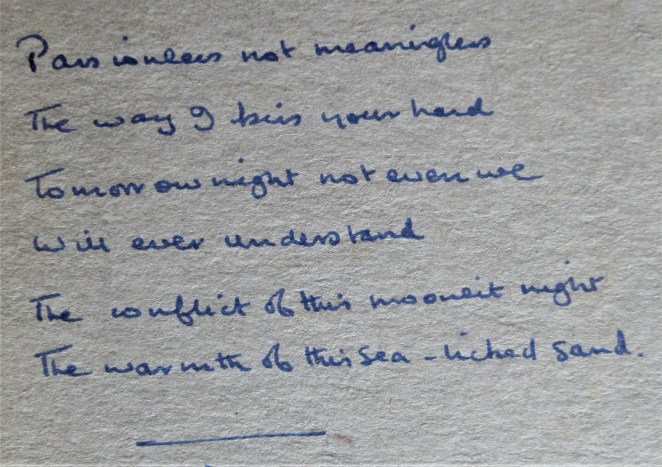
passionless not meaningless
the way I take your hand
tomorrow night not even we
will ever understand
the conflicts of this moonlit beach
the warmth of this sea-licked sand

PS. There, see, I told you I couldn’t read my own handwriting. Kiss / take; night / sand. Oh dear, the old grey cells are playing chess with my mind again: P-K4 / e2-e4 … whatever next? Well, I warned you!!!!


Beach Heat

IMG_0572 (2).JPG

Beach Heat

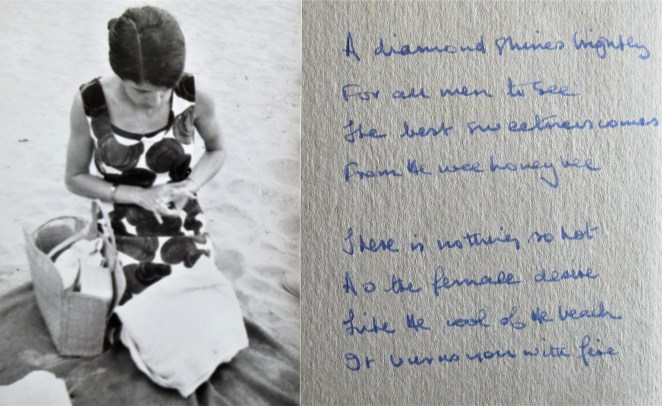
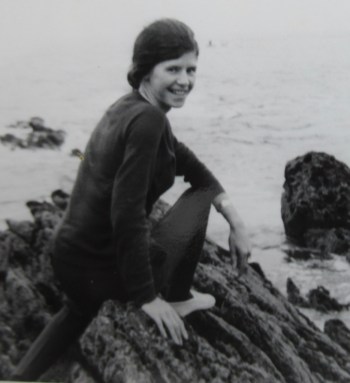
This is the beach at Goran Haven, with Clare, on the sands, trying not to lose her engagement ring. It’s still with us, in spite of having left it in a washroom on the 401. When one of the support columns of the solitaire broke, we found the stone lying on the floor of the car … that was another close call. As for the poem, well, I suppose it is one of mine.

The enlightened may recognize its structure as belonging to The Book of Good Love / El Libro de Buen Amor, written in the 14th Century (1330-1343, according to some, though it may be a little later, 1347?), by Juan Ruiz, El Arcipreste de Hita. This early verse imitates the rhythms and sequences of Juan Ruiz’s poem: In praise of small women. Not that Clare is small: she is taller than me, and always has been. She is also younger than me and hasn’t manage to catch me up yet. She is cleverer too, but don’t ever tell her that I told you that. Life might become unbearable. Not admitting that little secret is what keeps me going.

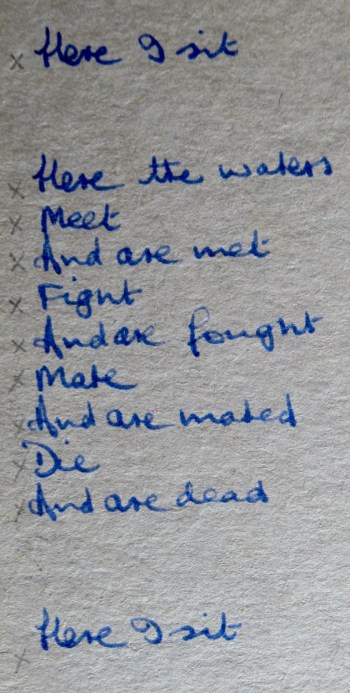
I take it you can read my handwriting. If not, ask politely, and I will add a typed version that is more understandable. Ask nicely, mind! None of that “yore ‘andritin’ is atrooshus’ stuff, sort of, loike.”

PS: I didn’t have a very good camera in those days. As for my current cameras: wow! How the world has changed. As we have changed with it.

PPS: Indeed I have received comments, not very complimentary, on my handwriting. Oh dear. Don’t worry I can’t always decipher it myself, even with my glasses on. Thank you all my friends and anonymous correspondents. So, here comes the translation into print.

A diamond shines brightly
for all men to see
the best sweetness comes
from the wee honeybee

There is nothing so hot
as the female desire
like the cool of the beach
it burns you with fire


Here

jLwRzd1BSwOGRYRVEcPwSA_thumb_2891.jpg


RrcBUdIhRESRs2CwUmEmJA_thumb_2892.jpg

Comment:

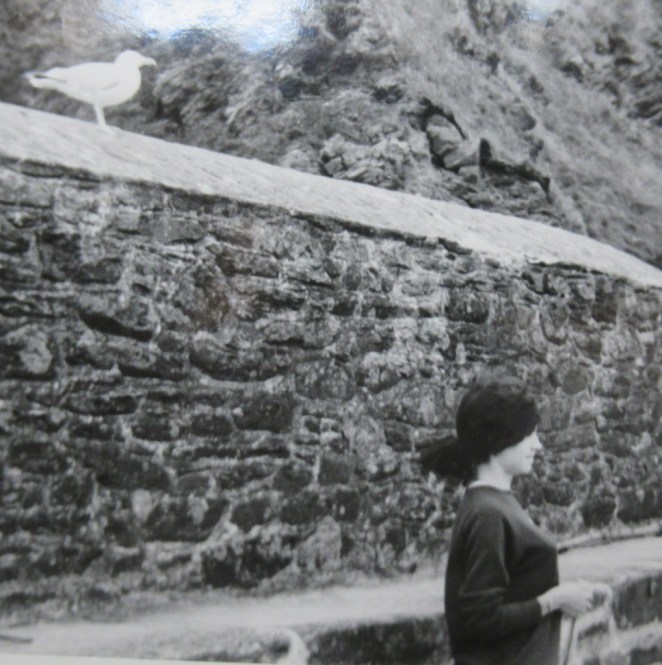
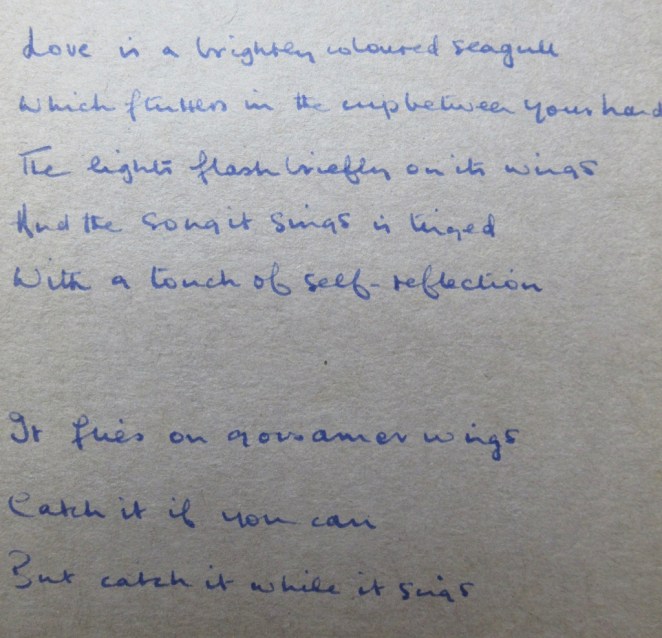
Another photo and poem from this early series (1966) while I still lived in the UK. Like Cervantes, I always wanted to be a poet. Like him, I may always be disappointed by my poetry. However, my beloved has never disappointed me.
This photo was taken at Dodman’s Point, close to where the Spanish Armada was first sighted in 1588. Dodman’s Point / Dead Man’s Point.
In 1988, a computer ran all the tides and all the times of the Armada’s progression up the English Channel, all based on those tides and the annotations of them in the sometimes seemingly haphazard English and the Spanish logs. Seemingly haphazard: because in spite of telling the time by water clocks (clepsidras) and marked candles, and in spite of the ten day calendar difference, and in spite of all the other different differences, these were real sailors and they lived and died according to the tides, the tides that the computer can track, all the way back to 1588, even as it can track the stars and their original positions when Stonehenge was first built in 3500 BCE.
I have stood on the temple mounds in Oaxaca. I have visited Maiden Castle. I have walked on Hengistbury Head and lain in the scrapes of the reindeer people. We underestimate the intelligence of our ancestors and, by extension, of many indigenous people, at our peril. And we over-estimate our own abilities as we destroy the very world in which we live.

Treason

IMG_1203 (2)

Treason

The cans betray their contents.
Bulmer’s Strongbow cider,
used to be from Herefordshire,
pale and dry,
now made in Amsterdam
from apples that have never seen
Hereford nor heard of the Malverns.

Somerset cider,
not made in Zummer Zet,
apples never falling
from zyder apple trees,
but born in Denmark
with value added sucrose

and an extra sweet taste
that would never be allowed
in a Wurzel song
about schoolboys and satchels.

No self-respecting
Zummer Zet head master
would allow such muck
in his school when local Scrumpy
was available at twice the taste
and half the price.

I can see the school note now:
“Next time send proper zyder,
Zummer Zet
made.
This growing boy of yours
needs real apple juice
and lots of Vitamin C
to keep his young cheeks
red and rosy.”

Dozy basturds these furriners,
stuffing their cans with false fruit
and sucrose, taking in vain
those sacred names:
Strongbow, Hereford, and Zummer Zet.