What aspects of your cultural heritage are you most proud of or interested in?

Daily writing prompt
What aspects of your cultural heritage are you most proud of or interested in?

What aspects of your cultural heritage are you most proud of or interested in?

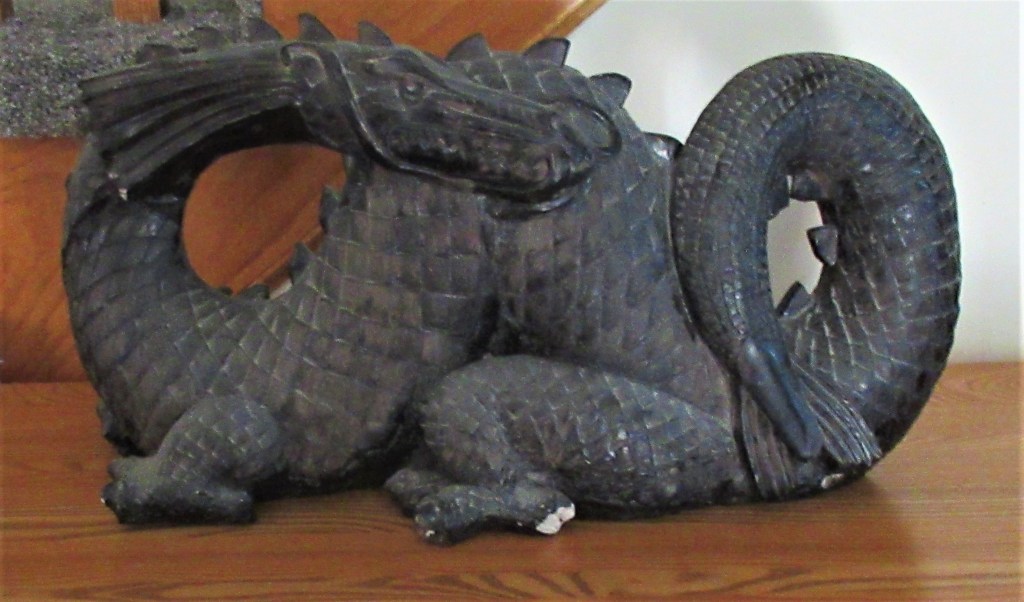
This dragon is not a dragon, well, it’s not a Welsh Dragon anyway. So, let us change the question – What aspects of your cultural heritage are you least proud of? Now that changes the perspective totally. I guess that I am least proud of the fact that, although born in Wales, I was never allowed to speak Welsh as a child. I speak with an English accent because I was sent to school in England so I wouldn’t even speak English like a person born in Wales. I am not proud of that aspect of my cultural heritage.

But I am proud of one little thing that stems from that Welsh cultural heritage – learning how to speak Welsh in my old age. It’s not easy to do that, here in Canada, but the internet carries many blessings, one of which is the learning of ‘foreign’ languages. Strange that Welsh should be considered a foreign language for somebody born in Wales. Something else not to be proud of, I suppose. Here’s my story.

Here I sit, an old man now, in front of my computer, learning at last my mother tongue, Welsh. I have discovered the beauty of simple words, not so much their meaning as their sound, the way they flow, the poetry of remembered rhythms: Cwmrhydyceirw, the Valley of the Leaping Stag, though legend has it that ceirw was really cwrw, and cwrw is beer, and its real name was the Valley of the Brown Stream Frothing like Beer.

Words have their own music, even if you cannot pronounce them properly: Mae hi’n bwrw glaw nawr yn Abertawe / it’s raining now in Swansea. Mae’r tywydd yn waeth heddiw / the weather’s worse today. Bydd hi’n dwym ddydd Llun / it will be warm on Monday. Place names also have their own magic: Llantrisant, Llandaff, Dinas Powis, Gelligaer, Abertawe, Cas Newydd, Pen-y-bont … Meaning changes when you switch from one language to another:  gwyraig ty / a housewife, gwr ty / a househusband, a concept of equality that has ruled Welsh lives since long before Julius Caesar invaded Albion, coming from Gaul with his legions in 55 BC.

The photographer asks me to smile. He wants me to say ‘cheese’ so I say it in French [fromage], then Spanish [queso], then Italian [formaggio]. “No, no, no,” he shakes his head. “I want to catch the real you. Try again.” So I say it in Welsh [caws]. He checks the memory card in his camera and looks puzzled.

“Your facial expression changes each time you speak a different language,” he tells me. “Please, won’t you just say ‘cheese’ in English? I want the real you.”

French, Spanish, Italian, then Welsh: all different and he wants the real me. Each language carves a new a map into my face.  Am I a clown, then, a comedian, a chameleon to wear so many masks and to slip so easily from one to another? And who am I, this stranded immigrant, marooned on a foreign shore that has finally become my home? Who or what is the real me?

“Cheese!” I say in desperation. “Got it,” he grins. “At last, I have captured the real you.”

What’s your #1 priority tomorrow?

Daily writing prompt
What’s your #1 priority tomorrow?

What’s your #1 priority tomorrow?

I have a couple of priorities, of course. I am not sure which is #1. Maybe I’ll ask the readers to tell me which one my top priority should be.

I guess my first priority is to wake up. That is very important at my age. A couple of my friends went to bed and never woke up. So, I guess an important priority, perhaps #1, is to actually wake up.

Having woken up, my next priority is to roll over, sit up, pull back the blankets, and actually attempt to get out of bed. This isn’t always easy. My back sometimes stiffens up overnight. Or else my hips don’t want to function. Then there’s the gammy knee I hurt playing rugby all those years ago. Then there’s the quality of the light – do I need a light on? If I do, I must reach for it without cramping up. Early morning cramp is not a good thing and really complicates the next step.

If I am in the high bed, then lowering legs, touching the floor with toes, and using arms to push up the rest of the way is relatively easy. But if I am in the low bed, I must turn sideways towards my bad knee, place my feet at an angle, and do a one handed pushup in order to find the right balance to get to my feet. That means watching out for slippery carpets. I do not want to fall. Sometimes I call on the aid of my faithful teddy bear and, by half throttling him, I manage to get that extra leverage.

Oh dear, I forgot another priority – condition of ageing bladder. All of the above activities are dependent upon the state of the union. If that is a problem, then I must call for assistance – and I hate doing that.

Next priority – the trip to the bathroom. I wish I hadn’t said ‘trip’, because sometimes I do. The effects of that can be a sudden grasp at something solid, a stubbed toe, a twisted something or other, or, worst of all, another fall. We certainly don’t want that to happen, especially if we are suffering from what Max Boyce [remember him?] once called ‘twisted legs and tails’.

Other priorities follow when we have reached the bathroom. I won’t go into those. Nor will I mention the perils of the return journey, the difficulties of getting dressed, the embarrassment when I fail with the patented sock-pull machine and have to wiggle my socks off, one by one, and then put them on again.

So, here I am, fully dressed, standing at the top of the stairs… one hand on the hand-rail, one hand on my trusty walking-stick, and down I go, hopefully one step at a time.

So: What’s my #1 priority tomorrow? You tell me. Which would you choose? And before you answer, just remember Dylan Thomas’s words ‘for whether we last the night or no, is surely only touch and go’. Touch and go, tip and run – I remember them well. And luckily I remember waking up this morning. I would hate to face the alternative – not waking up.

¡Qué será, será!

¡Qué será, será!

“Those who the gods would destroy,
            they first make happy.”

Twenty-four hours
            after our power came back,
it had been gone for 52 hours,
            we lost it again.

And happy we were,
            cleaning out the freezer,
            draining the water from the bath,
            packing up the pots and pans.

We sat down for happy hour,
            a drink before supper,
            and zap – the power went.

Promises, they made,
            estimates of when the power
            would return – 4:30 pm –
            5:30 pm – 6:30 pm –

Now we don’t know
            when it will return.
            The power site says
            “No estimate available.”

I write these words by candlelight.
            The battery on the radio
            just failed and now our cell phones
            are rapidly draining.

“¿Quién sabe?” Some are saying.
            “¡Qué será, será!” say I.
            Whatever will be, will be.

Share a lesson you wish you had learned earlier in life.

Daily writing prompt
Share a lesson you wish you had learned earlier in life.

Share a lesson you wish you had learned earlier in life.

I wish I had learned earlier how hard it is to grow old and how difficult it is to prepare for it. My first serious rugby injury, age 16, torn cartilage in left knee. Doctor’s advice: give the game up now. Later, you’ll regret it if you don’t. My response: I’m tough. 60+ years later, my left knee still creaks and I rub ointment in every morning. My second serious rugby injury, age 20, damaged lower back. Doctor’s advice: give the game up now. You’ll regret it later if you don’t. My response: I’m tough. 60 years later, my back really hurts. I rub ointment in every morning, take pain killers, and stretch. Same with hips, from kicking! One of my rugby friends, about the same age as me, has two knee replacements, one shoulder replacement, and one hip replacement. If he’s not the $6,000,000 man, he must be pretty close.

But there is a story beyond that story. I was sent to a series of boarding schools and no, I didn’t go there willingly. In the summers, I travelled abroad to learn foreign languages that were foreign to others but became familiar to me. I never saw my grandparents as they aged. Often, when they died, I was in school, or away on the continent. I never understood the ageing process. I never witnessed the natural decay of those whom I loved. I never learned that lesson. When I left university, I emigrated, and the same sequence happened with my parents. I was never there when it mattered. I was always somewhere else. And when I was there, I heard the usual litanies: “This never happens when you are not here. It’s your fault.” Or else, “this wouldn’t have happened if you had been here.” Told to me by a close relation at my mother’s funeral. I flew back home, though it was never really my home, to be present for that.

But what is the lesson that I wish I had learned earlier? Alas, there is not just one lesson, but a series of lessons. How to deal with the ageing process. How to face sickness and ill health in age. How to face diminishment with grace and humor. How to accept the natural process that occurs whether we want it to or not. How to face the gradual decline in someone, close to you, your life companion whom you really love. How to face the fear of passing (FOGO to some) and how to pass that lesson on to our own young ones. How to face my own end and how to die with as much dignity as possible.

How often do you walk or run?

Daily writing prompt
How often do you walk or run?

How often do you walk or run?

The painting above tells the whole story (thank you, Moo). On the left, the deer head (or is it a sheep’s head? Moo didn’t tell me) represents my hip and knee joints. On the right, the wolf’s head (or is it a bear’s head, look at those teeth) represents the osteo-arthritis that is sinking its own teeth into me and removing much of my movement. So, how often do I walk or run?

Walking, every day. I use two sticks in the outside world, or one stick and the furniture at home. The sticks are fun. I use them like chop-sticks to pick up fallen objects. And I have discovered that if I drop one of the sticks, I can stand on its rubber tip and raise the handle enough either to grasp it, or to secure it with the other stick. Wow!

Some days it is a positive circus act. Yesterday, the very thoughtful grocery store had placed the 1% milk on the top shelf, where I couldn’t reach it. I held on to my trusty shopping cart with one hand, reversed my stick and, with the handle, pulled a carton of milk to the edge of the shelf. I let go of the cart, flicked the stick, and sent the milk carton tumbling into my other hand. It took some concentration and I was surprised by the applause that came from several watchers, none of whom offered to help me. I do the same with out of reach beer cans, too. Bags of sugar on the lower shelf are much more difficult. my chopsticks aren’t designed to pick up a 3lb bulky bag of sugar.

As for running, well, my nose runs, my eyes water and run, my tummy rumbles and runs, and I move at a slowly increasing four-legged plod to the bath room, hoping against hope to get there in time. I usually do. My premonitions have become very accurate over the last few months. However, do nose, eyes, and tummy runs count? If not, well then, running rarely happens nowadays.

With the walking, though, in spite of everything, I aim for 2000 steps a day. I usually make it to 3,000, especially when I go shopping, and occasionally make it to 4,000. And that, ladies and gentlemen, is the best I can do.

What’s your all-time favorite album?

Daily writing prompt
What’s your all-time favorite album?

What’s your all-time favorite album?

My stamp album, of course. I am old enough to remember the joy of receiving letters from friends and pen-pals in far-away places with strange sounding names and oh, the joy of those colored squares of paper stuck in the top, right hand corner of the envelopes.

Then there were stamp dates, and stamp parties, where we gathered and swapped stamps, each trying to improve his or her collection. Not that I remember many young ladies saving stamps in those days, it seemed to be a boys only sport, like Conkers. I guess that was because those games were all dependent on one-up-man-ship. And yes, we have boycotts (some of them even open the batting for England), but I have never heard of girlcotts or one-up-woman-ship. I guess there are flaws in the language, all languages. Ceilings as well, probably – the height of linguistic folly.

Then there were stamp competitions when we could take our collections, more or less specialist, and show them off to our friends, admirers, and bitter rivals, hoping to gain fame and fortune. I for one never did. But I learned so much about the world, the rapidly changing world, as maps changed, borders changed, kings and queens changed, countries changed their names, divided their borders and morphed into something else.

Don’t forget those FDCs – First Day Covers – with their postal histories, not to mention the little booklets with the tear-out pages telling us all about Peter Rabbit, Flopsy Bunny, Mrs. Tiggy Winkle. and a dozen other tales. And then there were the special stamps – the penny blacks with their multiple Maltese Crosses, the Queen Victoria 9d green (mint), the Sea Horses, the French Painting Series, the Spanish Civil War stamps, issued on, and by, both sides of the conflict, and you mustn’t forget my own face as it appears on a Mexican do-it-yourself stamp, photo taken in Oaxaca, and the stamp sent back to Fredericton, NB, Canada, just for the fun of it.

My own stamp collection now sits in a cupboard, all covered in dust. I guess it is worthless. Nobody sends or receives letters anymore. Nobody collects stamps. Used stamps are now so much rarer. And those pristine new issues, so bright and cheerful, have never felt the lick of a lover’s tongue. And those envelopes have never borne the imprint of our secret messages – SWALK – PHTR – ICWTSY – and so many other little joys of a life that is long past, but never forgotten.

Friends

Friends
for Sarah
09-09-2023

What do we say when friends have birthdays,
what can we say? The conventional Happy
Birthday seems so inadequate.

It is even less satisfying to send a meme
of cake with candles, or gift-wrapped boxes
in colored packages tied with balloons.

How, in this age of instant communication,
do we reach out with sincerity and grasp
the importance of passing time when
electronic time and distance are meaningless?

I sit here at my computer contemplating
what words of joy and comfort I can send
to an online friend, that I have never met,
to help her celebrate her special day.

My mind is blank. My screen is blank.
I have so many questions, so few answers,
but I will reach out anyway and hope
she understands my tongue-tied silence.

Do you see yourself as a leader?

Daily writing prompt
Do you see yourself as a leader?

Do you see yourself as a leader?

First, I want a definition of leadership. Here’s one – Leadership is the ability of an individual to influence and guide followers or members of an organization, society, or team. Leadership often is an attribute tied to a person’s title, seniority or ranking in a hierarchy.

Let us begin with the last sentence. Leadership often is an attribute tied to a person’s title, seniority or ranking in a hierarchy. I am without a title, I have no seniority and, furthermore, I do not belong in any hierarchy. So, having nothing onto which to hitch my leadership, I am clearly not a leader. In addition, I can say, in all honesty, that I have no followers. Where on earth would they follow me? I have no wish to go anywhere, let alone to lead other people into the wilderness that so often surrounds us.

So, what am I, if I am not a leader under that definition. Am I a follower? I doubt it. I cannot remember following anyone in thought, word, or deed. A maverick, then? Possibly. All in all, I have always felt that, rather than ‘belonging’, I was outside the hierarchical cultures in which I found myself and was merely an outsider, looking in through the window and watching and observing others as they boldly led, or meekly followed.

So being neither a leader nor a follower, what might I be? Well, I am a creative person. I see the world in a very different light. I also encourage others to see things differently and to present different points of view while embracing their own authenticity. I see myself as an innovator. I see myself as a problem solver. But my solutions have all too often come up against the red taped inhibitions that bind those hierarchical cultures into their unbending, iron strangleholds that limit or deny fresh visions of truth and beauty.

I always remember a story my grandfather told me about one of his experiences during WWI. “See that pile of sand over there?” “Yes, Sarge.” “Well, move it over here.” “Yes, Sarge.” “Right. Well done. Now move it back again.” “Yes, Sarge.”

Ah yes, leadership. And in those days to disobey a direct order was to volunteer yourself for ‘forty days in prison’ or ‘back to bread and water’ or, even worse, to qualify you for a blindfold and a firing squad.

Are you holding a grudge? About?

Daily writing prompt
Are you holding a grudge? About?

Are you holding a grudge? About?

I have reached the stage in life when grudges belong to a distant past. Some of that past I still regret, but I have come to accept most of it as the normal rites of passage through which human beings must pass, if they are to grow and develop. This acceptance also comes from the understanding that the steps that led me to my current life and situation, were beneficial, even when I didn’t think they were at the time.

Garcilaso de la Vega once wrote: Cuando me paro a contemplar mi estado / y a ver los pasos por do me ha traído, hallo, según por do anduve perdido, que a mayor mal pudiera haber llegado. The Wikipedia translation offers us this – When I stop to contemplate my state and see the steps through which they have brought me, I find, according to where I was lost, that it could have come to a greater evil.

That said, I have learned to see the lesser evil in things that actually happened and the greater evils into which I might have fallen. I remember bearing grudges, but I feel that I have now set them aside. Reading John O’Donohue’s book Anam Cara, for the fourth or fifth time, has helped me to achieve that state of mind.

Some things do annoy me though. Speed reading is one of them. Well, not speed reading but the application of speed reading to any and all situations. In today’s Guardian, for example, I read that – “A lot of people, myself included, complain that they don’t have time to read but everyone has time to read a poem. You can read Ozymandias, for example, in just 17 seconds.”

One of the first things that I did in Grad School at U of T was to take a speed reading course. I found it absolutely essential in order to read and process the quantity of new material that was thrown at me by my profs. In my undergraduate education (Bristol University) I was told that “It is better to read one poem a hundred times than to read a hundred poems once.” As a poet, and a student of poetry, I prefer to dwell on a poem, to absorb its essence, its meaning, its subtleties, its associative fields, rather than to gulp it down in 17 seconds, for example, and then move on to something else. The poet and dreamer who live within me need that time to re-create, poeticize, and dream.

“What is this life if, full of care, we have no time to stand and stare, no time to stand beneath the boughs and stare as long as sheep or cows,” wrote W. H. Davies, author of Autobiography of a Super Tramp.

I realize just how much our lives have speeded up, how we are inundated by information, how we drown in sound-bytes, memes, and mini-clips. I also know that, however fast we read, we will never take it all in, not in one lifetime. Sometimes, less is more, slower is faster, we need to take time, to make time, to stand and stare. Seamus Heaney expresses it well – “Some time, take the time…” I don’t hold a grudge against those who can’t, or won’t, make and take that time. But I truly believe that many, many people would benefit by doing so. I also believe that a benevolent society would allow many more people to do just that.

Meanwhile, I will agree with the Guardian columnist that reading a poem in 17 seconds is much better than reading no poetry at all. So, some time, take the time….

King Canute

King Canute

I imagine King Canute, sitting on his throne,
at the seaside, surrounded by his court
as he tries to turn back the rising tide.
Or is he just proving that it can’t be done?

In vain we struggle against the rising waves.
We piss into the wind and try to drown
the thunder with our pitiful, impoverished farts.

Some preachers preach that we are immortal,
but mortal we are, facing such adversaries
as wind, rain, thunder, and the rising tide.

Who nailed us to this cross of cloudy doubt?
I hear crass crows cawing for tomorrow, but
it never comes, and if it does, it becomes today.

Today we must count the cost of every footstep
that leads us again into the Darkest Ages,
and back to the Stone Age, sent there by a rain
of unstoppable destruction, unleashed in our pride.