Angel Choir

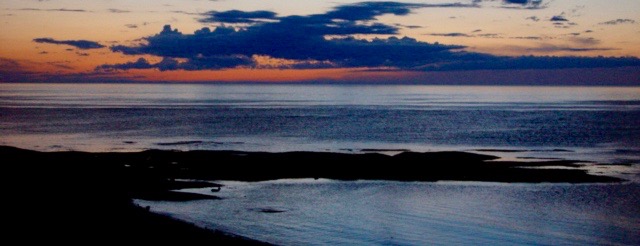
Sunset at Ste. Luce. We wait for the choir to arrive. Take a deep breath: it will soon be here.

Angel Choir
(on seeing the Northern Lights at Ste. Luce-sur-mer)
Sonnet

Listen to the choristers with their red and green voices.
Light’s counterpoint flowering across this unexpected son et lumière,
we tremble with the sky fire’s crackle and roar.

Once upon another time, twinned with our heavenly wings,
we surely flew to those great heights and hovered in wonderment.
Now, wingless, our earthbound feet are rooted to the concrete.
If only our hearts could sprout new wings and soar upwards together.

The moon’s phosphorescent wake swims shimmering before us.
The lighthouse’s finger tingles up and down our spines.
Our bodies flow fire and blood till we crave light, and yet more light.
We fall silent, overwhelmed by the celestial response.

When the lights go out, hearts and souls are left empty.
Leaving the divine presence is a gut-wrenching misery.
Abandoned, hurt and grieving, we are left in darkness.

Comment: The Spanish mystics, St. John of the Cross, and St. Teresa of Avila, wrote, in the sixteenth-century, about the ‘dark night of the soul’. That dark night also arrives when the communion with the spiritual finishes and the communicants are left alone, in their loneliness, abandoned to their earthly selves. To leave the divine presence is a heart-breaking, gut-wrenching misery. To turn from the marvels of nature can produce lesser, but still deeply moving feelings of grief and sadness. The secret is to preserve that joy and to carry it with us always, warm, in our hearts. Doing so makes the pain of separation much more bearable.
Croaking Angels

He knows the frogs are in there. He doesn’t need to hear them sing. But he loves to make them croak.

Croaking Angels

Their tunes are one note symphonies,
croaks of joy that move
their fellow frogs to ecstasy,
exhorting them to share
the splendors of ditch life,
in a springtime bonding
that will loft them skywards.

There’s an ancient magic
in this calling: water
and laughter, sunlight, warmth,
and all those joyous things
that fill the newborn spring.

Moonlight swings its cheerful love lamp.
New leaves and buds are also known to sing.

Comment: This always makes me think of the croaking chorus from Aristophanes. I do hope all those wonderful ancient plays, songs, myths, and legends are not forgotten in our croaking frog chorus of modern jingoistic advertisements and propaganda. Ah well, what’s a source for the proper goose is probably a source for the proper gander. Who knows nowadays? What we do know is that spring is just around the corner. Warmth and the absence of snow will help change our lives. And yes, that croaking chorus will be back.

Black Angel

from an original painting by Rogier van der Weyden (1399/1400-1464)

Black Angel

You cannot hide
when the black angel comes
and knocks on your door.

“Wait a minute,” you say,
“While I change my clothes
and comb my hair.”

But she is there before you,
in the clothes closet,
pulling your arm.
You move to the bathroom
to brush your teeth.

“Now,” says the angel.
Your eyes mist over.

You know you are there,
but you can no longer see
your reflection in the mirror.

Comment:

I first saw the Black Angel in Aldebarán’s cultural store in Ávila (2006). She sat there, in the shop window, along with several other angels, and I worshiped her from the distance of the street. Her image was taken from an original painting from Rogier van der Weyden (1399/1400-1464). This was turned into a 3-D image and then converted into the statue I saw in the shop window.

I brought the statue back to Island View, placed it on the shelf above the fireplace, where it still rests, and wrote several poems on the theme of Angels. I gathered them together in a chapbook entitled All About Angels that I self-published in Fredericton in 2009. The chapbook was dedicated to Clare’s great-aunt, D. E. Witcombe who departed this world on October 15, 2008.

All About Angels was also based on a book of a similar title, Sobre los Ángeles, written by Rafael Albertí, one of the major poets of Spain’s Generation of 1927. I avoided the ambiguity of the Spanish title — Sobre (in Spanish) can mean Above or Beyond as well as About — by limiting my own title to All About Angels.

For Carl Jung, angels are the messengers sent to inform people of the state of their world. For me, they are also the wild creatures that inhabit the world around me and often take the form of chickadees, crows, mourning doves, woodpeckers, deer, foxes, chipmunks, the occasional bear, and other spiritual creatures. They can be best seen in those moments of solitude when we are most open to the natural world around us. Then, and sometimes only then, we can hear the urgent messages they bring.

Alebrijes

Alebrijes

alebrije2
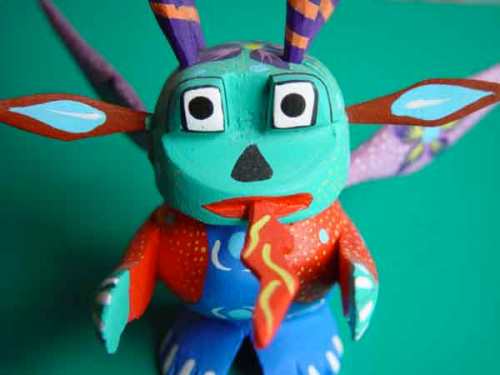
This is one of the first alebrijes I bought in the zocalo (main square) in Oaxaca. He has lost his ears and probably his tongue. They started falling out so we wrapped them up carefully and now we can’t find them. He’s still a happy chappy, hough, and has been in this house for a quarter of a century. Happy Birthday Alebrije!

     Alebrijes step out from dried wood and stand in the shower of paint that falls from the brush’s tip. Yellow flash of lightning, pointillistic rain, garish colors that mirror those of the códices. The carvings take the form of fantasy figures, anthropomorphic animals, and mythological creatures.
Sometimes one individual selects the wood, carves it, then covers it in paint. Occasionally an entire family takes part in the work of making the alebrije. One person collects the wood and prepares it for carving. Another carves and sands it. A third works on the undercoat, and a fourth applies the final patterns of paint.
The great debate: does the form in the wood reveal itself to the carver or do the carvers impose their own visions on the wood? In the case of the team, do the family members debate and come to a joint conclusion?
These thoughts, exchanged with wood-carvers in Oaxaca, have led to a series of interesting conversations. What exactly is creativity? Where does it come from? Do we, as artists, impose it upon our creations? Or do we merely observe and watch as new ideas float to the surface of our minds? How does the creative mind really function? And, by extension, how much of the sub-conscious creative sequence can be placed into words?

Alebrijes

 Are they half-grasped dreams
that wake, wide eyed, to a new day’s sun?

Or are they alive and thriving
when they fall from the tree?

Does the carver fish their color and shape
from his own interior sea,
or does he watch and wait for the spirit
to emerge from its wooden cocoon
to be reborn in a fiery block of color?

Daybreak:
in a secluded corner of my waking mind,
my neighbor’s dog greets the dawn with sparks
of bright colors born from his bark.

My waking dream: dark angels with butterfly bodies,
their inverted wings spread over my head to keep me warm.
In the town square, the local artist plucks dreams
from my head and paints them on carved wood.

IMG_0299
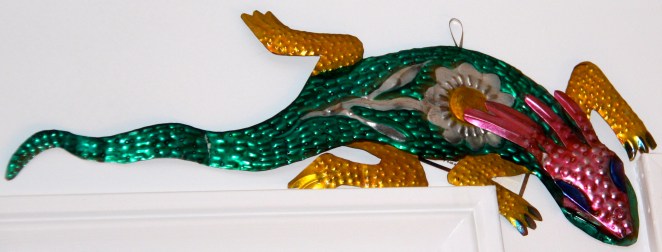
Our house iguana: he is not an alebrije, but is made out of painted metal foil, carved first, and then decorated. He’s the one who guards the front door and falls upon unwanted intruders when they least expect it. Never stay home alone without one, or two, or more. But watch out if you have too many and they get hungry.

Sympathetic Magic

Nunca llueve en los bares: it never rains in the bars.

Sympathetic Magic

“Rain, we need rain.”
The bruja whirls her rain stick.
Rain drops patter one by one,
then fall faster and faster
until her bamboo sky fills
with the sound of rushing water.

An autumnal whirl of sun-dried cactus
beats against its wooden prison walls.
Heavenwards, zopilotes float
beneath gathering clouds.
Rain falls in a wisdom of pearls
cast now before us.

Scales fall from my eyes.
They land on the marimbas,
dry beneath bar arches
where wild music sounds,
half-tame rhythms,
sympathetic music
like this rainstorm released
by the bruja‘s magic hand.

Comment: Bruja: witch, witch doctor; Oro de Oaxaca: mescal, the good stuff; Zopilote: Trickster, the turkey vulture who steals fire from the gods, omnipresent in Oaxaca; Marimbas: a tuned set of bamboo instruments. But you knew all that!

Crow’s Feet

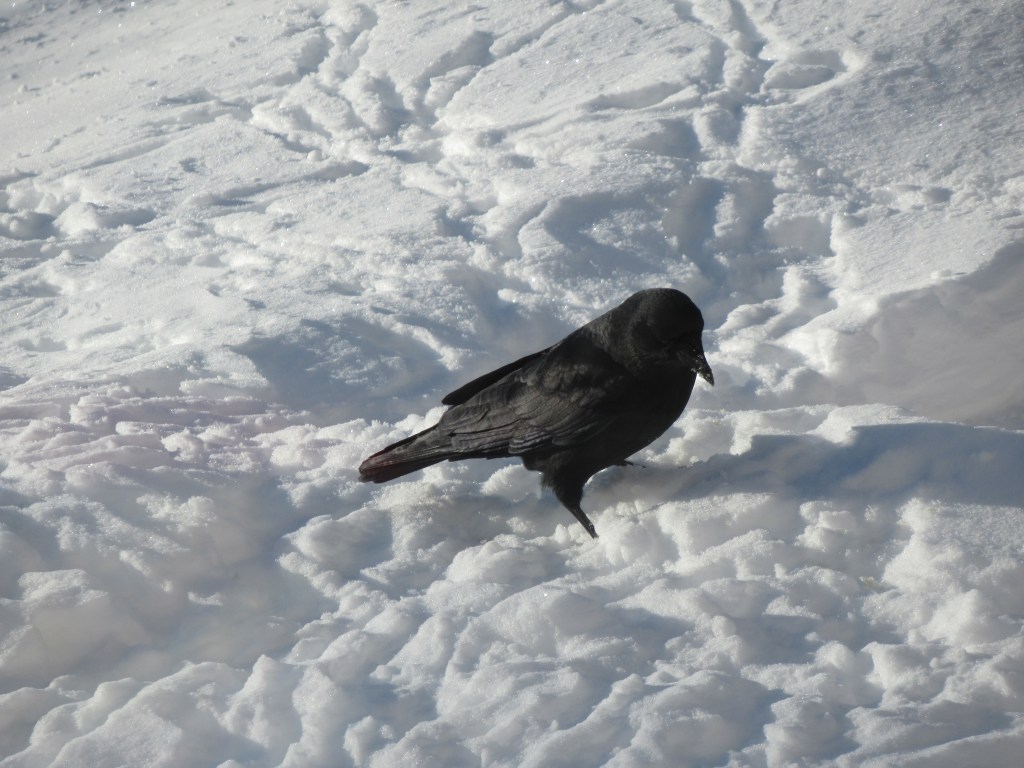
A crow, but not a beach. You’ll have to click on the link at the bottom of the page for the real beach photos.

Crow’s Feet

a convict’s arrows
marking the eye’s corner
and the beach at low tide
with its crackle of wings
as sea-birds fly
their defensive patterns
feathered sails
on a canvas wind

how many crabs
made in the image
of their carapaced god
hide in the sand
half-buried waiting
for the tide to turn
and water to return
and give them refuge

abandoned shells
postage stamps
glued in the top right-hand corner
of a picture post card beach

who can decipher
the sea’s hand writing
this mess of letters
stitched by sandpipers
who thread the beach’s eye
inscribing dark secrets
with the sewing machine
needles of their beaks

pregnant this noon tide silence
this absence of waves
where the quahaug lies buried
secured by a belly button
a lifeline to air and light
surrounded by crow’s feet
tugging at the beach’s dry skin

sand beneath my feet
sand between my toes
dry sand sandpapering

Comment:
And here’s the link to the beach photos.

https://moore.lib.unb.ca/poet/Crows_Feet.html

Thin Ice

Thin ice, light snow, and the crows’ feet of age marking the earth face with graven beauty, scars like those made by time’s tick-tock arrows.

Thin Ice
Vulnerant omnia, ultima necat

I walk on thin ice
at the frayed edge
of my life.

I search for the key
that will rewind me,
but I fail to find it.

Who will winch up
the pendulums on
my grandfather clock,
resetting it
in spring and fall?

Who will watch
time’s sharp black arrows
as they point the path
of moon change
and the fleeting hours?

Each hour wounds me.
Who will tend me
when that last one kills?

To be a writer ….

Photo by my good friend, Geoff Slater. Books by yours truly, who stayed on the bus and believed.

To be a writer ….

He who would true valor see,
let him come hither.
One here will constant be,
come bad or fair weather.
No line length can him fright,
he’ll with a paragraph fight,
and he will have a right,
to be a writer.

Those who beset him round
with dismal stories,
do but themselves confound:
his strength the more is.
There’s no discouragement
will make him once relent
his first avowed intent,
to be a writer.

Rejections nor bad critics
can daunt his spirit.
He knows he at the end
will a book inherit.
So critics fly away,
he’ll fear not what they say,
he’ll labor night and day
to be a writer.

Comment: John Bunyan tempted me and I fell into temptation. In fact, as my good friend Oscar Wilde once said: “I can resist anything except temptation.” So, ladies and gentlemen, change the he to a she or the pronoun of your choice, turn the writer to a sculptor, stoneist, poet, playwright, painter, novelist, dramatist, comedian, song-writer, singer. Breathe deep. Believe in your own artistic talent and remember: “Genius is 99% perspiration and 1% inspiration.” Remember this too: “You’ll never get to Vancouver by bus, if you get off the bus at Montreal or Toronto.”

Collateral Damage

And that’s not all they checked: a regular Spanish Inquisition. Post Covid-19 it has all fallen silent. Those doctors don’t call anymore.

Collateral Damage

Once a month, they used to stick
a needle in my arm and check my PSA,
cholesterol, and testosterone:
blood pressure rising, cholesterol high.

The doctors kept telling me
it was a level playing field
but every week they changed the rules
and twice a year they moved the goal-posts.

Monday Night Football:
a man in a black-and-white zebra shirt
held a whistle to his lips while another
threw a penalty flag. It came out of the tv
and fell flapping at my feet.
Someone on the field called a time out.

I haven’t seen my doctor for three years.
My urologist has been silent
for more than eighteen months.
It’s been two years since I last spoke
with my oncologist.

I have become collateral damage.
My body clock is ticking down.
I know I’m running out of time.

Comment: I know I am not the only one to have fallen between the cracks in the medical service. Nor will I be the last. I don’t want to cry ‘wolf!’ and yet I feel as though I have been completely rejected. A year after I recovered from my cancer, I received a survey asking me to assess my post-cancer treatment and services. I read it and cried. I did not even know that the services I was being asked to assess were even being offered. I had certainly received none of the follow-up services. “A law for the rich and a law for the poor” indeed. And so many cracks between so many floorboards with so many people falling through. This is not a rant: it is a warning that all of us must look out for ourselves. I can assure you that if you don’t care for yourself, nobody, but nobody, except for your nearest and dearest, will give a damn for you either.

Why?

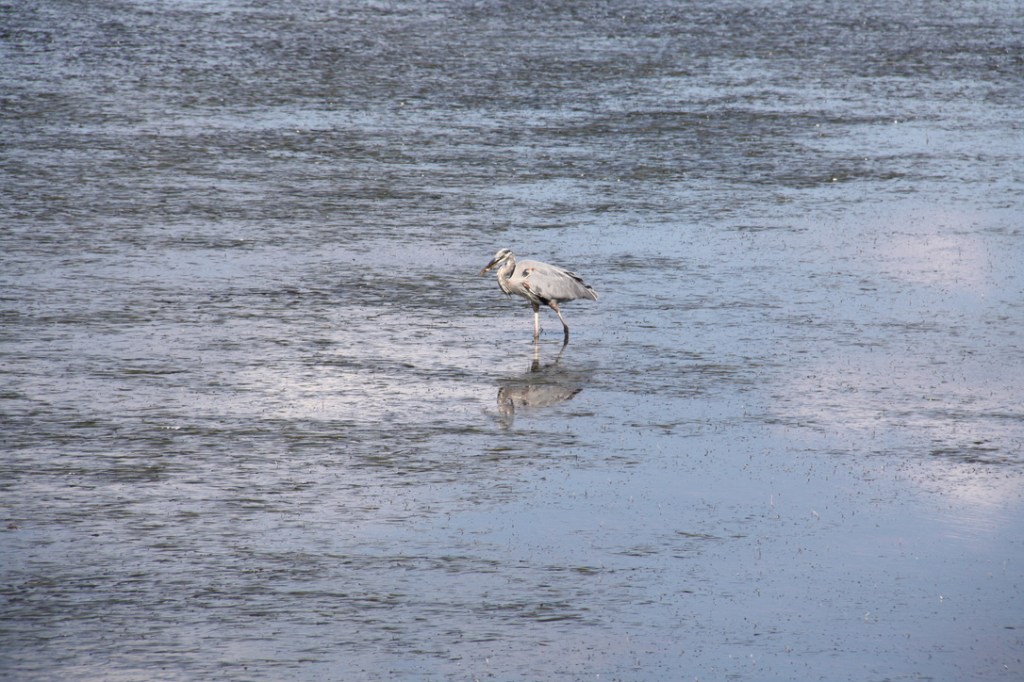
Different bird, same question: why? This one is from one of the beaches on the road to North Cape, PEI. Why, indeed?

Why?

In the mud nest jammed tight against the garage roof,
tiny yellow beaks flap ceaselessly open.

The parents sit on a vantage point of electric cable,
mouths moving in silent encouragement.

A sudden rush, a clamour of wing and claw,
a small body thudding down a ladder of air
to crash beak first on the concrete.
  “Why?”

 “Wye is a river.
      It flows through Ross-on-Wye
      and marks the boundary
      between England and Wales.”

And the swallows perch on the rafters
watching their fledgling
as it struggles on the floor:
the weakening wings,
the last slow kicks of the twitching legs.
“Why?”

“Y is a crooked letter
     invented by the Green Man of Wye.”

Comment: This is the original poem, written back in the eighties, wow, that’s forty years ago. I included it in my first poetry chapbook, Idlewood (published, 1991). It was a slim volume, dark green color, typed and photocopied, very humble, but MINE! A couple of years ago I wrote a prose poem, sort of flash fiction, in one of my Welsh sequences and included the story as part of the text. It came to me as a memory yesterday morning, and I posted it on Facebook. Here now is the story. Hopefully, you have just read the poem: I hope you liked it but, as I know all too well, de gustibus non est disputandum. I would like to know if you prefer the poetry to the prose. Please let me know, pretty please?

Why?

“Where are you going?” I ask. “To see a man about a dog,” my father replies. “Why?” I ask. “Hair of the dog,” his voice ghosts through the rapidly closing crack as the front door shuts behind him. “Why?” I cry out. I recall the mud nest jammed tight against our garage roof. Tiny yellow beaks flap ceaselessly open. Parent birds sit on a vantage point of electric cable, their beaks moving in silent encouragement. A sudden rush, a clamour of wing and claw, a small body thudding down a ladder of air to crash beak first on the concrete. “Why?” I ask. The age-old answer comes back to me. “Wye is a river. It flows through Ross-on-Wye and marks the boundary between England and Wales.” The swallows perch on the rafters watching their fledgling as it struggles on the floor, the weakening wing flaps, the last slow kicks of the twitching legs. “Y is a crooked letter invented by the Green Man of Wye,” my grandfather says. “Why?” I repeat. “I want to know why.” Silence hangs a question mark over the unsatisfied spaces of my questioning mind.