Hide and Seek

Hide and Seek

Pictures and memories play hide and seek.
They hunt the slipper that hides in the words
that slither and slide across my page.

They long to emerge, fully formed, and to step,
without effort, into your mind. They want
to linger there, to baffle, taunt, and haunt you.

Digging through the verbiage, a thought,
a metaphor, a grouping of words will join and
rejoin. This is the grit that the oyster slowly shapes
into the pearl of great price that glows so bright.

Consider the opal. Plain at first sight, yet changing
color, shimmering in sunlight, a chameleon
adapting to mood and shadow, its moon dance
hovering, a butterfly over burgeoning blossoms.

Who could ever forget, once seen, star light
illuminating the bay, the moon gilding the sea,
those summer nights, our secret love flowering.

The veiled will unveil itself and tease its way,
its path over the sparkling waters of the bay.
Knock and it will open. Seek and you will find.

Comment: I had a specific, named place in mind when I first wrote this poem. Then I realized that my secret place was not necessarily the remembered place of other people who had undergone similar experiences. So, I removed the specific and made it generic.

I know you have been there, to your own special place. A warm summer night. Star light over a bay. Or maybe it was an estuary, or perhaps a river bank? The moon appearing, lighting up the waters. Walking, perhaps, hand in hand. Or sitting, as I remember it so well, in a late-night café, watching the night lights on the fishing boats, as the moon spread its golden carpet over the bay.

Low Ebb

Low Ebb

We have been apart too long, my love,
night’s dark corridor lying between us
and neither of us approaching the other
when doors close and blinds are drawn.

The way to the heart of the matter is not
an easy path to walk, not any more.
Our secret ways and dreams lie cold
upon chill, empty sheets and pillows.

Each day the tide revives the beach,
flowing out, abandoning its wet debris
for the sun to perform its magic: fresh
seaweed drying above warm sand.

Sea-birds bury their beaks, writing claw
letters as crabs burrow, dig deep, waiting
for the tide to return and re-create
its alternate reality of dreamy waters.

Half of my bed performs its nightly duty.
The other half lies cold, empty, lonely.
No sea-life wanders there, not even in
my most creative dreams of sun and sand.

Comment: The loneliness of old age is compounded by many factors, including ill-health, sleeplessness, and the need to sleep in separate rooms. How many homeless people suffer that loneliness, and more, and at ages much less than ours? And then there’s the distress of trying to live in poverty, to survive from day to day, with safety net that will not protect us, if we chance to fall. A sad world then, as Polly Toynbee points out in today’s Guardian.


Flight

Flight

Such a miracle: those first steps to flight
taken by the cormorant over water.
That first one heavy, creating ripples,
the second one lighter, and the third one
scarcely touching the water.

The need to take flight lies deep within me.
Fleeing from what? Flying towards what?
Who knows? All I know is that the future
lies ahead where my bird’s beak points and
the past, a rippling wake, lies behind me.

That white water, trailing its kite’s tail,
tells me where I have been. Machado’s
voice calls out from the past: “Traveler,
there is no road, just a wake across life’s sea.”

Comment: The photo is a golden oldie, one of the first I ever posted on this blog. The poem is part old, part new. In reality, it is a revision, completed today, of the earlier poem associated with that old blog post. It is interesting to compare the two visions – with those seven extra years of creative experience between them. Let me know what you think!

A special thank you to my long-time friend, Dale Estey, for commenting and suggesting an improvement for the fourth line. Spot if if you can!

What do you enjoy most about writing?

Daily writing prompt
What do you enjoy most about writing?

What do you enjoy most about writing?

I love it when a special friend reads one of my books and then takes it to the place where it was composed, and sends me a wonderful photograph of the book cover and the exact spot, at Hopewell Cape, where the cover was drawn. Wow! That is so special. Thank you, Sara, my friend and accomplice, for making even more art out of art and involving nature in the process.

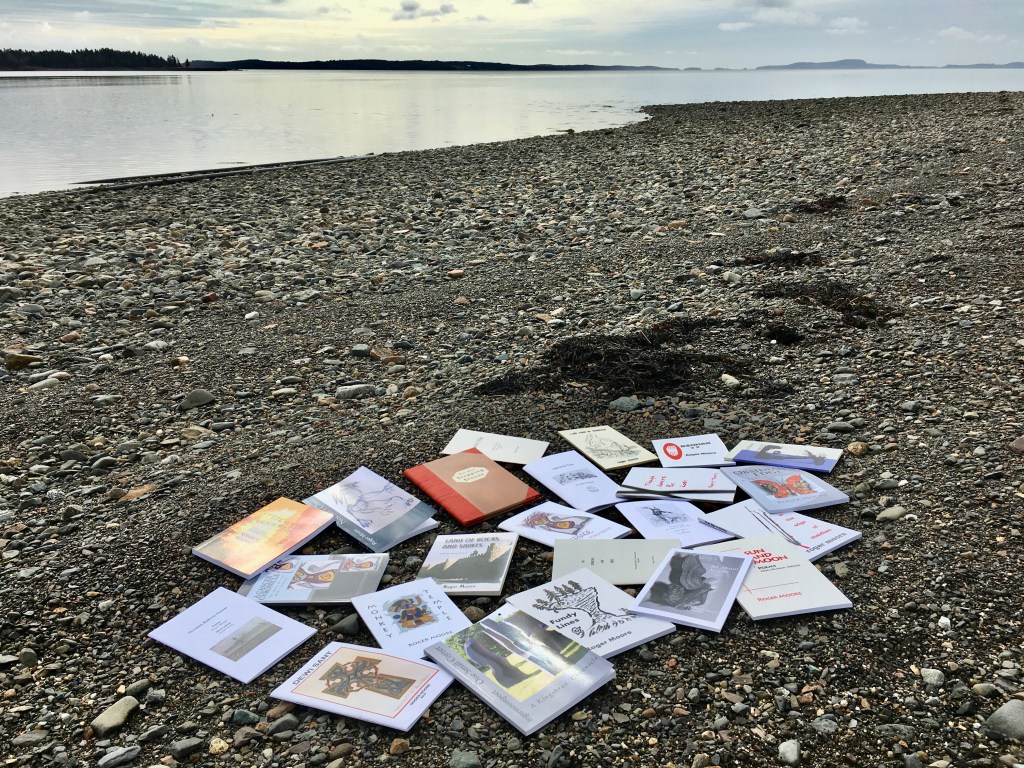
Other friends have done similar things. Here is a collection of my books on the sea shore at Holt’s Point. And yes, Fundy Lines is in there as well. Can you spot it? Another very good friend, Geoff, contributed this very meaningful photo. So much of my life, there, upon the sea shore, waiting for the tide to come in.

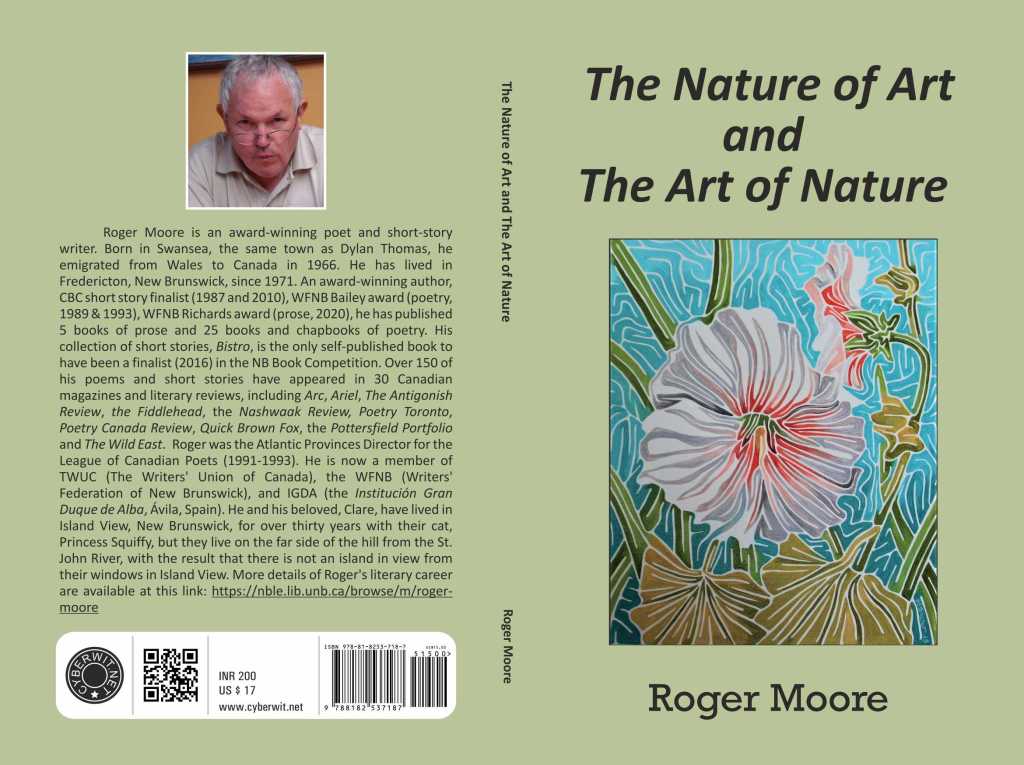
This book, and its cover, are also very special indeed. And here’s why.

Still Life with Hollyhock
Geoff Slater

How do you frame this beaver pond,
those paths, those woods? How do you
know what to leave, what to choose?
Where does light begin and darkness end?

Up and down: two dimensions. Easy.
But where does depth come from?
Or the tactility, the energy, water’s
flow, that rush of breathless movement
that transcends the painting’s stillness?

So many questions, so few answers.
The hollyhock that blooms in my kitchen
is not a real hollyhock. Intertextuality,
visible and verbal: this is a poem about
a painting of a digital photograph of a
hollyhock, a genuine flower that once
upon a time flourished in my garden.

A still life, naturaleza muerta in Spanish,
a nature morte in French, a dead nature,
then, portrayed in paint and hung alive,
on display, in this coffin’s wooden frame.

So, what do I enjoy most about writing? Everything – for whenever creative people create they draw in others into a web of intertextuality that spins its way from mind to mind and, especially in Canada, links shore to shore to shore.

Janus

Janus

I walked backwards into my childhood
a step at a time. I failed to find it
where I thought I had left it.

I opened cupboards, doors, drawers,
searched beneath beds, went outside,
rummaged through garden and garage,
and found absolutely nothing at all.

 My past was as dry as a squeezed orange
when the juice has gone and long days
left on the window ledge has dried it up.

I looked in the mirror, and the man
I saw was not the boy I had seen
the day before. How could he be?

Janus, two-faced, looks forwards and back.
I will no longer seek the self that was

I shall accept the self that is, the one that grew
outwards and upwards from the one
that was before. Acceptance. I can do no more.

Crossing the Bridge

Crossing the Bridge

When I got to there, I couldn’t cross it.
I sat in the coffee shop, over-looking
the River Severn and ordered a cup
of cafeteria tea. Time limped slowly by
and I let my untasted tea grow cold.

What was there for me on the other side?
Empty stood the house where I was born.
Sold, the bungalow, built by my father
and his father, the summer home I loved
so much. Lost the kitchens I remembered
so well, kitchens in which I had come of age.

I tried to picture the ghosts of Christmases
past walking the logs that flamed in the fire.
Ghosts? They inhabit my mind, share my life,
dwell in my days, dream with me most nights
when a golden moon sails past my window,
and silver stars fill my dreams with light.

Underworld

Underworld

In the secret world of my goldfish bowl
I speak in bubbles but only hear silence.

My fish-eye lens bends the pendulum
of the grandfather clock. Westminster chimes,

inaudible, do not intrude. Noiseless are time’s
ripples across the surface of my submarine sphere.

I feel, rather than hear, my troubled heart beat.
The foreboding sounds of distant voices leave

me untouched and becalmed. Rocked in love’s
cradle, these amniotic waters nourish and soothe.

In my beginning will be my end. One day I’ll return
to the beaches of my childhood, where the sun

always shines, and the moon path over the waves
is a welcoming walkway leading to the underworld.

Skype or Zoom

Skype or Zoom

I sit and watch the grandfather clock,
listening to every tick and tock.

So slow, the sullen pendulum swings
as time limps by on leaden wings.

When they arrive, the house will fill
with youthful joy and much goodwill.

Age will flee for a week or two,
then we’ll be alone, just me and you.

Watching the telly, watching the clock,
counting each tick and every tock.

We will be lonely, left here alone,
waiting for them to telephone.

The very best thing to lighten the gloom
is to see them again on Skype and Zoom.

What brings you peace?

Daily writing prompt
What brings you peace?

Septets for the End of Time

I

Crystal Liturgy

Here, in the abyss,
where song-birds pluck their notes
and send them, feather-light,
floating through the air,
here, you’ll find no vale of tears,
no fears of shadow-hawks,
for all blackness is abandoned
in the interests of sunlight and song.

Here, the crystal liturgy surges,
upwards from the rejoicing heart,
ever upwards, into the realms of light,
where color and sound alike
brim over with the joy that, yes,
brings release to head and heart.

Here, seven-stringed rainbows reign,
the everlasting harp is tuned and plucked,
and an eternity of music cements
the foundations of earth and sky.

Here, the master musician conducts
his celestial choir, their voices rising,
higher and higher, until they reach
the highest sphere, and song and voice
inspire, then expire, passing from our eyes
and ears into unbounded realms of light.

Here, the seven trumpets will sound
their furious dance, a dance that will announce
the end of this singer, the end of his song,
but never the end of song itself.

Apologia

Apologia
pro vita mea

The fairground’s distorting mirrors distort.
I change as I walk past one and then another.

Rage, rage against that hump-backed shape
that looks back at me from the bottle-glass.

Magic: eye of a newt, eye of a toad, cat’s
eyes at night lighting the road to bed.

Bedlam all around me. Absurd this world,
gone carnival mad in the blink of an eye.

I need a white stick to walk through
this fog that clings to my clay-bound soul.

This wine I drink, these thoughts I think,
life’s fountain pen soon runs out of ink.

Watch the tides as they ebb and they flow.
When your time runs out, pack up, and go.

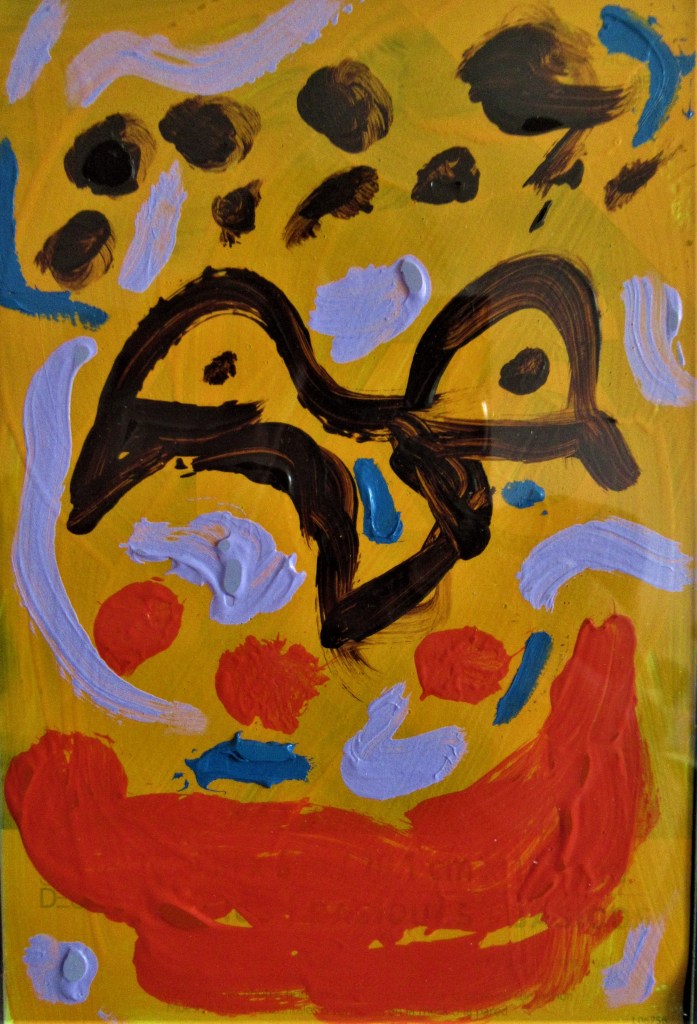
Comment: My friend Moo did himself proud with the above painting. What is it? I asked him. Dunno was his reply. I have shown it to several friends and speculation is rife: the dancer and the dance, dancer and diver, a blur of three figures, headless mermaid (I love that one). And yes, life is absurd (Albert Camus), a carnival (Bakhtin) in which knowledge is power and civilization is mad (Foucault).

Originality and imitation – how many genuinely original ideas are there? Very few. And the same goes for poetry – original poems are very rare. Most of our ideas come from elsewhere, even if we do not know it. The title of the above poem comes from Petrarch. It’s structure is traditional – a sonnet. Its ideas are borrowed from Camus, Bakhtin, Foucault. And yet, shuffle the cards (Cervantes) throw the dice (Mallarme’) and this poem and this post have both achieved a kind of originality and uniqueness by linking disparate ideas in a new unity.