I went to the pharmacy today for my regular shots, booster and upgrade. The pharmacist asked me if I was allergic to anything. “Yes,” I replied. “I am allergic to stupidity.”
Stupidity is a singular thing, but it comes in many forms. The car driver who weaves his car through thick traffic, breaking the speed limit, threading a narrow pathway, overtaking on the inside, the outside, turning a two way street into a three way street by adding a third lane, even though there is oncoming traffic in the new lane he has built for himself. Such people rely on the charity of others to give way and make space.
Then there are incompetent teachers. Not all teachers are incompetent. Some are wonderful, kind, friendly, and comforting. Others are martinets, escaped from the army cage, and strutting the classroom, using the ruler to beat the students into submission. ‘My way or the highway,’ they claim, and what they say goes, even if it climbs to the height of stupidity or falls to the bottom of the well of incompetence.
Goya illustrated the nature of various kinds of stupidity in his wonderful etchings. Witches flying, donkeys braying, simple people worshipping the expensive clothing but never seeing the corruption it covers. So, turn to the Caprichos and the Proverbios, or, if you want to receive a real lesson in man’s inhumanity to man, look at the Desastres de la Guerra, the disasters of war.
Stupidity – a simple word – but with multiple meanings. What bothers me, and why? Stupidity, plain and simple, in its multitudinous forms.
“May you live in interesting times.” This phrase, be it a blessing or a curse, it has been called both, is rapidly becoming a cliché. So, are we living in ‘interesting times’? Good question, and I have no answer to it, not one that I would publish anyway.
As to listing 10 things that I know to be absolutely certain, I can’t. And that may be the first thing I am certain about. The other thing about which I have a certain amount of certainty is uncertainty itself. I am certain that yes, we are indeed living in times of uncertainty. Well, most of us are anyway. The other thing that I am fairly certain about, well, 100% certain about really, is that death will come to us all, sooner or later, don’t know where, don’t know when, don’t know how.
So, perhaps I can manage to achieve three certainties – 1. The certainty of death, to quote Dylan Thomas, ‘for all poor creatures born to die’. 2. The certainty of uncertainty itself, to quote Stéphane Mallarmé, in my own translation, ‘a roll of the dice will never eliminate chance’. 3. The certainty that I cannot find seven more things about which I am certain.
That said, I am not all that certain about what I have just written
Well, what a strange question. In the first place what on earth does ‘are you seeking’ mean and to what does it refer? Some examples of what it might refer to include – shopping, investments, playing sports, dining out, preparing your own food, going on holiday, choosing a pair of shoes, or a new shirt, driving to work in the morning, parking the car. In each case, your answer will change according to the exact thing you are doing and what you are seeking when you do it.
Security or adventure – does it have to be one or the other? Rock climbing or mountaineering can be an adventure. But if security measures are neglected, then the adventure exposes the foolhardiness of the neglecting of security measures. You could say the same thing about driving to work. In the race to achieve access to a decent parking spot, do you go for ‘adventure’, drive fast, take risks, weave your way through traffic, honk your horn, and drive other drivers, would be parkers in your spot, off the road? Or do you set out early, drive carefully, obey the traffic rules, and seek the security of the knowledge that, with an early departure, the parking spot you desire will be there, without the rush of the madcap adventure?
When you combine security with adventure, and there is no reason why you shouldn’t for they are both compatible, then you have the best of both worlds. You can be secure in your adventuring and adventurous in your security. Think ‘Titanic’ – and you will realize that recent events have shown that adventure without total security is not the sort of risk that any sane person, in their right mind, wants to run.
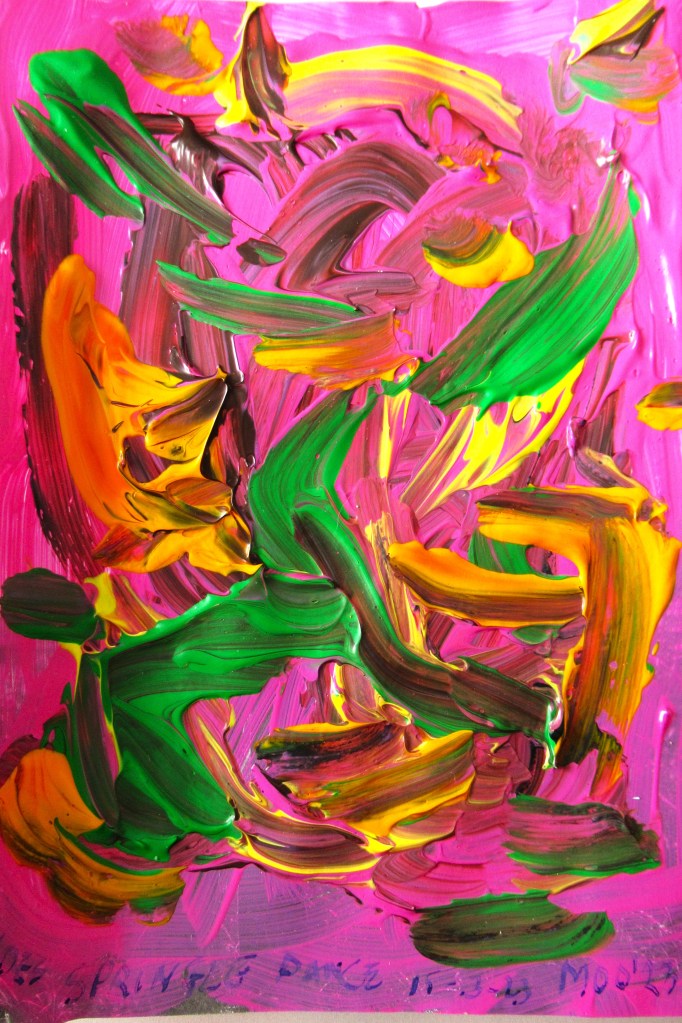
And look at that painting, the one above that leads the post, is it ‘secure art’ or ‘adventurous art’ or is it even art at all? Accept nothing at face value. Think carefully before you answer those questions too.
You make me think of the road not walked, the path untaken, the bay around the headland where we never swam, the cliffs on the Gower that we never had the time to climb.
Who knows which path is right or wrong when we throw the dice and stake our future on a single moment of time when, thinking done, we come to a decision and take that first step.
The more I know, the more I realize that I know so little and am surrounded by a world not only unknown, but totally unknowable, and me with my life dangling from a frail thread.
Sometimes, I dig deep into bottled sunshine, But find no answers there, just the same questions swirling round the glass, and the glass filled with the same uncertainties and lack of knowledge.
I really don’t know where to go, or how to get there. And then I remember that, if I don’t know where to go, any path I take will lead me there. That is when I shuffle the cards, breathe deep, and give the dice a throw.
“Patience achieves everything.” St. Theresa wrote this in Spanish, back in the old days, when patience was a virtue that few possessed. Patience has vanished nowadays.
It is as dead as a doornail, as dead as the proverbial dodo, as dead as whatever cliché springs to mind in the laziness of the instant possession of each passing cloud, each new slogan marketed madly on the TV.
Turn off the TV. Go out, barefoot, and walk on rain-wet grass or walk on sea-wrinkled sand out into the sun-warmed waves, there where the sandpipers stitch their secret messages and the crows walk barefoot too.
Learn the secrets sown there, decipher the ancient wisdom left on the beach by wandering gulls.
There, in the tide-mark you will find, among the sand-papered bones and skulls, the secrets that will solve the mysteries that you seek.
“If you try to force the soul, you never succeed.” John O’Donohue, Anam Cara, p. 147.
“La paziencia, todo lo alcanza.” St. Theresa of Avila.
I stand on a tiny platform, high above the upturned faces of the clamouring crowd. Before me, the high-wire stretches across the diameter of the circus tent.
Clad in the enormous shoes of a clumsy clown, I grip the wire with the toes of one foot. Now I must choose – umbrella or pole?
The spotlight outlines my face’s whiteness, the bulbous nose, the fixed, painted smile. My jaws clamp tight in concentration.
Clutching the brolly, a good old gamp, I walk the thin wire plank of my current destiny. One step, two steps, tickle you under the chin, and I pretend to fall, grasp the wire, and raised by the crowd’s gasp of despair, swing back up.
Then, a yard from the finish line, I swallow dive, turn a somersault in the air, and land on my back in the middle of the safety net as the crowd goes wild.
“The magician works on the threshold that runs between light and dark, visible and invisible.” John O’Donohue, Anam Cara, p. 145.
“The most difficult role in the play is that of the fool – for he who would play the fool must never be one.” Don Quixote.
When sunshine floods my body it leads me down into a secret, sacred space that I know exists even though, all too often, I am unable to locate it, search as I may, but then, when I no longer seek it, it is with me, and I know that I am no longer alone, but wrapped in the comfort of an angel’s protective wings.
That haunting presence lingers, plays melodies within my mind, invites me to return, keeps me warm when chill winds blow.
I depart from that place, a fingernail torn from the flesh.
“There is a place in the soul that neither space, nor time, nor flesh can touch. This is the eternal place within us.”
“You represent an unknown world that begs you to bring it to voice.” John O’Donohue, Anam Cara, p. 105.
I once asked my grandfather, a decorated soldier from WWI, if he was worried about dying. “No,” he replied. “Why not?” “Well, Roger, we’re all going to die. We just don’t know when. So, if I worry, I will die. If I don’t worry, I will die. So, why worry about it?” I was about five years old at the time and we were standing outside the Swansea Hospital, as was, by the seat where the old men used to sit and gossip. I didn’t realize it at the time, but that was my first lesson in Stoicism.
“The day I was born, I took my first step on the path to death.” Francisco de Quevedo (1580-1645), Spanish Neo-Stoic, among so many other things. Thinking like that tends to put things into perspective, for death walks with us every day. Death is our twin sibling, brother or sister. We face his shadow every time we look in the mirror and that shadow follows us around all day. “Death is a law, not a punishment, so why worry about it?” Also Quevedo. Dying is a different matter and yes, there are so many ways to go, some of them, especially nowadays, with the advent of life-preserving medicines, slow and unpleasant. Yet, mors omnia solvit – death solves everything. And it brings a release from all pain and suffering.
The lead photo shows a plaque in Avila (Spain). La Calle de la Cruz (1660) -The Street of the Cross. It is also known locally as La Calle de la Vida y de la Muerte – The Street of Life and Death. Why? It is rumored that here, turning left outside the main cathedral, duels were fought. Two men entered, but only one emerged alive. It is interesting to meditate on the close proximity of life and death, always there, side by side.
So, for the fun of it, let’s change the question: what is life? “What is life? A frenzy. What is life? An illusion, a shadow, a fiction. And the greatest good is small, for the whole of life is a dream, and dreams are nothing but dreams, after all.” Life is a Dream, Calderon (1600-1681). Looked at from this point of view, what is death? Is it the shutting down and the turning off of the cerebral computer or is it the great awakening from the sleep of life? You can think of it either way but, either way, it’s pointless worrying about it. As my grandfather also told me: “If there’s nothing afterwards, I’ll just fall asleep and that will be the end of it. But if death is the great awakening, then I will be very happy to wake up in a new reality.”
Robert Bly, in The Sibling Society, writes of the lateral movement that now embraces society with its grip of instant pleasure, instant gratification, instant happiness. As a result, we have strayed far from the vertical knowledge that sustained us for centuries. We have abandoned the wise words of our ancestors. Now the old are no longer the keepers of wisdom and the guardians of culture, the institutional memories of the race, if you like. Now they are foolish, clumsy, out of date with the world’s most rapid advances. Only the young, and their siblings, can keep up with the ever changing instants of life as presented to us.
But all is not lost. “What a peaceful life, that of the wise man who withdraws from this noisy world and follows the hidden path along which the world’s wisest people have always walked.” Fray Luis de Leon (1527-1591). We can move far from the madding crowd. We can construct our own realities. We can base them on the words of wisdom handed down to us over the generations. Switch off the TV. Watch the sun as it moves across the cathedral face (Monet) or the walls of your house (Moo). Live each moment of each day. Do not fall into despair. Above, don’t worry – it does no good at all.
“Yes: I am a dreamer. For a dreamer is one who can only find his way by moonlight, and his punishment is that he sees the dawn before the rest of the world.” Oscar Wilde.
“The dreamers by day are dangerous people, for they are the ones who make their dreams come true.” T. E. Lawrence.
Two interesting and contrasting quotes on dreamers. They seem to contradict each other – but do they? How do we dream? What do we dream of when we dream? What does the word ‘dream’ really mean? How can it change, that meaning when a person announces in a sharp, sarcastic voice: “In your dreams.”? Were the Everly Brothers right when they sang their version of dream, dream, dream?
There is no right and wrong with dreams. Some dreams come at night. They rise from deep within our resting – restless minds, asking questions, answering questions, doubling down on what we did, or didn’t do. Some dreams are obsessive and occur again and again. These are individual to each sleeper and cannot be interpreted, en masse, by a dictionary of dreams. Other night dreams creep in through the bedroom window. These may not be our dreams – they may be the dreams of other people, come to disturb us as we sleep. These can be dangerous dreams, disturbing moments, and that’s why the indigenous have created dream-catchers that will snare those dreams and prevent them from entering.
Other dreams come by day. Day-dreaming is a rite of passage for many young children, trapped in boring school rooms with an ageing teacher droning on and on. “Knowledge is that which passes from my notes to your notes without going through anyone’s head.” I woke up enough from my day dream during that particular first-year lecture to note those words in my notebook. They were the only notes I took in that class and I day dreamed my way though a year of that man’s pseudo-lectures.
But the dreams we dream by day – yes, they can indeed be dangerous – because we can make them happen. One person dreams of being a doctor and, against all the odds, that person becomes one. Another visualizes – another form of day-dreaming – breaking a world record. And does so – such people fulfill their day-dream. Some, like Don Quixote, dream the impossible dream. These are fantasists whose dreams will never come true, for they are based on unrealities, and not founded on the essential truths of real life.
“Yes: I am a dreamer. For a dreamer is one who can only find his way by moonlight.” Much as I love this quote, I am disturbed by the adverb ‘only’. It is so limiting. Dreamers, as I have tried to show, can find their way by day as well. “His punishment is that he sees the dawn before the rest of the world.” This, too, I find enigmatic and disturbing. Why should dreamers be punished when they can also be rewarded? Why is seeing the dawn a punishment? Why is seeing the dawn before the rest of the world a sort of double punishment? And why does the dawn punish people? In order to answer that question, we must define the dawn! Maybe we’ll do that in another post.
“Be yourself. Everyone else is taken.” Oscar Wilde.
One of my favourite authors. A creator of bons mots and a specialist in renewing the meaning of meaning within words. And yes, within the witticism is a pearl of great price. We must indeed be ourselves. But who are we? That is the question. And how do we find ourselves, or know when we are lost, or know when we are found? Alas, all of us must seek those answers for themselves. No one size fits all.
Re-reading Robert Bly’s The Sibling Society, I am struck by his description of a lost generation that looks sideways for knowledge and ignores the long-held traditions of those earlier generations who brought us here and led us to where we are now. Lost people living in a lost world of instantaneous, shallow distractions. Deflect, distract, don’t think, gaze in awe and wonder, and let the show go on.
The Romans, towards the end of their Empire, had words for it too – bread, wine, and circus. Wrap yourself in an invisible cloak of instant pleasures, think no negative thoughts, do nothing, indulge, enjoy, envy, and climb that ladder as fast as you can. Onwards and upwards into the clouds of unknowing and uncaring.
Up there the Wizard of Oz performs his magic, his illusions, his trickery. Only believe and thou shalt see – whatever it is that the Magician wishes to show you. Don’t think. Don’t doubt. Be like someone famous. Copy them. Imitate them. Smoke like them. Drink like them. Be like them. Try to be them. There are some wonderful role models out there. Only believe ….
And forget about the Fall of the Roman Empire, forget about Oscar Wilde, forget about Robert Bly, forget about me. Above all forget these words – “Be yourself. Everybody else is taken.”
Forget them – or carve them into your heart and follow the Delphic Oracle and “Know thyself” or Shakespeare “To thine own self be true”. And remember – you can always make each day a good one. It’s up to you.






 rogermoorepoet