On what subject(s) are you an authority?

Daily writing prompt
On what subject(s) are you an authority?

On what subject(s) are you an authority?

First, I would like a definition of an authority. Here’s what I found – 1. the power or right to give orders, make decisions, and enforce obedience – as in “he had absolute authority over his subordinates”. 2. a person or organization having power or control in a particular, typically political or administrative, sphere as in – “the health authorities”. Isolating the words enforcement, power, and control, I am delighted to say that no, I am not an authority on anything, and I have no control over anyone. Also, I am not a monarch, and I have no subjects.

What happens if we change the meaning of the words slightly and ask another question? Here is a suggestion from the online Cambridge Dictionary – searching for an answer to my question “What is an example of authority on the subject? – I found this – The phrase “authority on the subject” is correct and usable in written English. You can use this phrase to describe someone who has extensive knowledge or experience on a particular topic. For example, “Dr. Smith is considered an authority on the subject of modern psychology.”

Now this becomes a very interesting question and it can be answered from a variety of perspectives. In our two person household, I deem myself an authority on some forms of cooking. I regard my beloved wife, my better two-thirds as I call her – an authority on the forms of cooking that I have trouble with – for example, baking, cooking vegetables, boiling eggs. She does a wonderful boiled egg. I am hopeless at boiling eggs – either too hard or too soft, usually the former. But I am the authority on Spanish omelets and scrambled eggs. They are my specialities. She makes wonderful chowders. I specialize in gazpachos, sopa de quince minutos a very quick (15 minute) Spanish sea-food soup, and Cawl Mamgu and other Welsh stews.

Once we step outside our kitchen, the world changes. In a world (New Brunswick) where cricket is virtually unheard of (save in the minds and cultures of fellow immigrants) I am considered an authority on cricket. Not that I am an authority, but at least I know what it is and have a good idea of what is happening in a cricket match. Therefore, we must also consider ‘being an authority’ in the context of the audience that receives our words of wisdom. To my nine year old grand-daughter, I am an authority on several subjects. However, I have absolutely no control over her – how she thinks and what she does. I can suggest or persuade, but I cannot and will not enforce.

In the undergraduate classroom, in which I taught for 43 years, I was considered an authority on Spanish by my students. Outside the classroom (and sometimes inside it) I learned more from my students than they ever learned from me, especially in my formative years as a Canadian when I was learning to skate and to ski. Don’t go there – too many painful memories of falling only to rise again!

But when we moved from the classroom to the wider university, to the full Canadian Scene of the Learned Societies, as they used to be called, I became the learner and the authorities were to be found elsewhere, often on the podium, sometimes in the bar. Same thing when we move onto the international stage. There are very few world authorities, in my field. However, there are many wannabe’s, but for them, after careful analysis of their strengths and weaknesses, I have usually had very little respect.

So, today we have opened another can of worms and look at them, wriggling and crawling before our very eyes. Worms – one of my friends really is an authority on earth worms. She knows all about them. Another of my friends is an authority on worms in puppies and kittens. A world wide authority, known every where and often quoted? I doubt it. But certainly in my garden and the vet hospital where I take my pets, they are both authorities.

Ah, the joys of Discourse Analysis – maybe, one day, I can be an expert on that. But take my words, as always, with a large pinch of salt, and, whatever you do, don’t put salt on slugs, and snails, and puppy dog tails. On that point, we can all be authorities.

What public figure do you disagree with the most?

Daily writing prompt
What public figure do you disagree with the most?

What public figure do you disagree with the most?

Some definitions please. What is a public figure? There are several statues in my local park. Are these public figures? If they are, how do you, or I, disagree with them when they can’t reply to our questions? Their mere presence, is that enough? Their historical past? Their figures now cast in bronze or stone? The crimes they committed (in our current opinion) from a time in which they did good (their society’s position)? “Judge not lest ye be judged!” We are all walking on thin ice and I do not wish to be the one who casts the first stone.

What is a public figure? A politician – provincial, regional, national, international? A TV personality? A film star? A rapper? A musician? A teacher? A preacher? A newscaster? A hockey player? A baseball star?

And how do you define disagreement? How do you disagree, and in what ways, with Beethoven’s Ninth Symphony and the Song of Joy, even if you are a Beatle and can sing “Roll over Beethoven” or mimic it on a Tuesday night in the local bar at a Karaoke show?

How do you define the most without defining the category and nature of disagreement? Mozart vs Bach vs Beethoven vs Vaughan Williams? Wordsworth vs Byron vs Donne vs Dylan Thomas? So let us go back to the beginning, and ask again “What is a public figure?” “How do you define disagreement? And how do you categorize “the most”?

Goya vs Velasquez vs Turner vs Dali vs Picasso?

“What’s the definition of Baroque?” “When you’re out of Monet.” Come on, you’re joking, aren’t you. “You’re having me on, aren’t you? You’re having me on.” “Pull the other leg. It’s got bells on.”

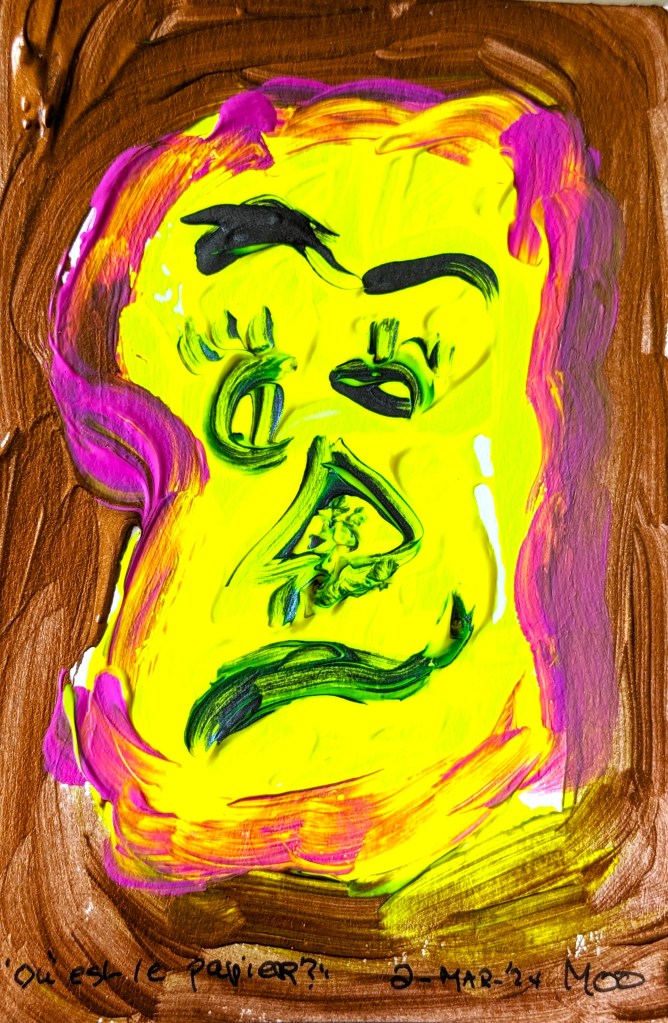
And I offer a nod of gratitude to The Two Ronnies and my good friend, Moo, who painted the painting that leads into this blog. He called it “In search of enlightenment.”

And no, I don’t disagree with him. But is he a public figure? Or just a figment of my imagination? And if he is a figment of my imagination, what, dear reader, are you?

In Place of Grief

In Place of Grief

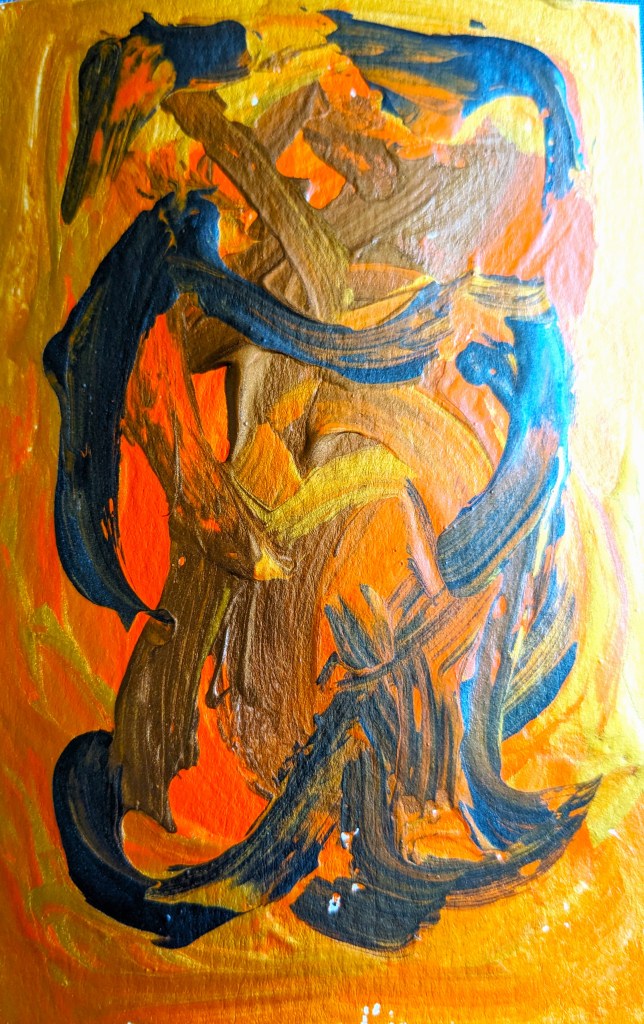
A double meaning of course / wrth gwrs. (a) to be in a place of grief and (b) to do something in place of grief i.e. instead of grief. Take your pick. One of my close friends immediately called it Chains. I replied – Ray Charles – “Take these chains from my heart and set me free.” Sometimes, with a great effort, we can do that ourselves. But, if the hole we have dug for ourselves, or that has been dug for us, is too deep, then we may need help.

Creativity is always a help. Painting and poetry, for me. And sometimes the hand of friendship, reaching out from the anonymity of hyperspace – the space beyond the space in which I live and with which I hold my Bakhtinian Dialog what he calls my chronotopos – my dialog with my time and place. Alas, sometimes it is a monolog – and then, when I get not reply, either from time nor from place, I feel an existential grief.

Door

A door slammed shut
          in my heart.

That closed door
          left me outside,
shivering in the cold.

Now I no longer know
          who or what I am.

The shadow of nothingness
          wraps its black shroud
around my shoulders.

Dark night of the heart,
          and me alone,
walking an unlit road
          with no end in sight.

(a) The shadow of nothingness is Meister Eickhard’s Umbra Nihili. A reference to the medieval philosopher.

(b) The dark night of the heart is a reference to St. John of the Cross’s dark night of the soul, part of the Via Purgativa, the mysterious road walked by the Mystics.

When you were five, what did you want to be when you grew up?

Daily writing prompt
When you were five, what did you want to be when you grew up?

When you were five, what did you want to be when you grew up?

I attended an international research conference on Quevedo, a long time ago, when I was teaching full time. A senior researcher, at the reception, heard me speaking and spoke to me – “Excuse me, and forgive me for asking, but I love your accent. Where did you grow up?” The question took me by surprise and, slightly off-balance, I replied – “I don’t think I have yet.” I assume the laughter was provoked by whatever my fellow academics were quaffing at the time.

Yet the answer lies very close to the truth. When I was four or five years old, one of the local priests asked me a similar question – “What do you want to be when you grow up?” At that stage of my life, I lived in a very strange world. All around me, my family seemed to fight like cats and dogs. I watched my dog chasing cats, and thought that women were cats and men were dogs. And all they ever did was chase one another and fight. I didn’t want to live a life like that. “I never want to grow up,” I told that priest. “You have to grow up,” the priest replied. “Everybody has to grow up.” “Peter Pan didn’t,” I said. “And I won’t either.”

I have tried, like Picasso, to see worldly things through they eyes of that child who has always lived in me. Sometimes, it is not easy to do so. The bitterness of the adult world creeps in and my world is flooded by those same old conflicts that have been there ever since I can remember. Fray Luis de Leon wrote about them when, after five years, he was finally released from imprisonment by the Spanish Inquisition.

“Aqui la envidia y mentira / me tuvieron encerrado,” he penned. “Here, envy and lies / kept me imprisoned.” Rather than the rat race of the adult world, he chose to follow the “hidden path trodden by the few wise sages who have lived in this world.” He also chose to be surrounded by simplicity and the child-like pleasures of a solitary life in which he found himself “ni envidiado, ni invidioso” / “neither envied nor envious.”

And there you have it, drawn from the mind of a five year old child and framed in the words, more or less, of a an excellent Spanish poet, whose work, dating from the 16th. Century, borders on the mystical nature of pantheistic theological thought.

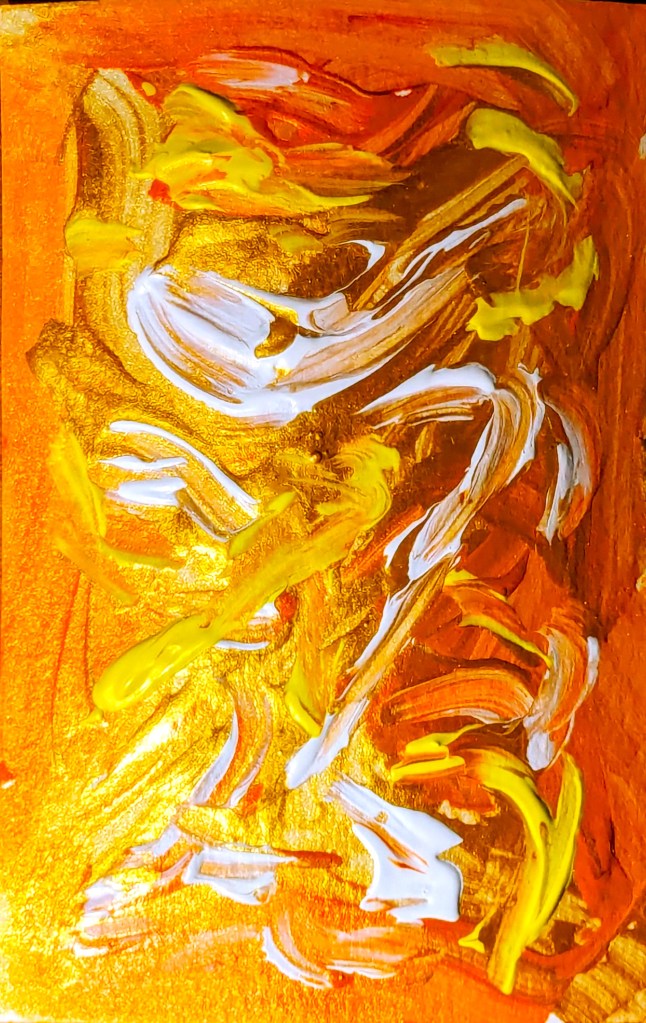
The painting, incidentally, is by my artist friend, Moo, and he calls it Pi in the Sky. You can think what you like about that and interpret it in any way you want. I hope Moo never grows up either.

Name the most expensive personal item you’ve ever purchased (not your home or car).

Daily writing prompt
Name the most expensive personal item you’ve ever purchased (not your home or car).

Name the most expensive personal item you’ve ever purchased (not your home or car).

I began by checking the meaning of item and found the following – an individual article or unit, especially one that is part of a list, collection, or set. Then I started to think about the meaning of meaning. Is an education an item? Is it an individual unit? Can it be considered part of a list, collection, or set? Let’s put it this way – I started school when I was four years old. I continued until I was 18. Along the way I collected many items of knowledge and many certificates to prove it. Then I went to Paris for a year to perfect my French – now that was an expensive adventure, I can assure you of that. Next came Santander, Spain, for a whole summer, to do for my Spanish what Paris had done for my French. I guess I didn’t really pay for these items, as my parents did, though I helped a little, with odd jobs here and there.

These adventures were followed by 3 years of undergraduate studies. They were covered in part by my local government authority, for which I am eternally grateful, also by my parents, and then I too assisted, again with odd jobs and summer work. Next came graduate school, at the University of Toronto. This was financed by my earnings as a Teaching Assistant and then a Teaching Fellow. My beloved and I got married in Canada, and she found work and also assisted with graduate school and the general cost of living. Assisted? She carried me along when the work load grew too heavy.

Then there was a Canada Council Doctoral Fellowship that helped finance two more years of study in Santander, Spain, where I completed manuscript research at the Biblioteca Menendez y Pelayo. This was followed by my first job, as a lecturer, at the University of New Brunswick, Canada. I taught full-time while completing my doctorate, but my education did not stop there.

I pursued coaching certificates with the National Coaching Certification Program of Canada and soon related coaching methods to in-class teaching methods. This revolutionized my teaching. As did a Certificate in Multi-Media Studies (at UNB), followed by courses in Digital Film and Video. Then came a Teaching Certificate from IATHE – the Institute for the Advancement of Teaching in Higher Education (based in Ottawa, but no longer extant). My Certification process was topped off by a Certificate in Creative Writing from Humber College, Toronto.

All of these degrees and certificates cost money. All contributed to the list of items that go together to form my education. But a personal education, in the meaning I give to the word, goes way beyond an accumulation of certificates. It is a life -long process of growth, personal development, and understanding, of reaching out to other human beings and helping them to create their own lives and their own paths to life-long learning.

Has this been expensive? You bet it has. But its worth is priceless compared to remaining static and enmired in a past knowledge that never develops and never grows, as sometimes – I might even write ‘often’ – happens when learning stops with the acquisition of the Ph.D.

When asked what I teach, my reply is always the same – “People, real, live people.” And that is something that I continue to do whenever and wherever I can. “To know the cost of everything and the value of nothing” – I scarcely remember – nor do I care to know – what cost I paid for each step along a road along which I am still travelling. But I do know and totally appreciate the value of the continuing education that I working so hard to buy.

What’s something you believe everyone should know.

Daily writing prompt
What’s something you believe everyone should know.

What’s something you believe everyone should know.

I think everyone should know that the world, as we see it right now, is a very troubled and troubling place. Everyone should also know that there is no so-called “silver bullet”, no single answer that will solve everything with the wave of a magic wand.

These two points are tied in to a third – that the world is filled with smoke and smoke screens. Misinformation, disinformation, manipulation, lies, downright lies, and AI statistics now rule. There is no longer a clear pathway to follow and there is so much downright tribalism and hatred that there are few safe places, save in the middle of a person’s own little tribe that protects while allowing no challenges to whatever truths their authorities present as being true.

Voltaire once persuaded Candide to say that “everything is for the best in the best of all worlds.” Personally, I wish those words were true. It is equally false to say that “everything is for the worst in the worst of all worlds.”

As I type these words, the first snow of winter is falling outside my window. It covers my garden with a thin, white blanket, soft, and fluffy, and wet. All the flaws of my late fall lawn are covered up, tucked away, lie buried beneath that blank sheet on which neither animal, nor beast, nor bird has yet set foot.

I imagine it as a clean page, a fresh beginning, a new start, a moment when the world can change and a new future history can be written starting now. I do not smoke, so pipe dreams are something I have not experienced. Alas, I fear that such a dream is nothing but a pipe-dream, a castle in the clouds, a chateau in Spain, as some say.

“Those who ignore history are doomed to repeat it, over and over, and over again. Then the snow settles. The winners write their stories on blank pages. The losers all disappear into the mists of time. But those mists contain the ghosts, and the myths, and the fairy-tales, that turn themselves into truths reborn, and the same merciless battles begin again.

Then the snow of memory loss starts to fall and the world is presented with another blank page on which to write. Alas, instead of a new future history, the old stories, the old myths, the old falsehoods emerge once more from the miasma and the world again becomes a very troubled and troubling place, and so it goes on, secula seculorum, for ever and ever, amen.

Was today typical?

Daily writing prompt
Was today typical?

Was today typical?

So, I Googled the meaning of typical and here are some of the synonyms that appeared. Standard, normal, stock, representative, usual, conventional, characteristic, regular, orthodox. Following the meanings offered, yes, today was typical. Dark at midnight, dawn breaking about 5:30 AM, full sun by 7:30 AM, noon – dead on 12 o’clock, as usual. And so it goes on. The weather may change, but the basic structure of the days, although also cyclical, growing longer then shorter, in terms of daylight hours, does not change much. Therefore, yes, by this definition, it was a typical day. But was it?

For creative people, each day is different and each moment, minute, hour of each day is different. Creatives listen, observe, feel, touch, delve beneath the surfaces of things, and see things in a lateral multiplicity that means everything is evolving, changing, growing, decaying. Creative people look and listen (with or without mother). They imitate, and from that imitation they create and re-create. And creativity moves way beyond the standard, normal, stock, representative, usual, conventional, characteristic, regular, and orthodox. If it doesn’t, it’s not creative, it’s just standard, normal, stock, representative, usual, conventional, characteristic, regular, orthodox.

Was today typical? Well, it’s not over yet. But up until now, it has only been typical in terms of its intimate creative typicality. The light has changed with the changing sky and clouds. Rain fell, and changed the tones of the colors around. The light changed, but so did the scents that arose from the warm earth with its carpet of grass and the tarmac and concrete, its heat suddenly cooled. The ground glistened, spider-webs sparkled, birds sang when the sun returned, flowers tossed their heads, in slightly different ways from yesterday, when the wind was warm. Now, damp and shining, their dance-steps and rhythms also changed. Now the world is wet. The trees are waving their fans and have caused a slight wind to arise and rustle their leaves. This day is full of creative magic – but only for those who have ears to hear and eyes to see. For too many people, alas, yes, this is, after all, just another typical, humdrum, boring old day. As W. H. Davies wrote: “What is this life if, full of care, we have no time to stand and stare?” Creatives make that time – and they live among the blessed.

What Bothers You and Why?

Daily writing prompt
What bothers you and why?

What bothers you and why?

I went to the pharmacy today for my regular shots, booster and upgrade. The pharmacist asked me if I was allergic to anything. “Yes,” I replied. “I am allergic to stupidity.”

Stupidity is a singular thing, but it comes in many forms. The car driver who weaves his car through thick traffic, breaking the speed limit, threading a narrow pathway, overtaking on the inside, the outside, turning a two way street into a three way street by adding a third lane, even though there is oncoming traffic in the new lane he has built for himself. Such people rely on the charity of others to give way and make space.

Then there are incompetent teachers. Not all teachers are incompetent. Some are wonderful, kind, friendly, and comforting. Others are martinets, escaped from the army cage, and strutting the classroom, using the ruler to beat the students into submission. ‘My way or the highway,’ they claim, and what they say goes, even if it climbs to the height of stupidity or falls to the bottom of the well of incompetence.

Goya illustrated the nature of various kinds of stupidity in his wonderful etchings. Witches flying, donkeys braying, simple people worshipping the expensive clothing but never seeing the corruption it covers. So, turn to the Caprichos and the Proverbios, or, if you want to receive a real lesson in man’s inhumanity to man, look at the Desastres de la Guerra, the disasters of war.

Stupidity – a simple word – but with multiple meanings. What bothers me, and why? Stupidity, plain and simple, in its multitudinous forms.

Interesting Times

Daily writing prompt
List 10 things you know to be absolutely certain.

Interesting Times

“May you live in interesting times.” This phrase, be it a blessing or a curse, it has been called both, is rapidly becoming a cliché. So, are we living in ‘interesting times’? Good question, and I have no answer to it, not one that I would publish anyway.

As to listing 10 things that I know to be absolutely certain, I can’t. And that may be the first thing I am certain about. The other thing about which I have a certain amount of certainty is uncertainty itself. I am certain that yes, we are indeed living in times of uncertainty. Well, most of us are anyway. The other thing that I am fairly certain about, well, 100% certain about really, is that death will come to us all, sooner or later, don’t know where, don’t know when, don’t know how.

So, perhaps I can manage to achieve three certainties – 1. The certainty of death, to quote Dylan Thomas, ‘for all poor creatures born to die’. 2. The certainty of uncertainty itself, to quote Stéphane Mallarmé, in my own translation, ‘a roll of the dice will never eliminate chance’. 3. The certainty that I cannot find seven more things about which I am certain.

That said, I am not all that certain about what I have just written

Are you seeking security or adventure?

Daily writing prompt
Are you seeking security or adventure?

Are you seeking security or adventure?

Well, what a strange question. In the first place what on earth does ‘are you seeking’ mean and to what does it refer? Some examples of what it might refer to include – shopping, investments, playing sports, dining out, preparing your own food, going on holiday, choosing a pair of shoes, or a new shirt, driving to work in the morning, parking the car. In each case, your answer will change according to the exact thing you are doing and what you are seeking when you do it.

Security or adventure – does it have to be one or the other? Rock climbing or mountaineering can be an adventure. But if security measures are neglected, then the adventure exposes the foolhardiness of the neglecting of security measures. You could say the same thing about driving to work. In the race to achieve access to a decent parking spot, do you go for ‘adventure’, drive fast, take risks, weave your way through traffic, honk your horn, and drive other drivers, would be parkers in your spot, off the road? Or do you set out early, drive carefully, obey the traffic rules, and seek the security of the knowledge that, with an early departure, the parking spot you desire will be there, without the rush of the madcap adventure?

When you combine security with adventure, and there is no reason why you shouldn’t for they are both compatible, then you have the best of both worlds. You can be secure in your adventuring and adventurous in your security. Think ‘Titanic’ – and you will realize that recent events have shown that adventure without total security is not the sort of risk that any sane person, in their right mind, wants to run.

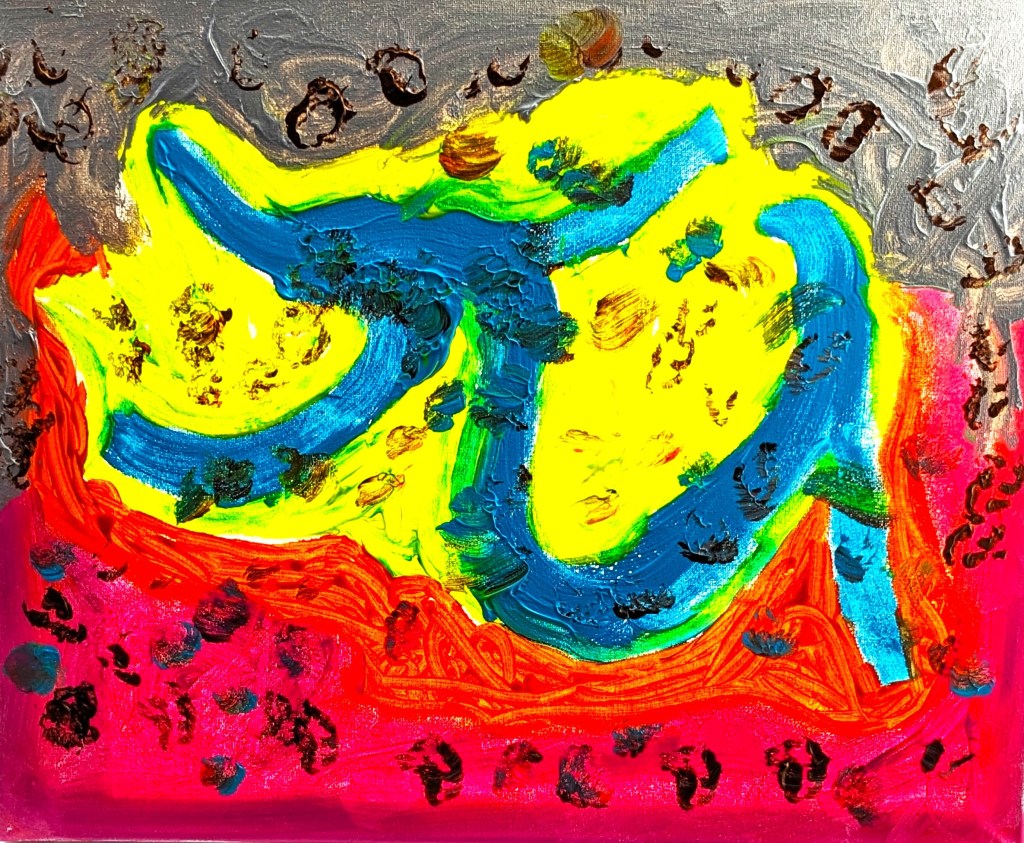
And look at that painting, the one above that leads the post, is it ‘secure art’ or ‘adventurous art’ or is it even art at all? Accept nothing at face value. Think carefully before you answer those questions too.