Carved in Stone 65 & 66

Carved in Stone
65

Flames flow sparkling waters,
a cataract of fire,
down church walls
as the Castillo burns.

Fireworks claw upwards
to knock on heaven’s door
and waken the sleeping gods
reminding them
not to forget their people.

A knife edge slices sun
from shadow, heat from cool,
solombra, Paz calls his neologism
with its combination
of sun and shade / sol y sombra.

66

I will never forget the taste and smell
of my own sweat as I walk beneath
the heaviness of a midday sun,
its heat falling vertical
and rebounding in waves
from concrete and cobbles.

I recall the roughness
of hand-hewn stone
heated by that burning sun,
the smoothness of silk
contrasting with the harshness
of tares in hand-woven wool,
marketed in the central square.

Commentary:

Fireworks claw upwards to knock on heaven’s door. The celebrants would buy their rockets in groups of 3, 6, or 12. When the first rocket went up – whoooosh – BANG! – we would wait for the fourth. When the sixth rocket went up, same thing – do they have a full dozen? And when the seventh rocket goes up, indeed, we know they do. Sometimes, we would be woken up in the early morning, as the joyful people returned home after a night of reveling. When that seventh rocket flew skywards – we knew it was useless to try and go back to sleep!

I remember leaving the zócalo one night, turning into a side street, and being met by a wall of people. A whole village, with its accompanying band stood there, waiting. Up went the first rocket, the band started to play, and the dancing broke out. No sleep for the gods that night. Their people needed them and had come knocking on the door. I was always amazed by the way the old gods stood shoulder to shoulder with the new gods of Christianity. The number of people who worshiped both also surprised me.

I last visited Oaxaca in 2001. I wonder how much has changed. I hope the dancing trees never change. Inside them, young children, their eyes peering through the bark, followed the band music. Occasionally, one of them would stop, open his or her tree, and invite you in. Alas, I never had the courage or the skill to accept the invitation. Even by 2001, the traditional carnival figures – monos – were gradually being replaced by Donald Duck and Mickey Mouse. Tragic, in so many ways. I hope they keep the traditions of the rockets and the music and the trees.

People of the Mist
A Poet’s Day in Oaxaca

If you want to read more about Oaxaca
Click here to purchase this book.
Carved in Stone 64

Carved in Stone
64

I cannot bring you
the sounds and smells
of my own backyard,
let alone those of Oaxaca.

The pungent odour
of the first drops of rain,
falling from a blue sky
into dry dust.

The tang of bees’ wax candles,
burning in the cathedral’s darkness
where la Virgen de la Soledad
clad in black velvet sequined with stars
stands on guard in her small side chapel

Nor can I bring you the high notes
sung at the golden altar
in Santo Domingo
by the old woman, dressed in black,
who sings here every day.

The central market
is a bustle of bursting scents,
rooftop goats snicker above me,
my neighbor’s German Shepherd
patrols the roof-garden
and growls in my ear.

Commentary:

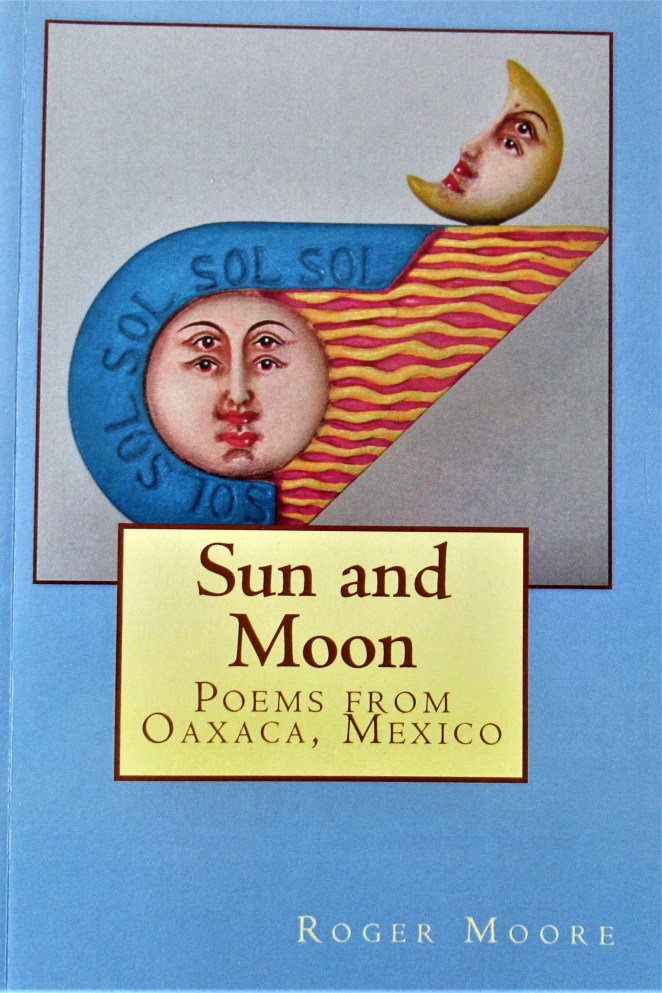
Sun and Moon is the first book in the Oaxacan Trilogy – Sun and Moon, At the Edge of Obsidian, Obsidian 22. I travelled to Oaxaca for 6-8 weeks each year between 1995 and 2001. I taught there and also researched the language, the culture, and the Mixtec Codices. Quite simply, my Oaxacan experiences changed my artistic, linguistic, educational, and cultural life. How? I earned to distinguish between what I could, and couldn’t do. A simple lesson, but one that needs to be understood at the deepest level of understanding.

The lessons took in all of my five senses – touch – dry dust, carved wood and stone, the tares in woven blankets -, taste – mole, flor de calabaza -, sight – the castillo burning -, sound – animals, goats and sheep, herded to the market-, smell – the central market is a bustle of bursting scents – hearing – rooftop goats snicker above me. A select few that blended with music of guelaguetza and the dancing that accompanied the village bands. But the experience(s) went beyond that. I began to realize, deep down, who I was, what I was, and, perhaps more importantly, what I wasn’t, what I could never be a part of, what separated myself from the other, the other whom I loved, who loved me, but who could never be a part of me.


Yesterday

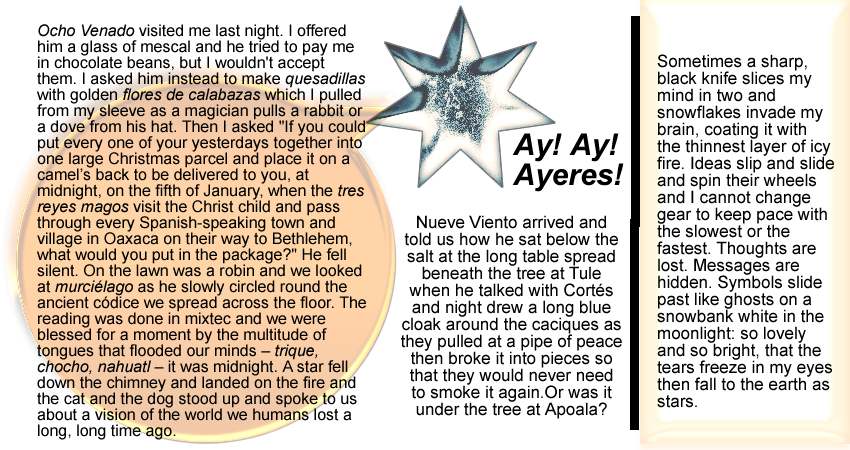
Ay Ay Ayeres

Digging around in the photo files that I transferred from my old computer to my Google drive, I discovered this golden oldie composed of my words and Clare’s images. What a revelation: I had completely forgotten that this group of work existed. I’ll dig them out ne by one and post them from time to time. Ayer is the Spanish for yesterday, hier in French. The title “Ay! Ay! Ayeres!” with its multiple plays All our yesterdays and its reference to the old song “Ay, ay, ay, canta no llores” draws together a series of memories, some in the past and some in the future. ‘How can we have a memory in the future?’ you ask. By recognizing a present moment, or one that lies just ahead in a future that ill become soon enough a present, as one that has already occurred in the past, thus confirming the circularity of our lives and the idea that all time is time present, one of T. S. Eliot’s recurring themes.

Ocho Venado: Eight Deer is a central figure (war leader) in the Zouche-Nuttal, a pre-Columbian Mixtec Codex. He is the war leader in the Conquests recorded in the codex (circa 1050-1100).
Quesadillas: Oaxacan tortillas filled with cheese and flores de Calabaza, gourd flowers.
Reyes Magos: the three wise men or kings who visited the Christ Child on January 6, the traditional Spanish Christmas.
Murcielago: the bat and a symbol of death in Oaxacan mythology.
Nueve Viento: Nine Wind descends from heaven to separate the sky from earth and its waters. Nine Wind at Tule meeting with Cortes is mythical not historical, though the meeting of Cortes with the Mixtec chiefs (caciques) did happen.
Apoala: The Mixtec nation was born form a cave (sometimes a tree) in Apoala, Oaxaca.
Spinning the wheels in the snow: a reference to Jean Chretien and one of his famous images.

The piece is written in a surrealist style that mixes historical fact with creative writing. The distant past is recalled (1050-1100), then the middle past (1525-1530), and finally the present appears. This mixing of time and place (Mexico and Canada) is also related to the surrealist movement. Surrealism creates a dream world in which images float and change shape within a time-space conundrum where dream is more real than reality and creates its own new meanings that are individual to each reader.

Any comments on this rediscovered piece will be warmly welcomed.