The Origin of the World

IMG_0265

The Origin of the World
Gustave Courbet:
L’Origine du monde

The origin of the world and where I came from,
her deep, moist cave that cast me from dark to light.
She loved me, she said, depriving me of her warmth,
leaving me to go back to her lover, loving him more.

Was it guilt that drove her to drinking whisky?
A forty-ouncer a day at the end, sometimes more.
She would wake in the night, wander the house,
banging against chairs, tables, walls, and doors.

She ran up bills in local shops, and the keepers
would dun me for the money she owed. She also
borrowed cash and some days her fingers were bare.
She left pawn shop IOUs on the table and I drove

 into town to redeem her rings. Once, in a drunken
frenzy, she cursed her only child. A mother’s curse is a
terrible thing. A living albatross, it claws lungs and heart.
Its weight drove me to the bottle. I too sought oblivion.

Reborn each day, mornings cast me back from dark to light.
Joy came when blackness descended, the albatross flew,
amniotic waters rocked me in warmth and comfort,
and my body’s boat floated once again on an endless sea.

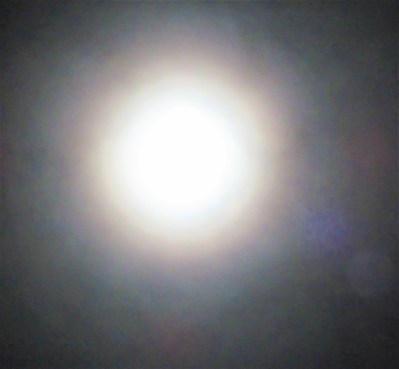
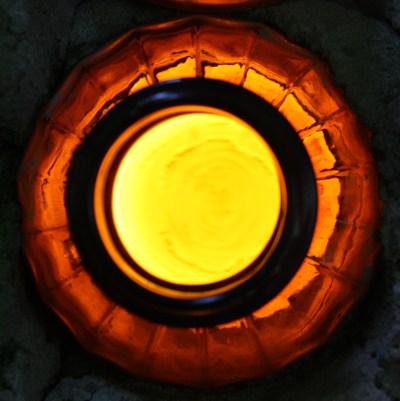
Comment: The photos show light shining through bottles in The Bottle House on Prince Edward Island. There is something very special about sunlight shining through stained and colored glass. Color distorts, speckles hands and face with a pointillistic magic, and the circular framework becomes a sun in its own right. As for Courbet’s painting, it still has the power to shock the viewer as it sets the eternal conundrum of the power relationship between the viewer (male) and the viewed (female). And remember: El ojo que ves no es ojo porque lo ves, es ojo porque te ve  / the eye you see is not an eye because you see it, it is an eye because it sees you, as Antonio Machado tells us. As for the poem, it stands or falls on its own, as does the painting. Visual shock or verbal shock: take your pick, but I hope you do not walk away unmoved.

IMG_0251


Empty Nest

IMG_1258 (2)

Empty Nest

The wind at the window
scratches tiny notes.
I can no longer hear the tune
nor read the words.

Who walks beside me
as I pace my lonely path,
abandoned in this empty house.

My self-portrait
stares back at me:
a splintered selfie,
framed in a sliver
of silvery glass.

Above me,
a monkey moon,
that itinerant tinker,
walks a fractured way
over broken glass.

The knapsack on his back
is cobbled together
from cobwebs and clumsy
veils of drifting clouds.

Comment: Another Golden Oldie from that same throw-away manuscript that I discovered a couple of days ago. I wrote this one the year after my mother’s death. My father was in hospital and I had flown back to Wales to visit him. When I was not with him, I wandered alone in a large house, empty of people, but filled with memories. The whole experience was rather surreal, just like the imagery I conjured up to describe it. Early spring, but a cold one. After hospital visiting hours, I wandered an untidy house and an unkempt garden. My mother had departed. My father was on the way out. I was alone with a life-time of memories. “No hay pájaros en los nidos de antaño” wrote Cervantes in the Quixote. “There are no birds in last year’s nests.” With no brothers, no sisters, no close family, and no friends left in Wales, I found that out the hard way. Those days of wandering, ‘upstairs, downstairs, in my lady’s chamber,’ taught me that most difficult of lessons in the hardest of ways.

IMG_0456 (2)

Striations

IMG_0299

Striations

There are striations in my heart,
so deep,
a lizard could lie there,
unseen,
and wait for tomorrow’s sun.

Timeless:
this worm at the apple’s core
waiting for its world to end.

 Seculae seculorum:
the centuries rushing headlong.

Matins:
wide-eyed this owl
hooting in the face of day.

Somewhere,
I remember
a table spread for two.
Breakfast:
an open door,
a window that overlooks
a balcony and a garden.

“Where are you going, dear?”

  Something bright has fled the world.
The sun unfurls shadows.
The blood whirls stars around the body.

“It has gone,” she said.
“The magic.
I no longer tremble
at your touch.”

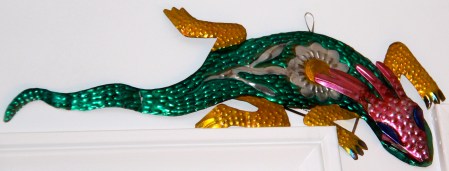
Comment: A real Golden Oldie. The lizard, it’s probably an iguana, came originally from Oaxaca, Mexico, and now sits over the door on the front porch. I had to bend his tail to get him into my carrying bag, poor thing. I found this poem in my poetry discards file, though what it was doing in there is a mystery to me. I think I discarded the longer manuscript in which it was included. Never mind, I have re-found, rediscovered it and it merits a place here, on my blog, along with the iguana. Byddwch lawen: rejoice and be glad.

Lost

IMG_1058 (2)

Lost

My body’s house has many rooms and you, my love,
rule over them all. Your shadow dances on walls.
in mirrors, and your breath brushes my cheek

every time I open doors or windows. That silly cat
looks for you and hisses when I bring her kibble.
I walk from room to room, but when I seek you,

you are no longer here. I knock, nothing opens.
Afraid, sometimes, to enter a room, I know
you are in there. I hear your footsteps on the stair.

Sometimes your voice’s echo breaks the silence.
You whisper my name in the same old way.
How can it be true, my love, that you have gone,

that you have left me here alone? I count the hours,
the days, embracing dust motes to find no solace
in salacious sunbeams and my occasional dreams.

IMG_1774

Comment: A Golden Oldie. I wrote this some time ago while my beloved was in Ottawa visiting our daughter. Separation is such a strange thing: an absence, yes, but also a presence in the tiniest details and the most unsuspected moments. And then there is the dream world where things join together, and then fall apart. This poem has so much more meaning in a time like this when so many people are separated and can no longer be together. Time … I have written about it before … passes. Hopefully, families and friends will be reunited once more, the sooner the better. In the meantime, we’ll meet again, don’t know where, don’t know when. Chadwch eich fydd / Keep your faith, as St. David, the patron saint of Wales is said to have said circa 500, byddwch lawen / be joyful, and gwnewch y pethau bychain mewn bwywd / do the little things in life.

Garbage Day

image1 (17) - Copy.jpeg

Garbage Day
(1789 AD)

all the dustbins
dancing down the street
trying no doubt to achieve
a spring time copulation
so they can give birth
to even more dustbins

you can’t have a revolution
without dustbins
dusty … dusty … filthy
dusty dustbins
a sadistic way to look at
dustbins full of sawdust
heading off down the street
between potholes
and blowing bins
a right Danse Macabre
conducted by
St. Vitus

me sitting there knitting
Montreal Canadians
this Red Cap
I keep flying high

even though I stand
upon Gibraltar’s Rock so fair
not to mention Paris
the Place de la Bastille
with tumbrils rattling

Old Moll in a Moll’s Cap
toothless fairy
at a Goblin Party
watch out
for toad s’tools
[sick this poem
this joke

and all that’s in it]

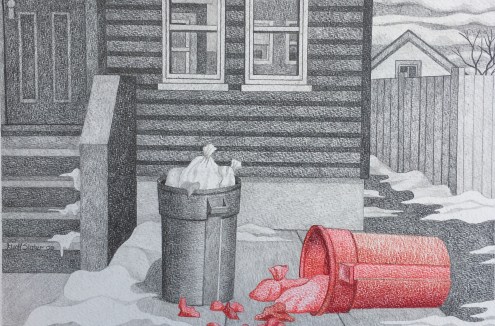
Comment: A wonderful drawing by my friend, line painter Geoff Slater. The poem, of course, represents the garbage in (and out of) the garbage can. 1789 is the date of the French Revolution. I found this poem in my discard file, so it was one of those that didn’t make it anywhere. Maybe it shouldn’t have made it here either. But it takes all sorts to make a world and Geoff’s red dustbin reminds me of the red caps knitted by the old women beneath the scaffold and the guillotine. Funny things, guillotines: invent them and they drop on you when you fall out of favor. There are so many allusions in this poem that I am ashamed to say I remember them all, and not all of them are pleasant. Mind you, few things are pleasant nowadays and remember: it is better to leave your dustbins out to roam the streets and be plundered by the crows and swept away by the high winds than to leave them festering and smelling bad and all cooped up in the locked down garage.

Settling Accounts

Empress 314


Settling Accounts

How did I earn my money? Let me count the ways.
Of madmen, priests and preachers, I sang the praise,
sinners all who tried to change my ways
by grooming me in all their awful styles
to share the sadistic rhythms of their wiles.

Then there were bosses, CEOs, and chief execs,
whose aim in life was troubling their employees,
the men for unpaid work, the women for sex,
and while we slaved, they lived a life of ease.

Senior teachers, department heads, and deans
reduced all genius to counting and recounting beans.
Those bean counters checking up on us, every hour,
flexing their muscles, overwhelming us with power.

Sometimes, at night, my nightmares fill with screams
as their abuse and privilege shake me from my dreams,
my dreams of freedom, sharing, caring, love, and joy,
all the small things I’d taken for granted when a boy.

In a twisted, corkscrew world we all must live
where the richest rob the poorest who work and give.
And even more shall be given to those who hold
while those who have-not labor and are sold.

A sad world this, but some things remain with me:
my power to dream, to create a legacy,
to mold still willing people with my voice,
to gift them beauty, thought, and power of choice.

Oh dreamers, join with me and sing, be it high or low,
but don’t forget your dreams, don’t ever let them go.

Comment: I went to pick up groceries today and sat in line, waiting in the car, rear hatch open, for 30 minutes. Unwilling to waste my time, I decided to write a poem. Oh dear: I had left my note book at home. I rummaged around the car and found a redemption slip from two years ago and a bank slip from last year. I wrote two poems, one on each of them, each poem thematically linked to the slip of paper it was written on. This is the bank slip poem. I’d say “Enjoy” except that this is what the waiter / waitress says each time s/he places a particularly unpalatable meal before me. Luckily this cannot happen anymore and I am eating delightfully well at home, thank you. I am not a Cordon Bleu Chef by any means, but I am a good one, having learned at my Welsh Grandmother’s knee when I was a tiny tot. Supper tonight: salmon and leek and potatoes! Cost: about $5. It would have cost fifty in a restaurant and it would have been half as good. So count your blessings: cooking and creativity are two of mine and yes, every time I look at what I have and see what so many others are missing … I break my heart.


img_0003

Lamplighter


img_0218

Lamplighter

When I was very young, many of our streets still had gas lamps.  The lamp-lighter would appear in winter around three or three-thirty to light those lamps. I remember him walking up the street with his long pole over his shoulder, moving from lamp to lamp. We had one outside our front door. He would turn on the gas, then light the lamp from the lighted wick at the end of his pole.  Sometimes he carried a ladder with him. Then, every so often, when the lamp needed tending, he would climb the ladder and adjust the wick. These gas lights were not very bright but they stood out like light houses between stretches of darkness and we would walk from pool to glowing pool, as if they were stepping stones leading us up the hill to home. We all knew the lamplighter and he would often wave to us as we sat in the front room window to watch him walk by. We rarely saw him in the mornings when he came back to turn off the lamps. We were all tucked safely into our beds. I remember that I wanted to be lamplighter. Later I realized that there are many ways to light a lamp and spread brightness through the world. When I qualified as an academic and a teacher, I became a lighter of a very different set of lamps.

IMG_0262

Comment: I discovered this prose poem in an old and dusty manuscript. I can’t even remember when I wrote it. Prose poems: I discovered Charles Baudelaire’s Petits Poèmes en Prose in a small bouquiniste along the banks of the Seine when I studied French in Paris during the school year I spent in France, 1962-63. I have always loved his prose poems and I have always wanted to write some of my own. That I did, and then promptly forgot about them, is one of the wonders of my creative life. How could I forget these creations? Funny: reading what I wrote back then takes me straight into the front room in my grandmother’s house in Brynmill. She would sit in the bay window playing eternal games of patience and together we would eat grapes, peep at the cards, wait, we didn’t know for what, and watch the light slowly fade. Nobody ever told me my grandmother had cancer. She died from it one day when I was away at school and when I came home for the holidays, she just wasn’t there. Her chair and her table were still there, but her warm presence, her loving kindness, had all gone. I never had a chance to properly say good-bye to her. Maybe these belated words will serve that purpose.


CV-19 Week 3 Day 1

IMG_1058 (2)

CV-19 Week 3 Day 1

So, yes, I am starting the third week of my self-imposed isolation. I am also in the first week of an imposed provincial State of Emergency. What I was doing willingly before, self-isolation, has now become law, self-isolation by edict.

It seems a minor change, but it isn’t. Whereas before I was happy not to go out, now the very prohibition makes me want to go out. Yes: I now want to be out there, wandering the now-empty streets, shopping in the now-closed stores, and visiting the newly locked and barred bars and restaurants.

This situation reminds me of the word-games we used to play as children in which you were given a word which you mustn’t use and then you discovered that you really, really wanted to use it, simply because you had been told not to. One such banned word, in my childhood, was bloody. All the grown-ups used it, but it was forbidden to the little children. Bloody hell, we thought. Or bloody nice weather, we said to friends of our own age. Then, if our parents caught us using the forbidden word, out came the carbolic soap and it was mouth wash time again. Yuck: I have never forgotten the taste and smell of that carbolic soap.

We devised schemes for getting round the prohibition. I guess children of all ages devise schemes for breaking down prohibitions. That’s why so many soldiers in WWI used to ‘break out of barracks’ as they resisted the imposition of nightly curfews with their locks and keys. “Oh we’re breaking out of barracks,” they would sing, “as we have done before.” Then came the other verses. “Take his name and take his number.” “Up before the CO.” “Forty days in prison.” Back to bread and water, as we have done before.”

So, when my mother took us to the butcher’s shop one day, we were all primed. “Look at all that bloody meat” we cried out , shrieking with laughter and rolling all over the saw-dusted floor. My mother was furious, but we were spared her wrath as the butcher, and his other customers, found it so amusing.

But CV-19 (Corona Virus \ Covidis 19) is not so funny and the punishments are much more drastic than a simple carbolic soap mouth wash session. That said, the itch to break the prohibition is so much stronger now that the law is provincially enforced and not self-imposed. That said, these are rules well worth following. Nobody wants to catch this and, much more important, nobody wants to be responsible for passing it on to somebody else, especially if that somebody else is in the target range for a serious, perhaps fatal, bout with the virus.

Funny old world, eh? And some funny old people living in it.