Downsizing

Books abandoned on the sea shore of life.

Downsizing
Francisco de Quevedo

I chose each book, held it in my hands for
one last time, then placed it peacefully in
its new resting place. Old friends, they were …
I broke that friendship and set my friends free
to fulfill their promised afterlife on
another reader’s shelves.

Mind to mind, though they had
lived five hundred years ago,
I strove to engage them in lively
conversation, Bakhtinian dialogs
within our time and space, and
that space my basement library.

I loved to hear their lilting speech,
to listen to their wisdom with open eyes
and mind. I answered them with words
I quickly pencilled on each page.

One day, a man arrived from the university.
He carried them away in a delivery truck
and they were borne to a wider world.

If you see on, bless it, read it, cherish it.
Blind now my eyes that devoured their words.
Deaf now my ears that heard the dead,
for I can listen no more.

Note: “Escucho con mis ojos a los Muertos /
I listen with my eyes to the words of the dead.”
Francisco de Quevedo (1580-1645)

With thanks to Nicholas Wermuth, who was kind enough to comment and help me revise and restructure this poem.

Survivor

Survivor

Every day, now he’s learning to speak Welsh,
he finds out something new about his childhood.
It’s not the need to talk so much as the necessity
of diving into himself and mining his memories.

Brynhyfryd / Mount Pleasant.
Pen-y-Bont / the End of the Bridge.
Ty Coch / the Red House.

This latter the house in which he was born,
way out of town, by Fairwood Common,
away from the strafing and bombing.
The war generation of his family all born
in the same in-the-country Gower bed.
No room in war-time hospitals
not even for the birth of war babies.

Three of his brothers did not survive
those rough, household births.
He still bears the forceps’ scars
from the moment the doctor
plucked him out, head first,
and hung him up by the heels,
shaking him, bringing him back to life.

He bears other scars as well
from the survivor’s burden of carrying
three dead brothers for seventy long years,
alive and kicking in the womb-warm
crevices of his still beating heart.

Thanks Giving

Thanks Giving

Driving from St. Andrews to Island View,
giving thanks for fall foliage as I pass
fields and forests filled with autumn blushes
blueberry patches brushed with cyan,
violet, sprinkled with primary red.

Trees crowd close, encroach, add yellow
and orange, fresh tonal values at each turn.

Sunlight strokes white touches of pointillistic
beauty through showers of golden leaves.

 Ochre and brown burn shades where pinprick 
black ghosts shadow grays through a gilded tree.

Cubist, this fire-bright, iron-sheeted shed.
Surrealist that rusted tractor, abandoned.
The road’s black thread ties together vivid
impressions of leaves as they tumble and fall. 

Fall

Mactaquac and geese at the head pond

Fall

Red leaves multiply on maple trees.
Bright berries staining a mountain ash.

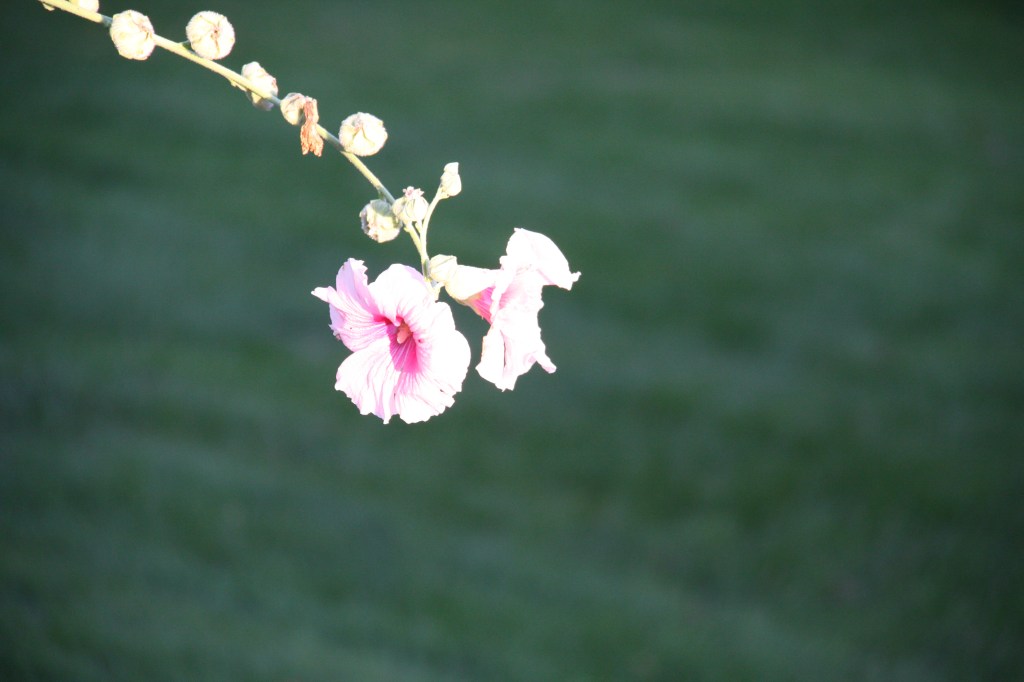
One flower survives on the hollyhock,
its blaze of glorious blooms lost, faded
in a silence of dried seeds, absent bees.

Hummingbirds are now long gone. Geese
gather in great gaggles feasting on grass
before taking flight and soaring south.

I want to ask questions about their journey
but they mouth denial and waddle away
to paddle on grey waves when I approach.

Comment: With a temperature yesterday of 21 C (that’s plus 21 C) rafts of geese are still around. These photos are from earlier in the fall. I love the way several stand erect, looking at and for possible intruders, while others feed. Shared responsibilities. I guess we humans could learn a great deal from the geese, if only ‘we were not full of care / and had some time to stop, and stare’ (W. H. Davies, one of my favorite Welsh poets, the verses changed slightly and adapted to Mactaquac). Roedd hi’n y tywydd heulog a cynnes yfory / the weather was sunny and warm yesterday. What a joy to be able to write that in Welsh after so many years without the language.

Carpe Diem

Autumn in the Garden

Carpe Diem

Seize the day. Squeeze this moment tight.
Nothing before means anything. Everything
afterwards is merely hope and dream. 

A tiny child, you chased wind-blown leaves
trying to catch them before they hit the ground
Elf parachutes you called them and trod with care
so as not to crush the fallen elves as they lay leaf-bound.

I stand here now, a scarecrow scarred with age,
arms held out, palms up, in the hope that a leaf will descend,
a fallen sparrow, and rest in my hand.

When one perches on my shoulder and another
graces my gray hair, my old heart pumps with joy.

Comment: Autumn in the Garden was framed by Geoff Slater who gifted it to me this summer. Thank you Geoff. A double picture, it shows the flowers and the trees with that first touch of drifting snow. NB it snowed here in Island View early September this year while we still had flowers and leaves. The poem, Carpe Diem, is from a series of quasi-sonnets. Quasi, because they rarely have 14 lines! Oh Petrarch: shake in your shoes.

Eyeless in Kingsbrae

Eyeless in Kingsbrae Garden

A feather upon the cheek,
this fern held fragile, hesitant
between fine fingers.
Touch and smell:
two senses engaged.

A paint brush sounds,
brush-brushing lightly
on expectant skin.
Faint the taste tested
suggestive on tongue tip.

No sight, just insight.
I have a sense of senses lacking.
My words reach out like fingers,
but they can neither retain
nor explain the meaning of it all.

Eyeless in Kingsbrae,
They push me, blindfolded,
around the garden.
Gravel crunches beneath
the wheelchair wheels,
sharpens my inability to be sure
of shadows and shapes
that are no longer there.

The ones who push me talk
and tell but cannot show.
How could they hold a rainbow
before my sightless eyes
or explain those lights that
crisp and crackle in the night sky?

There’s warmth in a color,
and heat’s visible to the touch.
Shocking pink has a different
feel beneath blind fingers,
and it has no name
that you and I, sighted,
would ever know.

Oh, Song of Songs, and the singer
deaf to his own sublimity.
Oh dealer of false cards,
fingerless pianist,
and dancer shuffling
on amputated stumps.

Comment: The poem Eyeless in Kingsbrae Garden is contained in my book One Small Corner: A Kingsbrae Chronicle (2017), available online at Amazon / KDP.

Monkey’s Clockwork Universe

Monkey’s Clockwork Universe

Some days, monkey winds himself up
like a clockwork mouse.
Other days he rolls over and over
with a key in his back
like a clockwork cat.

Monkey is growing old and forgetful.
He forgets where he has hidden the key,
pats his pockets, and slows right down
before he eventually finds it
and winds himself up again.

One day, monkey leaves the key
between his shoulder blades
in the middle of his back.
All day long, the temple monkeys
play with the key,
turning it round and round,
and winding monkey’s clockwork,
tighter and tighter,
until suddenly, one day,
the mainspring breaks
and monkey slumps at the table:

no energy, no strength, no stars,
no planets, no moon at night,
the sun broken fatally down,
the clockwork of his universe
sapped, and snapped.

Candle Light

Candle-light

Five candles burn at my table.
Outside, the night wind howls like a dog
and scratches its pelt on my roof.

The wind has torn branches from the trees
and polished the evening frost until
it sparkles like eighteenth century silver.

A moth circles, sizzles, and flares.
I keep my vigil at night’s altar
and place a wrinkled palm
into the candle’s liquid flame.

Put out a candle, put out a child.
Who would put out a dog on a night like this?
Outside, playing tag between dark trees,
the wind runs wild.

Paella

Paella

A bullfrog lives in my computer.
He eats all the full stops and I can’t
type a period to end my sentences.

I imagine he thinks they are tadpoles,
though the commas, with their short,
twisted tails, would be visually better.

I could live without commas, I can’t face
an endless future with no periods in sight
and www-comma-com just isn’t right.

I guess I could survive a future without
frogs, though cuisses de grenouille appear
each summer at my local super market.

I ate a paella québécoise in a Spanish café
in Montreal once. It was full of frogs’ legs
and was very, very tasty. I wonder if I can
find that bullfrog and put him in a paella.

October

October

… and the wind a presence, sudden,
rustling dusty reeds and leaves,
the pond no longer a mirror,
its troubled surface twinkling,
sparking fall sunshine,
fragmenting it into shiny patches.

It’s warm in the car, windows raised
and the fall heat trapped in glass.
Outside, walkers walk hooded now,
gloved, heads battened down
beneath woollen thatches.

A wet dog emerges from the pond,
shakes its rainbow spray
soon to be a tinkle of trembling sparks
when the mercury sinks
and cold weather closes the pond
to all but skaters. Then fall frost will turn
noses blue and winter will start to bite.