What’s your favorite word?

Daily writing prompt
What’s your favorite word?

What’s your favorite word?
Seems like a daft question to me. Just one word?

Llanfairpwllgwyngylldrawbwlchllantisilioggogogoch – how’s that for a single word? And what’s wrong with married ones anyway. Or should I go for something like – home, health, morning (good or bad), night, how? -as in How! And what about the vast quantity of expletives that are found in so many languages? Many of them are single words, although many others are found in fertile and creative compound structures.

Of course, wrth gwrs, we are thinking of how many single words in how many languages? Or are we? I personally think that phrases might be more important than single words. Thank you becomes gracias (in Spanish) or te / se lo agradezco (more formally). It changes to merci (in French) or merci bien, or merci beaucoup, or grand merci, or merci mille fois, or je vous remercie. Then, in Welsh it becomes diolch, though many prefer diolch yn fawr.

Mind you, when living in Mexico, especially in some of the more isolated villages where food and water are not always the cleanest, bathroom may be a key word. Quick is also an important one. Put them together and you get bathroom quick! Help is also very useful when travelling alone and lost. As is Please! Por favor, in Spanish – two words of course!

Single words, in isolation, can be very dangerous. Especially when using a second language that one doesn’t dominate. Examples of embarrassing mistakes are multiple in the language-learning text-books. Speaking of which, it is interesting how infrequently they offer phrases like “Where is the bathroom?” or “I need the toilet. Now.” Alas, they also avoid the inevitable consequences like – “Too late!” “Sorry!” “Where is the nearest dry cleaners?”

A funny thing, language. And other people’s languages are equally funny. By funny, I mean weird, strange, and unpredictable, especially without a sharp cultural knowledge to permit the speaker to actually understand what he or she wants to say and how to phrase it correctly. Simple example – embarazada, in Spanish, does not mean embarrassed, it means pregnant. You would be surprised at how many young ladies, learning Spanish in Spain, have amazed their hosts and teachers by the simple announcement, often in class, that ‘estoy embarazada’‘I am pregnant’ – and I have seen the looks of amazement adorning the sympathetic faces of the families gathered round the table or the looks on the faces of the classes being so addressed.

So, a little knowledge is a dangerous thing. I can think of very few words, single words, that I would use on their own. But I can think of many, many phrases, most short, that I would be happy to use, and many more that I would avoid at all costs. As the students in the lower grades of Spanish used to say – “Buenas Nachos” and “I only want to be able to ask for a beer.” “Can’t we watch the Smurfs?” Have you ever tried to understand humor in another language, another culture? It is one of the hardest things to master, especially when it depends on the double-meaning of words, words which, all too often, only have one meaning in the pocket dictionaries people carry around with them. Caveat emptor. Buyer beware. And tread carefully, for you may not know just whose toes you are treading on, nor why, nor how they will react – the people, not the toes. Dangerous things those pronouns.

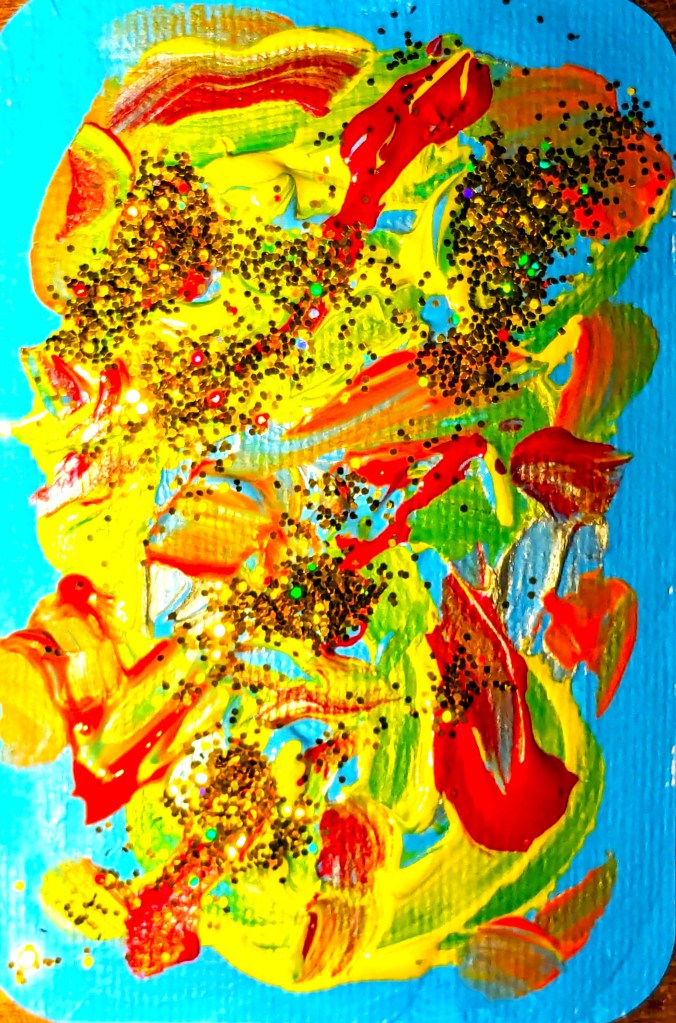
On the other hand, we can always go religious and turn to the Bible for advice. There we find “Faith, hope, and charity, and the greatest of these is charity.” So. Problem solved. I have found my one word – Charity. That said, I do like the painting Moo offered me for this prompt. He calls it Hope. And remember, you can’t go wrong with any of those three words – Faith, Hope, and Charity. Tolle lege. Amen.
Scour the news for an entirely uninteresting story. Consider how it connects to your life. Write about that.

Daily writing prompt
Scour the news for an entirely uninteresting story. Consider how it connects to your life. Write about that.

Scour the news for an entirely uninteresting story. Consider how it connects to your life. Write about that.

Scour the news – what on earth does that mean? Let’s begin with scour – If you scour something such as a place or a book, you make a thorough search of it to try to find what you are looking for. Rescue crews had scoured an area of 30 square miles. Synonyms: search, hunt, comb, ransack. Search, hunt, scour, ransack – well? Which one are you after? And how long have I got? Question: what am I looking for? Answer: an entirely uninteresting story. What a tremendous waste of my time. And, when you get to my age, time is precious.

As for the news, well, what on earth do you mean by that? I speak several languages fluently. Am I looking for an entirely uninteresting piece of news in all of them? As one of the Two Ronnies used to say “You’re having me on, aren’t you? You’re having me on.” Let’s just stick to one language – English. Then let us ponder for a moment the meaning of the news. How many newspapers do you wish me to purchase and peruse? I am not a millionaire, you know. Or do you want me to listen to the news on the radio or the television? If so, how many channels? How about sending me online? I love the thought of that. There are thousands of websites out there filled with all kinds of news, good bad, indifferent, fake, artificial? And you want me to scour them all in search of, and I quote “an entirely uninteresting story”! Pull the other one, as the old comedians used to say, ‘”it’s got bells on”.

I’ll tell you what I’ll do. I’ll scour your prompt, that’s what I’ll do. Having given it a brief analysis, I declare it entirely uninteresting. Next I’ll consider how it links to my life. Well, sorry, it doesn’t. If I were to follow it through, I’d be sitting here for hours, wearing my fingers out on the keyboard. So, what’s the link between your prompt and my life? A total waste of time, that’s what. Sorry, I have better things to do with my life. Like reading Shakespeare – “Friends, Romans, Countrymen, and prompt readers, lend me your shovels. I come to bury this prompt, not to praise it.”

Here endeth the lesson and the prompt.

White Space

White Space

A place of silence,
          white space
at page edge,
          bearing witness
to the absence
          of words.

A place to pause,
          rest,
to think.

A place,
          like the white space
between lines of prose,
          where eye and mind
can pause and rest.

Bewildering
          the pounding
of earwig music,
          the advert repeated

again and again,
          the omnipresent
sound byte.

Everlasting,
          the loop, the loop,
the interminable loop
          that intrudes on
silence.

Words

Words emerge
          from the silence
of blood and bone.

They break
          that silence
the day they are born.

Silence,
          once broken,
cannot be repaired.

A word once spoken
          cannot be recalled.

The greatest gift –
           knowing how to be alone,
how to sink into silence.

A world of words
          smothered at birth
and that world,
          dismissed, forgotten,
sometimes still-born.

A lost world of words
          whirled on the silent wind
that fans the unborn fire within.

The spider web of the mind
          blown clear by the wind
that blows unspoken words.

The hush of the tadpole
          swimming
into its own metamorphosis.

The sultry oblivion
          of blood and bone.

Poetry that expresses the authenticity of being. Playful, yes, but packed with meaning. Taste it on the tongue. Savor it in the mind. Touch the words on the page. Indulge yourself in the white spaces between the words. Read and re-read each poem. Dive into its depths. Swim – but do not let yourself drown. When you surface again, return to the light and remember, all will be well.

Joy of Words

Joy of Words

If the words won’t come, don’t worry.
Sooner or later, they will arrive, driving
down in flurries. Think wind-driven leaves
or the soft white whisper of snaking snow.

There is a moment when all sounds cease
and you can be at one with your inner self,
there, where summer sunshine twinkles
and soft rains bring forth clarity and joy.

What are words anyway, but soap bubbles
emerging from an iron ring to rise in
child-hood’s skies, soaring, dying, around
the cloudy thrones of sun-kissed clouds.

We, their so-called creators, are left below,
building cotton-wool castles spun from air.

Comment:

The painting, animales de fondo, comes from a book by Juan Ramon Jimenez in which he describes human beings as ‘animals living at the bottom of an ocean of air’. I have tried to capture the concept both verbally and visually.