On Being Welsh – Dydd Dewi Sant

On Being WelshDydd Dewi Sant

On being Welsh
in a land ruled by the English

 I am the all-seeing eyes at the tip of Worm’s Head.
I am the teeth of the rocks at Rhossili.

I am the blackness in Pwll Ddu pool
when the sea-swells suck the stranger
in and out, sanding his bones.

Song pulled taut from a dark Welsh lung,
I am the memories of Silure and beast
mingled in a Gower Cave.

Tamer of aurox, hunter of deer, caretaker of coracle,
fisher of salmon on the Abertawe tide,
I am the weaver of rhinoceros wool.

I am the minority, persecuted for my faith,
for my language, for my sex,
for the coal-dark of my thoughts.

I am the bard whose harp, strung like a bow,
will sing your death with music of arrows
from the wet Welsh woods.

I am the barb that sticks in your throat
from the dark worded ambush of my song.

On Being Welsh – short stories – Amazon and Cyberwit

On Being Welsh – poems included in my selected poems (1979-2009)

Cherry always listened to my readings

Click here to here Roger’s reading on Anchor
– On Being Welsh

Writing in the Red Room

Writing in the Red Room

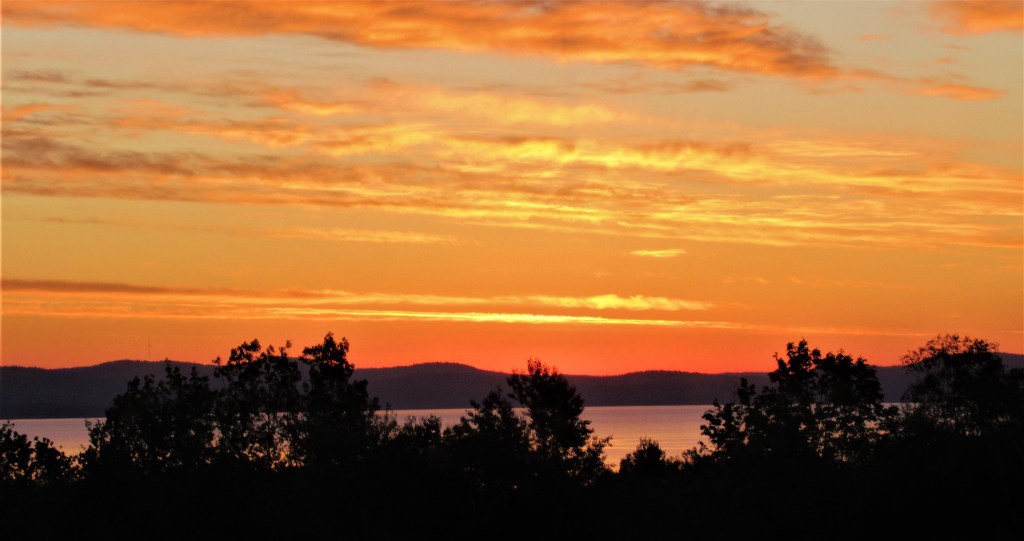
Dawn over Kingsbrae, as seen from the writer’s desk in the Red Room in KIRA. “A poet could not but be gay, in such a jocund company.” Wordsworth, thankfully, for how words change their value as language transforms itself and old values and meanings grow wings and flit away.

Gai saber – from Old Provençal: “gay knowledge” or “gay science”, the art of composing love poetry, especially the art of Provençal troubadours as set forth in a 14th-century work called the Leys d’amors. But one doesn’t have to be gay, in any sense of the word, old or new, to write poetry, and it is difficult not to write poetry when the sun creeps over those hills and lights up the room and the bay below.

Warmth and light flood into your heart. The pen fills with words and they splash out over the page, moving the writer as the sun moves, as light moves, as light breaks where no sun shines as yet, but will, soon, so very soon, and here it comes, filling the heart once more with wonderment, the bay with light, and the page overflowing with the joy of light.

To be here is to be honored and privileged beyond words. To be able to share that joy with others is a blessing that many seek and few find, and none possess, for, like fairy gifts, such powers fade away all too swiftly. And, when all is said and done, one can only be humble, rejoice in each moment, and give thanks.

Goodbye

Goodbye

It is never easy to say Goodbye. Some goodbyes are easier than others. Some are indeed difficult. “In my end is my beginning and my beginning is in my end.” Conscious goodbyes are one thing. We say farewell knowing we will never be back that we will never see each other again. These are the hard ones.

I stood in the bar of El Rincon, in Avila, at 6:00 am, waiting for the taxi that would take me to Madrid and away for the last time. I was planning to return the following year and then it hit me – this was indeed my last goodbye and I would never return to that place. A tidal wave of emotion swept over me and I felt a deep, earthy sorrow – the sorrow of permanent loss.

It was matched on two other occasions. The first occurred when I drove to the sea shore of my childhood in Wales, with my mother’s ashes in the back seat and strict instructions on how and where to scatter them. Walking away was one of the most difficult things I ever did. Even more difficult was leaving my father, a widower now, in his bed, and saying that goodbye. It was not the final goodbye, but I knew I would never see him again, in that house, under those circumstances.

I cried in the taxi, all the way to the railway station. Great, heart-rending sobs that tore me apart, body and soul. The spill over from my nostrils reached the floor of the cab, a long, thick spider-thread of deep-seated despair, because I knew my life had changed forever, and the support on which I had always counted would no longer be there.

People and pets – both are difficult. Holding the paw of a beloved cat, while the vet slips the needle in, and the companion of ten, fifteen years, drifts quietly to sleep. Or watching a faithful dog, slipping slowly downhill, and knowing that someday, soon, the decision must be made, the dark deed done. The knowledge that one relieves suffering and brings an easy release does not decrease the heartfelt pain of that last goodbye.

I used to visit the Sappers Club in Toronto. In the basement of that establishment I discovered a wealth of photographs from WWI. The old men would lead me downstairs and, through thick salt tears, explain what each photo meant to them. Round about midnight, a group of them would stand before a photo called Goodbye Old Friend. It depicted a shell-shocked, broken horse, with a pistol held to its head. The men, they explained, had volunteered for war, and knew all about its suffering. The animals were innocent, and knew not the reason why. Ah, ending the sufferings of the innocent, human or beast, that is, perhaps, the saddest farewell, for some, but not for others.

We each will hold a private moment within our own hands and minds. To share or not to share – that is the question, for each of us – poor creatures, as Dylan Thomas says, born to die.

My Teenage Self

My Teenage Self

What advice would you give to your teenage self? In one word – grow up. Useless advice really, because it happens, whether we want it to or not. That said, I have lost so many young rugby players that I coached or played with, to driving accidents and other misfortunes, sometimes self-inflicted via alcohol or drugs, that to say grow up – please! – is so important.

Each morning I read the obituaries in the local newspaper. Afterwards, I look back over the path I have journeyed. If I had perished at the age of the current ‘missing person’ – say, 45 – 50 – 55 – 60 – I think of all that I would have missed in those intervening years. Then I grieve for all that they will have missed in the life that should have lain ahead of them.

“Don’t cry over spilt milk” – Old Welsh Proverb. And no, we mustn’t cry over what is lost. We must celebrate what has been achieved, Dylan Thomas (1914-1953), one of Wales’s greatest Anglo-Welsh poets, dead at 39 – what other glory may have lain ahead of him? Garcilaso de la Vega (1501-1536), one of Spain’s purest and most innovative poets, dead at 35. What more might he have written in an extended lifetime? Federico Garcia Lorca (1898-1936), executed, many say tortured and murdered, at the age of 38. Think of the theatre, the poetry, the Gypsy Ballads, the songs of a dark love – what more did he have, hidden inside him, that was never allowed to spread its wings and fly out into the light of day?

So, I would give to my teenage self, the same advice that I would give to any teenager – grow up – please, grow up, don’t go too soon, – and please grow into that unique and wonderful being that you have the potential to be.

Parents

Parents

Today’s prompt – what were my parents doing at my age? Well, actually, they were both dead. We aren’t meant to mention death anymore, so let me say ‘they had passed’. Loads of cliches of course – pushing up the daisies – moved into higher society – or lower but I hope not – deceased – demised – expired (like my driver’s license) – extinct (like the Dodo) – passed on – recycled – enough – no more – it’s not as sweet now as it was before – nor do I like any potential answer when I look in the mirror and wonder – who am I? – What am I? Where am I going? Am I next?

My father being an excellent rugby player – on the wing – in the old days – I can imagine him running, and kicking and chasing – but I can’t imagine him passing. Or setting up a maul or a ruck. Dear Lord – times have changed – and the laws of rugby have changed – and the rules of etiquette have changed – and political correctness has put dark hands upon our throats and choked us -let us not contemplate the myth of freedom of speech – but consider the endless stupidity of senseless questions that changeth not and abide with all of us, on radio and tv and in the newspapers – all day and everyday.

Here’s anther prompt – Where have all the young men gone? Depends on which song you listen to – emigrated – gone down the mines – gone west – gone AWOL – gone astray – gone to graveyards, everyone. But will we – or they – ever learn – blydi hel – a good Welsh expression – I doubt it.

So – I ask myself – what are my parents doing today? – and the answer is – I really do not know. I would like to think they are happy – happy in the knowledge that they did their best for me – happy to know that I am still here – ar gwaetha pawb a phopeth rh’y n’i yma o hyd – I hope I spelled that right – I have seen several versions – and yes – in spite of everything, I am still here – I am well – and I would like to tell them that I love them – and I would like to thank them for all they did right – and forgive them for anything they did wrong – and yes, I loved them so much – and still do – and I miss them – and blydi hel – now you’ve got me crying.

Warm in the Kitchen

Warm in the Kitchen

This early morning, the only warm place in the house is the kitchen, close to the fire, with all the doors closed. The black-out curtains from the Second World War are still in place and hang languidly over ill-fitting windows that let cold air into the house. They must be pulled back in preparation for that first glimpse of day-light. Your elders move in and out, letting in the cold air as they open and close the doors at either end of the warm space where the fire is just taking hold.

Your grandfather banked it overnight with black sea-coal and then he raked the fine, grey ash, with its still smouldering lumps of charcoal, into a warm mound, ready for paper, kindling, coal, and the match. He has also placed a newspaper over the fireplace to create a draft. If the fire doesn’t catch soon, he will throw some sugar onto the embers to aid the blaze. The fire will suddenly flare into life and the room will be quickly warmed. In the meantime, the kitchen, though warmer than anywhere else in the house, is still slightly chilly because the damp night cold has invaded and made everything wet and slick.

It’s great when you’re at your grandparents’ house, but when we are back in ours, my father and mother always leave early, to go to work.

When I was younger, they had to feed me, but I soon learned to make my own breakfast from whatever I found in the fridge. Now I can use a frying pan. I fry bacon first, and then, when I have plenty of bacon fat, I fry bread, eggs, sausage, black pudding, kidneys, tomatoes, mushrooms, and anything else I can find, including laver bread.*

Before I know it, I have become a latch-key kid and, when I am hungry at home, I fry myself an all-day breakfast: eggy-bread or fried egg-with-its-hat on doused in HP sauce for lunch, all washed down with tea to which I add condensed milk and sugar.

But this morning, they have made breakfast for me: porridge. “Porridge, porridge, skinny and brown, / waiting for breakfast when I come down.” And I hate porridge, especially burnt porridge, with a passion, and yes, they’ve burned the porridge again. I hold a cup of hot tea in my hands. I breathe in the steam and it loosens up my chest. The china cup warms my fingers. I prod at the porridge, feed some to the canine mouth that dwells unseen beneath the table, and stuff myself full of toast. Whatever I eat, when the food is inside me, I feel much, much warmer and now I am ready for the rest of the day.

*Laverbread Bara lawr in Welsh: edible Gower sea-weed, a delicacy often called Welsh Caviar.

A Winter Awakening

A Winter Awakening            

You hate the Christmas holidays. You always have and I expect you always will. Broken promises litter the ground like so many new year’s resolutions, made and then set aside in a jumble of wrapping paper, party hats, and empty, smelly beer bottles. So vicious, these early morning calls, your father pinching your ear or tugging your hair, then stripping back the clothes and leaving you lying there, the cold air invading your bed, shocking your toes, tweaking the small hairs on arms and legs.

You reach out to the bedside chair, grab your shirt, socks, and pants and stuff them between your legs where it’s still nice and warm.  Then you pull the bedclothes up to your chin and your day clothes lie between your thighs, a teddy bear bundle gradually warming you up again. You wriggle down into the bed, and try to go back to sleep, but it doesn’t work.  A great shout from downstairs: “Breakfast is ready!”

Now comes the tricky bit: staying under the covers, wriggling out of your pyjamas, putting on your shirt, your pants and your socks while still staying warm beneath the blankets. Then, a porpoise breaking the surface, you burst out of bed, pull on your trousers and a sweater, and you run downstairs to the kitchen the warmest room in the house, where breakfast is waiting.

A Season of the Heart

A Season of the Heart

Here in the autumn of my life,
surrounded by the fruits of my labours,
filled with the accumulated wisdom of years,
surrounded by solitude, yet confronted
by fall’s splendour and the harvesting
of so many golden days, collected
and gathered in, safe from winter’s storms.

Old friends from years gone by move
restless through the mists of time
that hide so many things, while revealing
others in the sunbeam’s spotlight
that marks with a sudden enlightenment
the meaning of something I thought
I had lost, yet that still lingers, a shadow
on the mind-wall of memory’s cave,
where firelight flickers and brings things
back to life, magic moments released
from time’s spell and paraded before me,
here, where no bitterness dwells
in the sweetness of remembered time.

Click for Roger’s reading on Anchor.
A Season of the Heart

Movement

Movement

Incoming tide, a sparkling sea,
waves dancing beneath the sun,
white-maned ponies prancing.

Summer light changing as a cloud
moves its shadow over meadows
where cows graze, their advance slow,
gentle their movements, browsing.

Autumn wind, the dry leaves
casting a red-gold rainfall
over the lawn, shuffling along,
in time to the whispered wind song.

Silent, the deer, soundless as they move
through the trees at garden’s foot,
walking the tight-rope edge
dainty, between kempt, and wild.

Click for Roger’s reading on Anchor.
Movement

Silence

Silence

Words emerge from the silence
of wood and stone. They break
that silence when they are born.

Silence, once broken, cannot
be repaired. A word once spoken
cannot be recalled.

The greatest gift is to know
how to be alone amidst the crowd,
how to sink into silence.

A world of words smothered
at birth and that world, unborn,
dismissed, forgotten, still-born.

A lost world of words whirled
on the silent wind that fans
the unborn fire within you.

The spider web of the mind
blown clear by the wind
that blows unspoken words.

The sultry silence of wood and stone,
the hush of the tadpole swimming
into its own metamorphosis.

Click for Roger’s reading on Anchor.
Silence