What aspects of your cultural heritage are you most proud of or interested in?

What aspects of your cultural heritage are you most proud of or interested in?

Right now, I am quite interested in (re-) learning the Welsh Language. Although I was born in Wales, I was never allowed to speak Welsh at home and my parents sent me to schools in which Welsh was never seen nor heard, let alone taught. That didn’t stop me from hearing out on the streets, reading it on the street signs, or visiting places whose names were only available in Welsh, or an Anglicized form of Welsh.

I am no longer an assiduous student of languages, but I get a Welsh Word a day by e-mail, and each word comes with an explanation of meaning and extended meanings. I also receive the words’ pronunciation and its phonetic changes (something peculiar to Welsh – they come in written form and can be quite complicated). Useful sentences are added – not long, but 3-4 seconds, repeatable ad infinitum, by reliable Welsh speakers, who often offer the variant pronunciations not only of North and South Wales but of other regions as well.

A great deal of linguistic and cultural history is wrapped up in language and the origins of the word are analyzed – sometimes going back to Indo-European, proto-Welsh, Medieval forms, and modern changes to the language. Emphasis is also placed on the survival of Welsh and its preservation, in written form, in Y Beibl Cymraeg, The Bible in Welsh. This fixed the language and helped enormously in its preservation.

I am also interested in Welsh Songs and Hymns. I already know most of the tunes having sung them in English during my childhood. Now I am learning them in Welsh and am currently working on the words to Calon Lan, one of my favorite hymn tunes. So, there you are. A new start at a very advanced age. A return to the past and an investment in the unknown future!
Empty Nest

Empty Nest

Who are they, these ghosts who flit into my life
and leave me foundering in treacherous waters
as I search for enlightenment and meaning?
Why do they return, revenants, to disturb
my peace and quiet, and to trouble my sleep?

I watch them wandering through the coal mines
of my mind, while yellow canaries twitter rage
from their cages. Oh, praise the blind pit ponies
whose blinkered eyes will never see the light.

They are so lonely, so distant, so lost in deep-down
galleries that I no longer know them.
Memory’s fish-hook cannot snag them,
cannot haul them back into daylight reality
far from night’s net of silvery dreams.

A place… a time…the sudden scent not of presence,
but of absence. The absence of movement,
noise, of that other body that once walked the rooms,
floors, opening and shutting doors, windows, a robin’s
whistle, a thrush’s trilled song… gone now, gone, all gone.

We drift through silent sadness, avoid each other’s eyes,
sit with our heads in our hands or knit our fingers together
in desperate gestures that express our emptiness,
the emptiness of an empty nest…

Comment:
So many people, leaving, drifting on, out, and away, so many empty nests left behind. Why do I grieve, when I know that this is the natural path of life? And for whom do I grieve, for myself, or for them? I do not know. I only know that when that last visitor leaves the party and the door finally closes, the walls close in and I am left alone in this emptiest of nests.

To sleep, perchance to dream. And that is when they return, those broken ghosts who visit me at night and fill my empty head with memories, some happy, some beautiful, some ugly, and some of them sad. They fly, tiny silent birds, when the first rays of the sun, hit my window and awaken me. But they endow my day with memories – each morning marked by the rawness of a nightmare, or the sweetness of a midsummer night’s dream.

Bubbles

IMG_1173 (3).JPG

Bubbles

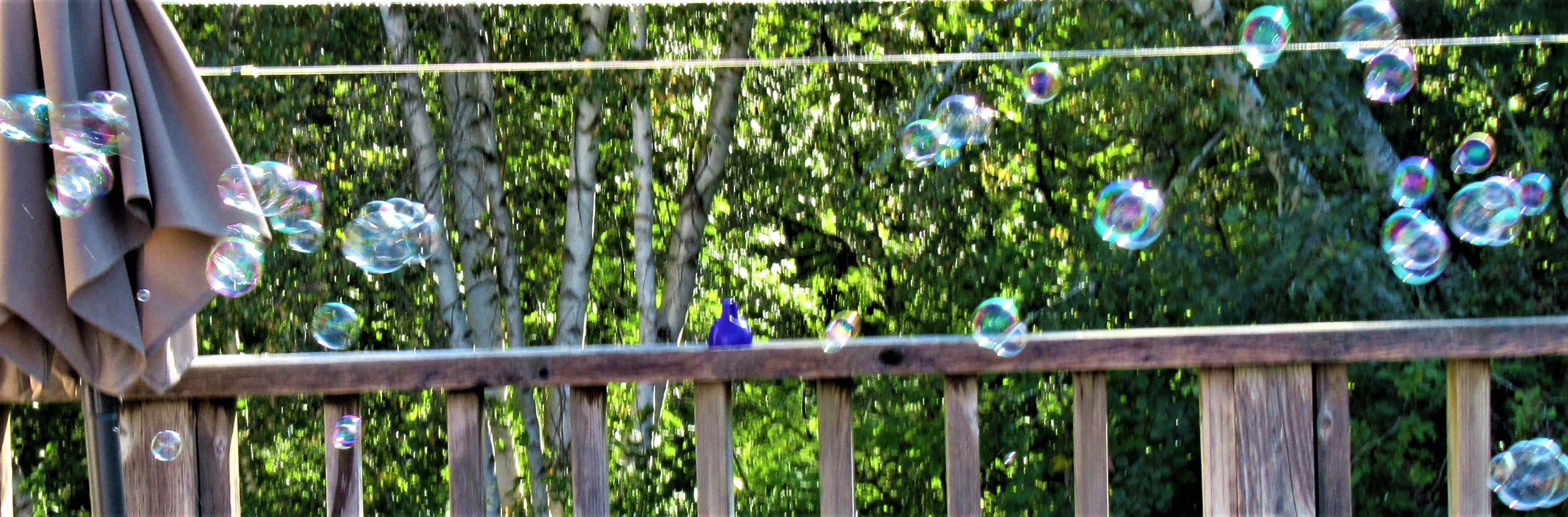
Count them. Each day she was here, a bubble. Little did I know as I saw them floating in the sun across the porch against a background of leafy trees that they would so soon burst and vanish, one by one.

Lost now, her voice, gone her footsteps from the stairs, no more the scrape of her chair as she climbs up beside me, calling my name. When I wake in the morning, I wait for her joyful call. How she loved to bounce on my bed. Knees up, but no Mother Brown this, just my grand-daughter, four years old.

And now she is gone.

Rolling Stones

IMG_1159 (2).JPG

Rolling Stones

I have counted down the days, hours, minutes,
one by one, each tock of my grandfather clock
linked in pen and ink chains of endless words.

From arrival to departure, time’s fickle finger has
pointed me onwards into my future or backwards
into a delusional past that never was as I recall it.

Packed bags, backpacks crammed full of snacks,
ammunition against the hunger wars soon to be
upon them, they commence their long journey home.

Grown ups, some in their second childhood, bemoan
ties that bind, tides that rip us apart, tearing hearts,
swinging us in and out as, cockle-shell heroes, we man

our coracles and consult wide-ranging horoscopes that
never fail to comfort, the future’s wild words, written
in pitiless skies to guide and inspire all earthly creatures

born into sadness and death. No heroes in this house.
Just two old people, grey-haired, broken, contemplating
this soon to be silent home, knowing the Rolling Stones

were right, that rocks in motion don’t gather no moss,
that each lost moment is a finger-nail torn from flesh,
that today of all days could verily be ‘the last time’.

Commentary: Here for such a little while and gone already. Two years since they were here and two more years before they come back again. The silence is overwhelming. Only CNN with its endless cacophony breaks into the conscious mind, though that mind is unconscious now of words and their meanings. Images of emptiness, empty nests, this empty nest, these empty nests fill the vacancy of space. The heart is a black hole in the chest, sucking everything out of the light and into that dark, vacant space.

IMG_1112 (2).JPG

Things

18581930_1306791786107970_4016640231053970709_n-1

Things I carry with me

            That old black cast-iron stove, wood-fired, that baked the best ever breads and cakes and warmed the bungalow on cold, summer mornings. The Welsh dresser with its age-blackened rails that displayed the plates, and cups, and saucers. The old tin cans that ferried the water from the one tap located at the end of the field. Full and wholesome, its weight still weighs me down as I carry it in my dreams. The Elsan toilet from the shed by the hedge and the shovels that appeared, every so often, as if by magic, as my uncle braved the evening shadows to dig a hole on the opposite side of the field, as far from the bungalow as possible.

            The outhouse at the end of the garden. The steps down to the coal cellar where they went when the sirens sounded, to sleep in the make-shift air raid shelter, along with the rats and mice that scurried from the candles. The corrugated iron work shop in the garden where my uncle built his model ships, the Half-Penny Galleon and the Nonesuch. The broken razor blades I used to carve my own planes from Keil Kraft Kits, Hurricanes and Spitfires, an SE5, and once, a Bristol Bulldog. Twisted and warped, they winged their ways into nobody’s skies, though once we built a paper kite that flew far away in a powerful wind and got tangled in a tree. The greenhouse from which I stole countless tomatoes, red and green. Kilvey Hill towering above the window ledge where the little ones sat when there were more guests than chairs in the kitchen. The old bombed buildings across the street. The bullet holes in the front of the house where the Messerschmidt strafed us.

            The old men spitting up coal dust from shrivelled lungs. The widows who took in lodgers and overnight travelers. The BRS lorries, parked overnight, that littered the street. The steep climb upwards into those lorries. The burrowing under dirty tarpaulins to explore the heavy loads, and many other things. The untouchable, forbidden drawer where the rent money waited for the rent collector’s visit. The old lady, five houses down who, when the shops were shut, sold warm Dandelion & Burdock and Orange pop for an extra penny a bottle.  The vicious, snub-faced Pekinese that yapped fierce defiance from the fortress of her lap. The unemployed soccer referee who on Saturdays walked five miles to the match and five miles back just to save the bus fare, his only financial reward. My father’s shadowy childhood. His first pair of shoes, bought at five years old, so he wouldn’t go barefoot to school.

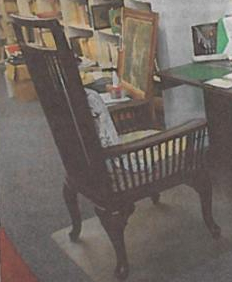
            Wet cement molded onto the garden wall, then filled with empty bottles to be smashed when the cement set solid. The coal shed where the coal man delivered the coal: cobbledy-cobbledy, down the hole. The outside toilet with its nails and squares torn from yesterday’s newspaper. The lamp-lighter who lit the lamps every evening as the sun went down. The arrival of electricity. The old blackout curtains that shut in the light and shut out the night. The hand rolled fabric sausage that lay on the floor by the door and kept the heat of the coal fire in the kitchen. The kitchen itself with its great wooden chair drawn up by the fire. That chair: the only material possession I still have from that distant past.