If you could be someone else for a day, who would you be, and why?

Daily writing prompt
If you could be someone else for a day, who would you be, and why?

If you could be someone else for a day, who would you be, and why?

My instant response was – I would be a billionaire, names don’t matter, then transfer a couple of million to myself, then back out of the alternate persona for another day, and there I would be – rich and happy, my old self once more. Then I started thinking – ‘billionaires don’t do things like that’ – then I really started thinking. How much of my alternate persona would I take over? Would I be myself in another body? Or would I be that person, privileged, hard, caring only for myself and my fortune, sparing nobody as I strove for my ultimate desire, the Noah’s Ark of a bunker that would protect me from the oncoming disaster that I was myself encouraging to happen? Enough, I said to myself. That’s not for me.

I thought about it during the night, in those elusive moments between waking and sleeping, that half-sleep contained in the Spanish duermivela. And then the light bulb flashed and I knew who I would be.

I have always wanted to visit Australia. The cost, the length of the flight, the rigors of the journey, the fear of DVT, have all prevented me from making that voyage – quite simply a flight too far. But what if I could be my cousin Frances, in Sydney, for a day? I have never met most of her family, and this would be a wonderful chance for me to do so. I would see her husband, George, in close-up. Also her four children, two of whom I have never seen except in photos. I could also meet their partners, and the grand-children, and all of that merely by waking up in another body on another continent. If I timed it right, I might even manage to visit the Sydney Opera House and see the harbour bridge, or catch a test match, or a rugby international – the red lights are flashing – overload – overload – overload -!!! Too much – too greedy – KISS – Keep It Simple Stupid – !!!

Seeing the family, experiencing her daily life, looking at her garden, so beautiful in the photos, maybe even sinking my fingers into that rich earth, that would be more than enough. Ayer’s Rock – Uruburu – Alice Springs, the Fremantle Doctor, my cousins in Perth and Bundaburg, they will have to wait. Sydney and my closest family, that will be more than enough.

But how much will I retain upon my return? How much will I remember? And what will happen to Frances? Will she become me and be forced to suffer our Canadian winter, for a day, while I rejoice in her Australian summer? So many questions.

Too many questions. Maybe I’ll just be myself, after all, as Oscar Wilde says “Be yourself. Everybody else is taken.” I’ll just be myself and to the above offer I will reply: “Thanks, but no thanks. I just want to be me.”

You’re writing your autobiography. What’s your opening sentence?

Daily writing prompt
You’re writing your autobiography. What’s your opening sentence?

You’re writing your autobiography. What’s your opening sentence?

The End.

Why did I write that? Because I like reading T. S. Eliot – Four Quartets – “In my beginning is my end.” If that statement be true, then, ipso facto, The End must be my first sentence, because that’s my beginning. Eliot converted to Catholicism – and, according to the Jesuits, “The end justifies the means” – so, when we start with the end we are justifying the writing (the means) of all that led us there.

You don’t like my logic, you say? Why not? It is as straight as the corkscrew I hold in my hand when I am threatening to add the contents of a bottle of wine to my autobiography. Is a bottle’s end in it’s beginning? Of course it is. If you don’t open the bottle, you can’t finish it. If you don’t start it, you cannot end it, so in the beginning lies the end.

Oh the mysteries of mysticism, those truths that know no logic and follow no known paths from their beginning (via purgativa), through their middle (via iluminativa), to their end (via unitiva). Or is life and truth a circle that has no end? In which case wherever I begin the circle of my autobiography, there too is my end.

In my end is my beginning and in my beginning is my end.

Mors omnia solvit.
The End.

What are three objects you couldn’t live without?

Daily writing prompt
What are three objects you couldn’t live without?

What are three objects you couldn’t live without?

Oh this is so easy and so obvious. Every verb needs a subject and most verbs need an object. Can you imagine living a life in which no verb has an object? Indescribable. And how about an indirect object? Or a direct or indirect object pronoun? And now let us move on to the object of a preposition…

Wow! And now I must choose three out of those five? What are you trying to do to me? This is so cruel. It’s why I always fail IQ tests – there are so many answers that do not fit the desired paradigm of the programmers who set the questions and the appropriate answers. Are we all to be programmed then? And who shall program the programmers?

Or do you wish me to choose three inanimate things? If you did, you should say so in a clear and understandable fashion. An inkwell? A quill? A piece of paper? Salt or sand to scatter on wet ink? How many people out there remember post office pens, also called scratch pens, also called dip pens? There was a time when life without such objects was unthinkable.

And why stop at objects? What would life be without subjects?

Oscar Wilde once stated he could make a pun about any subject. A voice came out from the audience “Queen Victoria”. “The Queen, sir,” bellowed Oscar, “is not a subject.”

“Oh, Oscar,” I said to him, “I wish I had said that.” “You will, Roger,” he replied. “You will.”

And I just did.

Who are your favorite people to be around?

Daily writing prompt
Who are your favorite people to be around?

Who are your favorite people to be around?

Creatives – because creative people need support in their creativity and need to believe in themselves and in their creations. I wrote two days ago about Rejections and Silence – while both are needed by creatives – rejections to help perfect and polish – and silence in which to create – too many rejections and too much silence can result in alienation, depression, and the suppression of creative acts.

“We few, we happy few, we band of siblings!” Not quite what Harry said before the Battle of Agincourt, yet can we, the readers, be absolutely certain that what Shakespeare said he said was actually what he said? But we share the spirit of creativity with creators big and small, famous, infamous, and struggling. That is why we need to band together, to support each other, and to ensure that creativity isn’t killed by the straitjacket of a nine to five job, or longer, or the multi-employment that has become so necessary just to survive in our diminished and diminishing world.

“What is this life if, full of care, we have no time to stand and stare?” wrote W. H. Davies, one of the great Welsh poets. And he concluded this poem with a parallel couplet: “A sad life this, if full of care, we have no time to stand and stare.”

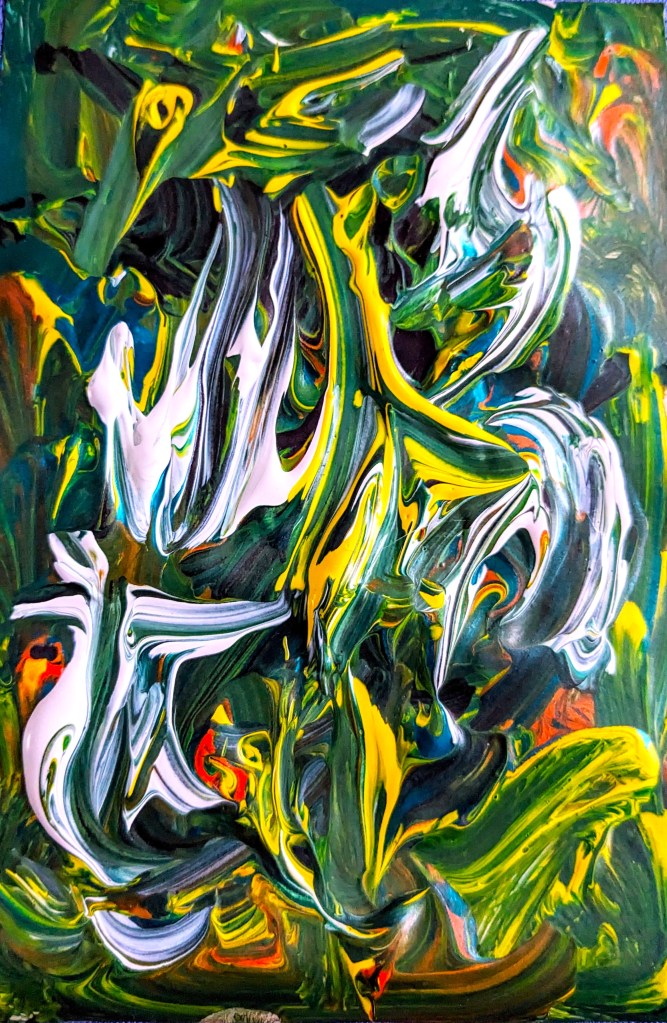
I hope you like the painting that heads this prompt that is turning into a joyous rant. It is by one of my creative friends, the poet-painter Moo. He calls it Spotted Coppers and he painted it last night after watching the Midsomer Murders episode that dealt with the theft of valuable Spotted Copper Butterflies. Intertextuality – one text leads to another, and the butterfly becomes a TV episode becomes a painting by a friend becomes a rant prompted by my computer and written by me.

That is the circle of creativity and it blends into the circle of friendships, and creative artists are both competitors and friends, for “whether creativity survives or no, I’m sure is only touch and go.” Another line that another great Welsh poet, this time Dylan Thomas of Swansea, might almost have said.

So, who are my favorite people to be around? Creative people, of course, with all their passions, energy, warts, flaws, and their constant need of encouragement and support.

What makes you feel nostalgic?

Daily writing prompt
What makes you feel nostalgic?

What makes you feel nostalgic?

I am not sure that nostalgic is the right word. I think of Robbie Burns with his “man’s inhumanity to man” and I realize that “the war to end all wars” never ended anything. It only started a series of new cycles. I am certainly not nostalgic for these endless cycles of violence and inhumanities. I am though nostalgic for man’s humanity to man, that spark of kindness and good will that seems, on the last day of the old year, with the new year about to come in, to have vanished. Could it be forever? I certainly hope not. May the new year (2024) bring peace, happiness, love, and understanding, to all the human beings on this tiny planet we, of necessity, share.

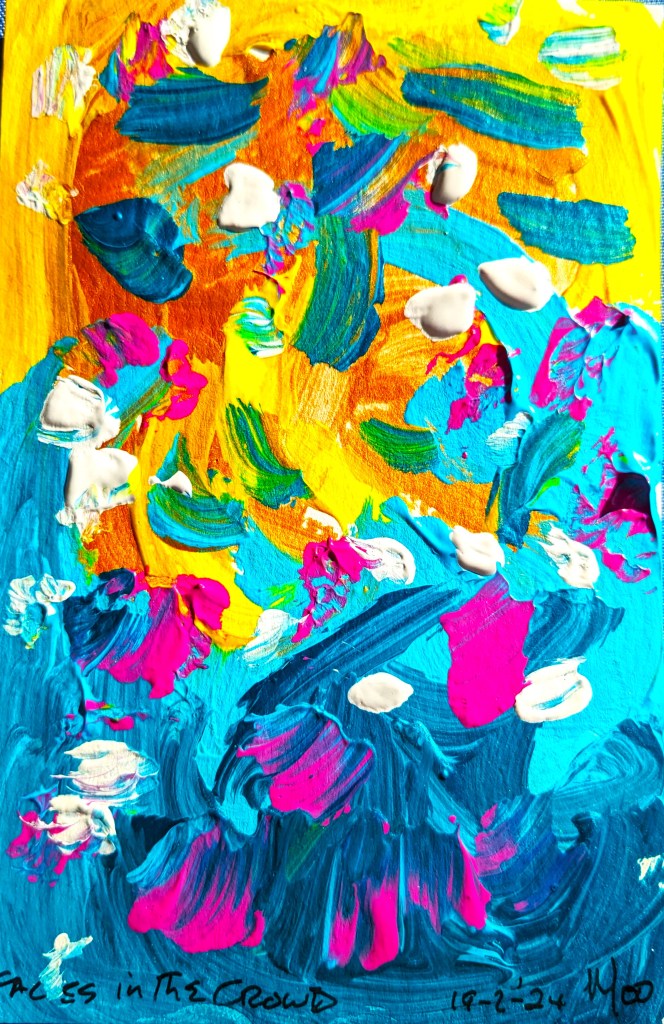
My friend Moo’s painting (above, thank you Moo), has for its title Fiat Lux – Let There Be Light. I am nostalgic for that light. May it soon return to our world.

Remembrance Day
11 November 2023

I wasn’t there
I never saw the gas clouds
            rolling over our positions
            never felt the barbed wire’s bite
            nor the bayonet’s jab

I never hung out my washing
            on the Siegfreid Line
            (“Have you any dirty washing, mother dear?”)
            never broke out of barracks
            never did spud bashing
            nor feasted on bread and water
            nor heard the rifle’s rapid rattle

I wasn’t there
            to see them carried away in carts
            coughing spluttering vomiting
            or bandages over their eyes
            walking slowly to triage a hand on
            the shoulder of the man ahead
            the sighted leading the blind

I wasn’t there
            but both my grandfathers were
            both decorated
            one mentioned in dispatches
            signed by Winston Churchill
            that one uninjured
            the other one gassed
            coughing up his lungs
            bit by bit for forty years

I am here now
    to remember
    and to honor them
           though so much
    has been lost

What relationships have a positive impact on you?

Daily writing prompt
What relationships have a positive impact on you?

What relationships have a positive impact on you?
I think one of my poems answers this question best. I write “one of my poems” but it is really my ‘free’ translation of one of Francisco de Quevedo’s sonnets – Retirado en la paz de estos desiertos. I have changed the poem slightly, but I am sure Don Francisco (1580-1645) will excuse Don Roger’s impoverished effort (2023).

On Loneliness
29 December 2023

Resting in the peace of these small rooms,
with few, but welcome books together,
I live in conversation with my friends,
and listen with my eyes to loving words.

Not always understood, but always there,
they influence and question my affairs,
and with contrasting points of view,
they wake me up, and make me more aware.

The wisdom of these absent friends,
some distant from me just because they’re dead,
lives on and on, thanks to the printed word.

Life flits away, the past can’t be retained.
each hour, once past, is lost and gone,
but with such friends, I’m never left alone.

The painting, by my friend Moo, is called Fiat Lux – Let There Be Light. It is reminiscent of Dylan Thomas’s poem, Light breaks where no light shines. Intertextuality – Quevedo drew inspiration from the Stoics. I drew inspiration from Quevedo. Moo drew inspiration from Dylan Thomas. The nature of creativity and its continuing links throughout the ages shines clearly through these wonderful associations.

What is the greatest gift someone could give you?

Daily writing prompt
What is the greatest gift someone could give you?

What is the greatest gift someone could give you?

The greatest gifts that anyone could possibly give me have already been given. Greatest of all, this life I live, this body I inhabit, given to me by my mother such a long time ago. Without that gift, and blessing, all other gifts would be meaningless. The second gift, chronologically, was the education that they provided for me. This included time on the continent during the summer and the school year to develop, in France and Spain, my knowledge of the languages and cultures.

The third gift has to be my meeting with Clare, and her decision to stay with me as her chosen partner. This includes my moving to Canada to study at the University of Toronto, and her decision to follow me here. Then, we got married, on Christmas Eve, and she became my greatest gift, giving me, in her turn, the gift of a child – our daughter, who in turn gifted us with a granddaughter. This last group of gifts includes the gifts that keep on giving, year after year.

So, a life viewed through rose-colored spectacles? Yes, in some ways. We have had our ups and downs but the gifts of life, love, and laughter have carried us through the difficult times when the winds blew, the sea rose, and we rowed on into brighter weather. There have been other gifts, of course. They include the gifts of family and friendship bestowed upon me by so many people in Wales, England, France, Spain, Canada, and Mexico. The gift of friendship, in later life, and my meeting with like-minded people who have walked with me, some for a little while, many for a lot longer. And we must never forget the gifts of adoration and love, bestowed upon us by our four-legged friends, the dogs and cats who have entered our various homes and enhanced our existence.

Having said all that, one moment, one gift, a much more recent one, does stand out. We lost power for three days, seventy-two hours, just before Christmas this year. At the start of the fourth evening, we were looking at temperatures of -10C to -15C. Our house temperature had descended to +53 F and we didn’t know whether we could face another cold night, or not. Then, at 7:15 pm, the exact moment when we had lost heat three days earlier, with a click and a whirr, the lights came on, the heating started again, and we received, from anonymous people, who we will probably never meet, the gift of power restored and the return of light and heat.

So, to the linemen of NB Power, those anonymous workers who strove to bring the light and spirit of Christmas to the dark homes of the cold and lost, we send our thanks. You gave us, without even knowing us, one of the greatest gifts that living things can receive – heat and warmth and light at Christmas Time, in the bleak mid-winter. Thank you, men and women of NB Power. You were the bearers of great gifts and you and your devotion to duty (under the worst of the weather), and the gifts you brought us are all truly appreciated.

You get to build your perfect space for reading and writing. What’s it like?

Daily writing prompt
You get to build your perfect space for reading and writing. What’s it like?

You get to build your perfect space for reading and writing. What’s it like?

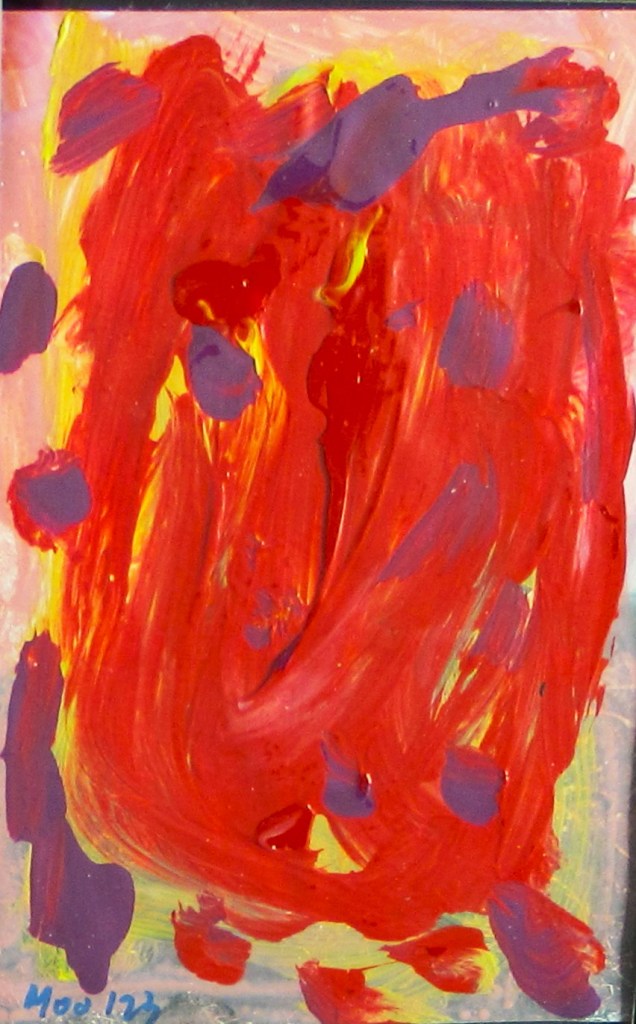
After an outpouring of poetry, during the recent three day – 72 hours – power loss, I have run out of words. Having had nothing to do but write, I now have everything to do, except write. So, I did some painting instead. This one is called Emotions in Motion. It is a picture of the inside of my head.

The inside of my head (pictured above) is the perfect space for both reading and writing. It is an especially good place when illuminated by candlelight as the flickering flames help the emotions to get into motion, if you see what I mean. And you probably don’t, because you have never entered a perfect writing, reading, and painting place, like mine.

Anyone can have a desk, with a window, looking out onto a garden. There may even be wonderful landscapes with fantastic sunrises and surprising weather events. But no space is perfect, save for that one perfect space (as depicted above). I can just imagine my friend Vincent (Van Gogh) doing aerial cartwheels with his paintbrush in his hand as he perambulates around his Starry Night, another perfect space in which to paint and read and write.

I painted Emotions in Motion during the aftermath of the three day power out[r]age when all sorts of thoughts and licorice all-sorts were floating around in there. You can probably taste a couple of the flavo[u]rs when you look at the picture. Never mind. Words will return – or not – in which case I’ll let the blobs of paint speak for me. And you can read my fortune in Vincent’s stars – or not, as the case may – or may not – be.

Share what you know about the year you were born.

Daily writing prompt
Share what you know about the year you were born.

Share what you know about the year you were born.

How much does anyone know about the year when they were born? When do childhood memories begin? What do we really know about those early days, those first surroundings, the family, the friends? I only know what I have been told – and not all of it is pleasant. Here for example is the song my grandfather used to sing to me when I was a very young child.

“I’ll never forget the day, the day that you were born.
They took you to your father and he looked at you with scorn.
Said he, ‘if that’s his face, the best thing you can do,
is stick a tail the other end and take him to the zoo.'”

I don’t remember what I looked like, acted like, or sounded like. I don’t remember much at all. But I have never forgotten that song with its innate cruelty. Oh yes, people laughed and pointed. Maybe you did too. But is it really funny? And what if your only childhood memory is a sense of being unwanted, rejected, left on the shelf, sent to the zoo… ? “Little boys should be seen and not heard.” Another piece of wisdom from the ancients.

Mind you, I have heard stories, and written them. Here’s one.

The Stork

My story almost didn’t begin in Number One, the first house that I recall from Gower, Wales. My mother gave life to me, a very long time ago, in the middle of a frost-bound winter in that land now distant in time and space. Yet begin it did just as the clock struck eight, that Sunday evening, in January, mis Iawnor. I know this is meant to be my story but the beginnings are swathed in a misty past that tells of a lack of awareness, a search for the meaning of shape, color, and form, the realization, however slow, of the need for language, words, a map, a direction, a slow growth of the seed from baby hood to boyhood, to manhood, and beyond.
 My parents told me I was flown in by a meandering stork that just happened to pass by our house at eight o’clock that night. I don’t remember much about the flight, although I have always dreamed of tumbling through that sky-blue air, only to be trapped at the last moment, my hips and legs caught in a vice that squeezed and squeezed until I could no longer breathe. This nightmare haunted me for years. All through my childhood, I climbed through ever narrowing tunnels and caves until I was trapped, struggling, suffocating, trying to get out. Many times, I would wake myself up with my own panicked screams. The twin holes in my temples, marks made by the doctor’s forceps, remind me to this day of the last stages of that journey.

Our dog, a black Labrador called Paddy, after St. Patrick, of course, and all the Paddies who worked the Paddy fields in Ireland and Wales, had been exiled to a neighbor’s house until after … after what? After the delivery? Were they afraid the dog might frighten away the stork? Who knows what they thought back then? In Galicia they still throw stones at storks to keep them from bringing babies to houses. It’s cheaper than contraception, which is illegal there anyway. When the clock struck eight, Paddy, curious and maybe jealous, turned herself into a stone, threw herself through the neighbour’s front bay window, and rushed home barking. The stork, scared by the noise, dropped me, plop, right down the chimney, and when the doctor held me upside down by the heels and slapped me, I started to scream.
How do I know all this? I don’t. I merely repeat what I’ve been told. Simpletons at heart, poets and babies believe so many things, myths and legends, fairy tales, tall stories, the stories of storks … can you tell talk from mutter, or Stork* from Butter as the TV ads used to ask? I know I can’t. But this is my tale to tell, even though I don’t know how it began (Alpha) nor how it will end (Omega). So many mysteries hide behind thick curtains of mist that conceal both the future and the dimly remembered past, a past that we often reconstruct while calling it ‘memory’.

*Stork: a brand of margarine that the tv ads said “tasted just like butter”. Hence: “Can you tell Stork from butter?”

Describe a man who has positively impacted your life.

Daily writing prompt
Describe a man who has positively impacted your life.

Describe a man who has positively impacted your life.

Does it have to be a man? Many women have impacted my life in a positive fashion. My Welsh grandmother taught me how to cook. She would stand me on a small stool placed beside the stove and I would watch as she explained what she was doing and why she was doing it. She allowed me to stir the various mixtures, to help beat the eggs, and when she baked, she always gave me a small piece of cake mix or dough so that I could create something for myself and bake it in the oven with the all the other things. It is hard to beat that type of impact. The small stone she threw still sends ripples through my kitchen and that of my daughter and granddaughter.

When I think of kitchens, I think of the many, many kitchens that I visited when living in France, Spain, and Oaxaca, Mexico. In each of them I picked up so many hints and ideas. In Santander, how to make a tortilla espanola / Spanish omelet. Every evening, my first landlady would leave, on the kitchen counter, one egg, one potato, and one onion. That was my supper – but I had to make it myself. I have made Spanish omelets for 60 years now. Some are simple, others combine different ingredients. All come from the kitchens I have visited in Spain.

In France, I learned the Parisian way to scramble eggs. Again, my landlady taught me how to scramble them her way, the only correct way. My scrambled eggs, learned as I was perfecting my knowledge of French language and culture, are still the talk of the table, when I serve them. Oaxaca was a total revelation, as I have said on many occasions, as was Oaxacan cooking. The first thing I learned – how to prepare quesadillas. Alas, there are no offerings of flor de calabaza with wish to garner them, not here in Canada, not that I have seen, anyway. Next came pico de gallo, that inimitable blend of cilantro, onion, jalapeno, tomato, lime, and salt. All of these recipes came, verbally, and practically, from the wonderful women who have enriched my world, as did the bacon and eggs, on a tortilla, with salsa mexicana, and the eggs scrambled in orange juice. And we won’t talk about the chapulines, grass-hoppers fried in garlic, nor the avocado with tuna delicacies.

Of course there have been men as well. Mon, the friend who spent twenty-three years in a Franco jail as a political prisoner, and survived. He built his own boat, powered by an old engine from a bakery that he adapted, and together we fished the Bay of Santander, every Sunday, for three consecutive summers. He taught me the secrets of the bay, where the fish were, where they hid, how they moved with the tides. He would encourage me to jump over the side, in deep water that lifted me up with the surge of the Biscay, under my armpits, and wouldn’t let me back on board until I could name every part of the bote. I became a very quick learner, especially as he was eating the omelet and drinking the wine as I was speaking. It was another incredible enrichment.

 Juanra, from Avila, was another such teacher. He would take me on his Sunday excursions to buy the week’s wine for his hostal-restaurante, and together we would visit La Seca, and other local wine-growing regions. I remember the day he and the lady who owned the vineyard we were visiting baptized me. We stood, thirty five feet underground, beside a wooden barrel, one of twelve in that cellar, that contained 5,000 litres of white wine. Juanra climbed a six foot ladder, and stood beside a tiny feather that acted as a plug to keep air out of the barrel. The lady, who performed the role of high priest, gave me a glass, showed me where to hold it, beneath the spigot, so that the wine would fill it and I could taste and test it. She turned the tap on – but no wine came out – then she held my hand ‘to keep it and the glass steady’. “Ahora / Now!” she gave the command. Juanra withdrew the feather, the wine flowed, and the lady jiggled my arm and soaked me from wrist to elbow, shrieking with a high-pitched laughter that blended with Juanra’s bass guffaw. “Ya te hemos bautizado,” they cried in unison. “Now we have baptized you.” And there I stood, a child of the vineyard and an adopted son of the land.

Just one? Only one? How could you be so cruel? I remember with great fondness one of my rugby coaches. Many of the people who surrounded him thought he was a clown, and told me so behind his back. But he had a certain something – and I wasn’t sure what it was. One day, at a national coaching conference, he took me on one side. “You already know everything that people here can teach you. But, somewhere, there is one piece of gold. You may find it here, or there, or in the bar. But that one piece of gold is what you will take home with you.”

When I coached the provincial junior team, one summer, I invited that coach to visit and to help me coach. We walked onto the field together. “Leave this to me,” he said. I asked him what I could do to help and he said – “Nothing. Just sit in my back pocket. See what I see. keep quiet. Ask questions later.” He started with a warm up game of rugby, which he refereed. “Whenever I blow the whistle three times – like this peep! – peep! – peep! – I want you to stop wherever you are. Don’t move until I tell you to.”

Then followed the most wonderful master coaching session I have ever witnessed. A ruck – peep! – peep! – peep! – – “Who was first to arrive?” No answer. he pointed. “You were. What did you do? Why did you do it?” This went on and on – scrums, lineouts, kick-offs, penalties, 25 yard drop outs – we weren’t metric yet. “Peep! – peep! – peep! – What did you do? Why did you do it? What else could you have done? Why didn’t you do that?”

They had called him a clown, the ones with the papers, and the coaching certificates, and the education, behind his back, and to them he was clown. But to me, he was a master coach. He taught me how to look, to listen, to see, to ask questions, and never to judge anyone until I had walked in a person’s shoes, or sat in their back pocket, not just for a mile, but for a whole wonderful weekend. He had a wonderful sense of humor and the clown left everyone laughing. Clown? He might have been the Prince of Clowns, but I have never forgotten what he taught me, nor how he taught it.