What aspects of your cultural heritage are you most proud of or interested in?

What aspects of your cultural heritage are you most proud of or interested in?

Right now, I am quite interested in (re-) learning the Welsh Language. Although I was born in Wales, I was never allowed to speak Welsh at home and my parents sent me to schools in which Welsh was never seen nor heard, let alone taught. That didn’t stop me from hearing out on the streets, reading it on the street signs, or visiting places whose names were only available in Welsh, or an Anglicized form of Welsh.

I am no longer an assiduous student of languages, but I get a Welsh Word a day by e-mail, and each word comes with an explanation of meaning and extended meanings. I also receive the words’ pronunciation and its phonetic changes (something peculiar to Welsh – they come in written form and can be quite complicated). Useful sentences are added – not long, but 3-4 seconds, repeatable ad infinitum, by reliable Welsh speakers, who often offer the variant pronunciations not only of North and South Wales but of other regions as well.

A great deal of linguistic and cultural history is wrapped up in language and the origins of the word are analyzed – sometimes going back to Indo-European, proto-Welsh, Medieval forms, and modern changes to the language. Emphasis is also placed on the survival of Welsh and its preservation, in written form, in Y Beibl Cymraeg, The Bible in Welsh. This fixed the language and helped enormously in its preservation.

I am also interested in Welsh Songs and Hymns. I already know most of the tunes having sung them in English during my childhood. Now I am learning them in Welsh and am currently working on the words to Calon Lan, one of my favorite hymn tunes. So, there you are. A new start at a very advanced age. A return to the past and an investment in the unknown future!
What aspects of your cultural heritage are you most proud of or interested in?

Daily writing prompt
What aspects of your cultural heritage are you most proud of or interested in?

What aspects of your cultural heritage are you most proud of or interested in?

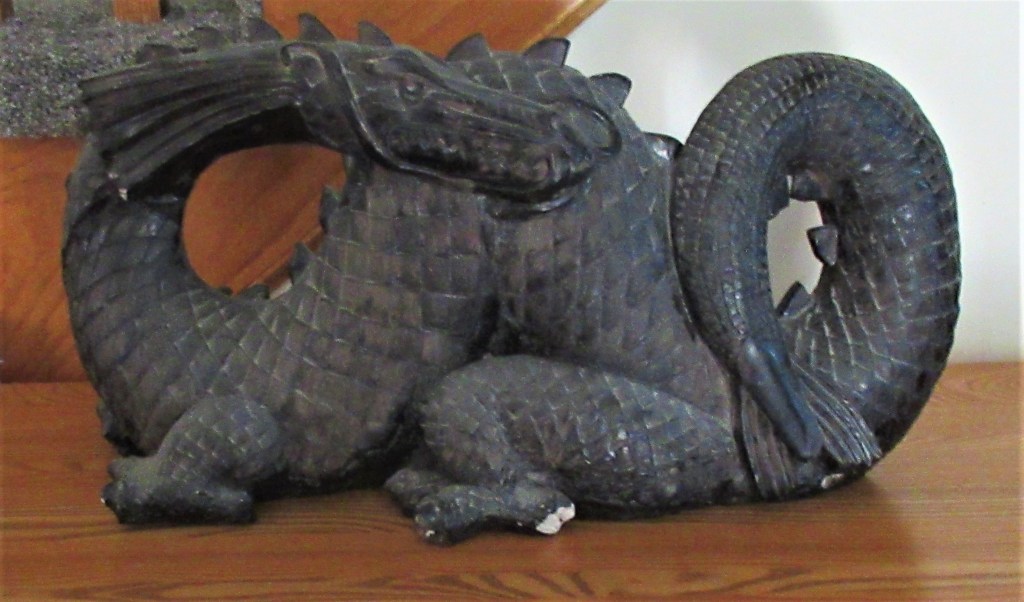
This dragon is not a dragon, well, it’s not a Welsh Dragon anyway. So, let us change the question – What aspects of your cultural heritage are you least proud of? Now that changes the perspective totally. I guess that I am least proud of the fact that, although born in Wales, I was never allowed to speak Welsh as a child. I speak with an English accent because I was sent to school in England so I wouldn’t even speak English like a person born in Wales. I am not proud of that aspect of my cultural heritage.

But I am proud of one little thing that stems from that Welsh cultural heritage – learning how to speak Welsh in my old age. It’s not easy to do that, here in Canada, but the internet carries many blessings, one of which is the learning of ‘foreign’ languages. Strange that Welsh should be considered a foreign language for somebody born in Wales. Something else not to be proud of, I suppose. Here’s my story.

Here I sit, an old man now, in front of my computer, learning at last my mother tongue, Welsh. I have discovered the beauty of simple words, not so much their meaning as their sound, the way they flow, the poetry of remembered rhythms: Cwmrhydyceirw, the Valley of the Leaping Stag, though legend has it that ceirw was really cwrw, and cwrw is beer, and its real name was the Valley of the Brown Stream Frothing like Beer.

Words have their own music, even if you cannot pronounce them properly: Mae hi’n bwrw glaw nawr yn Abertawe / it’s raining now in Swansea. Mae’r tywydd yn waeth heddiw / the weather’s worse today. Bydd hi’n dwym ddydd Llun / it will be warm on Monday. Place names also have their own magic: Llantrisant, Llandaff, Dinas Powis, Gelligaer, Abertawe, Cas Newydd, Pen-y-bont … Meaning changes when you switch from one language to another:  gwyraig ty / a housewife, gwr ty / a househusband, a concept of equality that has ruled Welsh lives since long before Julius Caesar invaded Albion, coming from Gaul with his legions in 55 BC.

The photographer asks me to smile. He wants me to say ‘cheese’ so I say it in French [fromage], then Spanish [queso], then Italian [formaggio]. “No, no, no,” he shakes his head. “I want to catch the real you. Try again.” So I say it in Welsh [caws]. He checks the memory card in his camera and looks puzzled.

“Your facial expression changes each time you speak a different language,” he tells me. “Please, won’t you just say ‘cheese’ in English? I want the real you.”

French, Spanish, Italian, then Welsh: all different and he wants the real me. Each language carves a new a map into my face.  Am I a clown, then, a comedian, a chameleon to wear so many masks and to slip so easily from one to another? And who am I, this stranded immigrant, marooned on a foreign shore that has finally become my home? Who or what is the real me?

“Cheese!” I say in desperation. “Got it,” he grins. “At last, I have captured the real you.”