The Book of Everything

Discourse Analysis
and
The Meaning of Meaning

Words have dictionary definitions that allow us to agree on what they mean. In this fashion, when I say ‘my grandmother’, you automatically know that I am referring either to the mother of my mother (maternal grandmother) or the mother of my father (paternal grandmother). This is the dictionary meaning of the word ‘grandmother’.

But words have lives of their own, and their meaning changes when used by individuals. You, the reader, never knew my grandmothers. You never will. They both passed away a long time ago. I loved them both, but for very different reasons, and to me they were as different as different can be.

This means that when you, the reader of these words, reach the word ‘grandmother’, the faces you see, the emotions you feel, the memories conjured up by that word are totally different from mine. Same word, same dictionary definition, different personal memories, experiences, relationships. In addition, the role that our grandmother(s) played in our lives will be very different too. That role may vary from culture to culture, from language to language, and from the social structure of the changing society in which we live.

For example, when I first went to Santander, Spain, I visited a family who lived in a large, detached house that contained three generations of the family – grandmother and siblings, father and mother, grandchildren, and an assortment of aunts and uncles. No need for babysitters in that household. Everybody had a vested interest in the development of the young ones and the older ones received tender, loving care, twenty-four hours a day, every day of the week.

I lived from time to time in the same town as my own grandparents. I saw them regularly, but rarely on a daily basis. When my parents sent me to my first boarding school, age six (if I remember correctly), I lost contact with my family. My paternal grandfather died when I was away at school. My maternal grandmother died while I was away at school. My paternal grandmother died when I was living in Spain. My maternal grandfather died when I was living in Canada. Alas, after those early years, I scarcely knew them. My experience, then, was so different from that of other people.

When I moved to Canada, the Atlantic Ocean separated me from my parents. My daughter, born in Canada, grew up with no close knowledge of her grandparents. The word ‘grandmother’ did not mean the same to her as it did to the grandchildren in Santander, or to me. How could it? All those miles between the families, and visits limited to a couple of weeks every other year at best. Although the dictionary meaning is always the same, what a difference in the emotional meanings for each person using that word.

Discourse Analysis, the way I use it, builds not on the dictionary meanings of words, but on their emotional and personal resonance. I take the standard, dictionary meaning of words, twist it, look for meanings at different levels, and then build an alternative narrative on that changed meaning. I have great fun doing so.

Part of that verbal fun comes from my childhood. I listened to Radio Shows like The Goon Show and Beyond Our Ken. Giles’ Cartoons gave my names like Chalky White, the skeletal school teacher, or Mr. Dimwitty, a rather dense teacher in another school. These shows also twisted the meaning of words and drew their humor from such multiple meanings. The Goon Show – “Min, did you put the cat out?” “No, Henry, was it on fire?” Or on an escaped convict – “He fell into a wheelbarrow of cement and showed every sign of becoming a hardened criminal.” Or from Beyond Our Ken – “My ear was ringing. I picked it up and answered it. ‘Ken here, who am I speaking to?’ ‘Larry Choo.’ ‘Ah, Choo.’ ‘Bless you, Ken.’ Verbal scenes like these – it’s hard to get visual pictures from listening to the radio – remain engraved in my memory banks. More than engrained, they become part of the verbal system from within which I write.

This system includes Direct Discourse, Indirect Discourse, and the Twisted Discourse of an Inventive Mind that still wishes to create. It also comes from Francico de Quevedo’s Conceptismo, from Ramón del Valle-Inclán’s esperpento, and from certain aspects of Albert Camus’s Theory of the Absurd, all blended with the poetry of Jacques Prévert and the songs of Georges Brassens. This from the latter – “Tout le monde viendra me voir pendu, sauf les aveugles, bien entendu.” Everyone will come to see me hanged, except the blind of course.

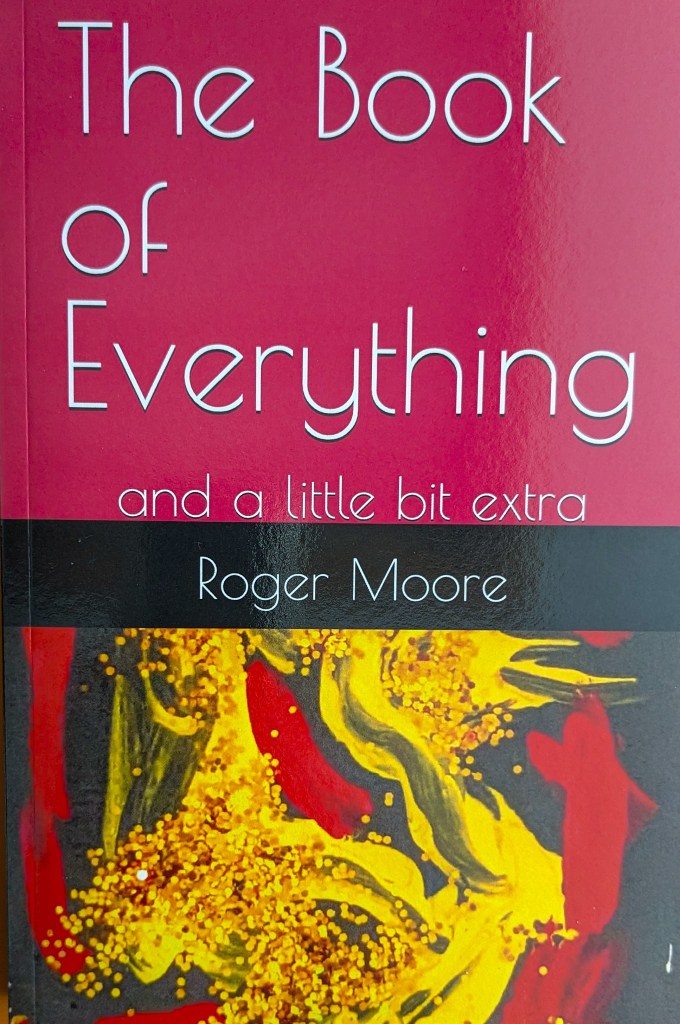
This is not always easy humor, nor is it a comfortable way to see the world. But it is a traditional one with a long literary history. The title of my book goes back to Francisco de Quevedo, of course, who, in 1631, in Madrid, published El libro de todas las cosas y otras muchas más / The book of everything and a lot more things as well. Don Roger turns to his good friend Don Francisco whenever he needs a helping hand.

The pieces themselves were first published on my blog rogermoorepoet.com. They have been revised, and I have added some more pieces in a similar vein. Tolle, lege – Take and read.  Above all, enjoy this world of mine, with its subtle and not so subtle humor, its sly digs at many of our follies, and its many forms of creativity.

The Book of Everything
and
a little bit extra

Click on the title to purchase this book.

When are you most happy?

Daily writing prompt
When are you most happy?

When are you most happy?

What on earth does that mean? When? Are we talking time of day, or time of night? Are we talking a season of the year? Are we talking mood swings – happy now, oh dear, mood swing, not happy now? Are we talking Hen Wen, the magic white pig at the feeding trough? “I am at my happiest, oink-oink, when I am eating a big burger from …” – and here you name your favorite burger outlet. None of that Hen Wen nonsense applies, of course, if you are vegetarian, vegan, or have an allergy to burgers or buns!

I can tell you when I am least happy – 7:30 am, on a wet, damp, cold, icy, snowy winter morning, when I have to get up, get dressed, and go out in the mush and the slush to have an early morning blood test – no food or drink for 12 hours – at the local hospital. Last time I did that, I couldn’t find a parking spot, and drove round and around until eventually one opened up, as far away as possible from the hospital of course. No, I was not a happy camper on that occasion. Especially when I slipped on the ice, returning to my car, and then found someone had driven into my side while I was parked there. Oh, that made me so happy and so jolly, I laughed until I cried. [I do hope you can recognize sarcasm when you see it.]

So, let us reverse the question and reframe it by saying that I am perfectly happy when the things that make me miserable do not happen. No fender-bender in the ice and snow – I am a happy man. Caught speeding or jumping a red light – totally by accident, of course, – and the man in blue asks me for my license, sees that it’s my birthday, and lets me drive away with a verbal warning and a jovial ‘happy birthday”! Ah yes, reverse psychology, that sort of thing does make me happy.

So, above all, it’s the little things in life that go right, and not wrong, that make me happy. This morning’s boiled egg, boiled to perfection – not too hard, not too soft. My coffee a perfect blend designed to bring joy and happiness. Marmalade on blue cheese, the Welsh equivalent of Chinese sweet and sour – oh yes, and actually making someone laugh or smile when they read this nonsense I write. Even Hen Wen grunts with joy – oink! oink! – at that one. So if you have enjoyed this post, please take the time to send me an oink or two, and I will be happy. Thanking you in advance is, yours sincerely, Hen ‘oink!’ Wen ‘oink!’ Wink, ‘oink!’

Who are your favorite people to be around?

Daily writing prompt
Who are your favorite people to be around?

Who are your favorite people to be around?

Creatives – because creative people need support in their creativity and need to believe in themselves and in their creations. I wrote two days ago about Rejections and Silence – while both are needed by creatives – rejections to help perfect and polish – and silence in which to create – too many rejections and too much silence can result in alienation, depression, and the suppression of creative acts.

“We few, we happy few, we band of siblings!” Not quite what Harry said before the Battle of Agincourt, yet can we, the readers, be absolutely certain that what Shakespeare said he said was actually what he said? But we share the spirit of creativity with creators big and small, famous, infamous, and struggling. That is why we need to band together, to support each other, and to ensure that creativity isn’t killed by the straitjacket of a nine to five job, or longer, or the multi-employment that has become so necessary just to survive in our diminished and diminishing world.

“What is this life if, full of care, we have no time to stand and stare?” wrote W. H. Davies, one of the great Welsh poets. And he concluded this poem with a parallel couplet: “A sad life this, if full of care, we have no time to stand and stare.”

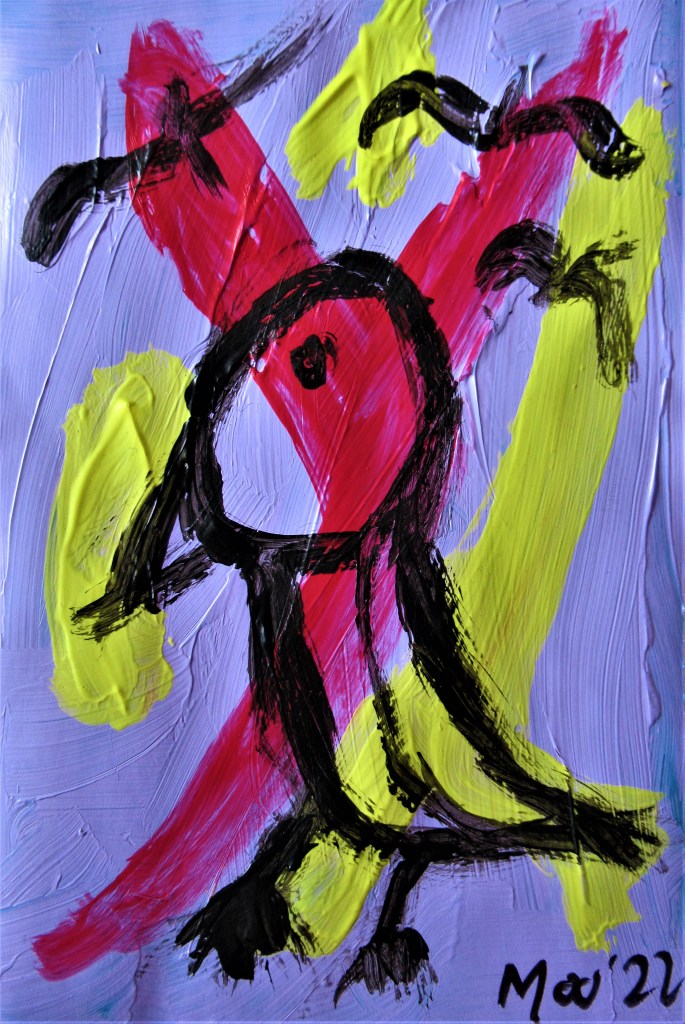
I hope you like the painting that heads this prompt that is turning into a joyous rant. It is by one of my creative friends, the poet-painter Moo. He calls it Spotted Coppers and he painted it last night after watching the Midsomer Murders episode that dealt with the theft of valuable Spotted Copper Butterflies. Intertextuality – one text leads to another, and the butterfly becomes a TV episode becomes a painting by a friend becomes a rant prompted by my computer and written by me.

That is the circle of creativity and it blends into the circle of friendships, and creative artists are both competitors and friends, for “whether creativity survives or no, I’m sure is only touch and go.” Another line that another great Welsh poet, this time Dylan Thomas of Swansea, might almost have said.

So, who are my favorite people to be around? Creative people, of course, with all their passions, energy, warts, flaws, and their constant need of encouragement and support.

What is one thing you would change about yourself?

Daily writing prompt
What is one thing you would change about yourself?

What is the one thing you would change about yourself?

Only one thing? I remember a story about a boy who boarded in a monastery school, and there, like the monks, they all changed their dirty habits once a week. So, is a dirty habit a thing? Probably is, if its a brown, sackcloth habit, tightened around the waist with a white cord by a man wearing open-toed sandals and no socks. So, there we go, once a week, on Wednesdays, like those monks, I also change my dirty habits. I also change my shoes, my socks, my shirts, my sweaters, my jeans.

More important, as I grow older, I have permitted myself to change my mind as often as I like. So, yes, I also change my mind, and not just on Wednesdays. And I really do change it when, like my habits, it gets dirty. “Oooh, you’ve got a dirty mind, you have.” “Well, so I do. Never mind, I’ll just go and change it.”

“What did Big Ben say to the Leaning Tower of Pizza?” – I’ve got the time, if you’ve got the inclination.
“How many ears did Davy Crocket have?” – Three – a left ear, a right ear, and a wild front ear.
“What’s yellow and deadly?” – Shark infested custard.
“What’s black and deadly?” – A crow in a tree with an AK47.
“When is a door not a door?” – When it’s a jar.
“What time is it Eccles?” – “It’s eight o’clock.” “Here, how do you know it’s eight o’clock?” “I’ve got it written down on a piece of paper.” “What do you do if it’s not eight o’clock?” “I don’t look at the paper.”
“Ding-a-ling” – That’s my ear ringing. I’ll just pick it up and answer it.
“What’s the first sign of madness?” – Hairs in the palm of your hand. “What’s the second sign of madness?” – Looking for them.

So what is one thing I would change about myself? Possibly the absolute necessity to tell awfully bad jokes. Easy to say – I’ll probably keep adding to these as I remember more of them. Take care – you have been warned.

“How many – men – does it take to change a light bulb?” – Five. One to hold the bulb and four to turn the ladder. Jokes like these can be good or bad. Good because they are occasionally funny. Bad, because it so easy to insert an adjective before – men – and to turn the joke into something more devious and not necessarily very pleasant.

“And that is the end of the gnus,” said the lion on BBC television, as he licked his paws. “Enough, no more. It is not as sweet now, nor as sour, as it was before. Pass the chow mean, please.”

What’s something you would attempt if you were guaranteed not to fail.

Daily writing prompt
What’s something you would attempt if you were guaranteed not to fail.

What’s something you would attempt if you were guaranteed not to fail.

Well, I remember when Arthur Lydiard was coaching Peter Snell, this was back in the early sixties. He ‘allegedly’ said – and I write from a decaying memory – that anyone could be trained to run a mile in under four minutes, using his methods. Next day, it is rumored that a fifty year old man, overweight, smoking a cigar, turned up at training and asked Lydiard to fulfill his promise.

Well, maybe it was Percy Cerruti training Herb Elliott. Same time frame. Different memories. Great coaches and great athletes. So here am I, at eighty (well, nearly), and I have always wanted to run a mile in under four minutes. My fastest time was 4:07 – downhill, with a following wind, during the Bristol University Rag Run (1966 – Bristol – Stamford Bridge – Hastings – Bristol). So, I am guaranteed not to fail, eh? I also hope you will guarantee that I do not fall, eh? And can I use both my canes, or only one, eh?

Okay, so this is how we’ll do it. You load me on the back of a flat bed truck. It has one of those walkways on it, with handrails on both sides, like they use in the rehabilitation centers. I won’t need my canes then. The truck drives a measured mile, in 3 minutes and 59 seconds exactly, and I “run aka speed walk aka speed lurch” all the way, hanging on to the handrails, thus covering a measured mile, in under four minutes, and achieving a life-time goal, attempting which I am guaranteed not to fail.

What was that line from Man of La Mancha aka DQ (and I don’t mean Dairy Queen) – “to dream the impossible dream.” And now, tired from my exertions, I will take a brief siesta and see if, in my impossible dreams, I can bring that time down a little bit lower. New world record, anyone?

Interesting Times

Daily writing prompt
List 10 things you know to be absolutely certain.

Interesting Times

“May you live in interesting times.” This phrase, be it a blessing or a curse, it has been called both, is rapidly becoming a cliché. So, are we living in ‘interesting times’? Good question, and I have no answer to it, not one that I would publish anyway.

As to listing 10 things that I know to be absolutely certain, I can’t. And that may be the first thing I am certain about. The other thing about which I have a certain amount of certainty is uncertainty itself. I am certain that yes, we are indeed living in times of uncertainty. Well, most of us are anyway. The other thing that I am fairly certain about, well, 100% certain about really, is that death will come to us all, sooner or later, don’t know where, don’t know when, don’t know how.

So, perhaps I can manage to achieve three certainties – 1. The certainty of death, to quote Dylan Thomas, ‘for all poor creatures born to die’. 2. The certainty of uncertainty itself, to quote Stéphane Mallarmé, in my own translation, ‘a roll of the dice will never eliminate chance’. 3. The certainty that I cannot find seven more things about which I am certain.

That said, I am not all that certain about what I have just written

Broken Laws and Broken Rules

Broken Laws and Broken Rules

Rugby Football is a wonderful game. It has laws, not rules, and yes, like almost every rugby player I have known, I have broken the laws, and got away with it. How? Stepping off-side, handling the ball in the ruck (old laws), blocking and obstructing ‘accidentally on purpose’. I asked one of my instructors on a national coaching coach whether we should be coaching school age players to play outside the laws. His reply was most instructive. “The laws – there’s what the law book says, what the referee is calling on the day, and what you can get away with. You get away with what you can.” He was a national level coach – so much for the laws of rugby.

There is a difference between the rule of law, specific laws, and rules. Life in various boarding schools, twelve years, from age six to eighteen, taught me that rules were made to be broken. No talking after lights out. Whisper away – just don’t let yourself be heard by the prefects or monitors listening outside the dormitory door. No hands in trouser pockets. So – stick them in your coat pockets. No smoking – well I didn’t smoke, never have. But I know many who did but very few who got caught. No talking in prep – so I taught myself and a couple of friends basic sign language – the alphabet mainly. You may not place butter on your bread – so put the butter on the bread and turn it upside down when you eat. And no, that wasn’t me. No reading in the dormitory after lights out – so, go to the toilet, with a book in your pajamas and sit there and read Lady Chatterley’s Lover for as long as you want. You may only wear ties of a quiet color. So, wear a V-neck sweater and make sure the nude lady on your quietly colored tie cannot be seen by the masters. It is forbidden to enter a public house. So, sit outside in the garden. It is forbidden to drink beer. So, order some cider – it was the West Country, after all. And remember that rules, especially school rules, are often asinine, ie -stupid, like an ass – and made to be broken.

“The law is an ass is a derisive expression said when the the rigid application of the letter of the law is seen to be contrary to common sense.” Well, that is quite explicit, as is this – “This proverbial expression is of English origin and the ass being referred to here is the English colloquial name for a donkey, not the American ‘ass’, which we will leave behind us at this point. Donkeys have a somewhat unjustified reputation for obstinance and stupidity that has given us the adjective ‘asinine’. It is the stupidly rigid application of the law that this phrase calls into question.” Both quotes come from the following site – and I am indebted to the writers thereof – https://www.phrases.org.uk/meanings/the-law-is-an-ass.html

It is well worthwhile to remember, not just the law, but the spirit of the law. I can honestly say that I have never broken a law or a rule in such a way as to cause someone else to get hurt, physically or emotionally. Play up, play up, and play life’s game – ludum ludite – I have always done so – and always have I stayed within the spirit of rule or law.

My Favourite Candies

My Favorite Candies

I searched for the blog prompt, but I couldn’t find it. Not by name and I don’t remember the number, nor do I know how to search for it. So – here I am, on the sea shore, stranded, looking for something I may never find. Yet an echo of it has found me.

I googled ‘candy’ to find out what it meant because when I think ‘candy’ I think of Candy Floss, that long, thinly-spun web of sticky pink sweetness sold at the fairgrounds and the ice-cream stalls of my childhood beaches, back in Gower. Barred and banned it was, and seen as a source of cavities and visits to those much-to-be-feared, brutal, ex-Armed Forces dentists who terrified our childhood while working in those days in the NHS.

Candies, in my Olde English language, were called sweets. In post-war Britain, where rationing was the unwelcome rule, sweets were rare, for they cost us coupons, and were therefore, very, very precious. In those days, my grandfather had many friends and his friends were priceless. On Saturday mornings he would take me to Swansea Market, the one that had been bombed during the war. It had been rebuilt but, in those days, remained roofless. There he would work a shift at Green’s Sweet Stall while someone took a break – and I helped him. We would take the orders, count and weigh the sweets, take the cash, count it, check it, place it in the till, and hand over the correct change along with small, white paper packets that contained the hand-made sweets.

We received no money for this pleasurable work. However, when our duty was done, I would be given my choice of hard-boiled sweets. My favourites were those red and white striped sweets, called winter warmers, laden with the lusty tang of cloves that lingered long in the mouth. We held competitions to see who could make their sweet last longest. And woe betide the losers who cracked them, or swallowed them whole, for they were mocked and forced to watch, minute by minute, the lucky ones whose sweets dwindled on and on, shown off, paper thin, on tongue tip, for all to see.

But better than any candies were the Cockle Women in their tall black hats and red Welsh shawls who came all the way from Penclawdd on Saturdays with their baskets of cockles and their buckets of laverbread – bara lawr – at thruppence a pound. Laverbread – Welsh Caviar, Richard Burton used to call it, a delicacy to be savoured for breakfast or lunch and sweeter to the enthusiast and devotee than any candied sweets, even winter warmers.