“My grandfather told me there’d be times like these” and he was right. I wonder about his blue days, down there in the trenches, on the Somme, and on other fronts. He survived. He was a survivor. Sometimes that’s the only thing to be. So how do we survive? How do we ignore the snipers, the whizz-bangs, the star shells, the other things that go bump in the night?
There is no single answer. One of my best friends goes into hospital tomorrow, 6:00 am, buccal cancer. An operation. All may be well afterwards. I certainly hope so. I will be here for him, as my grandfather was there for me, as I have been there for others, as others have been there for me. I will not mention names. A blue, blue day indeed. But what shade of blue? If all goes well, the celestial blue of joy and hope, the blue of Mary’s robe when she crushes the serpent beneath her foot, the joy of the blue sky after the storm.
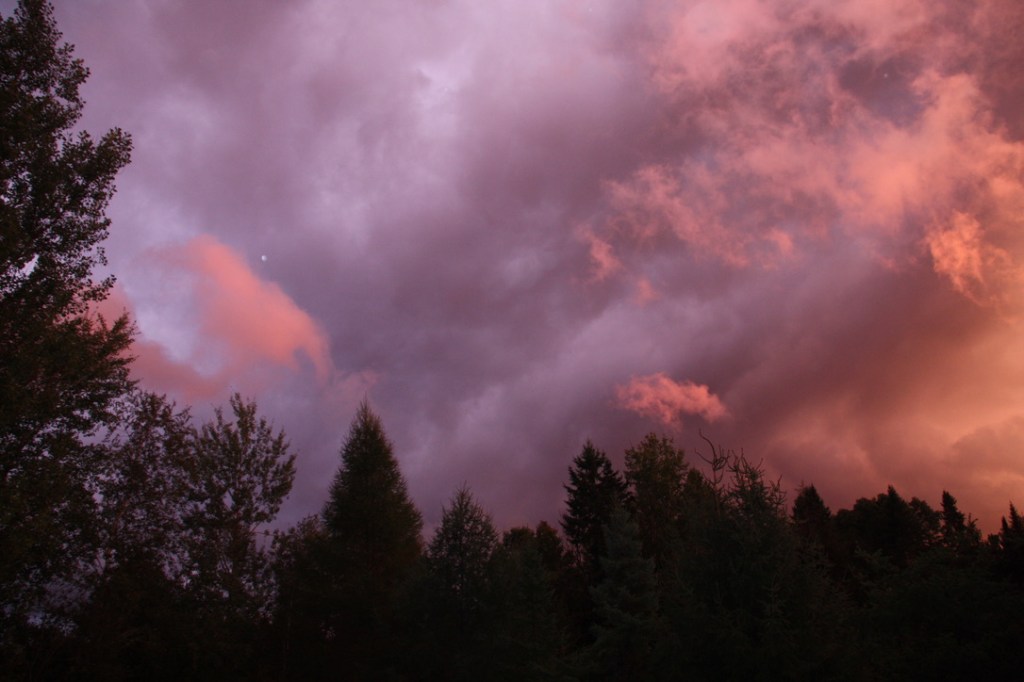
Not, we hope, the dark blue, almost purple, of the gathering storm, the blue of thunder clouds turning almost into black, the midnight blue of the last chance saloon with its overtones of tragedy and disaster. “I never felt more like singing the blues”… indeed I didn’t. But what shade of blue? And for me, it is always the blue of clearing skies, the blue of Mary’s robe, the blue of hope.
“And still I live in hopes to see, Swansea Town once more,” thus sang my father’s father during WWI. He was gassed, he was wounded, he was decorated, he was mentioned in dispatches, so many things happened to him. But he survived the snipers, Big Bertha, the star shells, the whizz-bangs, and he saw his beloved “Swansea Town once more.” As I hope I will, but my dream of a return to the blues of Swansea Bay may be fulfilled in a very different fashion.
Alas, my beloved Swansea Town is now a city. “And so I live in hopes to see, Swansea City once more.” It doesn’t sound the same, does it? It doesn’t have the same carry, the same rhythm, the same resonance. And what about Town Hill? Has it now been renamed City Hill? I am sure Town Hall, the old Brangwyn Hall where my father used to work, is now City Hall, which my father never entered. Enough, no more for “you can never walk in the same river twice” (Heraclitus).
This is the original version. It is much better than the revision that I posted earlier.Sometimes, when we revise, we lose the freedom of thought and association that comes with the early version. Message: keep your variations and keep an open mind. Over-elaboration is the poet’s worst enemy.
Wingless in Gaza Street
amputees deprived of flight they flutter grounded in the gutter
galley slaves chained to broken oars they ply blunt stumps relentlessly
shorn of strength and beauty their once glorious shuttles weave dark circles
my mouth is a full moon open in a round pink circle bone and its marrow settle in subtle ice
futile fragility of the demented heart pumping its frequency of fragmented messages
frail beauty torn from its element of air this brightness of moths drowning in inky depths
the seven o’clock news brought to you from an otherwise deserted street.
Not clematis, but bruised clematis clouds. I’ll keep looking. Maybe I’ll find the real things.
The clematis unfolds bruised purple on the porch. Beneath the black and white hammers of ivory keys, old wounds crack open. A flight of feathered notes: this dead heart sacrificed on the lawn. I wash fresh stains from my fingers with the garden hose while the evening stretches out a shadow hand to squeeze my heart like an orange in its skin. Somewhere, the white throat sparrow trills its guillotine of vertical notes. I flap my hands in the air and they float like butterflies, amputated in sunlight’s net. The light fails fast. I hold up shorn stumps of flowers for the night wind to heal and a chickadee chants an afterlife built of spring branches. Pressed between the pages of my dream: a lingering scent; the death of last year’s delphiniums; the tall tree toppled in the yard; a crab apple flower; a shard of grass as brittle as a bitter tongue at winter’s end. I know for sure that a dog fox hunts for my heart. Vicious as a vixen, the fox digs deep at midnight, unearthing the dried peas I shifted from bowl to bowl to measure time as I lay in bed. I sense a whimper at the window, the scratch of a paw. I watch a dead leaf settle down in a broken corner and it fills me with sudden silence. Midnight stretches out a long, thin hand and clasps dream-treasures in its tight-clenched fist. The lone dove of my heart flaps in its trap of barren bone and my world is as small as a pea in a shrunken pod. Or is it a dried and blackened walnut in its wrinkled shell of overheating air? Sunset, last night, was a star-shell failing to fire. Swallows flew their evensong higher and higher, striving for that one last breath lapped from the dying lisp of day. Its last blush rode red on the clouds for no more than a second’s lustrous afterglow. I lower the delphiniums, body after body, into their shallow graves. Night’s shadows weave illusions from earth’s old bones and rock becomes putty, malleable in the moonlight. Midnight readjusts her nocturnal robes and pulls bright stars from a top hat of darkness. Winged insects with human faces appear with the planets and clutter the owl’s path. Night swallows the swallows and creates more stars. The thin moon hones its cutting edge into an ice-cold blade.
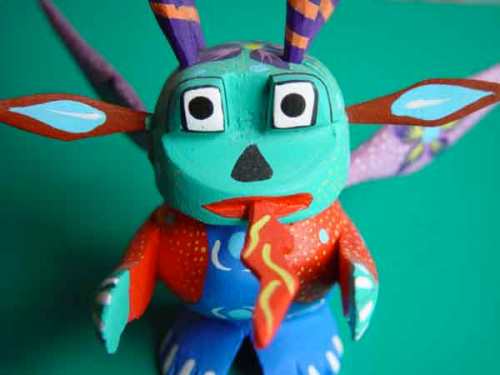
This is one of the first alebrijes I bought in the zocalo (main square) in Oaxaca. He has lost his ears and probably his tongue. They started falling out so we wrapped them up carefully and now we can’t find them. He’s still a happy chappy, hough, and has been in this house for a quarter of a century. Happy Birthday Alebrije!
Alebrijes step out from dried wood and stand in the shower of paint that falls from the brush’s tip. Yellow flash of lightning, pointillistic rain, garish colors that mirror those of the códices. The carvings take the form of fantasy figures, anthropomorphic animals, and mythological creatures. Sometimes one individual selects the wood, carves it, then covers it in paint. Occasionally an entire family takes part in the work of making the alebrije. One person collects the wood and prepares it for carving. Another carves and sands it. A third works on the undercoat, and a fourth applies the final patterns of paint. The great debate: does the form in the wood reveal itself to the carver or do the carvers impose their own visions on the wood? In the case of the team, do the family members debate and come to a joint conclusion? These thoughts, exchanged with wood-carvers in Oaxaca, have led to a series of interesting conversations. What exactly is creativity? Where does it come from? Do we, as artists, impose it upon our creations? Or do we merely observe and watch as new ideas float to the surface of our minds? How does the creative mind really function? And, by extension, how much of the sub-conscious creative sequence can be placed into words?
Alebrijes
Are they half-grasped dreams that wake, wide eyed, to a new day’s sun?
Or are they alive and thriving when they fall from the tree?
Does the carver fish their color and shape from his own interior sea, or does he watch and wait for the spirit to emerge from its wooden cocoon to be reborn in a fiery block of color?
Daybreak: in a secluded corner of my waking mind, my neighbor’s dog greets the dawn with sparks of bright colors born from his bark.
My waking dream: dark angels with butterfly bodies, their inverted wings spread over my head to keep me warm. In the town square, the local artist plucks dreams from my head and paints them on carved wood.
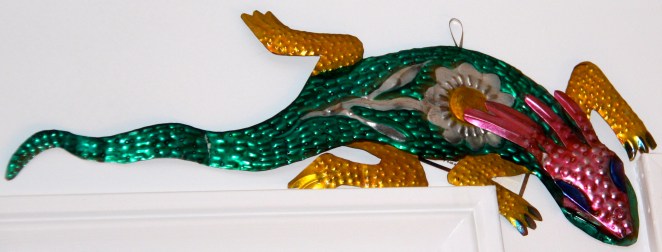
Our house iguana: he is not an alebrije, but is made out of painted metal foil, carved first, and then decorated. He’s the one who guards the front door and falls upon unwanted intruders when they least expect it. Never stay home alone without one, or two, or more. But watch out if you have too many and they get hungry.
I thought for a moment that, yes, I was an angel and I was dancing on a pinhead with so many other angels, and all of us butterflies spreading our wings with their peacock eyes radiant with joy and tears spark -ling in time to the music that wanders up and down and around with inscrutable figures held spell-bound in a magic moment … and I still feel that pulsing in my head, that swept up, heart stopping sensation when the heavens opened and the eternal choir raised us up from the earth, all earthbound connections severed and all of us held safe in an Almighty hand.
A fiery wedge, fierce beneath black-capped clouds, alive the firmament with light, breaking its waves over woods, waters, tranquil the bay, grey, yellow-streaked, then blue, the new day dawning, driving night away, false shadows fleeing.
2
To rock this new born babe, to swaddle it in a cloak of cloud, disguised for a moment its promise, nature nurturing heart and mind, filling the flesh with memory’s instantaneous flash breaking its light into the dark where no light shone, fearful, the dream world, gone now, dwindling, as day light shafts its arrowed flight.
3
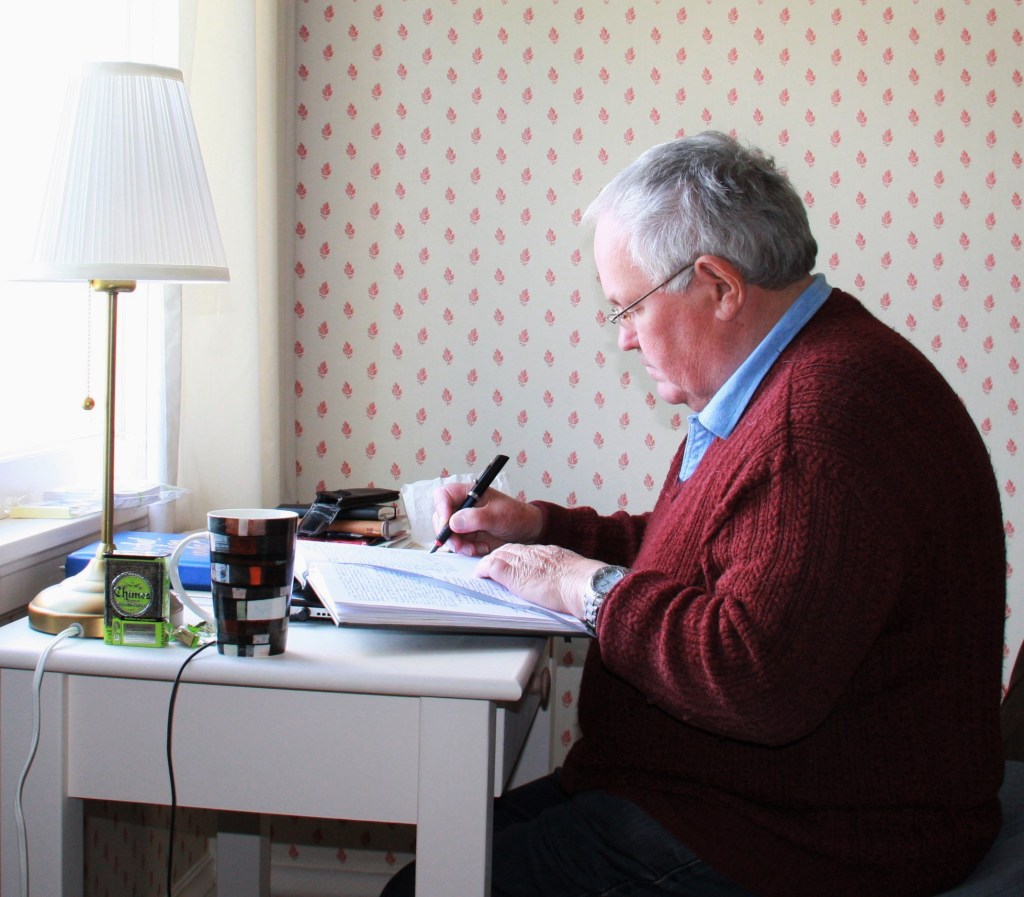
How thoughtful My Lady who placed me here, at this desk, at this window, at this moment of time.
Glorious, this day-break: words no justice can do to peace and light, this early morning, filtering sunlight through the waking mind, relighting the fires within the heart, and glory a word’s throw away outside this window.
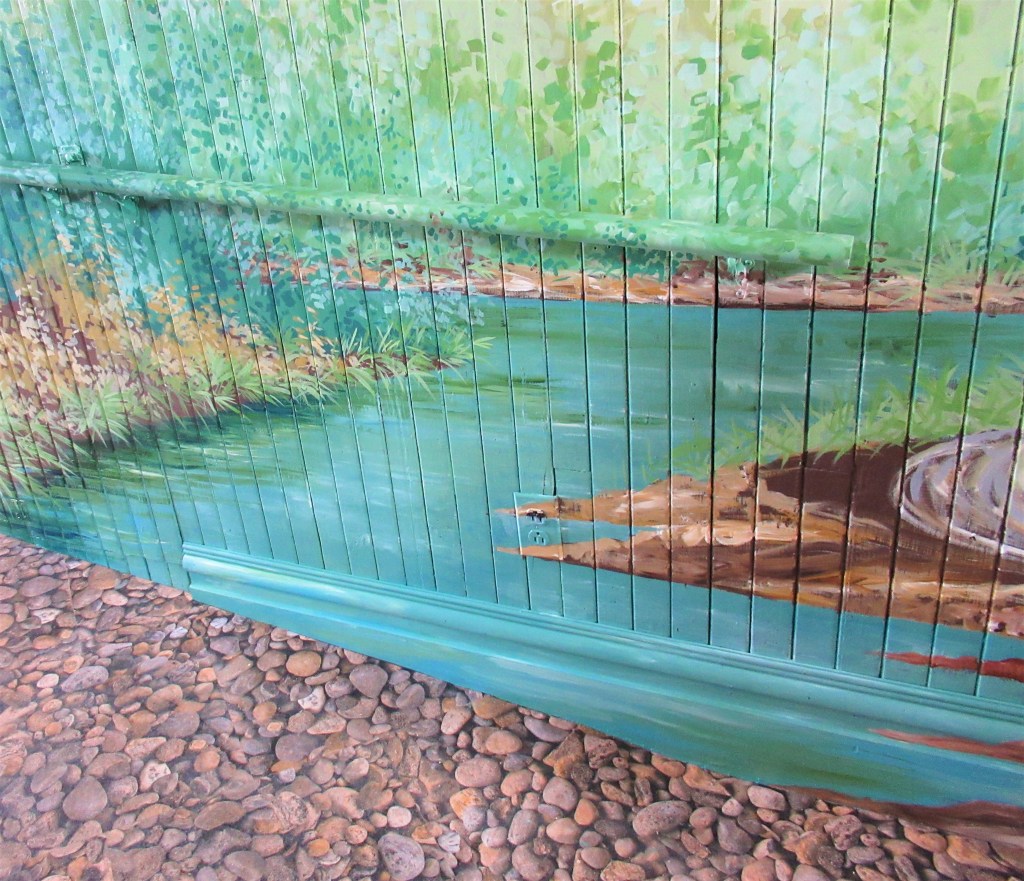
Geoff Slater’s mural at McAdam Railway Station. ‘You cannot step in the same river twice.’ Heraclitus.
Heraclitus
Nothing will ever be as it was before.
Time, like water, like these people marching, constantly flows, trickling through my fingers, uncatchable, unstoppable, sand filtering through the hour glass’ waist.
Water flows, currents shift, rocks wear down, banks slide and fall.
“You cannot walk in the same river twice nor ever attend the same demonstration.”
Nor can you recapture that first, fine, careless rapture, the touch of that first drop of river water.
Kneeling by the river bank, like St. Kevin and his Blackbird, I cannot recall the river’s name.
Comment: I love the reality of the river, its impressionist style of flowing water, impossible without the enormous presence of Claude Monet and his portraits of the Seine. However, what makes the mural, for me, is the brutal reality that breaks into the painting’s unreality. The boards covering the interior wall, the hand rail blended into the painting, the skirting board, the electric socket. I also like the intertextuality: art speaking to poetry, poetry replying to art, the links to Heraclitus, poetry speaking to poetry, the anonymity of the river, and the further poetic links to Robert Browning and Seamus Heaney. I often wonder if readers and viewers pick these things up. Or do they just speed-read, link to their own experiences, and move on with no further thought? You tell me. But what I will tell you is that artists reaches out to art, poets extend their hands to poetry, and our world is an inter-connected maze of thoughts and ideas, linking and unlinking, occurring and re-occurring, lapping like an incoming tide at the fingers and toes we immerse in those amniotic waters, often so long-forgotten, in which our creativity is berthed and from which it is born.
Searching for le mot juste, the exact word that sums it all up, catches the essence of the thing and holds it in the mind forever.
Think flowers. Think scent. Think of the limited ways we describe how daffodils lift and clematis clings.
I look across the breakfast table and see my wife of fifty years, a teenager reborn, walking into that café where we had our first date.
I search my memory and my mind for the words to describe that beauty, that surge of excitement, I still feel when she enters the room:
but find I cannot find le mot juste.
Comment: I shortened this poem from its earlier version. You can click on this link to compare the two versions. I am always puzzled by the dilemma of lengthening or shortening. My thoughts center on the longer and shorter versions of some Raymond Carver stories. Follow the editor’s advice and cut all material down to its essential bones or fill out the skeleton with flesh and blood and expand the creative process further. I also think of the exhortation to ‘stay in the moment’. Anything that takes the reader away from the central experience is superfluous. Experienced writers are aware of that moment and its importance. Writers at my stage are often baffled by it and need to be told yes, this is the moment or no, that is not the moment. I guess the more we write, the more we understand the process. Understand: do we work this out consciously or does it develop in unconscious fashion? Are some people just born with those skills or we must work hard to develop them? Sunt rerum lachrimae: tears are in all things and I guess hard work is all part of the process. As I was told a long time ago: genius is 99% perspiration and 1% inspiration. You have to put in the hard work for that little light bulb to go ‘pop’!
Warm in Bed. Cozy. I roll over and the flashlight clipped to my Teddy Bear’s ear drives its hard, metal lump into my face. “Are you awake?” Teddy’s soft voice lilts across the pillow. “I am now.” “Look!” Teddy points with his little leather paw. “The moon: it’s climbing the fir tree.” Sure enough, a thin fingernail of gold is perched on a branch. It hides its face among the fir’s darkness and vanishes for a moment. “The maple tree has a garland of tiny Christmas lights,” says Teddy, pointing again. “Those aren’t Christmas lights, they’re stars.” “Spoilsport. Look, that one’s moving. I think it’s an angel.” “What time is it, Teddy?” “I don’t know.” “Here, lend me your flashlight.” I pull him towards me, switch on the torch, and focus its light on my wristwatch. “4:55 AM. That’s the early morning flight from Toronto. It’s a plane.” “I’d much rather it was an angel.” “Me too.” “Can we pretend it’s an angel, a Christmas angel?” “Of course we can. But it’s gone now.” “Perhaps angels don’t live long when they come to earth.” “I think they live for ever. Especially if we believe in them.” “Do you believe in angels?” “I was taught to believe in my guardian angel.” “What’s a guardian angel?” “He’s the one who looks after you when you sleep at night.” “But you don’t need a guardian angel. You’ve got me.” “But you’re a teddy bear, not a guardian bear.” “That’s true, but you’ve got Blueberry. He’s your guardian bear. Look at him standing there, on guard, all night long to protect you from the Night-Bumps.” “Ah yes, good old Blueberry. I’ve got a busy day today. I need some more sleep.” “Okay. Blueberry and I will watch over you. I’ll watch over you. I’ll let you know if any more angels climb the tree.” “That would be nice. Now I’m going back to sleep.” “Good night. Or should that be ‘good morning’.” Some days, when I wake up, I think I have dreamed all of this. Other days, I believe in talking teddy bears and angels. Today, I’m not so sure.
Los toros de Guisando, pre-Christian Celtic stone bulls, Avila, Spain.
Invisible Scars
Our minds absorb words as blotting-paper soaks up ink. Phrases carve beehives deep in our inner circuits. No te preocupes / don’t worry. Yet tone and carry are different in each language and the comfort-blanket serenity of note preocupes does not translate easily from Spanish to English. The verbal vibes are just not the same. Nor do the catcalls from the soccer, aimed equally at opponent and referee, and tumbling raucous from the stands where people sit. Shrill whistles sound in the bull ring: a matador who seems afraid to approach this particular bull for reasons only known to him, yet his shakiness visible to all who watch and understand what they are seeing. The Cordobés answers the telephone he places on the bull’s nose, yet fails to approach between the horns and his sword rebounds off bull bone: pincha hueso. Each one wounds, the last one kills. El Viti, stately, graceful, an elderly churchman proud of his vocation and always willing to perform to perfection the weekly ceremony of the sacrifice. The boos when the bull enters the ring, stumbles, and comes up lame and limping. The cheers that accompany the arrival of the seventh bull. The refusal to eat meat that has been slaughtered in the bullring, even though it is advertised outside the butcher’s: tenemos solomillo de toro de lidia / we have tenderloin steaks from fighting bulls. Bulls who have led the best of lives, fed on the tenderest pastures, watered by flowing streams. Bulls grown for slaughter and public sacrifice.
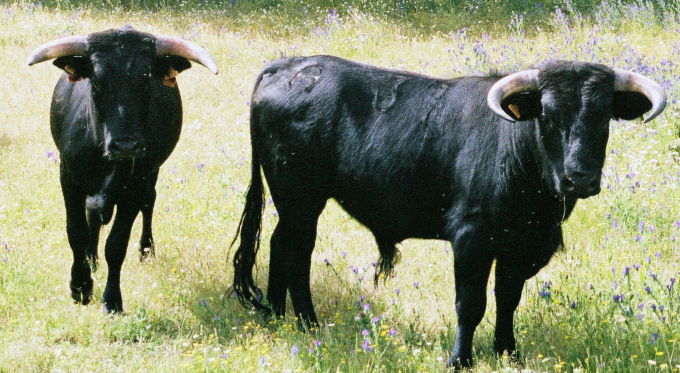
The real thing: young fighting bulls (novillos) on a bull farm in Salamanca, Spain.
Guernica. The bull fight in the sand-filled square. Except it wasn’t a fight, it was more a circus. The slippery pig. The hens and chickens. The rabbits and hares. All the animals running scared. The animals released, one by one, and the spectators jumping into the ring, really a sand-filled square, one by one, and chasing down the animals, taking them home for dinner, if they could catch them. Then the bigger beasts. The mule, ferocious, jumping into the air, kicking four tormentors, one with each leg, and biting a fifth with his teeth. No fearful, clucking chicken this, nor the cow who came after with her padded horns. Participants moved more carefully now. She watched them from her querencia, the where she chose to fight, not die. She knelt, scraped off the rubber balls that covered her horns. Re-armed, she charged and the crowd scattered, all but one young kid, caught, falling to the ground, the cow standing over him, ready to gore again. Sixteen years old, an outsider, I jumped with others over the barrier, twisted this away and that, thumped the cow’s side, smelled her fury, her fear, the whole soured being that emanated from her. Together, we hustled her, bustled her, dragged her kicking, butting, from the ring, backwards, pulled by the tail. Visible scars of damaged animals. Scars of the participants. That young man who broke his leg. That old man, inebriated, stuffed with food and drink, who loosened his belt to move more freely. We watched as his pants slipped from his waist to fall around his knees and trap him, just as the cow charged. He survived but will bear the scars forever, some visible, many not. Long summer days, on the Sardinero, the Segunda Playa, playing soccer. Different rules, different skills, different swear words: I carry a dictionary tucked into my bathing trunks and refuse to play while I look up the words spat at me by my opponent. Good heavens, I think, is that anatomically possible? The ball bounces away on the hard, sand ridges. I chase it and steadily dehydrate under the hot sun. A sea-salt wind desiccates my body. My mouth fills with salt water when I swim out to retrieve the ball from the sparkling sea. My tongue sticks to the inside of my mouth. When I spit, I spit dry and everyone laughs. Now I am totally dry, shiver, and no longer sweat. On the way home, we get off the trolleybus early, at Jesús del Monasterio and enter the long string of bars that lead past Numancia towards Perines. Red wine in glasses, in porrones, with tapas and raciones to soak up the alcohol, morcilla, mariscos, callos, patatas bravas, wine consumed until our blotting-paper bodies are ready once more to sweat. Bread soaks up the wine that relieves the oil that now filters through our skins and who needs suntan lotion when the oil is inside us and bodies are oiled, well-oiled, from the inside out? These excursions are all male, just like the soccer teams. I have four friends and I know them by their nicknames and the way they play soccer. I also know them from the way they try to trick me and laugh at my mistakes, or the way they treat me as a human being and help me to understand this new world into which, sink or swim, I have been thrust. Total immersion in another culture does not come with a set of instructions and the rules of soccer change from grass field to beach sand. Pedro plays centre-half, loves heading the ball, even when it’s laden with sand. I watch him playing field hockey one day, out at La Albericia, and when a low shot heads for the corner of the goal, he dives and heads it away. They carry him off on a stretcher, blood everywhere, and you wonder if his scars will ever heal. Tennis on the clay courts, also at La Albericia. I play so slow but they play so fast. I learn top spin, side spin, back spin, cutting the racket beneath the ball and learning to bend it sideways off the clay that is not clay really, but a fine-packed Italian sand on which I can slide and glide, and commit to a shot running one way then turn and commit to another in the opposite direction. I try it on a hard court, after the immersion period ends, when I get home, and my foot sticks on the tarmac (or whatever that hard, non-slip surface is) and over I go, skinning my knees, creating more scars.
Comment: Another Golden Oldie reclaimed from the reject file. I remember the scenes so well, even though I have moved deliberately in the piece from Elanchove and Guernica (Basque Country) to Santander (now Cantabria). I got lucky and was able to attend a series of workshops on memoirs run by Brian Henry of Quick Brown Fox. Taking his workshops, I realized that most of what I write is more akin to Creative Non-Fiction (CNF), rather then memoir, though much of what I write is rooted in memory. What thrills me in this style of writing is the rhythm that emerges, the word patterns I knit with my pen and a skein of ink, the remembered brightness of the Spanish sun, the sparkle of the waves, the warmth of a people, still grieving after their losses in a bitter civil war, their willingness to accept me, a foreigner, and take me to their hearts. The Other: we talk so much about The Other. But when we ourselves have been That Other, have been dependent on Other Others for food, drink, warmth, care, and love it is so much easier to understand what The Other is lacking and what we can give. Warmth, not scars; a hug, not a punch; open arms, not a fist… so easy to say. I have been there. I know. But can we, deep in our hearts, find it in ourselves to make the sacrifices for The Other that other others have made for us? Only time will tell.




 rogermoorepoet