If you won two free plane tickets, where would you go?

Daily writing prompt
If you won two free plane tickets, where would you go?

If you won two free plane tickets, where would you go?

Wrong question – because I wouldn’t go anywhere. Now, I’ll ask the right question: If I won two free plane tickets, what would I do with them? That I can answer.

I am no longer a willing traveler. Even a trip into town to go shopping is too much some days. So, I wouldn’t use them, but I would look for someone who could. But before that, a question – are these single tickets – you go there and have to stay there or else pay your own way home? Or are they return tickets, there and back and again, or as they say in Spain, ida y vuelta? If they are the former, I have a couple of people in mind that I would bundle off to the other end of the planet and leave them there, stranded. If they were return tickets, then other options are family.

My Canadian family: a free trip home during these difficult financial times would be excellent. I guess that would be my first choice. But I have family in faraway place, with strange sounding names, and maybe my Australian family would enjoy a trip to Canada to visit me. Or else a trip back home to Wales where there’s always a welcome for the prodigals that return. And what if the family weren’t interested?

Then I would advertise the tickets for a local family that needed free travel for health purposes or family visits. If nobody came forward, I would raffle them or auction them, and give the proceeds to one of my favorite charities, the women’s shelter or the local food bank.

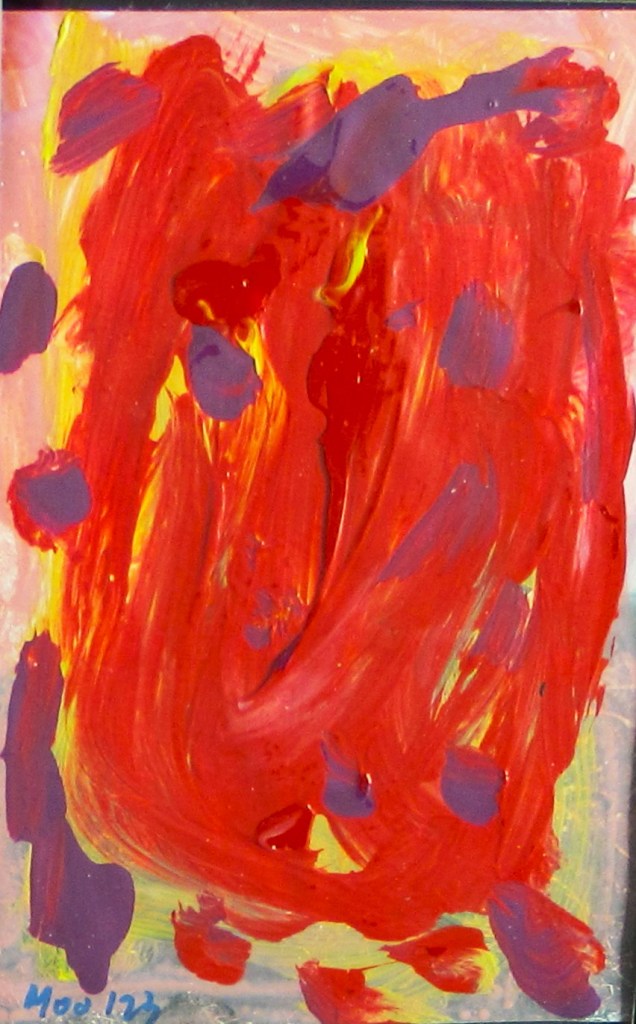
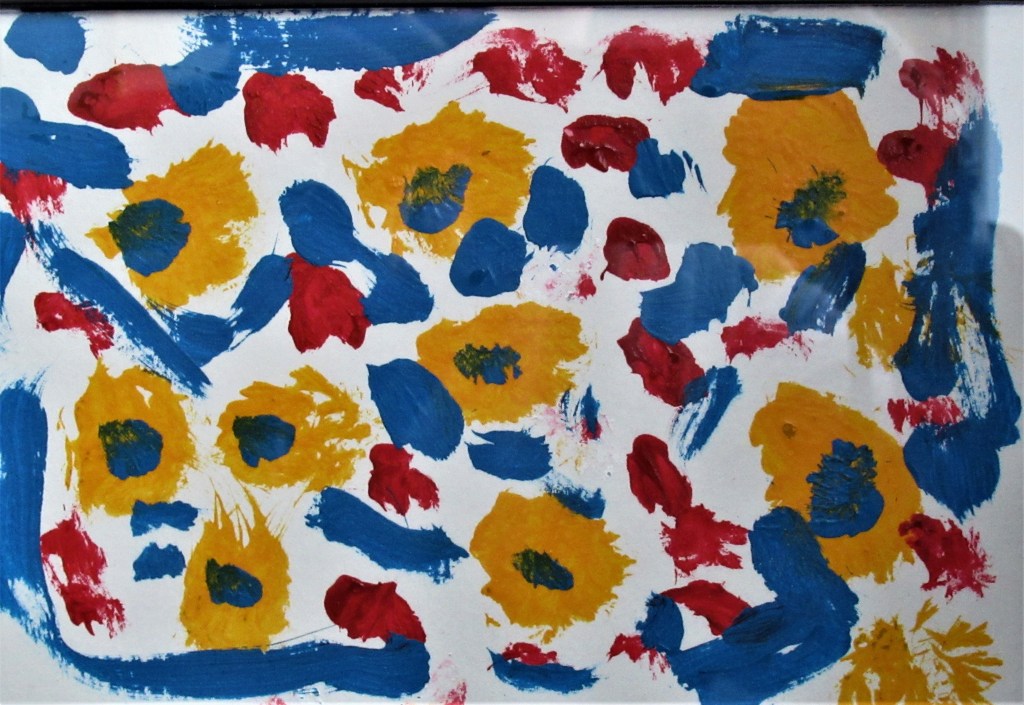
And there you have it. Meanwhile, courtesy of Moo, my favorite artist, the little green man goes sailing through the air in the painting above, flying into the sunset, and enjoying every minute of it.

What’s the story behind your nickname?

Daily writing prompt
What’s the story behind your nickname?

What’s the story behind your nickname?

A long time ago, while Franco was still alive, we lived in Spain, where I was researching my doctoral thesis. Our two bedroom apartment did not have washing facilities for dirty clothes other than a hand wash in the basin and a pegging out on a clothes line outside the bathroom window, that gave on to an inner courtyard. A very good friend suggested we take our dirty washing to her local laundry. The custom in Spain, at that time, was to print in black ink as much of the name of the customer on each item of clothing as was necessary for the clothes to be recognized.

We handed our dirty washing over early one morning and the receptionist told us it would be ready later that afternoon. When we returned, a neatly wrapped parcel of brownish-pink paper, all tied up with colored string, awaited us. We paid our laundry bill, picked up the parcel, and carried it home.

When we got there Clare opened the parcel. Everything smelt clean and the clothes, hers and mine, positively glowed. They were all very carefully folded. Clare picked up the top item, a pair of my Y-front underpants, held it up, and started to laugh. When I asked her why she was laughing, she pointed to the three black letters that distinguished our clothing from anybody else’s in that city – MOO. “Oh Moo,!” she said. And I have been called Moo ever since. And that s why my paintings bear that name – Moo. Oh yes, the above painting is a self-portrait of Moo. Look closely and you may just be able to see him in there. Clare, by the way, is now known, within our family, as Mrs. Moo.

PS – Please don’t tell this story to anyone else. We wouldn’t want everyone to know about it.

What strategies do you use to maintain your health and well-being?

Daily writing prompt
What strategies do you use to maintain your health and well-being?

What strategies do you use to maintain your health and well-being?

Covid changed the world and my outlook on the world. Since the first rumors in 2019, I cut my own hair and stopped eating out. I avoided crowds, left home as little as possible, wore a mask everywhere, and maintained as much distance as possible between myself and other people. I stopped inviting people around to the house, and, as a result, we have hardly had a visit or a visitor in the last four years. We got regular shots and boosters. So far, with those precautions and a little bit of luck, we have avoided Covid.

My health care deteriorated during the Covid period. I had very few visits to my GP’s office, and most business, like prescription renewal, was done over the phone. Consultations were by telephone as well. I missed out on the regular blood tests that my urologist / oncologist had been scheduling for me, after a bout with prostate cancer. These picked up again in late 2021, and were resumed in 2022 and 2023. Things seem to be moving well currently. Thank heavens.

I interpret well-being as my state of mind, rather than my state of body. I would say that my well-being suffered from my lack of human contact, although I have slowly developed a series of online support groups. In this way, I was able to continue my writing, for example, in Zoom sessions. I also missed my family visits. I no longer travel well, and due to Covid restrictions, I did not see my daughter or my granddaughter from 2019 to 2022. Clearly, we all missed the family closeness and we were all affected. However, we are used to isolation from family. Boarding schools, travel abroad in the summer, emigration to Canada, saw our family connections broken. That said, the advent of social media, Skype, Zoom, Messenger, texting, free phone calls, have all lessened the miles between us and maintained a contact that we never had, post migration, with our parents and grandparents, and extended family. The isolation and loneliness have been hard. They are hard upon all ageing, isolated people. We have suffered less than most.

As for strategies, I really have only three: 1. to adapt 2. to survive 3. to create beauty via my writing and my painting. Painting, prose, and poetry – these I can share with my friends. Vita brevis, ars longa – life is short, but art endures. Pax amorque – peace and love.

Listen!

Listen

When I cannot write,
I take a paint brush,
and start to paint.

When I paint, I listen
to the brush as it moves
itself over the canvas.
I listen to the colors
as they demand attention
and tell me where to place them.

I listen to the paint as it says
‘just here, not too thick,
not too thin, a swirl please,
gently now.”

I also listen to flowers, trees,
the wind in the willows,
the songs of falling leaves,
and the voices of birds
that mourn their empty nests,
abandoned on the branches.

Comment:

This poem also came from yesterday’s prompt – what do you listen to? The act of ranting, based on a prompt, usually generates imagery and ideas that can then be used in either poetry or prose. For me, the secret is to cut away the dross and to search for the gems that are often hidden within verbal outpour. This leads, in my opinion, to enhanced creativity.

Voices

Voices

I forced my characters
into the roles that I chose for them.
Sometimes they complained
and refused to obey me.

Late one night, they came
and knocked on the window
that opens in my head when I dream.

They started to complain
about how I was treating them
and demanded that I change my ways.

I listened as they yapped, and yammered,
and strewed their growing pains
on the counterpane before me.

When I woke up, I remembered
what they had told me and I wrote
down their stories in their words, not mine.
Then they came to life and spoke through me.

Comment:
This poem and the next one both came from yesterday’s prompt – what do you listen to? The act of ranting, based on a prompt, often generates imagery that can then be used in either poetry or prose. The secret is to cut away the dross and find the gems that are often hidden within the rant. This leads, in my opinion, to enhanced creativity.

What do you listen to while you work?

Daily writing prompt
What do you listen to while you work?

What do you listen to while you work?

While I was actually working, although I never called it work, because I thought of it as a vocation, I listened to the complaints of the administration (often about my way of work). I also listened to my students (all too often their complaints about the system and the way they were being taught and treated). And then I listened to the problems that were daily laid before me in my office by these same students. These, problems and students, were many and varied. One day, I designed a label for my door that announced: Office of Creative Solutions. And yes, I provided many innovative and creative solutions to problems that, to young people, especially my students, seemed almost impossible to resolve.

Then I retired. At least, like an ageing horse, or an unwanted donkey, I was put out to grass. And in that clover-filled meadow, I grazed at leisure and worked no more. But I did have time to write and so I became a creative writer. At first, when I started creative writing, I forced my characters into the roles that I had chosen for them. Sometimes they complained. Then, one day, or maybe it was one night when I was dreaming, a host of my characters, minor and major, came knocking on my door. They carried a big arrow that had, written upon it, Office of Creative Solutions. They pointed it at me and began to complain about how I was treating them. I remembered the poem I had memorized as a child – The owl, he was a wise old bird, the more he spoke, the less he heard. The less he spoke, the more he heard. There never was such a wise old bird.

I remembered how I had listened to my students and how, by listening, I managed to find creative solutions to their problems. So, I listened to those characters as they yammered away. One by one, they told me their woes, and their problems. Then, the following day, I rewrote everything I had written previously and wrote the stories down in their own words, instead of mine. When I listened to them, I allowed my characters to tell their own stories, and to speak for me and through me.

Sometimes, when I run out of voices that come in the night and tell me what to say, I cannot write. Then I take a paint brush, and I start to paint. What do I listen to when I paint? I listen to the brush as it moves itself over the canvas. I listen to the colors as they demand attention and tell me where to place them. I listen to the paint as it says ‘just here, not too thick, not too thin, a swirl please, gently now.”

Now, when I am not working, I listen to flowers, trees, the wind in the willows, the songs of the falling leaves, and the voices of birds.

My Go To Comfort Food

Daily writing prompt
What’s your go-to comfort food?

What’s my go to comfort food?

Sorry, people. I do not have a ‘go to comfort food’. When I need that comforting feeling I do three things.

1. I fast. That is to say, I go without food. I feel more comfortable and comforted on an empty stomach, rather than a full one. I know that many people like to sit down and ‘stuff’ themselves, but, sorry, I am not one of those.

2. I rant. Especially if I need comforting for something that upsets me. Then I sit down at my desk, open my note book, and let the feelings flow out with the ink. I will use different color inks for different feelings – purple, green, antique copper (given to me by one of my best friends) – and different pens with different nibs. I have Extra Fine, Fine, Medium, Broad, and three types of italic nibs – fine, medium, broad. Yup – a ‘comfort rant’ is just as good as a ‘comfort food’, if not better.

3. I paint. I actually find painting under stress is easier and more comforting than the verbal rant. The rant focuses on the source of the problem, while the painting – choice of theme and color – allows me to escape into another world, the alternative universe of visual creativity.

I must admit that I try and avoid TV as an escape. I do follow the cricket, though. England versus Australia, in the Ashes, and the day’s play rained out. Well, the MCC members will be seeking the solace of their comforting prawn sandwiches, but I take my pen and rant about the folly of selecting out of form players, just returning from injury, and continuing with them in an act of faith and belief that confirms the joys of ‘jolly good fellows’ and ‘mock brotherhood’ – we few, we happy few, we band of brothers – Henry the Fifth – while blaming the inevitable defeat upon the weather, the windy old weather, the rainy old weather, not on the eleven lost cricketers unable to pull together.

Great rant, that one. Now I do feel hungry. I wonder what comfort food I might find in the fridge?

What’s your favorite [card] game?

Daily writing prompt
What’s your favorite game (card, board, video, etc.)? Why?

What’s your favorite [card] game?

Well, it’s so easy to get bored with board games, so my favorite card game is sending and receiving e-cards for all sorts of occasions. Costs nothing, other than the initial membership / subscription fee, arrives almost instantly, often elicits an unexpected response, keeps me in touch with my friends all over the world, no quarreling over who is winning or losing, because when card and reply arrive, we are all winners, and there is very little lost in the post, like those letters that are still turning up from the WWI trenches. Missing, believed lost in action, didn’t refer only to those poor souls who strayed into no man’s land and never returned.

And let’s go back to counting the costs for a moment. While I love real cards sent by mail, and I just love opening them and reading well-known hand-writing, there is something incredibly sapping about the rising cost of stamps. the ever-longer delivery delays, the enormous rise in the cost of the card itself.

And the delivery delays? Well, I sent myself a card, the other day, by the old-fashioned method. It took nearly ten days to arrive. I think that it was sent by a slow sled driven by half-starved, rebellious huskies, to the north pole, and back, possibly via one or all of the -lands – Greenland, Iceland, Ireland, or Newfoundland. Two of those places I have visited, which, by a simple sum of subtraction, means that there is at least one that I haven’t. Oh dear. I was never very good at maths or math or mathematics, or spelling either by the look of it.

And the one really unbeatable thing about playing the game of sending e-cards by e-mail: you never have to lick the banana flavoured gum on those horrible envelopes. Remember that taste? Now gone forever, though the taste lingers on in my memory.

One Small Corner

One Small Corner

 And this is the good thing,
to find your one small corner
and to have your one small candle,
then to light it, and leave it burning
its sharp bright hole in the night.

 Around you, the walls you constructed;
inside, the reduced space, the secret garden,
the Holy of Holies where roses grow
and no cold wind disturbs you.

 “Is it over here?” you ask: “Or over here?”
If you do not know, I cannot tell you.

But I will say this: turning a corner one day
you will suddenly know
that you have found a perfection
that you will seek again, in vain,
for the rest of your life.

Comment: This is the title poem of the book One Small Corner – A Kingsbrae Chronicle, written at the first Kingsbrae International Residences for Artists (July, 2017), and published on Amazon – Kindle that same year. This is the video that accompanies the poem. https://www.kingsbraeartscentre.com/ – turn up your sound. My thanks to all those involved in that first residency and especially to Mrs. Lucinda Flemer, Geoff Slater, and my fellow resident artists, Ruby Allan, Carlos Carty, Elise Muller, and Ann Wright. One Small Corner, along with some other publications, can be found by clicking here. Special thanks for the making of the video itself go out to Geoff Slater, Jeff Lively, and Cameron Lively.

Ghost Train

Ghost Train

I remember the little electric railway
that ran on a single loop around
the kitchen table, diddly-da-diddly-da,
just like a real train, except no smoke,
no puff the magic dragon, no sense
of a schedule or arriving and departing
when circular time is meaningless,
as are the numbers on the sundial
when the sun isn’t shining,
or the hands on the clock’s blank face
when the numbers are missing,
and you don’t know whether you are
looking in time’s distorting mirror
or are standing on your head
in the Antipodes, and all the while
the clock hands are marching round
and round, tick-tock, and there is
no track by which time can be tracked.

And the runaway hands go round the track,
and the electric train goes round the table,
 and the ghost train hoots whoo-hoo,
as it vanishes into the timeless tunnel,
then exits, the engineer, like Rip Van Winkle,
grown old with a long beard, and the carriages
all covered with cobwebs, and skeletons
leaping out of the compartments,
then sitting beside the travellers
as they snore on their seats.

Comment: Another poem based on a prose prompt. What a great source for poetry those prompts can be, when you don’t take them too seriously and allow your imagination to run riot and your memories to flow. Not automatic writing, but writing that springs from an absurd, surrealist approach to the crazy world that surrounds us. Rain that causes the yucca plant to grow, then falls so hard that it is battered to the ground by the very thing that gave it life. And so it is with my memories of the many trains on which I have travelled and with which I have played. Once upon a time, I couldn’t conceive of life without the railway. Where is it now? I haven’t been on a train for more than fifteen years. Strange how their ghosts flit through my dreams at night: fast trains, slow trains, the wrong train at the wrong time taking me to the wrong place in time. Ah, the poetry of trains yet, “ni temps passés ni les trains reviennent.” And you can give yourself a glow of satisfaction – thank you Tommy Reed – if you recognize the quote, and two more if you know who Tommy Reed is. I use the present tense because, although long gone, he is ever-present in my mind.

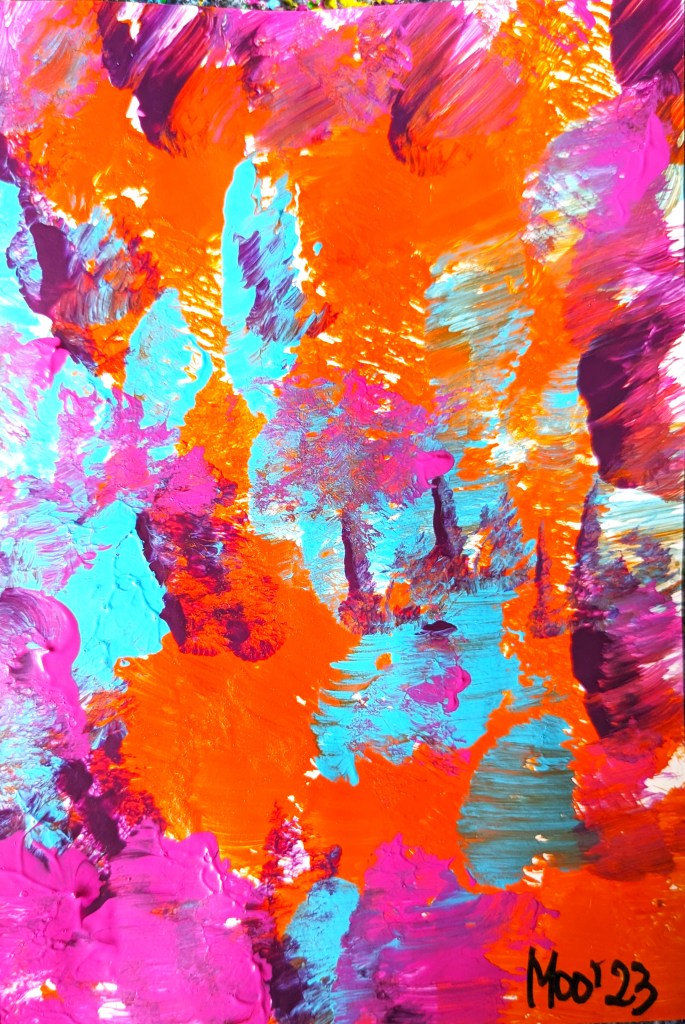
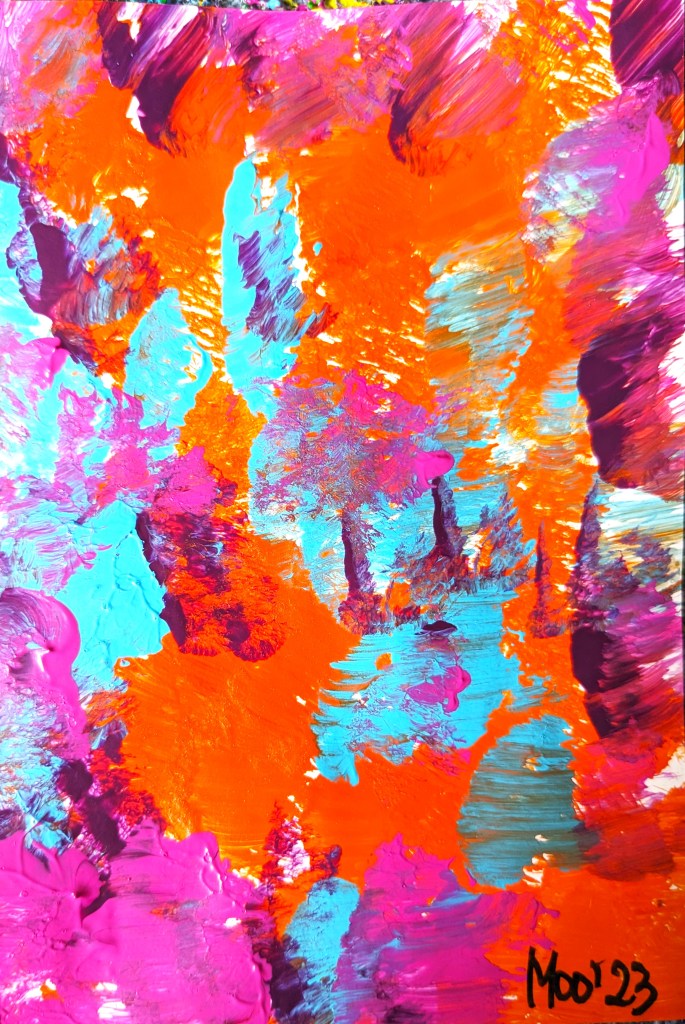
Today’s painting – another gift from my friend Moo.