Share what you know about the year you were born.

Daily writing prompt
Share what you know about the year you were born.

Share what you know about the year you were born.

How much does anyone know about the year when they were born? When do childhood memories begin? What do we really know about those early days, those first surroundings, the family, the friends? I only know what I have been told – and not all of it is pleasant. Here for example is the song my grandfather used to sing to me when I was a very young child.

“I’ll never forget the day, the day that you were born.
They took you to your father and he looked at you with scorn.
Said he, ‘if that’s his face, the best thing you can do,
is stick a tail the other end and take him to the zoo.'”

I don’t remember what I looked like, acted like, or sounded like. I don’t remember much at all. But I have never forgotten that song with its innate cruelty. Oh yes, people laughed and pointed. Maybe you did too. But is it really funny? And what if your only childhood memory is a sense of being unwanted, rejected, left on the shelf, sent to the zoo… ? “Little boys should be seen and not heard.” Another piece of wisdom from the ancients.

Mind you, I have heard stories, and written them. Here’s one.

The Stork

My story almost didn’t begin in Number One, the first house that I recall from Gower, Wales. My mother gave life to me, a very long time ago, in the middle of a frost-bound winter in that land now distant in time and space. Yet begin it did just as the clock struck eight, that Sunday evening, in January, mis Iawnor. I know this is meant to be my story but the beginnings are swathed in a misty past that tells of a lack of awareness, a search for the meaning of shape, color, and form, the realization, however slow, of the need for language, words, a map, a direction, a slow growth of the seed from baby hood to boyhood, to manhood, and beyond.
 My parents told me I was flown in by a meandering stork that just happened to pass by our house at eight o’clock that night. I don’t remember much about the flight, although I have always dreamed of tumbling through that sky-blue air, only to be trapped at the last moment, my hips and legs caught in a vice that squeezed and squeezed until I could no longer breathe. This nightmare haunted me for years. All through my childhood, I climbed through ever narrowing tunnels and caves until I was trapped, struggling, suffocating, trying to get out. Many times, I would wake myself up with my own panicked screams. The twin holes in my temples, marks made by the doctor’s forceps, remind me to this day of the last stages of that journey.

Our dog, a black Labrador called Paddy, after St. Patrick, of course, and all the Paddies who worked the Paddy fields in Ireland and Wales, had been exiled to a neighbor’s house until after … after what? After the delivery? Were they afraid the dog might frighten away the stork? Who knows what they thought back then? In Galicia they still throw stones at storks to keep them from bringing babies to houses. It’s cheaper than contraception, which is illegal there anyway. When the clock struck eight, Paddy, curious and maybe jealous, turned herself into a stone, threw herself through the neighbour’s front bay window, and rushed home barking. The stork, scared by the noise, dropped me, plop, right down the chimney, and when the doctor held me upside down by the heels and slapped me, I started to scream.
How do I know all this? I don’t. I merely repeat what I’ve been told. Simpletons at heart, poets and babies believe so many things, myths and legends, fairy tales, tall stories, the stories of storks … can you tell talk from mutter, or Stork* from Butter as the TV ads used to ask? I know I can’t. But this is my tale to tell, even though I don’t know how it began (Alpha) nor how it will end (Omega). So many mysteries hide behind thick curtains of mist that conceal both the future and the dimly remembered past, a past that we often reconstruct while calling it ‘memory’.

*Stork: a brand of margarine that the tv ads said “tasted just like butter”. Hence: “Can you tell Stork from butter?”

Change

1

Change

Waters rise, tides get higher,
streams wash roads away.
grey, rainy skies, day after day.

Temperatures drop down at night.
Water turns to ice. Northern Lights
burn bright, set the sky alight.

I forget my gloves. Fingers, cold,
fumble at buttons, and my zip
is not the easy zip of old.

My life cries out for change,
but change is out of reach.
I change the things I can arrange.

Some days I’m weary and sore.
Most days I can do no more.

2

Change

Waters rise, tides get higher,
streams wash roads away.
Grey, rainy skies, day after day.

Temperatures drop down at night.
Water turns to ice. Northern Lights
burn bright, setting the sky alight.

I forget my gloves. Fingers, cold,
fumble at buttons, and my zip
is not the easy zipper of old.

Some days I’m weary and sore.
Most days I can do no more.

My life cries out for change,
but most changes are out of reach.
I change the things I can arrange.

Comment:

I decided to change my format today and go back to the left margin alignment, rather than the central alignment that I usually use for poetry. Your comments on the adjustment would be welcome. I have included both formats so you can see how the poem flows in each one. As for this poem – a rhyming sonnet, wow!

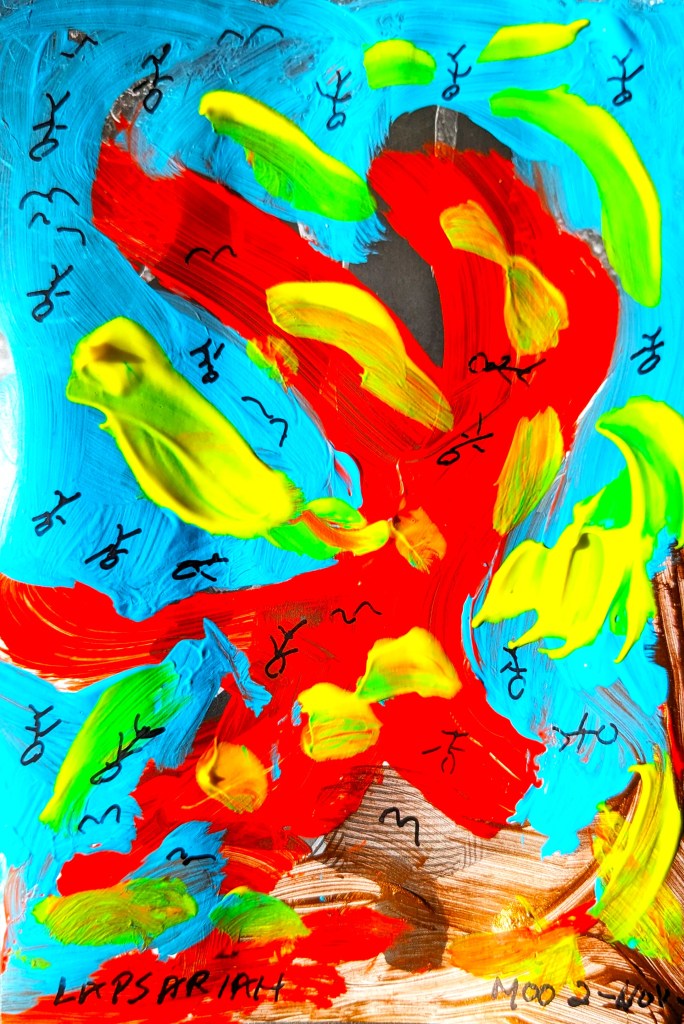
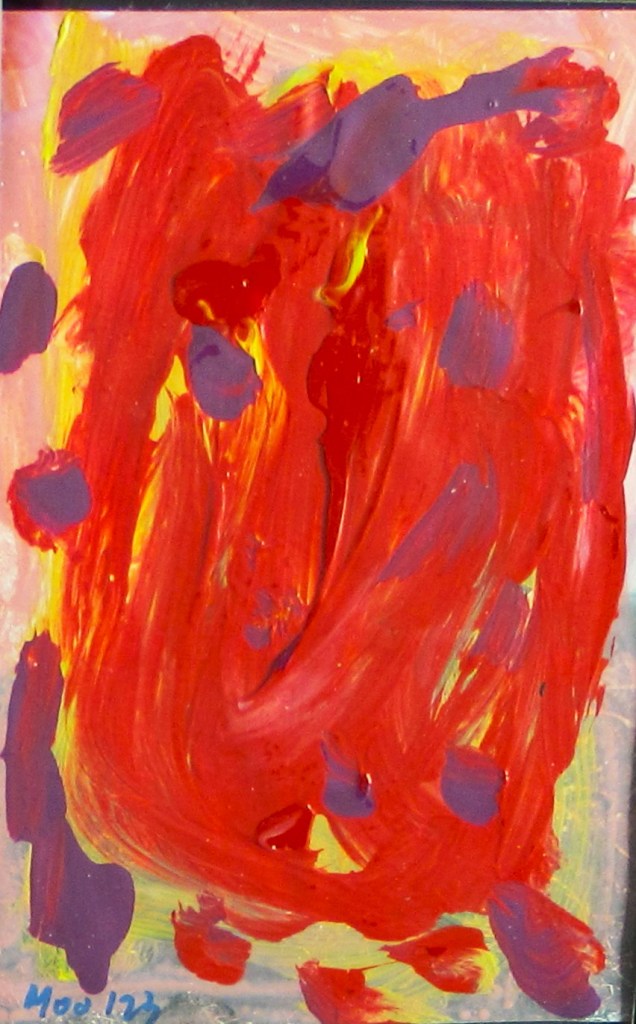
Moo’s painting, executed late last night, is his way of showing how rage can suddenly build and, like a runaway river, suddenly and unstoppably break out. It is extraordinary how his paintings so often mirror my moods and word flows.

Tell us about your first day at something — school

Daily writing prompt
Tell us about your first day at something — school, work, as a parent, etc.

Tell us about your first day at something — school

My father held my hand all the way to the convent. I wiggled, squirmed, dug in my heels, but it did me no good. Too firm, his grip, too determined his grim, muscled chin. When we arrived, he dragged me up the gravel path leading to the stark, red-brick building, and jangled the bell that hung from an iron clasp. He kept a tight hold of my hand as the bell’s echoes faded away into the interior corridors. A tapping of feet, and the wooden door opened just enough to let a small, four-year old boy in. My father pushed me through that gap. I turned to wave good-bye, only to see his back as he walked rapidly down the drive.
            “Come along, child, we’ve been expecting you,” a figure in flowing black robes with a white wimple framing her face emerged from the shadows.     The nun closed the door and banished the sunlight. “Welcome,” she said. “Wipe your feet.”
            “It’s not raining. My shoes are clean.”
            “When you enter this convent, you do as you are told. Wipe your feet. Blow your nose and dry your eyes. You should be ashamed: crying at your age.”
            A rough brown coconut mat lay by the door. I stood on it and moved my feet backwards and forwards, sniveling as I did so.
            “Now follow me.”
            The nun walked down the shadowy corridor, her leather sandals flip-flapping against the polished wood floor. The scent from the highly waxed boards rose up and flooded my nostrils. I looked down to see my face distorted by the floor’s polished woodgrains.
            We approached a classroom from which a babble of young voices echoed down the corridor. The nun opened the door and all chatter stopped. She led me to an empty seat on a wooden bench and there I sat. The nun went to the teacher’s desk in front of the class.
            “Class: you will all stand. I ordered you to be silent in my absence. You were talking when I opened the door. Who started the talking?”
            My new classmates stared silently at their feet.
            “I heard voices, many voices. Who started talking? Was it you? You? You?” She stabbed her finger at the class. Nobody said a word and nobody moved. “Will someone tell me who was the first to disobey my orders?”
            Silence.
            “Then I shall punish you all. You will kneel on the floor. You will raise your arms to shoulder height. Like this.” The nun imitated the arms of Christ as he hung from the Cross. “You will recite ten Hail Mary’s,” she turned to me. “Your new classmate will count them. His name will now be Joseph, a good Catholic name that will help him establish his convent identity. Joseph: you may stand, not kneel. Class, begin.”
            The piping of shrill voices chorusing a prayer filled the room.

I looked at the girls as they knelt there, arms out, all dressed alike, and I realized that I was the only boy in this particular class.

Do you have a favorite place you have visited? Where is it?

Daily writing prompt
Do you have a favorite place you have visited? Where is it?

Do you have a favorite place you have visited? Where is it?

Just one place? So difficult to choose. I have been very lucky in my travels. I haven’t gone far, but I have tried to go deep, returning to the same places again and again. One place I often visited was St. Luce-sur-Mer in Quebec. It is a wonderful little town on the banks of the St. Lawrence River. The sunsets are sheer marvels and the views of the Northern Lights across the bay are just outstanding. Site of the wreck of the Empress of Ireland, it is filled with mystery and memories, as is the nearby Rimouski. Ste. Luce sur Mer would be my third choice.

Oaxaca, Mexico, would be my second choice. The city itself, capital of the state, is packed with history. I taught there for a couple of weeks (maximum six) every year from 1995-2001 and every time I returned I found something different and more mysterious. The dancing and music in the capital, the cascades of fireworks flowing down the facade of a church, the Christmas Cribs that grew day by day as people added to them, the incredible food, and above all the people – dancing in the Zocalo on Sundays to the music of the State Orchestra, crowding the markets with color, and the markets themselves, the scents of peppers, coffee, chocolate – to visit Oaxaca, in those days, was to visit the heart of Mexico. Imagine sitting beneath the tree that Hernan Cortes had sat beneath when he visited Oaxaca just after the Conquest of Mexico City – Tenochtitlan – and talked to the Mixtecs and Zapotecs of the Oaxaca Valley. And the codices – wonderful – I cannot say enough in praise of Oaxaca.

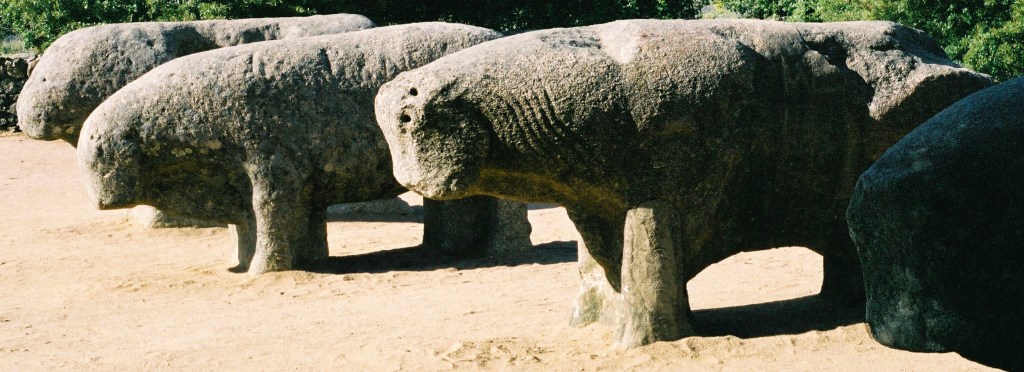
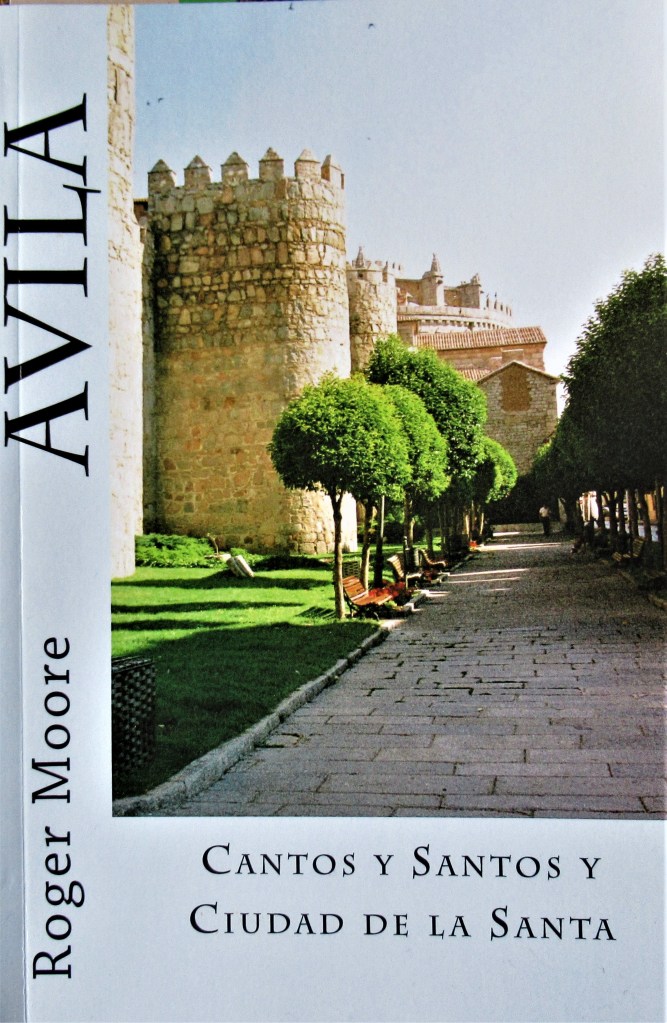
My number one choice: Avila. The lead photo shows the Toros de Guisando. Pre-dating Christianity, these four stone bulls – verracos – were often used as boundary markers by the Vettones who lived there before the Romans. One of these four bulls bears, carved into its side, the marks of one of the Roman Legions that passed this way. The countryside around Avila has to be seen to be believed. The walled city itself is a wonderland – three kilometres of walls, 9 gateways, a Cathedral that shows an enterprising mixture of styles, museums, libraries, squares, and a welcoming people who make you one of the family. I visited here for four summers, 2005-2008, staying for between 6 and 8 weeks on each visit, and always residing in the same place, El Rincon, close by the Mercado Chico.

My Knapsack

My Knapsack

Throughout my childhood,
I carried a knapsack on my back.
Into it I stuffed my darkest secrets.
Along with all my dirty washing
they filled every cranny and nook.

Words of hate, carved into my life-slate,
shuffled and cut, but unchanged,
unchangeable, remained engraved
on the tombstone I took from above
 the hole I dug to bury the casket
in which I hid the shards of my heart.

On a rainy day, when push came
to shove, I left my childhood home
to wander the world, alone, on my own.

I walked to the station, boarded a train
and never went back home again.

At journey’s end, I left my knapsack
and its contents in the luggage rack.
I never want to see them again.

Comment:
“Pack up your troubles in your old kit bag, and smile, smile, smile.” My maternal grandfather used to sing me this song from WWI. “While you’ve a Lucifer to light you fag, smile, boys, that’s the style.” I wonder how many people now remember what a Lucifer is, let alone a ‘fag’, in that sense of the word. It has, of course, morphed into many other meanings, some of them not necessarily pleasant. I remember my grandfather, standing in the kitchen, before the coal fire, and saying “I remember when Wills’ Woodbines were a penny a packet.” Wills’ is still with us, but may not be for much longer. I can’t remember when I last saw a Woodbine. I certainly never smoked one, in fact, I never ever smoked at all. But as for that kit bag aka knapsack aka backpack aka rucksack, well, put all your troubles in it, tie them up tight, and take it somewhere safe where you can leave it and forget about it, and then start life again. “Good-bye old friend, I am on the mend. And that’s the end.”

As for the painting, by my good friend Moo, that shows The Fall – Pre-Lapsarian / Post-Lapsarian – when all the devils, demons, and black angels were tumbled out of Paradise and abandoned to the depths below, where, alas, they still roam. So, if you meet any of them along the way, shove them in that old kit bag and get rid of them too. You’ll feel much better afterwards.

The Banks of the Seine

Banks of the Seine

Gnawing at the carcass of an old song,
my mind, a mindless dog, chasing its tail,
turning in circles, snapping at the fragment
of its own flesh, flag-flourished before it,
tournons, tournons, tournons toujours,
as Apollinaire phrased it, on a day
when I went dogless, walking on a mind-leash
before the Parisian bouquinistes who sold,
along the banks of the Seine, such tempting
merchandise, and me, hands in pockets,
penniless, tempted beyond measure,
by words, set out on pages, wondrous,
pages that, hands free, I turned, and turned,
plucking words, here and there, like a sparrow,
or a pigeon, picks at the crumbs thrown away
by pitying tramps, kings, fallen from chariots,
as Eluard wrote, and me, a pauper among riches,
an Oliver Twist, rising from my trance, hands out,
pleading, “Please, sir, can I have some more?”

Comment:
This is a fusion / confusion, if you like, of The Kingston Trio’s song – The Seine – with a quote each from Guillaume Apollinaire – Alcools – and Paul Eluard – Il ne m’est Paris que d’Elsa, and Francisco de Quevedo’s – El Buscon – and a tip of the old chapeau nouveau to R. S. Thomas and Charles Dickens. Fools rush in, I am afraid, where angels fear to tread. Go on. Rush right in. Sort it all out. I double-dog dare you – and thank you for that one, Jude.

Dark

Dark

The lights went out suddenly,
leaving me in the dark.
A cloudy night, not a spark
of starlight to light my way.

My search for candles was slow.
I found them, struck matches,
and sat at the table watching
light catch and flames glow.

A war baby – bombs, blackout
curtains, diminished light, all
are present in my DNA, and yet,
I fear the dark above all.

Like a moth, or a high plane
caught in a searchlight,
I struggle to escape from twin
siren calls: fire and light.

I sat and waited for power
to return. An hour, two hours,
three, four. Then I couldn’t wait
any more. I climbed the steep,
wood hill that led to bed.

At the top of the stairs
a plea for light filled my head
and a plea for the return
of light formed the focus
for long-forgotten prayers.

Comment:
We lost power for 15 hours a couple of weeks ago. One moment we were sitting there, after supper, ruminating quietly, with the lights on. The next, we were sitting in the dark. We found a flashlight – light but no warmth. Then moved on to candles. Candles need matches. When the ingredients were ready, we struck the matches to light the candles. These were the first three we lit.

We are so lucky. Sure, it was an awkward night. But it was only fifteen hours. We talked about the homeless, their poverty, often in the middle of such wealth, the poor who have homes, but who cannot afford to light them or heat them, the innocent victims in war zones, powerless in every sense of the word, deprived of light, heat, water, plumbing, sanitation. Our prayers that night included them as well – all of them.

What are your two favorite things to wear?

Daily writing prompt
What are your two favorite things to wear?

What are your two favorite things to wear?

What a strange question. I suppose it merits a strange answer. And the answer is – it depends. You see – I live in Atlantic Canada. Here we have several sayings. One from the Bay of Fundy is – “You don’t like this weather? Hang around five minutes. It will change.”

I had the snow blower prepped for winter a week or so ago. So, what are my two favorite things to wear when snow blowing? Only two? Hat, scarf, water-proof / wind-proof coat, thick gloves, scarf, warm socks, boots that keep out the water and the cold and that have soles that grip into the snow. You mean I have to choose two things from that lot? I just checked the calendar – it’s not April the First, you know.

In summer, when the Fundy Fog rolls in from the sea and wraps scarves of salty mist around the trees, and it becomes so cold, so damp, and so chilly so quickly – what are my two favorite things to wear? I guess you can double-check the list above and eliminate an item or two. But I wouldn’t chuck out too many.

And what about cross-country skiing? As the weather changes, and as you warm up, you need several layers of removable clothing that can be taken off, when you warm up, and placed back on when you hit the shade between the trees and you start to cool down. But only two items? What are you doing to me? And what about the wind-chill factor?

Once, when I walked the picket-line at -35C, we had all been pre-emptively locked out from my former place of employment, we were visited by Flying Pickets from the Northern Part of Canada. They had a saying: “There’s no such thing as bad weather, only bad clothing.” You notice they didn’t say anything about two items of clothing. I wonder why not?

So there you have it. Be prepared, I say. It always depends. And remember: “Never mind the weather / As long as we’re together.” Perhaps those two items might just be you and me! But then, we’re not clothing, are we? Not unless we are just rag dolls.

The Seeker

The Seeker

Weaver of words, I wander my weary way
across a field of snow, careful as I go
not to slip and fall into the depths that wait below.

I know them of old, those man-trap mine-shafts
where darkness dwells, hand in hand with despair.
I know only too well the weight of coal dust,
fine and thin, polluting lungs with unfiltered air.

How long will I have the courage and strength
to survive so deep beneath the surface
and to explore those depths at greater length?

Who would now, willingly, plunge, or dig
and delve so deep into the mines underground?
Ony the searcher, the seeker who knows that
in dark pits wondrous gems can still be found.

Comment:
I don’t really know why, but my thoughts are now appearing (more or less) in rhyme and often in sonnets. Well, Milton Acorn’s Jack Pine Sonnets, straggly and wild, like the Jack Pines of Canada’s East Coast. Sometimes I think that this is a new format for me. And then I realize it’s where I started so long ago – a rhyming poet. “In my beginning is my end.” I have indeed returned to my roots. But now they are Jack Pine roots, well settled here in this wonderful Maritime Province of New Brunswick, amid Jack Pine, rock, and winter snow.