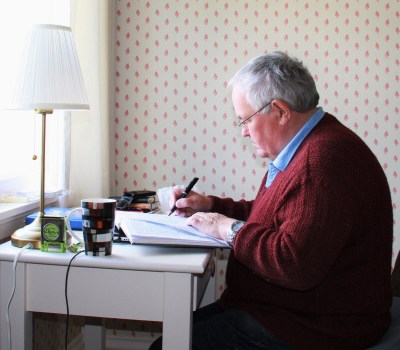
Writing at KIRA

39948917_706398923049634_3046174897211441152_o (1)

BOUTIQUE WRITING RETREAT
SUNDAY SEPTEMBER 30 – SATURDAY OCTOBER 6

This KIRA Boutique Retreat invites former KIRA Resident Artists (Roger Moore (June, 2017) and Jeremy Gilmer (July, 2018) to blend their knowledge and skills with those of the Kingsbrae Artistic Director, Geoff Slater, in a unique Artistic Retreat, tailored to the needs of each participant.

KIRA Boutique Retreats offer a series of one-on-one and small group encounters within the glorious surroundings of the KIRA Residence.

The KIRA Boutique experience includes scheduled one-on-one interviews with each of three instructors, Blue Pencil Cafés, small group workshops (according to demand), lively meal time discussions, and evening readings and talks by facilitators and participants.

The secret of these unique KIRA Boutique Retreats is the unbeatable ratio of participants to facilitators within a small, welcoming artistic community.

Your KIRA Boutique Experience may also include the wonders of whale-watching, the award-winning gardens at Kingsbrae, special events at the Kingsbrae Gardens, the beauties of the resort town of St. Andrews, and the outstanding gourmet food of the  Kingsbrae Garden Café.

As a participant, you can enjoy the solitude of your 20’ x 20’ artistic studio or you can join in the artistic discussions launched by our expert facilitators.

RETREAT FEES:

The KIRA Boutique Experience costs $750 for a six night residency.

This includes:

1. 6 nights accommodation in the beautiful KIRA residence.
2. 2 meals a day.
3. Tailor-made writing workshops (on demand).
4. Blue Pencil Cafés, one-on-one interviews with the facilitators.
5. Round-table artistic discussions at meal times.
6. Evening talks and / or open reading sessions.

Facilitators:

Geoff Slater, Artistic Director, Kingsbrae Garden / KIRA.

Roger Moore, award winning poet and short story writer, KIRA (June, 2017).

​Jeremy Gilmer, CBC finalist (short story), KIRA (July, 2018).

Please contact Mary Jones to sign up.

Phone 506-529-8281

PLEASE FEEL FREE TO SHARE THIS EVENT

Click here for the direct link to  KIRA and Kingsbrae.


MT 2-6 Monkey Meets An Anarchist Ant

img_0188

MT 2.6
Monkey Meets An Anarchist Ant

(Memories of El Camino de Santiago)

The anarchist ant dresses in black.
He wears a little red base-ball cap
backwards on his head.
His eyes are fiery coals.

“Phooey!” He says.
“It’s folly to go with the flow.”
So he turns his back
on his companions and marches
in the other direction.

Some ants call him a fool.
The Ant Police try to turn him.
The Thought Police try
to make him change his mind.

Others, in blind obedience
to a thwarted, intolerant authority,
first bully him, then beat him,
then bite him till he’s dead.

Comment: One of the legends of the Road to St. James, the pilgrim route across Northern Spain that I walked in 1979, states that if you do not walk the road as a human being, in your own lifetime, you will come back as an ant and be forced to walk it ant form, when you are dead. I stood on the hill outside Astorga, looking back at the city. On the old pilgrim road, at my feet, and beneath the old Cruz de Harapos, a colony of ants was busy walking in a long line towards Santiago de Compostela. One turned his back on the group and started to walk the other way, but he didn’t last long. “Go to the ant, thou sluggard.” Fair enough. But watch out for the ant-police and the thought-police. 

Obsolescence

img_0281

Obsolescence

The programs that no longer work.
The files you can no longer access.
Photos that vanish
leaving a blank space in the album.

Memory that goes on the blink.
Forgotten phone numbers,
the birthdays of family members,
that carton of eggs left in the store,
your cousin’s face, her name,
the parking spot where you left your car.

“What day is it today,” you ask,
for the second or third time.
“What time is it?”
“Who’s that coming for tea?
Are you sure I know them, dear?”
“Where did you say we were going?”

“Just round the corner, to visit a friend.”
Or should that be … round the bend?

Comment: Apparently I placed this poem on Facebook a year ago, but I have found no trace of it here, on the blog. This time last year, I lost both of my computers to what was diagnosed as obsolescence. Luckily I had most things backed up. The group who swore they could transfer 99% of my hard-drive material to the new machine, migrated just 1% (my desk top) and the other 99% went on walkabout. I was able to piece much of it back together, but obsolescent programs and out of date apps no longer functioned. So much material was deemed irretrievable. This experience made me realize, yet again, how fragile is our hold on our possessions, our memories, our sanity, and yes, our very lives. For me, it is a very sobering thought that, with a flick of a switch, I, like my computer, could be turned off, and 99.9% of the wonders of my beautiful existence would totally disappear from the memory-banks of this earth. Some say, and I believe them, that, like my computer, I will be re-cycled, recirculated. I will become a part of the wider oceanic world-consciousness. Alas, we can have faith in whatever we wish to believe, but sometimes, we really don’t know.

MT 2-5 Monkey Meets Pontius Parrot

img_0181

Monkey
Meets
Pontius Parrot
(With glorious  memories of Macarronic Latin)

 Pontius Parrot is very clever
and very pontifical.
He pontificates from his pulpit.
“Pretty Polly!”

His name isn’t Polly
and he doesn’t have a pulpit
but he parrots words
in Macaronic Latin:

“Caesar adsum jam forte.”

Pontius Parrot is
perky at the podium.
He bounces up and down,
preens himself prettily,
rattles his chains,
shakes his bars:

“Brutus aderat.”

 Shame and scandal
wear him down.
A dysfunctional family
of feathered friends
henpecked him
until he was black and blue
and threw up copiously:

 “Caesar sic in omnibus.”

He dips his wings in holy water,
calls for some soft soap,
and washes
feathers and claws.

Poor Pontius Parrot,
He can only say
“Repent!”

“Brutus sic in at.”

Comment: Anyone who suffered through school Latin, especially if they went to boarding school or grammar school, will recognize famous Macarronic Latin quotes such as the verb bendo, whackere, ouchi, sorebum, and the one the author of Monkey Temple reproduces in the above poem. If you are unfamiliar with Macarroni Latin and have had the good fortune to have avoided both grammar and boarding schools, just read the Latin normally in English and you will establish its Macarronic meaning.

MT 2-4 Monkey Visits the Chimpanzees’ Tea Party

img_0181

MT 2-4
Monkey Visits
the Chimpanzees’
Tea Party

Dressed to the nines in their gala outfits,
they have come here for the tea party.

Hairy penguins,
they waddle back and forth
across the temple,
then lunge for a table
with its jumbo shrimp,
smoked salmon,
scallops, baked oysters.

Faces slashed from ear to ear
by enormous grins,
“Food’s free!” they say
and stuff themselves
regardless of the consequences.

Serviettes tucked into collars,
they scoff lobster and crab.
Birds of Paradise,
subtle delicacies
flown in from half a world away,
decorate the tables.

There is something about them,
these chimpanzees,
gripping cup handles
between finger and thumb,
enormously pleased to be
the centre of attention,
however clumsily they walk
in their hired-for-the -occasion,
ill-fitting, black and whte
penguin suits.

MT 2-3 Monkey Visits the Poisonous Snakes

MT 2-3
Monkey Visits the Poisonous Snakes

img_0181

Monkey Visits the Poisonous Snakes

A swift death
was never their style,
the cobras, the vipers,
the adders and subtractors,
the bean counters and snatchers,
the diminutive dudes.

They prefer death
by blow-gun
their poison dart
injected through
hollowed fangs

or Chinese Water Torture,
the slow drip after drip
of poison inserted into ears
and veins, a drop at a time,
and slowly gathering …

… until their victim slows down,
ceases to struggle,
stands there, eyes open,
unable to move,
poisoned and paralysed.

Comment: with all the exciting things that are happening concerning my new poetry writing, I forgot all about my monkeys. It seems they have been bouncing up and down, fretting in their cages, bounding all over the ruined, broken-down temple, poor little blighters. Apparently, on their last visit to the rest of Bristol Zoo, they left the big snakes and decided to visit the little, poisonous ones. I guess they didn’t like them at all. Does anyone? I hope there are no ‘snakes in the grass’ near you, and I don’t mean grass snakes. And watch out for snake charmers, some of those snakes believe more in harm than charms.

PS Let me know if you want a voice text. I haven’t recorded this one yet.

Loss of …

IMG_0062.JPG

Loss of …

By the time I remembered your name,
I had forgotten your face. Then I couldn’t
recall why I wanted to talk to you.

I trace dark landmarks on the back of scarred
hands: blood maps, unremembered encounters,
dust covered photographs, grey, grim, anonymous,

not belonging in any family album.
At night I cruise among islands, emerald green
against sapphire seas. Why didn’t I visit

some of these places? Golden sand trickles through
night’s fingers and time’s hour glass, as stars
sparkle and planets dance in Platonic skies.

My memory fails. I wake each morning
unaware of where I have been the night before.
I track the sails of drifting ships, white moths.

I think I have caught them in overnight traps,
but they fly each morning in dawn’s forgiving light.
I give chase with pen and paper, fine butterfly nets

seeking wild thoughts waiting to be caught, then tamed.
I grasp at something just beyond my fingertips,
but I can’t quite remember what it is.

Comment: I first published this poem on July 31, 2018 (click here for the original post). Here it is now, in revised form. I find the revision process to be totally fascinating: the polishing of old ideas, the arrival of new ones, a different structure, a reshaping of the poem’s internal logic. So much happens in the revision process. Many great poets wrote and rewrote their poems, again and again.  I consider Francisco de Quevedo and Juan Ramón Jiménez to be poets who continually revised. A perusal of the variants to their poems (28 versions in the case of some of Quevedo’s poems) gives the reader an understanding of how the great poets think, of how they purge, intensify, sometimes simplify, usually improve their initial instincts. We lesser poets can learn so much from the greats. Above all, we can understand that poetry is a life-long practice, that it is a love of words and emotions, that it is a desire to catch and preserve the uncatchable that can never be completely caught. The critics say that the reader can never know the writer’s intentions. I agree with that, to a certain extent, as I never know why I am writing what I put down on the page. I guess I often have no intent. More important, my original intention can change as I write, and what I write is by no means what you understand I wrote when you read, for each of us processes the imagery, especially metaphors, in a different, and very personal, fashion. That said, when I rewrite a thought pattern emerges and my intentions become that much clearer, not from the words on the page, but from the footpath that led me in different directions until the final version emerged on the page.

Lost

img_0137

Lost

My body’s house has many rooms and you, my love,
walk through them all. Your shadow dances on walls,
in mirrors, and your breath brushes my cheek

every time I open doors or windows. That silly cat
looks for you and hisses when I bring her kibble.
I move from room to room, but when I seek you,

you are no longer here. I knock, nothing opens.
Afraid, sometimes, to enter a room, I know
you are in there. I hear your footsteps on the stair.

Sometimes your voice seems to break the silence.
You whisper my name in the same old way.
How can it be true, my love, that you have gone,

that you have left me here alone? I count the hours,
the days, embracing dust motes. I find no solace
in salacious sunbeams and my occasional dreams.

Comment: Regular visitors to this blog will probably recognize this poem. It is a rewrite of an earlier one, also bearing the title Lost (click here for earlier post). I rewrote, or rather, reorganized the structure of the poem, added some words, and subtracted others. I did this earlier this summer while Clare was in Ottawa visiting our daughter and grand-daughter. And yes, I missed her. I always do when she in not present or I am away. Comments on either version will be welcome, particularly if you prefer one version over the other.

Knowledge

F1040022

Knowledge
Thursday Thoughts
9 August 2018

In response to yesterday’s post, The Curse of Cursive, I received this comment.

“I have always blamed my own illegible (except – well sometimes – to me) scribble on the hours sitting in college lectures attempting to make a record of what was being said. Consequently, I could only ever record about every 3rd sentence. Something which I claim accounts for all those gaps in my learning.”

This comment merits a Thursday Thought.

First thought: the whole process of note-taking. One of my professors in Bristol University, where I did my undergraduate degree, was in the habit of sipping Harvey’s Bristol Cream while munching his sandwiches, consequently his post-lunch thoughts were always most enlightening. Here is his post-lunch declaration on knowledge: “Knowledge is that which passes from my notes to your notes without passing through anyone’s head.” This statement was followed by a closing of the drowsy eyes and an enormous hiccup.

For me, the art of note-taking goes way beyond the copying down of another’s ideas. As  note-takers, we must sift the incoming information, break it into salient and important features, and get the main drift of the argument down on the page. And not just the argument, but our own questions and challenges as well. Much of what I was taught at the various schools I attended was, frankly, nonsense. However, I learned a great deal about teaching from those who taught me that nonsense. A dictated note from an early geography class, preserved for ever in the young student’s mind: “The earth is geoidal, ie, earth-shaped.” Good one, teacher. “Please sir, if the earth is earth-shaped, what shape is the moon?” “Don’t be cheeky, boy, I’ll see you afterwards.”

When I received my first important teaching award I realized that it came to me on account of what I had avoided (all those inadequate lectures and lessons) and that what I was doing was engaging students and challenging them to challenge me by developing their own questions and ideas, by doing their own background checks, and by establishing their own thought processes, rather than trying to imitate somebody else’s dictated and regurgitated notes with their partial pictures of (in)complete and often antiquated knowledge, and all this often dredged up and recycled in the form of ancient, dusty scrawlings from pre-historic graduate courses.

I realize that this is unfair to several lecturers I encountered over the years who were able to deliver riveting and thought-provoking adresses. However, these were few, very scarce, and much appreciated. Their names and ideas are engraved on my mind. They and their methods are not forgotten, even now, but, as I say, there weren’t many of them.

As for knowledge, it is so personal and becomes an integral part of who we are and what we do. I know people who received everything they knew about life with their first degrees. They thought they possessed everything, the complete tree of knowledge in one rolled up certificate. Alas, many of them spent their lives never progressing, standing still and contemplating their known world, neither learning nor needing to learn anything else.

Our knowledge is incomplete. If we are at all ‘thinking people’, we know this. We also know we can never get enough knowledge. A PhD is great: knowledge Piled higher and Deeper. But often it is Reinforced Ignorance, the false knowledge that this knowledge is the only knowledge, well, the only knowledge that matters to the individual who, at a substantial living wage, ekes it out with great care and tests other people on their ability to reproduce it in its exactitude. “And I never-ever thought for myself at all” (I am the Monarch of the Sea, the Ruler of the Queen’s Navy, HMS Pinafore).

And here we enter the world of clichés: life-long learning, an everlasting thirst for enlightenment, for more light, more knowledge. The only real knowledge that we simply must transfer to our students, our followers, is how they can gain knowledge and even more knowledge for themselves. A love of and a desire for life-long-learning is the teacher’s greatest gift. If the teacher can pass that on, then the world of ideas will not fail, knowledge will not become carved in stone, set in concrete, entrenched in notes ‘that pass from my notes to your notes without going through anyone’s head’.

Here ends my Thursday Thought. A rant, really, and a very satisfying one. Thank you, Roland of Roland’s Ragbag, for turning on the tap and allowing these refreshing waters to once again flow.

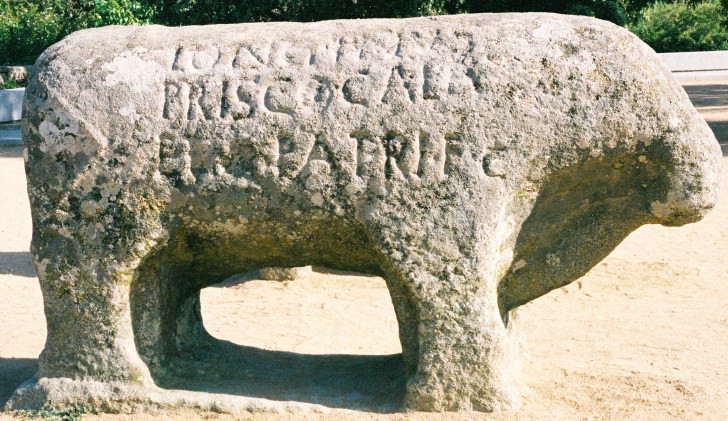
Comment: Opening photo, knowledge set in stone. One of the Bulls of Guisando (Province of Avila, Spain), with graffiti carved by a Roman legion.
Purple

IMG_0067

Purple

I write poems
in green ink,

but I prefer
purple.

Bruised clouds
on an evening sky,
dark depths
of a rainbow glow,
Northern Lights
singing at the deep
end of their scale …

or just a desire
to be different …
slightly different ..

as if that one thing,
the color of my ink,
might tip the scales
and turn me
from mediocrity
to celebrity

with a wave
of a violet wand.

or the click
of a pair
of ink-stained
fingers.