Wednesday Workshop: Attending a Reading

weir 2

Wednesday Workhop
Wednesday, 04 April 2018
Attending a Reading

            Number one piece of advice: don’t arrive late. I thought last night’s reading at the Oromocto Public Library began at 7:00 pm. I used Google maps to locate the library and I left plenty of time to get to there early. The Oromocto Public Library is just off the main road, tucked sideways on, so you are driving past it before you see it. I didn’t see it.

            I drove to the first roundabout, went straight through that, looked again: no library where the library ought to be. So I drove to the second roundabout. Still no library, and now I was running out of road space and the highway beckoned. So, I went right around the second roundabout, scanning both sides of  the road for the library as I drove. Still no library. I returned to the first roundabout, went right around it, drove back to the second roundabout … I was becoming fixated on driving in circles … then back to the first again.

            Just past the first roundabout, I spotted a gas station. I pulled over to ask the way to the library and there it was, just in front of me, right beside the gas station, facing the new Japanese restaurant, and sideways on to the road. There was one parking spot left and I took it.

            When I got inside, the library was very silent. I asked directions to the reading room and was directed to the back of the building. The reader stood before the audience, with the podium at his back, and was already talking. It was 6:50 pm. “Wow,” I thought. “He must have started early.”

            I have known Chuck Bowie, the invited reader, for several years and we share the same writer’s group, a group which he organized. He invited me to join it and we meet regularly (there are seven of us), once a week, on Tuesdays. Regularly: this is Canada … regularly, when it isn’t snowing, when there’s no icy rain, when the temperature is above -30C, when the wind doesn’t threaten to blow the car off the road … regularly, you know what I mean. There are usually three or four of us at each meeting.

            “There’s Roger,” Chuck announced my presence as soon as he saw me.  The audience turned round and several people whom I knew gave me a smile and a wave. There were no vacant chairs. A lady at the back gave me hers and went to fetch another one for herself. I found out later that she was the organizer and I thanked her profusely for her generosity.

            Chuck, as I found out later, had started at 6:30 and was well into his stride. He mixed anecdotes from his stories with advice about writing. As I was settling, he was explaining how much research he had done into wine and wine growing for the winery scenes in his four Donovan novels (the series is called Donovan: Thief for Hire). I love wine and I have visited several excellent vineyards in Rueda and La Seca (Spain). Chuck’s deep knowledge of the vines impressed me. “Roots,” he told us, “sometimes going down twenty-one to twenty-four feet.”

            I thought of the Spanish wines with their denominations of Old Vines, Reserva, Gran Reserva as Chuck dragged me from the outside world to the inside world of the winery laboratory where the crime had taken place. Then he read an excerpt from his novel, four or five pages that illustrated the use to which he had put his knowledge of the vines (Book Four of the series, Body on the Underwater Road).

            Chuck then talked about writing from memory (Rumania) and emphasized that memory alone was not enough. Memory gives atmosphere but accurate details come from many places, including the ubiquitous, omnipresent, and virtually omniscient Google search. Thus, as he explained, cum grano salis, the churches in Rumania are circular, constructed that way “so the devil may not corner you.”

            From memory and Rumania, he moved to Manchester Gangs in the 1980’s (Book Three: Steal It All), a simple anecdote about how the neighborhood protection racket protected the local families who in turn protected the criminals, while all crime was committed outside the area. Chuck’s ability to turn a table-top conversation into the idea for a story, or in this case, a full novel, is exemplary. How many creative seeds are scattered on stony ground, never to come to full fruition?

            Violence can play a meaningful role in the crime thriller but it has to be meaningful, and it must be accurate. Chuck spent some time explaining how he had researched guns and armaments so that the right weapons would always be carried by the right people and used in correct fashion at the right time. He talked a little about entry and exit wounds and I had visions of Rumpole, in the Penge Bungalow Murders, stabbing a ketchup filled sponge in the kitchen of his suburban home on The Gloucester Road, to see how the stains spattered, much to the disgust of She-who-must-be-obeyed.

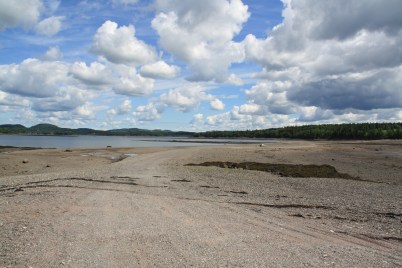
            Chuck’s next book, the fourth in the Donovan series, Donovan: Thief for Hire, is called Body on the Underwater Road. Much of this story takes place in St. Andrews, New Brunswick, and Chuck explained how he had scouted out the local area and, in particular, the ‘underwater road’ from the mainland to Minister’s Island. The Fundy Tides, the highest in the world, cause the roadway to disappear at high tide, thus making the island inaccessible for long stretches of time. It also makes the underwater road a natural fishing weir for dead bodies. This research work involved live interviews with the local RCMP and others on the movement of bodies in the Fundy Tides, where would they end up if they were inserted into the water at place A, B, or C. That sort of thing.

            Chuck ended with a request for questions and the audience announced their own engagement by asking questions on how to develop characters, how to name characters, how to thread narrative arcs, and on how much rewriting is necessary if an arc goes wrong. The answer: “Lots. Sometimes you need to abandon the arc completely; other times, you must rewrite it from top to tail. But cave scriptor / writer beware: if you make a change on page 272, make sure that it checks out all he way backwards, page by page, back to the book’s beginning on page 1.”

            The use of humor within a thriller series serves to illustrate the layers of complexity that the characters manifest. The insertion of this element serves notice that genre writers who are serious about their craft write with the intention of elevating words, their sense, and their impact on the discerning reader. It also serves to layer the novel with additional meaning. Such layers of complexity spark joy in the writer.

            An interesting evening, then. With some old friendships renewed and some words of wisdom cast before an appreciative audience by the Atlantic Provinces Director of The Writers’ Union of Canada and local Fredericton author, Chuck Bowie.  I attach his web page. Do some research: check it out.  http://www.chuckbowie.ca

Painting credit: Roger Moore. Fundy Weir Poles (acrylic), St. Andrews, NB.
Wednesday Workshop: Why I Write II

IMG_0055

Wednesday Workshop
Why I Write II
28 March 2018

Joan Didion’s autobiographical note did not appeal to me in the same way that George Orwell’s did, but then, I was born on the same side of the Atlantic as Orwell, and yes, that does make a difference. So much in Orwell is familiar, so much in Didion is alien.

For Didion, Why I Write (borrowed from George Orwell) is composed of three short words, each of them emphasizing the first person singular I + I + I. She sees writing as an ‘aggressive, even a hostile act’ in which she, as writer, imposes herself on other people (her readers) saying ‘listen to me, see it my way, change your mind’. From this idea of imposition springs the second idea of the ‘aggressive, hostile act’. This, in some ways, can be seen as a sort of combination of Orwell’s first, third, and fourth points (1) sheer egoism; (3) historical impulse; and (4) political purpose with possibly the first dominating.

That said, I like the idea Didion presents of ‘pictures in the mind’. She carries these pictures with her and then writes from them. She writes from the physical, the tangible, the ‘taste of rancid butter’, the ‘tinted windows on the bus’, the concrete nature of these things and her desire to describe them as accurately as possible, led her to discover herself as a writer.

When I apply her descriptions to my own writing, I gaze at my own memories of my childhood. They are like photographs, still, black-and-white photographs, like those we used to see when I was a child at the entrance to movie theaters. The skill for me in writing is to allow these pictures to spring back into life. Much of my writing, especially my stories about Spain, Mexico, or Wales, is autobiographical in its beginnings. However, as the pictures move and speak they tell me things and I write them down. What starts out as a story is very rarely the story that ends up on the page. A metamorphosis takes place. Words slip and shift and change their shapes and meanings according to the whims of characters and the situations in which they find themselves. In the beginning was the picture: that, I guess, is what Didion and I hold in common. But my writing is not her writing, and her pictures are not my photos, how could they be?

Interesting in my own original photos is the lack of sound, the lack of movement, the lack of taste and touch. First the figures are stiff and stolid. When I study them, they shift and move, and next they begin to speak. Alas, what they tell me when they speak to me in the shiftless shadows of my dreams at night is not necessarily what they lazily lisp in the full sun of my waking mind. A long time ago, I struggled to recall the exactness of that dream world and I tried to pummel the words and thoughts on my mind’s anvil and to hammer them into shape aided by the heat of my seemingly inexhaustible creative energy. Now I am more relaxed: I just listen to the daylight voices and allow them to shape themselves and their situations in their own way.

When I do this, background sounds and the tell-tale smells of time and place slip slowly in. Boarding school: the unforgettable stench of burned porridge. My auntie’s house: the whir of the cuckoo clock as it coiled itself up in preparation for the little bird to whip out and enchant the hours. My grandfather’s grandfather clock: the metallic lightness of the clock hands as I adjusted the minutes and the hours when the clock ran down and I sensed the tautness in the piano wires as I turned the key and wound the heavy brass pendulums back into their starting positions. My grandmother’s house: the bubble of water boiling on the hob, the warmth of constantly brewed tea, strong as a farrier’s horse and quite undrinkable without the second, third, or fourth watering and, of course, always the smell of boiled white fish cooling for the cats’ supper.

My best writing comes from deep inside myself. I find it  in the midnight coal mine of my mind where ghost-like figures drift and roam as they seek that special person, the one who will drag them to the surface and bring them back to life. Poor, pale, thin imitations of a reality that never was, I do my best to revive them. Often, my best is just not good enough and I must cast them away and drop them back into the depths to ghost away and prepare themselves for another day when perhaps, they and I will each be ready to deceive each other.

Why I Write

IMG_0055

Why I Write

In the online creative writing course that I am currently taking, we were invited to read two articles on why I write, one written by George Orwell and the other by Joan Didion.  Both articles set me thinking: why do I write? My response to these articles, borrowed from my course notes and suitably doctored for my blog, follows. Note: this is the first of three planned statements. The second, on Joan Didion, will appear tomorrow on my next Wednesday’s Workshop.

George Orwell … where do I begin?

Homage to Catalonia is, in my opinion, one of the great personal memoirs written about the Spanish Civil War. Orwell fought on the side of the Republic, the legally-elected government, but fell foul of the Russian-backed Communists as they tried to unify the left under a banner of total Communism. The other side in the Spanish Civil War was, of course, the solidified right of the Spanish Falange and the Fascist Party. Orwell was targeted by the Communists and, wounded at the front, escaped across the French border with falsified papers. As he himself says in Why I Write, the political realization of the nature of totalitarianism led him to his stance as a writer. Animal Farm borrowed heavily from his Spanish experience, as did 1984.

Orwell sets out four reasons for writing. (1) Sheer egoism; (2) aesthetic enthusiasm; (3) historical impulse; and (4) political purpose. I personally identify most strongly with #2. Above all, in my case, I write my poetry in praise of nature and in sorrow for how I see us failing the natural world around us. However, I must admit that I also write out of sheer egoism (#1) and yes, I enjoy thumbing my nose at all those who have in one way or another slighted me and upon whom I want literary revenge, even if it be posthumous. Several of my older friends also write this way, though many of the younger ones seem to be more interested in money than in art for art’s sake. I guess retirement and a small but relatively reliable pension added to the gradual onset of a blighting old age make me realize that there is not much time left in which to amass a fortune. This in turn also makes my professed credo of art for art and not for money more acceptable.

Having come to the conclusion that I never have, and never will, make any money through my writing, although publish or perish has walked side by side with me throughout my academic career, I now embrace the fact that I do not write for money. In fact, I usually give my independently published books away to my friends. Nor do I want the sort of fame that causes the paparazzi, with their microphones and videos, and camerasto flock to my doorstep, like starving sparrows or winter’s chickadees, in search of the breadcrumbs that fail to sufficiently nourish. To be appreciated, in my own small corner, like a well-loved local cheese or a craft beer, welcomed on a cool night for its fragrance and body … that is enough for me, although I must admit, that for one of my metaphors or images to be sniffed at, as if it were a glass of rare liqueur or specialized port or a welcome New Zealand Pinot Noir, also has its attractions.

This doesn’t mean that I am satisfied with who I am and how I write … I am not. I hope I never will be. I do want to be the very best that I can be. That’s why I keep writing and why I keep taking courses and workshops on writing. It’s also why I read and re-read, and why I keep reaching out to you and my other friends, and why I am so over-joyed when you, in your turn, reach out to me with the occasional word of praise for one of my stories or one of my poems.

However, warm as is the friendship of the beginning, failed and faltering writers’ support groups to which I belong,  most, if not all, writing is done in isolation: me and my memories, me and my invention, me and my keyboard, me and my blank page, me and my pen, me and a-penny-for-my thoughts as I refill that pen with Royal Blue ink in the hopes that something regal will actually fall from the nib and grace one of my pages, even though I am really wondering yet again whether I should start that first paragraph all over, just once more.

Alas, me and the cat and the keyboard do not share a healthy working relationship, especially when she walks across the keys, sticks her kitty-littered rear end in my face, scratches her itchy chin against the computer’s sharp edge, and purrs wildly for kibble while adding oft-repeated letters and deleting so many of the wonderful words that I have so carefully accumulated.

Wednesday Workshop: Preparing a Public Reading

IMG_0167

Wednesday Workshop
Preparing a Public Reading
21 March 2018

Preparation is all important. You cannot prepare enough.

First question: how long do you have? Your reading must be tailored to your time frame. Our local open mic sessions are composed of 3 minute slots. I choose poems or prose passages that can be read in 2 minutes to 2 and a half minutes. Time passes very quickly at the podium. Well-prepared, you will not over-run your time. Read your piece out loud and time it. If you can record it, do so. Listen to it as you read it. Do you feel comfortable with it? If so, go ahead with the reading. If you feel uncomfortable, or awkward, if you feel that the piece isn’t right, then choose another piece. Comfort is everything. Familiarity with reading the piece and with listening to your own voice will be of great comfort to you. You will step up there knowing you can do it, not wondering if you can do it.

Second question: are you familiar with the room and the mechanics of the room? If so, no problem. If not, take the time to visit the space in which you will read. Attend an earlier session. Visit one afternoon when nobody is there. It is easier to read in a familiar place than an unfamiliar one. Check out the room in advance. The mechanics are also important. How many will be in the audience? Will you need a microphone? Will you be expected to project your own natural speaking voice? Is there a podium? A reading table? Will you be sitting or standing?  Knowing this in advance reduces nerves and gives you practical answers and takes away both nerves and the fear of the unknown. Mechanics are important. Familiarize yourself with the mic. Is there an assistant to help? Think height and adjustment and remember, if you start your reading with necessary adjustments, this will take time out of your reading. Always leave that little extra space.

Third question: Is someone introducing you or are you expected to introduce yourself? If the former, your reading time will start when you start to speak. If the latter, your reading time will start when you start to speak. If you are doing your own introduction, then write it out in advance and read it out in advance. Treat it like a part of reading and include it in your reading time. Whatever you don’t, don’t start by explaining what you are going to read: this wastes time. Your work should speak for itself. If you are very confident, you can ad lib, but this takes precious time away from your reading space.  If you are not confident, then stick to your text, and plan and time your text in advance.

Fourth question: how will you choose your text? My suggestion is that you apply to your choice of text exactly the techniques that you use when writing and revising your text. (a) which chapter pleases you most? (b) you must feel joy: which sections give you the most joy? (c) which words, which sequences spark joy? I would also ask whether you want to read a single long text or a sequence of smaller texts. That is your choice. Again, comfort is the key word. If you are not comfortable reading out the F word in public, do not choose a passage that is filled with F words: your discomfort will transfer to the audience. Select a couple of passages, read them out loud, time them … then concentrate on one passage (longer) or a contrasting or complementary set of passages (shorter).

Example: Last Sunday, I was gifted a twenty minute reading slot. I chose six short pieces of prose that formed two distinct but complementary sequences. The total reading time was 17 mins and 30 secs. I was introduced, then read. I did some ad libs (I always do, sorry). I shuffled feet and pages. Total time of the videoed sequence 23 minutes, of which the intro, my slow arrival, and my initial sorting took about 3 mins. And yes, I was nervous. You could see my hands shaking and the pages waving up and down! I knew the audience, and I knew there was a possibility that young children might be present. They weren’t. So I read my F-word story … and yes, it’s full of F-words. I had another story, much gentler, in reserve. Just in case. If you are an experienced reader, you can respond to the audience and change at the last second. If you are not, stick to the plan.

Wednesday Workshop: Editing Plus

IMG_0068 (2)

Editing Plus
Wednesday Workshop
14 March 2018

We all need a second pair of eyes whether we are editing our own work or when we edit the work of others. Clearly,  there are several levels (layers is also a good word) at which editing can place.

1. Self-editing: I think we are better off creating the work first and editing it afterwards. However, whether we like it or not, self-editing, and even self-censorship, often takes place during the act of creation as we shuffle sentences, change words, and search for appropriate metaphors. Finish the first draft. When the piece has been drafted, we can look at editing it. I very much like the idea of going to an unfamiliar place so that we re-read in an unfamiliar setting. If familiarity breeds contempt, then unfamiliarity can often breed better editing. That is why I like to leave pieces fallow for a while, before returning to them.

2. Self-editing: One of the best forms of self-editing for me is publishing work on my blog or reading it at an open mic session. When I publish on my blog, I think of the offering, be it prose, poetry, memoir, or criticism, in terms of the ‘other’, those other eyes that will read it. When I read at an open mic session, I think of the people who will hear my spoken word. In both cases, I usually make changes in response to the audience and the perceived audience. Sometimes I make these changes as I read … realizing as I speak my offering that certain phrases are better said in a different fashion or left out altogether. Open Mic readings: I always read my offering aloud and time it before I read in public. Viva Voce is the best way, in my opinion, to catch errors in rhythm and to improve word usage.

3. BETA Readers: Many of my friends use BETA readers, trusted friends who read and criticize their work in early format. I like this idea, but I trust very few readers. Those I do trust are often too busy with their own writing to have time for consistent BETA reading.  Trust is a key issue here. If you have a good, tried and trusted BETA reader, shower them with gifts, buy them presents, keep them by your side.

4. Copy Editing: This comes at several levels that vary from the friend who corrects the occasional error, to the copy editor who fine combs your work and corrects grammar, accuracy, and punctuation. Good copy editors rarely work for free. However, it is well worth while to prepare a manuscript with great care, and some cost, before sending it away, especially to a professional publishing house. Again, trust is an important issue here.

5. Structural Editing: The editor who can deal competently with structural issues is both rare and priceless. We often see and hear how brutal editing can be, both on the writer and the text. While structural editing  can be destructive, both to the text and the writer, if well done, it can be very constructive. I think of Ezra Pound’s notes and changes to Eliot’s Waste Land as an example of exemplary editing. There are many others.

6. Editing and Publishing: I know of authors whose first books were edited heavily by the presses that published them. I also know that in some cases they never published again and in other cases they were frozen into a ‘what will the editor say mode’ that disabled their creativity enormously. Editing can be destructive as well as constructive. Alas, if we want that elusive publication, sometimes our professional editors give us very little choice. Publish or Perish + Change OR Else = an uncomfortable situation in the course of which the original wok can change shape in ways the author cannot control. This is doubly true if the writer belongs to the Truth is Beauty and Beauty is Truth school. And remember, beauty lies in the eyes of the beholder who just happens to be editing and then offering to publish your work.

This is an interesting topic and there is so much more to say. I hope I haven’t wasted too much of your time with this.
Roger,
waiting for the snow to arrive,
in Island View.

Wednesday Workshop: Writing from Inside

IMG_0010

Writing from Inside
Wednesday Workshop
07 March 2018

Crave More: I hate those words.  I always choose a cart with the shop’s name on the handle. I can handle that. I can’t handle a shopping cart that screams Crave More at me every time I stoop down and place another item in the wire grid. If stores were honest they would write Think More and Crave Less on their shopping cart handles. But I bet that would quickly cut into profits.

Anyway, there I was, in LaLaLand, leaning on my cart, still half asleep, when this ghost drifted towards me. “Help me,” it said. “I’m hungry. I need food.” I woke up from my dream, looked at the ghost, tall, skeletal thin, cavernous eyes and cheekbones protruding, grey face drawn with shame. The single word “Sorry” came automatically to my lips. Then I too felt shame. I looked at him again. “I only carry plastic.” The excuse limped heavily across the air between. I saw something in his eyes, I knew not what, and I turned away.

In my mind, I added 120 lb of muscle to the scarecrow frame. Took forty years away. Filled his body with joy and pride, not shame, and remembered how he played the game, hard and fast, but true. I ran my hand through the card index of former players that I coached and knew: their moves, and attributes, the way they played the game, their stronger / weaker side, their playing strengths, their weaknesses. I remembered him holding up the Champion’s Cup. But I couldn’t remember his name.

I pushed the cart all over the store in a frantic search for him. He was nowhere to be seen. I went to the ATM and took out cash. I could hand it to him. I could tell him he had dropped it. I went through a thousand scenes. I could invite him to the snack bar. I could tell him to buy what he needed and follow me to the  check out lane. A single opportunity. One chance. That’s all we get. Miss it, and we blow the championship. Take it, and we win the game.


Plagiary: Wednesday Workshop

img_0177

Plagiary
Wednesday Workshop
9 August 2017

No, plagiary has nothing to do with the plague, though it might do in certain circumstances, especially if a plagiarist is plagued by lawsuits from others who think that the thief has benefitted financially or unfairly from the theft.

What is plagiary? The Merriam-Webster dictionary suggests the following, and I quote, with references:

Plagiarius, the Latin source of “plagiary,” literally means “kidnapper.” “Plagiarius” has its roots in the noun “plagium,” meaning both “kidnapping” and “the netting of game,” and ultimately in the noun plaga, meaning “net.” The literal sense of “plagiarius” was adopted into English; in the 17th and early 18th century, a kidnapper might be referred to as a “plagiary,” and, in the legalese of the time, kidnapping was “plagium.” But “plagiarius” also had a couple of figurative meanings – “seducer” and “literary thief.” It is the latter that has made the most enduring contribution to the English language. A “plagiary” could also be one who commits literary theft (now usually referred to as a “plagiarist”) or the act or product of such theft (now, more commonly, “plagiarism”).

https://www.merriam-webster.com/dictionary/plagiary

From the above definition, we can conclude that plagiary is theft, the stealing of another person’s work, and, above all, the presenting of that work as if it belonged to the plagiarist. In other words, creators create: they are not meant to steal and misrepresent.

Does plagiary matter? Of course it does. By its very definition, theft, it is one of the Ten Commandments, and therefore something to be avoided: Thou shalt not steal. However, as with all things, the gravity of the crime depends very much upon the circumstances. In academia, where creativity and original thought is the ‘name of the game’, the theft of intellectual property is considered by the gatekeepers of the purity of knowledge to be a very serious offence. That is why so many universities so carefully define plagiary / plagiarism and place such stiff academic penalties on the plagiarists who offend. By extension, certain professions, such as journalism and science (in the broadest sense, the creation, protection, and distribution of knowledge) must hold to very strict rules on the subject of intellectual theft.

The article on plagiarism in Wikipedia [ https://en.wikipedia.org/wiki/Plagiarism ] opens several horizons. It stresses that academia (with its spin off into scientific and industrial research) and journalism (with its theory of scooping) are the two biggest areas in which plagiarism is considered offensive. Plagiarism, the article stresses, more than anything else, is re-quoting other people’s material while claiming it as one’s own and without citing the sources from which it was taken. This quickly leads to the infringement of copyright and this is a much more serious and complicated legal matter, as the article points out.

As for literary and artistic plagiary, this is a very different kettle of fish as artists seem to borrow from each other in the most curious of ways. Molière, for example, proudly announced that, as for his artistic material, “Je le prends où je le trouve.” This roughly translates as “I take it from wherever I find it.” In his day and age, imitation was a favorite rhetorical device, and the imitation of other people’s work was considered more like flattery than theft. Miguel de Cervantes, in the Don Quixote, that most original of novels, took the first sortie of the famous and ingenious knight almost word for word from an earlier entremés (short play to be performed in the interval between the acts of a longer play) entitled El entremés de los romances. This is not so much ‘Homer nods’ as Homer ‘carries a gun and holds up a local bank’. Do we cry plagiary or imitatio when the similarities between the play and the novel’s opening are such that for a long time people attributed the Entremés de los romances to Cervantes and referred to it as his early work?

I follow the Spanish tradition and often use lines and words from other authors in my own work. However, I think that what I borrow is in most cases well enough known for it not to need quote marks, nor to need identifying. Though Lovers Be Lost and Broken Ghosts, two of my book titles, come directly from Dylan Thomas’s poetry. However, I quote the verses in the opening pages of each book and Dylan Thomas’s name is clearly attached to them. If, however, I write “Rage, rage against the dying of the light” … or “Rage, rage … ” against anything, I think personally that the attribution should be clear as should the literary dialog that I am starting within the text. Similarly, if I write that “July is the cruelest month, because we expect the sun and it is always raining”, then surely the reference to T. S. Eliot is clear as well, and so is the attribution and twisting of his ideas. I have used the phrase “Jack Pine Poems” before now, without referencing Milton Acorn, but most Canadian poets will be aware of the origin of the term without my writing “following in the footsteps of Milton Acorn and his Jack Pine Sonnets” ….

To further complicate the matter, plagiarism is a hydra, and its many heads may take a multitude of forms. Wikipedia suggests that there may well be a whole epidemic of what might be called ‘literary borrowings’ that verge on plagiarism; there is, for example, a touch of ‘literary theft’ about all of these: “plagiarism, literary theft, appropriation, incorporation, retelling, rewriting, recapitulation, revision, reprise, thematic variation, ironic retake, parody, imitation, stylistic theft, pastiches, collages, and deliberate assemblages.”

However, as the Wiki points out: “There is no rigorous and precise distinction between practices like imitation, stylistic plagiarism, copy, replica, and forgery. These appropriation procedures are the main axis of a literate culture, in which the tradition of the canonic past is being constantly rewritten.” The quote marks show that this list is lifted bodily from the Wikipedia article.

What I would underline most strongly is that “the canonic past is being constantly rewritten.” Literature is, to a large extent, a writer’s dialogue not only with (in my case) his own times, but also with the way other writers have seen the world and written about it. And not just written about it: think of the geometric expansion of oral literature. We hear so much, so much is repeated, words and phrases slip in and out of common usage. There is usually a prime over, an original author, but when a word r a phrase slips into what might be called ‘common usage’, then plagiarism takes a turn in a different direction.

“To borrow from one author is plagiary, to borrow from many is research,” as Oscar Wilde is rumored to have phrased it. As a result, what is considered to be a can of worms in academia, science, and journalism, may turn into an interesting and not necessarily a dishonest practice in the artistic world. How about the erotic cowboy novel that I am thinking of writing? I am going to call it Fifty Shades of Zane Grey … how many copyright laws am I breaking with that little joke? None, in my opinion, yet given a competent lawyer and two or more clients greedy for money, and virtually anything can be turned into a fertile battleground for legalistic dispute. Hopefully, the pitiful pennies that I own and the innocent and innocuous literary discourse that I exchange with other authors, many of them long dead, will not bring on a flurry of lawsuits.

“Where there’s muck, there’s money,” as a famous Yorkshire millionaire once said. So quit mucking about with even the possibility of plagiary, check your sources, and, if in any doubt at all, make sure that you add those quote marks and those references. And remember, it’s better to be safe than holding up your hand in court and saying “I’m very, very sorry, M’Lud.”

Really? Wednesday Workshop

IMG0061_1

Really?
Wednesday Workshop
19 July 2017

“Steevie K says adverbs are out. You shouldn’t use anything ending in -ly.”
“Really?”
“No. -ly words are banned. They’re as bad as Anglo-Saxon four letter words.”
“That’s folly, surely?”
“No. It’s an absolute from the best of all writers. You do agree, don’t you?”
“Oh, absolutely, in a sort of writerly fashion. I’ll leave all my -ly words on the trolley.”
“Are you being facetious?”
“Absolutely not. Clearly, Steevie K obviously has a point. Totally too many -ly words in use. Well, usually, anyway.”
“What’s more he says that people in general and writers in particular should avoid adverbs.”
“Funnily enough, I actually feel the same way, relatively speaking, particularly nowadays.”
“But you use them all the time.”
“Only in July, when there are comparatively few alternatives.”
“You know, Steevie K counts the number of times people use the -ly word.”
“Surely not? But then, he must truly be thoroughly committed to the extermination of …”
“… words ending in -ly. Of course he is.”
“I bet he lovingly caresses his dictionary as he peruses the -ly section while scratching his belly.”
“There is no -ly section.”
“You are lying, surely?”
“No. Anyway, that’s ly-, not -ly, and ly- is not a letter , it’s a combination of letters. Do you understand?”
“Truly I do. I get on swimmingly with this. All of it, actually.”
“All of it?”
“Totally. I always wondered why they said ‘jello’ not ‘jelly’.”
“Who?”
“Those with the smelly yellow-belly, of course.”
“I’ll report you to the Steevie K thought-police.”
“Surely you wouldn’t do that, not really, that’s not particularly nice?
“Really and truly.”
“Verily, I say unto you: ‘Oh shut up, you falsely bloated, heavily spotted yellow-bellied sapsucker’ …”


Identity: Wednesday Workshop

IMG_0067


Identity
Wednesday Workshop

5 July 2017

Today’s workshop settles on the question of identity, loss of identity, and the attempt to recover any form of cultural identity that one feels one has lost. These questions are particularly important in the current age when so many differences are so easily erased. Language, culture, identity, music … they are all tied closely together.

The search for identity runs parallel to the search for the poetic voice (or the writing voice) that is so unique to each good writer. In fact, one can distinguish between good writers and lesser writers merely on the basis of voice. Lesser writers rarely establish a distinct voice while good writers usually have voices that are uniquely their own.

What to do we mean by voice? When we read Shakespeare or Miguel de Cervantes we know almost immediately whose work we are reading. The same is true of the great musicians. Bach, Mozart, Beethoven, Mahler, all have sequences and styles that are individual to them, as do Scarlatti, Brassens, The Beatles, Gordon Lightfoot, Gilles Vigneault, Edith Butler … their style, their voice is established. We listen to them and we know who they are.

Cultural identity is also very important. It is tied into language, childhood beliefs, fairy tales, myths, the basic culture that we receive as children. When we all listen to the same radio stations, or download the same ITunes, or watch the same TV programs with their infinity of ad nauseam advertisements, then we are socially engineered to be the same or, if not the same, remarkably similar within a series of very limited and extremely limiting patterns. When we establish our own identities, — and this is always difficult both for people who have had their culture taken from them and for immigrants, or the children of immigrants, who want to retain their culture at the same time as they blend in and fit in socially — then at the same time we develop our own voices.

When I hear the poetry of Lorca, of Antonio Machado, of Miguel de Unamuno, of Octavio Paz, of Dylan Thomas, of Gerard Manley Hopkins, of Wilfred Owen, I hear their very distinctive voices and recognize their individual styles and the cultural / poetic identities that they have established. The goal that we, as writers, are aiming for is to establish our own style, our own voice. To do this, we must listen to ourselves and discover how we think and how we feel. Then we must listen to others of our own generation. We must make comparisons and establish what we do differently, why we are different, what forms our differences … our own individual voice may come from speech rhythms, from language usage, from the establishment of a certain form of narrative, from the use of imagery or metaphor … there are so many different ways in which we are, each of us, different … or capable of being perceived as different.

When we write often enough and frequently enough, we at last begin to recognize those words, those phrases, those rhythms, those ideas, that are ours and nobody else’s. This is when we start to discover our own voices and our own personalities. It is a goal worth striving for … step by step … poco a poco … little by little … and a step forward everyday … until we grow into the type of writer or poet, fully established (or establishing), that we were always meant to be.

It is never easy to capture oneself and place oneself on the page in readable form. It’s a bit like trying to draw Picasso’s blue vase using only one blue pencil: not easy. It’s much easier to take a selfie with a flashy cell-phone.  Cell-phone selfies are easy, but verbal selfies are what we are seeking for. They take much longer to ‘produce’ and it is only when we finally achieve them, that we realize how difficult they are to actually achieve. But remember, read and re-read my earlier postings: don’t give up; don’t get off the bus!


Creativity: Thursday Thoughts

IMG_0070.JPG

Creativity:
Thursday Thoughts
Kingsbrae 15.1

15 June 2017

The KIRA experience has been very kind to me. It has enabled me to spend time writing and thinking without the necessity of worrying about the daily rituals and necessities of everyday life. In addition, the daily conversations with the other artists in residence have kept my mind focused on the process of creation and this has allowed me to study how I am creating. As many on this blog have noticed, I have been very productive during this residency, and there are several reasons for it. I would like to share some thoughts and ideas with you.

Journal: On 2 March 2017, I received an e-mail telling me that I had been accepted for the arts residency at Kingsbrae. As most of you know, I keep a journal and write in it every day. On 3 March 2017, I started my Kingsbrae poetry sequence. I began by reading the entirety of the Kingsbrae web page and then watched the Kingsbrae Garden videos online. Then I began jotting down in my journal poems and snippets of poems, creative thoughts, metaphors, images,  and ideas. By the time I came to Kingsbrae, I had 90 proto-poems in place. Since they were taken from photos and videos, and were not written in situ, I saw them as prototypes, rather than as the real thing.

The Journal as Poetic Quarry: I look on the journal as a poetic quarry. It contains many stones, some tiny, some larger, some useless, and some very precious indeed. One part of my poetic journey here at Kingsbrae is to go back over these stones, turn them over one by one, discarding the dross, and concentrating on the precious material that has lain there waiting to be re-discovered. Now that I am on site, it is easier to distinguish between those essential words, the ones that really count, and the lesser words, the ones that can be dismissed. This sifting process needs time and thought, and that is exactly what the residency has given me. Writing tip: keep a journal. Mark in red those passages that contain seeds of poetry, images, metaphors, rhythms etc. Return to them when you have the time to do so. Time and space are essential: a time in which to work and a space in which to work. Without these two things , we are lost as writers. ‘I don’t have time,’ you think. Ask yourself: ‘what is more important than a little time each day, spent on yourself and your writing?’ As writers, we MUST indulge ourselves with those two little gifts, time and space. An hour a day is more than enough: find that hour, use it. Ten to fifteen minutes a day is enough to keep us ticking over: if we can’t find that ten minute space, then we are unfortunate indeed.

The Revision Process: As I develop as a writer (and believe me, I am still developing), I realize that the ability to recognize good writing is one of the most important skills that we possess. Re-reading is one thing. Distinguishing the great (oh yes, there are great thoughts and metaphors in those journals), from the good, from the average, from the futile and meaningless is a key skill. All of us have wasted precious time on an idea that just didn’t work. We have worried at it like a dog at an old bone, drooling, gnawing away, growling at ourselves and the bone, getting no nourishment. Leave those ‘dead’ ideas, those ‘dead’ metaphors. Move on to the good ones asap. Our writing time is precious: don’t waste it. Learn to recognize the good and workable from the lesser writings that waste our time.

The Creative Process: “What is this life if, full of care, / we have no time to stand and stare?” This is the first line of one of W. H. Davies’s poems. The Kingsbrae Residency has given me time to stand and stare. It has also given me time to sit and stare. Emptying myself of the daily drudge, I have been able to allow light and inspiration to enter my mind and fill me with creativity. I have discovered that there are ways to do this: meditation, an open mind, an emptiness within that slowly fills, and, above all, carpe diem, the ability to recognize that moment and seize it and exploit it. None of the above is unique to me. If we are at all creative, we are all faced with a simple choice: to develop our creativity or to let it wither. Most of us are too ‘busy’, in the worst sense of the word, to allow ourselves the time we need to create. This is a process we must reverse. We must return to self time, thinking time, emptiness time, metaphoric creative time.

The Value of Art: The modern corporate businessman’s mind is of the type that knows the price of everything and the value of nothing. As a result, we have the tendency, as artists, to fall into the ‘price’ mold rather than the ‘value’ mold. If we do not stop and think, if we do not find the time to create, if we do not search for the absolute values that are represented by our art and our creativity, then we count the pennies, add up the costs, and look at the price. Nobody said art was facile. Nobody said that creating the time and space in which we could create would be easy. This residency has convinced me of one thing: that without that time and space, we are nothing but drones, workers, lifeless puppets, going through the motions as other people pull the strings, lacking the spiritual wherewithal … We must stand up for creativity, for being different, for doing things differently, for being ourselves. We must stop being digitalized consumers and become, or continue to be, active, thinking creators. The world needs creativity and art. It needs people who stop and think. It needs people who think differently. It needs artists and creators. It needs us. What we do as artists and creators is precious and valuable. Never doubt it. Never forget it.