White Wolf

img_0407

White Wolf

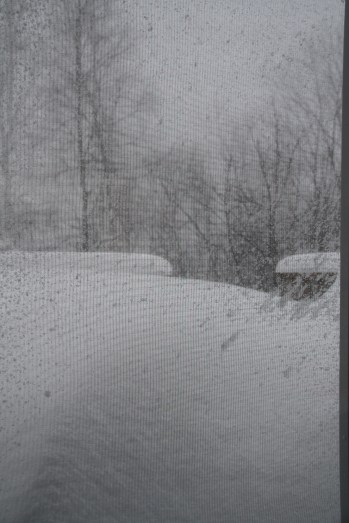
The white wolf of winter
exits her den-warmth and
shakes cold from her coat. Snow
flies, whitening the world.

She points her nose skywards,
clears her throat until
cold winds howl a chorus:
crystals, crunchy crisp.

We cower behind wood
walls, peer out through steamed
up glass. The white wolf draws
near. She huffs and she puffs.

The snow drifts climb higher,
blotting out the light. Night
falls, an all-embracing
Arctic night of endless

snow snakes slithering on
ice-bound, frost glass highways,
side roads and city streets.
Outside, in the street lights’

flicker, snow flies gather.
Thicker than summer moths,
they drop to the ground, form
ever-deepening drifts.

Our dreams become nightmares:
endless, sleepless nights, filled
with the white wolf’s winter
call for even more snow.

Sun and Moon 11

IMG0076_1


Sun and Moon 11

nochebuena[1] – a star spreading crimson fire
girasol – bright mirror to his golden face
colibri – hovering on a whirr of wings

am I less than a flower or a bird?

if my fingers could grow feathers…
if my face could sprout petals and leaves…

hollow bones whistle a sad song
the sailor lost at sea
the wanderer asleep in foreign soil

both far from home

[1] Nochebuena / Poinsettia; girasol / sunflower; colibri / humming bird.

Sun and Moon 10

img_0165


Sun and Moon 10

Sun thrusts his fierce face
through night’s dark window
his voice booms out like a golden gong

“What have you done with my child?

curled and flaming his orange corona
head lucent with a coronet of radiance and fire
his eyes sweep night beneath day’s rug

New Moon pales and fades in a corner
Serpent escapes through a crack in the wall


Sun and Moon 8

img_0165


Sun and Moon 8

draped across night’s blackboard
stars and constellations all erased

my black angel bruised by the dark
the world’s feathered wonder reduced to shadow and ash

what dreams are these?

feathers against night’s window
an angel of darkness descending a steep stairway
tumbling through the night

who’s dreams are these?


Sun and Moon 7

img0137_1

Sun and Moon 7

Old Woman weaves a crinoline from stars
she plucks roses from the void and turns them into haloes
nochebuena blossoms on the perfume of her breath

the cardinal’s song is a crimson voice hidden among leaves
mercurial in the moonlight
Old Woman coils her relentless cage

one by one the cardinal’s tunes are imprisoned
a butterfly impaled on a moonbeam
the last note of his song


Sun and Moon 5

IMG0023_1


Sun and Moon 5

dusky shawl of a knitted dream
wrapped round my shoulders
I pick at knots of tangled memory

a word as sharp as a stone
cast at a friend
sea shells cutting
naked feet
at the water’s edge
sunlight
weeping blood
over mother-of-pearl

Old Woman winds
a ball of wool
she handcuffs my wrists
with softness
spun from lambs
my hair turns silver in her mirror

snakelike I slide into my dream
slipping sideways
deep dark well of night


Sun and Moon 4

IMG0023_1

Sun and Moon 4

night without moon without stars
dark sand dropping
filling my mouth
I walk the lonely bed of a dried up river

when I stumble in my dream
my feet leave no footprints
colourless is my path
through shadow and sand

figures of darkness
conjured before me
hollow their eyes
their mouths black caverns
no flesh decks their bones

footless they sigh
a sibilant song
mindless they draw in
a net full of sorrows

silver fish darkling
losing their sparkle


A Multiple Trick Pony?

img_0363

Are All Writers ‘One-Trick Ponies’?

Forgive me, but I quote:

“Okay, who is the better writer; Fredericton’s Roger Moore, or Britain’s JK Rowling? (Harry Potter fans aren’t allowed to vote!) Some would argue Ms. Rowling, because of the vast number of book sales she’s enjoyed. Others would argue—compellingly—Mr. Moore, because of the diversity of writing he’s excelled at. Ms. Rowling has written a brilliant fantasy series, as well as a fairly average murder mystery. Mr. Moore has written literary analysis, reams of poetry, fiction (flash and otherwise), essays, academia, non-fiction and much more.

Where am I going with this? Two things occur to me as I perform this ridiculous compare-&-contrast between these two fine writers. My first thought is it’s madness to compare two very different writers and think you’ll arrive at a valid conclusion. My second thought is one of wonder. Writing a book is hard work. Writing a series is really hard work! Writing a series in a certain subject matter, and then switching to a different genre or subject matter is, well, taking the challenge up another notch. I admire those who attempt it, and until now, I’ve wished them well as I plodded along on my one-track series.”

For the full article, click on …

http://allanhudson.blogspot.ca/search?updated-max=2017-02-11T07:22:00-04:00&max-results=7

Comment:

Thank you, Chuck. However, I would remind you all that April 1 is April Fool’s Day / Le Jour des Poissons d’Avril. I would have expected this to appear on April 1, before midday.

March 1 is St. David’s Day, Dewi Sant, the patron saint of Wales. I take the above quote with a large pinch of salt, thrown over the shoulder.

Meanwhile,  I am avoiding black cats, will not walk under ladders, will not walk in toadstool rings, and am not stepping on cracks in the sidewalk in spite of the frost and snow.

“For whether we last
the night or no,
I’m sure is only
touch and go.”

Dylan Thomas … a poet, and a very good one, from my own home town.


Alebrijes or Inspiration

alebrije2

 Alebrijes or Inspiration

 Are they half-grasped dreams
that wake, wide eyed, to a new day’s sun?

Or are they alive and thriving
when they fall from the tree?

Does the carver fish their color and shape
from his own interior sea?

Or does he watch and wait for the spirit
to emerge from its wooden cocoon
to be reborn in a fiery block of color?

Daybreak:
in a secluded corner of my waking mind,
my neighbor’s dog greets the dawn:
sparks of bright color born from his barks.

My waking dream:
dark angels with butterfly bodies,
their inverted wings spread over my head
keeping me comforted.

In the town square, the  artist
plucks dreams from my head
and paints them on carved wood.

Comment:   Alebrijes step out from dried wood and stand in the shower of paint that falls from the brush’s tip. Yellow flash of lightning, pointillistic rain, garish colors that mirror those of the códices. The carvings take the form of fantasy figures, anthropomorphic animals,
 and mythological creatures.

Sometimes one individual selects the wood, carves it, then covers it in paint. Occasionally an entire family takes part in the work of making the alebrije. One person collects the wood and prepares it for carving. Another carves and sands it. A third works on the undercoat, and a fourth applies the final patterns of paint.

The great debate: does the form in the wood 
reveal itself to the carver
 or do the carvers impose their own visions on the wood? In the case of the team, do the family members debate and come to a joint conclusion?

These thoughts, exchanged with wood-carvers in Oaxaca, have led to a series of interesting conversations. What exactly is creativity? Where does it come from? Do we, as artists, impose it upon our creations? Or do we merely observe and watch as new ideas float to the surface of our minds? How does the creative mind function? And, by extension, how much of the sub-conscious creative sequence can be placed into words?

These questions lead us into our own minds. How do we, as writers, frame our inspiration? Do we wait for the muse to descend? And what if she or he (for there are masculine muses, too) doesn’t? Does this waiting for the muse lead us into the dreaded realm of Writer’s Block where we sit and twiddle our thumbs and wait and hope? Or does it lead us into the land of positive expectations where we use basic writing exercises and look for inspiration among our thoughts and words?

A practical solution for inspiration is regular writing in the journal … regular writing. From this practice, we soon learn to recognize beauty for we often generate small gems that can be dug out and polished. Sure, there is a great deal of dross, but a good wood carving leaves lots of shavings, and a few cut thumbs. That’s the nature of artistic discovery … and remember, it is the beauty in ourselves and the world around us that we are seeing and describing. Reading the words of others also generates small sparks to which we respond and the corresponding interplay of ‘their words with ours’ is not to be under-estimated.

By extension, the Bakhtinian Chronotopos is also important: man’s dialog with his time and place. Bahktin uses the masculine ‘man’; a woman’s dialog may well differ, but her dialog with her time and her place is equally as important as a man’s. Sometimes more so, and we do not pay sufficient attention to this fact. That said, we must always remember St. Teresa of Avila’s delightful line: “También anda Dios en la cocina entre las pucheras” / God also walks in the kitchen among the pots and pans.

One of our tasks, as writers, is to find the beauty of our time and place. It may seem insignificant at first for we are such tiny beings in an enormous and often anonymous universe, but when we sit in the sunshine and see the dust motes rise and count the angels dancing in the sunbeams before our eyes, we are indeed witnessing the daily beauty that surrounds us. It is our task to name that beauty and to describe it. And remember, too, that it is there in the flying snowflakes, in the pale disc of the sun peering through clouds, in the slide of the raindrop down the window pane.

My job as a writer, as I see and feel it, is to sense and see the beauty that surrounds me. Then my task is to describe it and bear witness to it. To bear witness … sometimes, that beauty is brutal and the bearing witness is painful in itself. The knife or chisel slips, the blood flows, and the musty cobwebs applied to the open wound seem to do no staunching. But there is beauty in injury too and we must also bear witness to the brutal beauty of blood.

Such brutal beauty can be found in Tanya Cliff’s latest book, A Haiku for Ricky Baker. In this volume of poetry, Tanya exposes some of the problems inherent in child abuse.  Her inspiration is taken from real events and her poems describe the lives of real people. This poetry reveals the color of blood and hurts with the deep slice of the knife into the carver’s thumb. Tanya has two main tasks: the first is to bear witness and the second is to gather funds by offering the proceeds from this collection to the very children who need help. I wish her all the best in her endeavor and I encourage all my readers to explore this project of Tanya’s for themselves.

The Dancer 10, 11 /11

IMG_0068

10

on Monte Albán the danzantes
sway to soft music
their shadows dance in and on stone
as they have danced for centuries

wind rustles the grass
moon casts sharp shapes

darkness ascends the temple steps
huge fingers grasping upwards
an owl’s feathers clutching at the skies

at dawn tomorrow
the sun will rise beneath our feet
we will squint down on its majesty
we will pluck the ripeness of its orange
in our outstretched hands

11

our last night together
I pluck a blossom from the tulipán tree
a final offering of my love

she gives it back
I place it in the pocket of flesh
where I once kept my heart

tomorrow when the flower breaks
it will stain my shirt
a damp splash of blood
no longer running in my veins

the scent of our happiness
will cling forever to my fingers