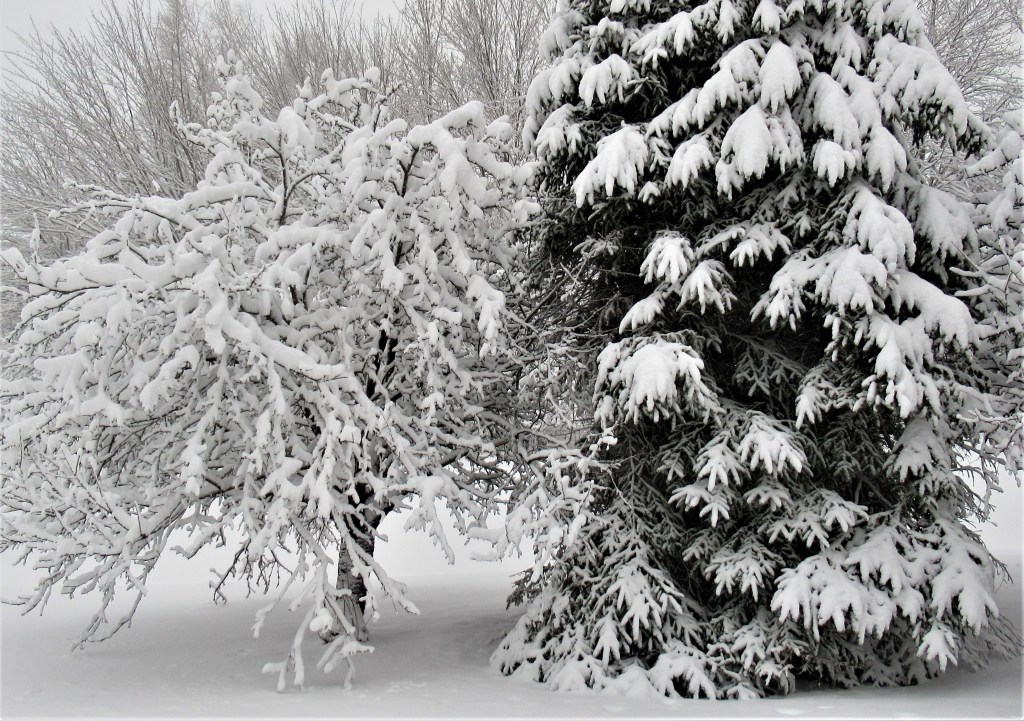
First Snow Blow

First Snow Blow
4 December 2023

A dry old stick of a man
I hang a warm coat
on my scarecrow frame
and don thick mitts
to keep out the cold.

Gripping grimly
the snowblower’s handles,
and hanging on tight,
I plod my wobbly way,
working the gears as I go.

The snowblower, this year,
is a recalcitrant shopping cart
with me, the shopper,
frantically pushing, pulling,
forcing the machine along
a narrow aisle of snow.

Out of breath, I stop,
breathe deep, and try to
regain control, first
of my heart and lungs,
and then of this machine
that so frustrates me.

It seems inanimate, but
some spirit must dwell within
and force me to follow
its devilish whim, instead
of going the way I want to go.

Comment:
Just the one snowfall so far, but there’s more on the way. Winter in New Brunswick, Canada, is never complete, without multiple falls of lovely snow. Lovely to look at, but not so much fun when you’re getting old and the snowblower snorts into life meaning that it’s time, once more, to go outside and clear the snow.
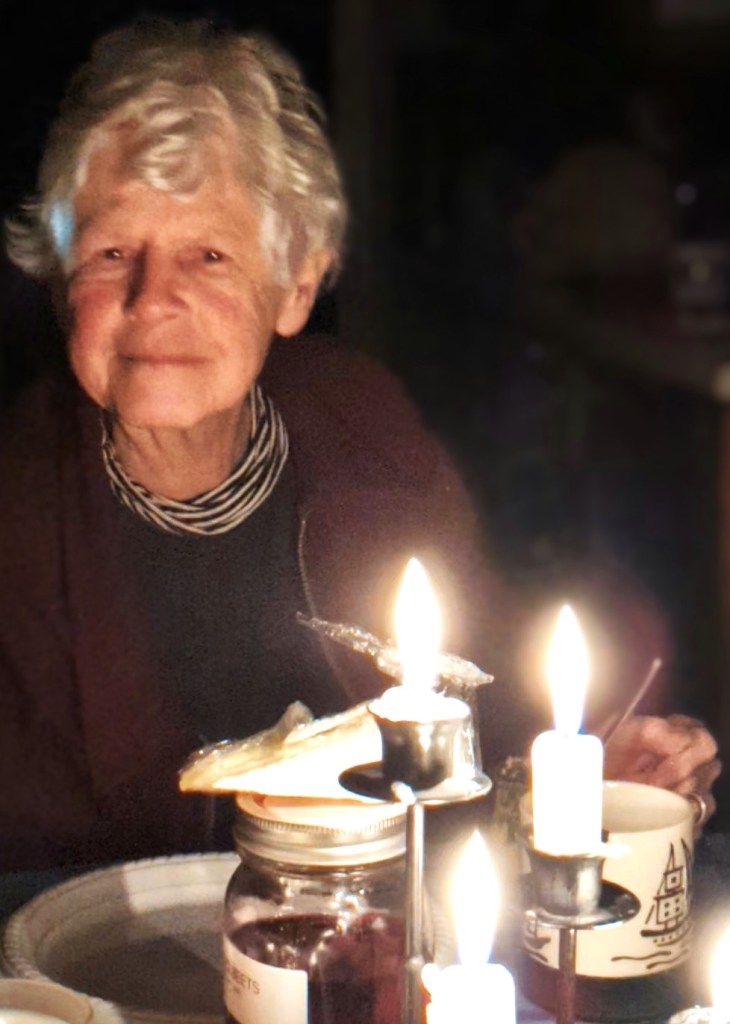
Clare by Candlelight

Clare
by candle-light

Flames flickering, her shadow presence
confirmed by the chiaro-oscuro
of extraction from the formlessness
formed by the lack of electric light.

Still no power. Each passing hour
creates new tensions in her face.
It is growing late, but still I will
try to capture the beauty of the one
who long ago sealed my fate.

What words can portray my beloved,
here beside me for sixty-two years,
and married for the last fifty-seven?

Words fail me. As this half-light,
drifting her among flickering shades,
fails to catch her, half-caught, half-seen,
a hyphenated-image in candle-light.

Comment:
Today is our 57th wedding anniversary. We have been together for 62 years. Blessings to all – and may you all be as happy as we have been. Long may it continue.

Change

1

Change

Waters rise, tides get higher,
streams wash roads away.
grey, rainy skies, day after day.

Temperatures drop down at night.
Water turns to ice. Northern Lights
burn bright, set the sky alight.

I forget my gloves. Fingers, cold,
fumble at buttons, and my zip
is not the easy zip of old.

My life cries out for change,
but change is out of reach.
I change the things I can arrange.

Some days I’m weary and sore.
Most days I can do no more.

2

Change

Waters rise, tides get higher,
streams wash roads away.
Grey, rainy skies, day after day.

Temperatures drop down at night.
Water turns to ice. Northern Lights
burn bright, setting the sky alight.

I forget my gloves. Fingers, cold,
fumble at buttons, and my zip
is not the easy zipper of old.

Some days I’m weary and sore.
Most days I can do no more.

My life cries out for change,
but most changes are out of reach.
I change the things I can arrange.

Comment:

I decided to change my format today and go back to the left margin alignment, rather than the central alignment that I usually use for poetry. Your comments on the adjustment would be welcome. I have included both formats so you can see how the poem flows in each one. As for this poem – a rhyming sonnet, wow!

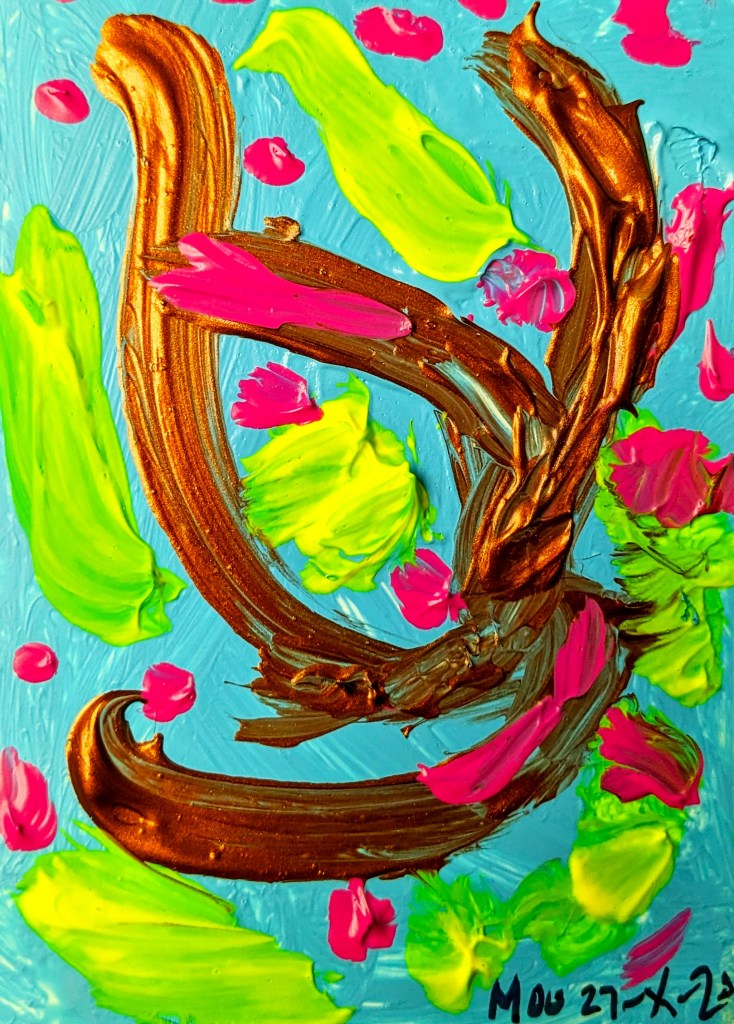
Moo’s painting, executed late last night, is his way of showing how rage can suddenly build and, like a runaway river, suddenly and unstoppably break out. It is extraordinary how his paintings so often mirror my moods and word flows.

My Knapsack

My Knapsack

Throughout my childhood,
I carried a knapsack on my back.
Into it I stuffed my darkest secrets.
Along with all my dirty washing
they filled every cranny and nook.

Words of hate, carved into my life-slate,
shuffled and cut, but unchanged,
unchangeable, remained engraved
on the tombstone I took from above
 the hole I dug to bury the casket
in which I hid the shards of my heart.

On a rainy day, when push came
to shove, I left my childhood home
to wander the world, alone, on my own.

I walked to the station, boarded a train
and never went back home again.

At journey’s end, I left my knapsack
and its contents in the luggage rack.
I never want to see them again.

Comment:
“Pack up your troubles in your old kit bag, and smile, smile, smile.” My maternal grandfather used to sing me this song from WWI. “While you’ve a Lucifer to light you fag, smile, boys, that’s the style.” I wonder how many people now remember what a Lucifer is, let alone a ‘fag’, in that sense of the word. It has, of course, morphed into many other meanings, some of them not necessarily pleasant. I remember my grandfather, standing in the kitchen, before the coal fire, and saying “I remember when Wills’ Woodbines were a penny a packet.” Wills’ is still with us, but may not be for much longer. I can’t remember when I last saw a Woodbine. I certainly never smoked one, in fact, I never ever smoked at all. But as for that kit bag aka knapsack aka backpack aka rucksack, well, put all your troubles in it, tie them up tight, and take it somewhere safe where you can leave it and forget about it, and then start life again. “Good-bye old friend, I am on the mend. And that’s the end.”

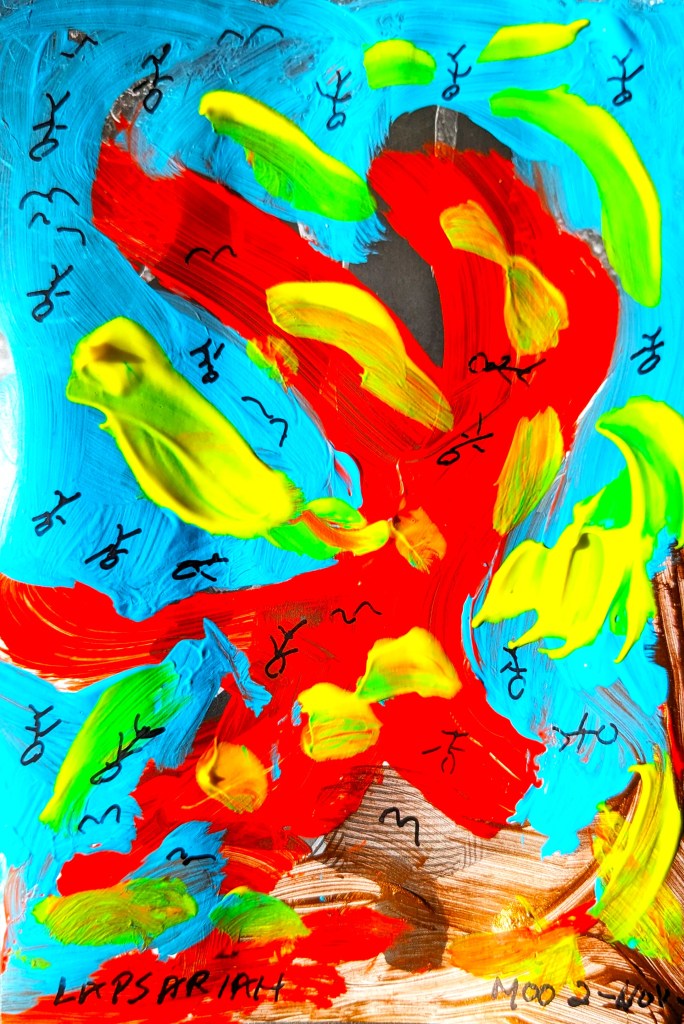
As for the painting, by my good friend Moo, that shows The Fall – Pre-Lapsarian / Post-Lapsarian – when all the devils, demons, and black angels were tumbled out of Paradise and abandoned to the depths below, where, alas, they still roam. So, if you meet any of them along the way, shove them in that old kit bag and get rid of them too. You’ll feel much better afterwards.

The Banks of the Seine

Banks of the Seine

Gnawing at the carcass of an old song,
my mind, a mindless dog, chasing its tail,
turning in circles, snapping at the fragment
of its own flesh, flag-flourished before it,
tournons, tournons, tournons toujours,
as Apollinaire phrased it, on a day
when I went dogless, walking on a mind-leash
before the Parisian bouquinistes who sold,
along the banks of the Seine, such tempting
merchandise, and me, hands in pockets,
penniless, tempted beyond measure,
by words, set out on pages, wondrous,
pages that, hands free, I turned, and turned,
plucking words, here and there, like a sparrow,
or a pigeon, picks at the crumbs thrown away
by pitying tramps, kings, fallen from chariots,
as Eluard wrote, and me, a pauper among riches,
an Oliver Twist, rising from my trance, hands out,
pleading, “Please, sir, can I have some more?”

Comment:
This is a fusion / confusion, if you like, of The Kingston Trio’s song – The Seine – with a quote each from Guillaume Apollinaire – Alcools – and Paul Eluard – Il ne m’est Paris que d’Elsa, and Francisco de Quevedo’s – El Buscon – and a tip of the old chapeau nouveau to R. S. Thomas and Charles Dickens. Fools rush in, I am afraid, where angels fear to tread. Go on. Rush right in. Sort it all out. I double-dog dare you – and thank you for that one, Jude.

Dark

Dark

The lights went out suddenly,
leaving me in the dark.
A cloudy night, not a spark
of starlight to light my way.

My search for candles was slow.
I found them, struck matches,
and sat at the table watching
light catch and flames glow.

A war baby – bombs, blackout
curtains, diminished light, all
are present in my DNA, and yet,
I fear the dark above all.

Like a moth, or a high plane
caught in a searchlight,
I struggle to escape from twin
siren calls: fire and light.

I sat and waited for power
to return. An hour, two hours,
three, four. Then I couldn’t wait
any more. I climbed the steep,
wood hill that led to bed.

At the top of the stairs
a plea for light filled my head
and a plea for the return
of light formed the focus
for long-forgotten prayers.

Comment:
We lost power for 15 hours a couple of weeks ago. One moment we were sitting there, after supper, ruminating quietly, with the lights on. The next, we were sitting in the dark. We found a flashlight – light but no warmth. Then moved on to candles. Candles need matches. When the ingredients were ready, we struck the matches to light the candles. These were the first three we lit.

We are so lucky. Sure, it was an awkward night. But it was only fifteen hours. We talked about the homeless, their poverty, often in the middle of such wealth, the poor who have homes, but who cannot afford to light them or heat them, the innocent victims in war zones, powerless in every sense of the word, deprived of light, heat, water, plumbing, sanitation. Our prayers that night included them as well – all of them.

Doubts

Doubts

At midnight,
when that dark owl calls,
I sip a bitter wine.

The thoughts I think
are not my thoughts,
how could they ever
be mine?

And yet they are
the thoughts I think,
and round and round
they twine.

They wrap me in
a thousand threads
and none of them
are mine.

Whose are they then,
these thoughts I think?
They do not come from me.

And yet they make me
double think
this person that is me,
and who I am,
and what I am,
and where I’m going to be.

Comment:
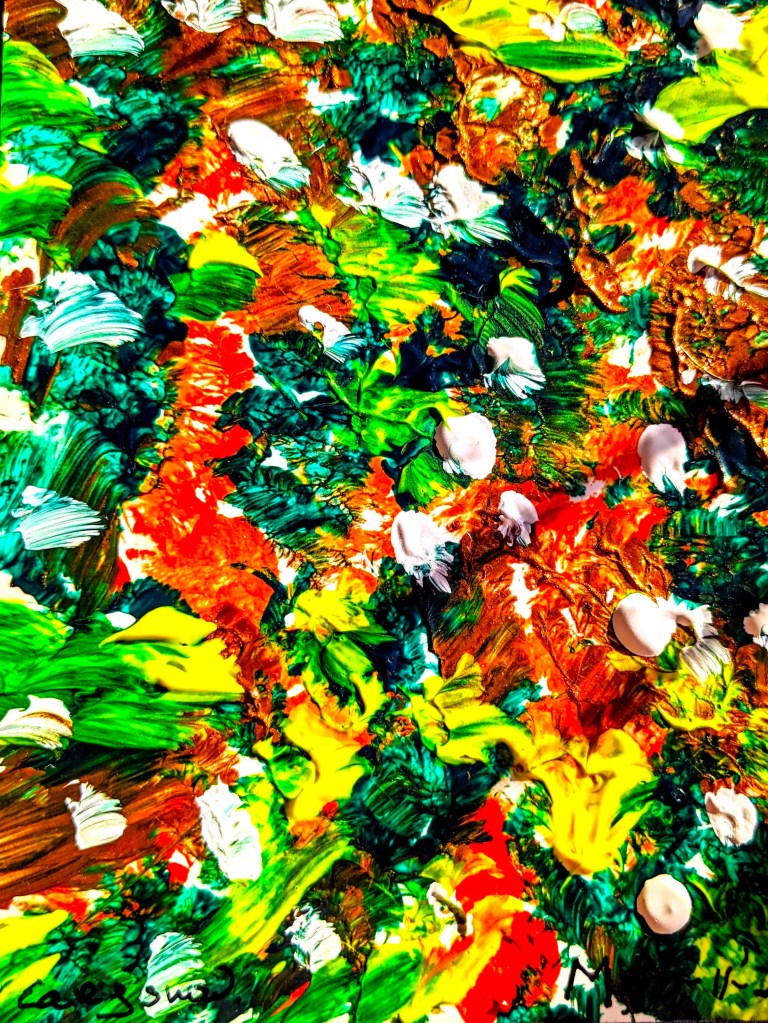
I guess that’s what happens when you finish your bottled sunshine (sol embotellado) before going to bed. The painting and the poem match up nicely though, ribbons of dark thought streaming through an empty head. Guessing and double-guessing, thinking and double-thinking, doubting and finding yourself inside that great cloud of unknowing in which you rarely know where you are going. Still, if you don’t know where you are going, any road will take you there. Pen-y-Bont, anyone? Or Abertawe, Cas Newydd, Llandeilo, Caerfili, Rhiwbina, Treorci, Trebanog

Magnolia

Magnolia

She stands there, at the garden gate, waiting for me.
I can see the scene, the flower beds, the magnolia
bleeding, in Wales, its soft, spring snow of ivory pearls.

Some fall on her head, crowning her with a beauty
more precious than frankincense or myrrh. Petals
also perch their pure, ermine cape on her shoulders.

She walks towards me, eyes shining, arms open.
Then, the vision fades and she drifts away, leaving me
alone, my face bathed in the tears of her passing.

For pass each other by, we did. Ships in the night,
trains rushing through a tunnel of darkness, bathed,
for an instant, in the constellation of a station’s light.

Now, when I try to go back and to recreate that scene,
I find an empty garden, fallen leaves, and winter’s cold.

Comment:
I have been struck recently by the number of published articles that speak of post-Covid loneliness and the difficulties of re-establishing old friendships that fell by the wayside, let alone establishing new ones. It seems to get harder and harder, as we age, to leave our post-Covid isolation, to get out of our new comfort zones – sometimes so limited and limiting – and to make new friends. As we age, our minds go backwards and we return to earlier days and happier memories. Yet all too often those memories are tinged with the sepia sadness of old photos, from a non-digital age, faded and stained.

Bay of Santander – 1963

Bay of Santander
1963

I stood there
on the sea wall
calling out to the dark
“Help!” “Save me!”

Moon hid her face
behind veiled clouds.
All hope denied
I called out to the tide,

outgoing, to take me
with it, out to sea,
past the island
and the lighthouse,

out to where the waves,
stronger than anything
I ever knew, would thrust
strong fingers under my arms

and lift me up,
then drag me down,
so I could finally rest
in peace, and drown.

Comment:
This painting is called Picking at Scars. Some scars run so deep that they are always there. When they itch, you scratch them, and they bleed afresh. The scar of loneliness is one such scar. Alone, in a foreign land, learning their language, the culture, their customs, feeling not just unaccepted, but unacceptable, and the moon at night shining on a land, a bay, a city, to which you know, deep in your heart, you will never belong. That loneliness walks with me still and, sixty years later, it still leaves me desolate.

Limbo

Limbo

I live with my head in the clouds.
What clouds you ask – Alto-Stratus,
Nimbus, Cumuli-Nimbus?

No, I reply, none of those.
At one level I build cloud castles,
in Spain, as they say in French.

But, at another level,
I find myself lost in the medieval
cloud of unknowing, this mental limbo.

Here, grey mists weave spider-webs
of doubt that glisten with dew, and sparkle
with the two-edged sword of thought.

Here, I feel my life-web tremble
and I realize that I alone can walk
this way and try to understand

how frail threads catch small flies,
how words tell stories, but not the story
of all I know, nor where my world will go.

Comment:
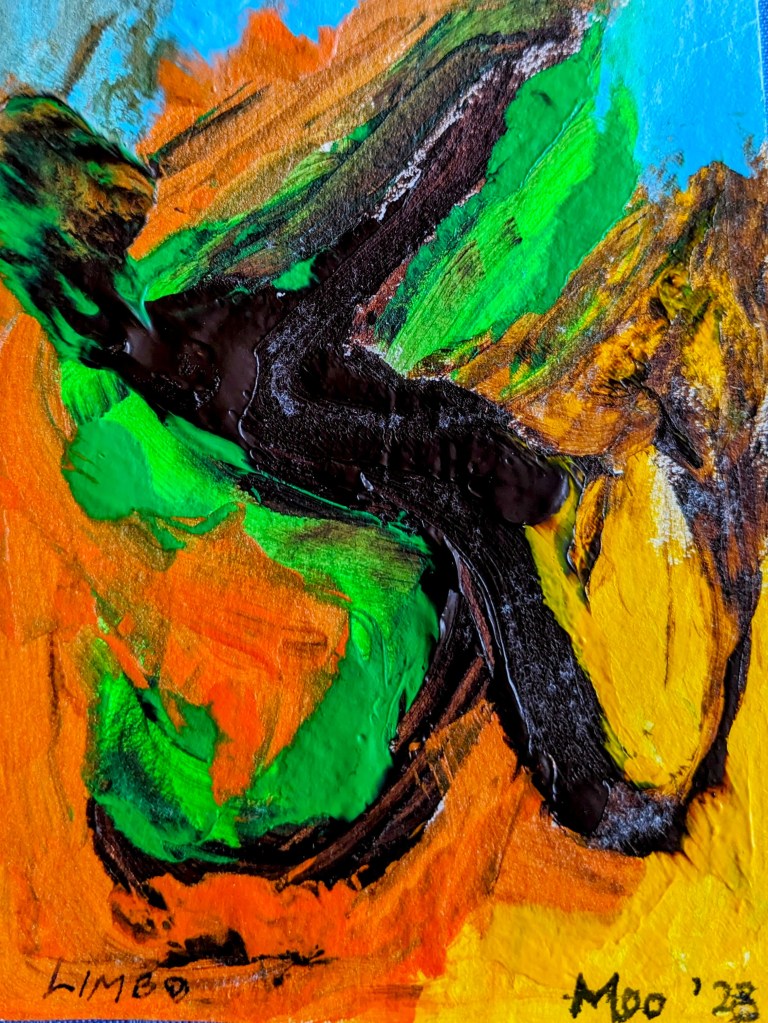
Once more I have linked verbal and visual images. Moo’s painting above – thank you, Moo, – called Limbo, depicts a limbo dancer while my poem expresses the reality of that internal space in which creative spirits sometimes find themselves. It is a sort of Limbo of the mind, in which thoughts appear, dance along the frail threads of the mind’s web, yet never really materialize into formal verse or poetic patterns. This is also the lost world of the dreamer. But remember, the dreamers of the day are dangerous people, because sometimes they make their dreams come true.