Gaia Sun & Moon

IMG0073_1.jpg

Gaia

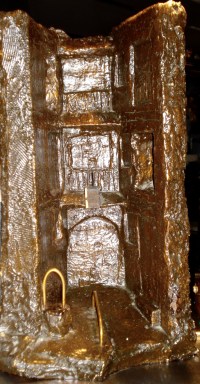
Worshipping the Earth Goddess, Gaia,
before the great altar in Santo Domingo

If the goddess is not carried in your heart
like a warm loaf in a paper bag beneath your shirt
you will never discover her hiding place.

She does not sip ambrosia from these golden flowers,
nor does she climb this vine
to mount to her heavenly throne,
nor does she recline in majesty
a pantocrator in a mandala frowning down.

In spite of the sunshine trapped in all this gold
the church is cold and overwhelming.

Tourists come with cameras
not the people with their prayers.

My only warmth and comfort:
not in this god who bids the lily gilded
but in that quieter voice that speaks within me,

bringing me light amidst all this darkness,
bringing me poverty amidst all this gold.


Tomb 104, Monte Albán: Sun & Moon

IMG_0181.jpg

Tomb 104, Monte Albán

 Crocodile wraps bat in the carved
crocodile jaws that open the doors to hell.

Cocijo clutches Owl’s feathers.
He wears a feathered headdress
as he flies on Owl’s back.

 At the back of the tomb,

a darker world hides in the shadows
beyond the finger of our flashlight:
hidden galleries,
carved and painted bones.

 Our torch
plucks faces from the dark.

 Brought back to life by our unsteady light,
shadows walk grey bristles
across cheek and jaw.

We blink like owls as we ascend
from the underground darkness.

Up here, in the false world,
the one we know and love,
our hearts sing like wild birds,
caged between red ribs.

 Above us,
the pocked skull of the moon,
bares white rabbit’s teeth.

 Tochtli
knows that life’s only reality
lies in wait for us

underground.

Sun & Moon

IMG_0231 (2).jpg

Sun and Moon was published on Amazon and Kindle today. This is the second (revised) edition of Sun and Moon, the first edition having been published in 2000. Although this is the second edition, I have returned to and revised the original manuscript. It is clearer, stronger, and better than the first edition. Here is the description of the book as it appears on Amazon and Kindle.

“They tore down our walls,” Mono whispered, “stone by stone. A new church they built on the land they stole from us.” These opening lines begin the verbal adventure of Sun and Moon. Written in Oaxaca, Mexico, between 1995 and 1999, the poems tell some of the tales  of the voiceless, of the conquered, of the displaced, of the survivors, of the people who eat and sleep in the streets of Oaxaca, spinning their myths and legends and recalling their oral histories and memories. Sun and Moon traces the relationships between two civilizations, the indigenous and the conquerors, from the first contacts between Europeans and the people of the Oaxaca Valley up to the modern day interactions between locals and tourists. In these pages, some of the ancient ceremonies and beliefs, as described by indigenous people, are brought back to life in vivid images and colorful metaphors, so sharp, they can be grasped between the fingers and examined by the light of the sun by day and the moon by night. The multiple voices in the poems are those of human beings who, like the author, himself an émigré, find themselves in exile, lost, abandoned, and displaced. As the final character cries out in the final poem: “You do not worship at our sacred places … you don’t know even know the meaning of my name.”

Inquisitor: Sun & Moon

IMG_0184.jpg

Inquisitor

He told me to read,
and plucked my left eye from its orbit.
He slashed the glowing globe of the other.

 Knowledge leaked out:
loose threads dangling,
the reverse side of a tapestry.

 He told me to speak and squeezed
dry dust between my teeth.
I spouted a diet of Catechism and Confession.

He emptied my mind of poetry and history.
He destroyed the myths of my people.
He filled me with fantasies from a far off land.

I live in a desert where people die of thirst,
yet he talked to me of a man who walked on water.

 On all sides, as stubborn as stucco,
the prison walls listened, and learned.

 I counted the years with feeble scratches.

For an hour, each day, the sun shone on my face;
for an hour, each night, the moon kept me company.

Broken worlds lay shattered inside me.
Dust gathered in my people’s dictionary.
My heart was a weathered stone
withering within my chest.

 I longed for the witch doctor’s magic,
for the healing slash of wind and rain.

 The Inquisitor told me to write out our history:

I wrote
how his church
had come
to save us.

Note: I am still working on Sun and Moon. It will be ready for publication on Amazon and Kindle some time this week. Monkey Temple, Though Lovers Be Lost, Bistro, and Empress of Ireland are now available for review or purchase on Amazon and Kindle.

Empress: A Survivor Contemplates

15 May 2002 Pre-Rimouski 141.jpg

A Survivor Contemplates
the Crucifix on the Point
Ste. Luce-sur-mer

Christ of the Rocks
hanging here on the point
from the crucifix
with your open eyes:

do you see, out at sea,
where gray waves cover
the graveyard of the Empress,
at rest, her passengers,
caressed beneath shallow waters.

They have gone on before me,
those friends I numbered,
their piercing eyes
lie covered now.

Splayed toes:
last night’s footprints
erased by wind-blown
dust and sand.

 Dry crunch of skull and skeleton
crushed underfoot by sea boots
ascending, descending
the beach’s gentle slope.

Unknown,
these lands around me:
emitte lucem tuam /
send forth Thy light!

 Unexplored,
these mountains that surround me:
ipsa me deduxerunt /
such things have led me on.

 Unsolved,
these mysteries that confound me:
in montem sanctum tuum /
unto Thy holy hill …
in nomine Patris /
… in the name of the Father.

 I wander from grave to grave,
reading the headstones:
quare me repulisti? /
why hast Thou cast me off?

Coarse grass weaves bindweed
with columbines combining.

Incessant mourning of glove grey
morning doves,
drawing tears from dawn’s face:
quare tristis incedo? /
why do I go sorrowful?

 Verdant stems,
unsophisticated flowers,
weeds dark between stark
granite stones.

 Names!
Whose names?
My long lost brothers’ names,
Eric, Phillip, Peter,
not yet carved in stone:

 non in tabernacula tua /
not yet in Thy tabernacle.

 This churchyard,
will it always be
as steady as a headland
even in a storm?

 Here, the terrestrial
centre is stable:
quare tristis es, anima mea? /
why art thou sad, oh my soul?

 The ark on the waters
moves from side to side,
lulled by the sea waves,
up and down.

 On the altar,
a gilded chalice,far from the far flung
malice of the sea:
quare conturbas me? /
why dost thou disquiet me?

Empress: Graveyard on the Point

Empress 314.jpg

Graveyard on the Point:
A Survivor Remembers his Catechism
Ste. Luce-sur-mer

The survivor at the cross roads,
wreathed in his personal storm:

et discerne causam meam /
… and distinguish my cause

de gente non sancta… /
from the unholy nation.

Rising waves:
bells on buoys
peal out sea warnings.

Tonight there is a grief across the grève.

Sa griffe / his claw,
ma griffe / my claw
homophonic puns

scratching at reality’s surface,
hiding inner meanings,
leaving the depths unplumbed.

Did he really paint
the reality of the shipwreck,
this Magritte?

 Cette pipe, qui n’est pas une pipe! /
This pipe which isn’t a pipe!

Mi grito que no es un grito! /
My cry which isn’t a cry!

Cette vie qui n’est plus une vie!
This life which is no longer a life!

This littoral bay
no longer a literal bay.

ab homine iniquo et doloso erue me /
from the unjust and deceitful man deliver me.

Over bird frosted rocks,
a ring billed gull cries out whose name
on its early journey to greet pale stars?

 On the beach at the cross’s foot,
a grey robed pilgrim

stands in dusk’s failing light.

et introibo ad altare Dei:
ad Deum, qui laetificat juventutem meam
/

and I will go unto the altar of God:
to God, who giveth joy to my youth.

Mouettes, göelands muets:
sea gulls, silent sea gulls:
white arrows shot over sea wet sand.

He stands solemn before this graven stone
waiting to be blessed:

 sicut erat in principio, et nunc, et semper /
as it was in the beginning, is now, and ever shall be …

The eider duck sigh for their siblings,
tossed from the crèche and lost
in the long low swirl of the sea.

Empress: A Survivor Lights a Candle

Empress 233.jpg

A Survivor Lights a Candle
During the Latin Mass for the Dead
Before the Main Altar
at the Sanctuaire Sainte-Anne
Pointe-au-Père

I am afraid of fire:

 in principio erat verbum /
in the beginning was the word.

 I am afraid of the loud voice of the match
scratching its sudden flare,

narrowing my pupils,
enlarging the whites of my eyes:

 et lux in tenebris lucet /
and light shines in darkness.

Booming and blooming,
igniting the soul’s dark night.

Voice of fire:

et Deus erat verbum /
and the Word was God.

 Flourishing to nourishment,
flames whispering on the flood:

omnia per ipsum facta sunt /
all things were made by Him.

Wool and water,
this sodden safety blanket;
and what of the cold plush

of the pliant teddy bear,
the staring eyes of the doll:

et tenebrae eam non comprehenderunt /
and the darkness comprehended it not.

The lashes of their eyes
bound together with salt water,

they were doused in a silken mist:

hic venit in testimonium /
this served as a witness.

 Still the patterns pierce my sleep,
hauling me from my opaque dreams,

holding my wrists in this sailor’s double clasp:

 non erat ille lux /
he was not the light.

Oh! Curse these dumb waters rising!

“Not a hair on your head
shall be harmed!” he said,
hauling my sister up by her hair

only to find her staring eyes
belonging to the already dead:

et mundus eam non cognovit /
and the world knew her not.

Night waters rising.

The moon raising
its pale thin lantern glow:

et vidimus gloriam ejus /
and we saw His glory

 shining forth
upon the waters’
mirrored face.

Dark Night of the Empress

15 May 2002 Pre-Rimouski 035.jpg

Dark Night of the Empress

 Her cooled lights drowning now,
fires subsiding, dying under rising waters.

Grit and river-bottom clog the dream:
eyes and mouths wide open, faces blurred.

 Seaweed: mermaid’s hair
drifting slowly before the eyes;

the cold tide sucking in at ankle and heel,
pulling them down.

 Celluloid fictions,
black and white films,
their mouths stretched in a silent scream.

What became of the photographers,
of the men and women who stood their ground
clicking their cameras in unison
as the ship went down?

News!
The air breaks apart:
delirious with dots and devious dashes.

 The lighthouse light goes round and round.

It points a finger of silence at the collier
looming silent through the mist.

What price the black pearl in the oyster?

 What price the nightmare,
cleanly wrapped in transparent plastic,
desperate fingers tearing the see-through
fabric from the face?

 Salt water dashed on mouth and lips,
this dream:
sharp bows, wet rocks, and a tugging tide.

Toys and boys and dolls and girls
and men and women,
their bodies disgorged untidily,
their useless limbs
flopping at the sea’s foamed edge.

 Last night,
mist shredded itself on the sea-cradled headland.

This morning, the spring tide is a gentle hand
erasing life’s autographs from the witnessing sand.

Silence after the storm:

a pocket full of posies
gathered into a dreamless sleep

they have all fallen down ….

Monkey FAQs

IMG_0185.jpg

I have a busy day today, so a brief post: two poems. The first, Monkey FAQs, comes from Monkey Temple, a book of poems now (or soon to be) available at Amazon. I am also working on preparing the text of Though Lovers Be Lost for publishing, again at Amazon. My thanks go out to all who commented on these poems and thus assisted me in revising them for publication. So, a busy day.

Monkey FAQs
(with apologies to all those who draw them up
at their work place, knowing they will never be read)

“What news from the ark?”

“Only the dark waves pounding the hull, the wet winds blowing.”

“Who placed the whale ribs on this mountain
and called them a cathedral?”

“Sunshine blossoms through hollow vaults and shadows shimmer.
The day is striped across my back
and I bear its weight like a beast of burden.”

“When the anvil rings out, will the armorers appear?”

“When I snatched a blade of grass, its fine glass sliced my finger.
Yet, when I grasped the nettle, its swan-song perished in sunlight.”

 “Who will forge chains for sun and moon?

“The peregrine falcon slices my eye in two and I am a mole,
blind with a weather’s wind.”

“Who will carve a cell door for errant stars?”

“I snuffle round the tightness of the temple clock:
its legion of Roman numerals marches to the beat
of a dull, dry pendulum.”

“Why are there no birds in last year’s nests?”

“The ox tongue sandwich on which I snack
talks back to the lettuce and salt clogs the tomato.”

“Why are you avoiding these questions?”

“Speak up: the wind is high. I can no longer hear you.”

April Fools

When we were young
we used to wake up
at night and
come
together.

Now we are old,
we wake up
at night and
go
together.

Dialogue: Wednesday’s Workshop

IMG_0146 (1).jpg

Dialog / Dialogue

The Tuesday night writing group that I meet with is very small. It currently consists of four members (Chuck, John, Kevin, and Roger), though it was larger. Several members dropped out for sundry reasons, but we four get on well and we have continued our Tuesday sessions for a long time now. We usually concentrate on discussions, sharing ideas, and encouragement rather than on anything else. We also share work in progress by e-mail for commentary online and we throw out current writing difficulties for discussion by the group. We also indulge in other activities. For example, on Monday last, John, one of the group members, visited me at home and kindly showed me how to process a manuscript for publication on Amazon’s CreateSpace. This was a first for me, though John, a very accomplished writer, has some twenty novels published in this fashion.

I thought it might be of interest to set out elements of the discussion that took place yesterday evening at The Second Cup Coffee Shop. Here are the notes, slightly amplified, that I sent round the group.

  1. We began by asking Chuck if he had benefitted from the previous week’s conversation, when he had set out a problem situation from his novel that we had all explored. He outlined briefly how he had responded to our suggestions.
  2. He then noted that some people can write dialogue with ease, others can’t, and illustrated this with info from a workshop he had given in which 13 of the 14 submitted manuscripts were narratives without dialog, and only one contained dialogue.
  3. This led us in several different directions and we opened with using telephone messages as a means of conveying information and also as a back up to “mysterious” dialog –can you hear both ends of the conversation?
  4. This in turn developed into texting and tweeting and electronics and from here we talked about the potentially deleterious effects of social media on conversational skills, and hence lack of dialog in society.
  5. Computer techniques and knowledge at a cross-words + game play + thought play + voice interaction to rival or replace writing novels came into the conversation and we added some comments on writing by dictation and computer transcribing of voice.
  6. The question of the historical development of the Dialogue form was opened: can Plato’s dialogues be considered monologues since many of the responses to Socrates are of the ‘yessir, nossir, three bags full sir” variety. We talked about creating action via dialogue and compared the modern newscast to the Medieval visitor who tells his audience what happened ‘over there’ and answered questions set by them. We also mentioned some dialogued novels of the 15th 16th C.
  7. The transition of the Quixote from single character (I, 1-5) to double character (the rest of the book) and the important role that dialogue played in the development of Cervantes’s novel also came forward. This led to the use and development of dialogue in other novels. We discussed dialogue on TV with reference to As Time Goes By and the Midsomer Murders. We discussed dialogue as a composite of what is said, how it is said, how it is delivered, and we emphasized the importance of timing of dialogue.
  8. We ended with a brief discussion of the age effect and development of narrative and dialog in children, especially in light of the effects of electronics on young developing minds and the substitution of screen for dialog.

Kevin was absent last night, but John and Chuck agreed to contribute a paragraph each in which they show their use of dialogue. I have added a poem in dialogue, just for the fun of showing a different usage. These are by no means state of the art models of how to proceed. They are examples of the type of work we are doing. Electronic links follow each example where appropriate.

Chuck Bowie: Steal it all.

“You know you got off lucky, Hendricks. It would have been so much easier, and given me so much more pleasure to have put the two slugs through that melon of yours. Now, get up. I want your seat.” While he spoke, he drew the blind closed. Walking over to the side of the small room, he turned off the ceiling light, leaving them with just the desk lamp to view one another.

Ace hauled his massive bulk out of the chair and shuffled around to the side of the office nearest the door. He eased into a dusty metal chair, taking care to avoid touching anything with his right arm.

“Tell me this.” Donovan waved his gun at the arm. “Why is it when a guy hurts his arm, he limps? I never figured that out.” This elicited another curse from Hendricks, and his attacker tossed him a roll of paper towels, which he failed to catch. Both ignored the useless roll as it found its way into a corner of the office.

“I’m very interested to hear your story, Ace. You’ve hurt a lot of people, some of them my friends. Want to talk about it?”

“You go square to ‘ell. My men’ll be here in a minute, and that’ll be the last of you, mate.”

Donovan shook his head.

“You have no more men. They’re all dead. Twelve separate industrial accidents, is how I heard it. Plus the scum you sent to kill Gemma. She weighs one hundred-fifteen pounds, by the way. Just before she killed him with her bare hands, he probably apologized to every woman and child he ever bullied. Nope, all you have left is that old

man, tied up by the garbage bin outside. And your millions. Um, nope, you no longer have that, either. Shit, you’re not really in good shape, my friend.

“But here’s what I can do for you. I can kill you, to save you the mortification of seeing your failure in tomorrow’s headlines. Is now a good time?”

Hendricks shook his head, unsure if Donovan was serious. The cloth around his elbow had darkened, and a drop or two had begun to puddle on the floor beside him.

“Okay, then. Here’s what I’m willing to do. I’ll name a name, and you’ll tell me the story. The more names you chat about, the longer you get to live.”


Buy Link for Steal It All:

https://www.amazon.ca/s/ref=nb_sb_noss_2?url=search-alias%3Dstripbooks&field-keywords=Chuck+Bowie

John Sutherland: Convergence of Fates.

Before he drove off he decided to make another call. He’d better report what he had learned, to the Park Rangers in the Clark National Park. They’d had a bear go missing a couple of weeks earlier. The phone rang a few times before it was answered.

“Is Scott there, please?” Then, he recognized the voice.

“Melissa, it’s you” He identified himself. “Charlie Easton. Hudgin’s Mills. Remember that bear you told us to watch for, about ten days ago?”

He didn’t need to say any more, and nodded in response to her suddenly pointed questions, interrupting what he had been ready to say. Why anyone would nod into a telephone seemed a strange thing to do, but it was a reflexive action.

“It might be here. Hudgin’s Mills. At least, close to it. I just took two people into hospital. One of them had been attacked by a bear.” He listened for a while and responded as far as he could, giving her more details about his injuries.  She seemed satisfied that it had been a bear attack.

“Yes I can show you where I picked them up.” He listened further. “I don’t have a clue who he is, but I know the young woman. Susan Whitcomb. She’s….” Melissa seemed to know her, but of course she did; they were related in some way through her grandmother. He continued to nod.

“The Rollins road, ten miles out of town. The young man was pretty torn up, and bleeding like a stuck pig, but….”

Melissa cut into what he was saying and asked those questions important to her, getting the responses she needed to hear.

“It must have happened not long before I picked them up. Ten, maybe twenty minutes before. He was still bleeding. He didn’t say much, but he was conscious all of the drive in. I couldn’t see any injuries on her.

“It could be your bear. I thought I’d better tell you. From the looks of them, they should both be in the hospital for a day or two at least, maybe a week, for him, so you have time.” He listened further, and looked out at the weather.

“Rollins Road,” he repeated. “Where the river comes closest to the road and before it joins the main channel. Ten miles out, where it’s fordable. There’s only one place it does that. They were both wet, so they had waded across that river.”

He saw a flash of light and then heard a rumble of thunder about five seconds later (his subconscious told him it was about a mile away), and then responded again.

“I don’t know. You’d have to talk to him to find out where, exactly. You could probably follow his blood trail back on the other side of the river and find out, except for this rain. There’s only that one shallow place where they could have crossed, but it might not be passable by morning if we get the amount of rain they’re forecasting.

“If you call the Hospital in a couple of hours, they might be able to tell you something by then. Ask for Doctor Lewis. That young man I brought in might even be able to talk to you, if they let him. I’ll be home about midnight. You can call me there in the morning if you need my help to show you.”

From what Melissa said, Scott, her husband, the man to hunt that bear down, was already fairly close to Hudgin’s Mills on other business, so he’d be on his way as soon as she talked to him, and she wouldn’t be far behind.

“In the morning then.”

Charlie rang off, and decided that he should make one more call before he headed out.

https://www.amazon.com/John-K-Sutherland/e/B007C8DCCQ


Roger Moore: Monkey Temple.


Monkey FAQs
(with apologies to all those who draw them up
at their work place, knowing they will never be read)

“What news from the ark?”

“Only the dark waves pounding the hull, the wet winds blowing.”

“Who placed the whale ribs on this mountain
and called them a cathedral?”

“Sunshine blossoms through hollow vaults and shadows shimmer.
The day is striped across my back
and I bear its weight like a beast of burden.”

“When the anvil rings out, will the armorers appear?”

“When I snatched a blade of grass, its fine glass sliced my finger.
Yet, when I grasped the nettle, its swan-song perished in sunlight.”

 “Who will forge chains for sun and moon?

“The peregrine falcon slices my eye in two and I am a mole,
blind with a weather’s wind.”

“Who will carve a cell door for errant stars?”

“I snuffle round the tightness of the temple clock:
its legion of Roman numerals marches to the beat
of a dull, dry pendulum.”

“Why are there no birds in last year’s nests?”

“The ox tongue sandwich on which I snack
talks back to the lettuce and salt clogs the tomato.”

“Why are you avoiding these questions?”

“Speak up: the wind is high. I can no longer hear you.”

This Kevin Stephen’s  excerpt from DiAngelo: Revelations

“Can we talk Mel?” asked Caitlyn.

“Are we not? What is your mind?”

“I’m getting bad readings, like all the time, but you’ve been busy or gone for the last couple of weeks so I couldn’t talk to you.”

“Why not talk on our road trip?”

“Because. Everyone would think I sucked if I said that Tarot reading was confusing. Alex wouldn’t let me live it down.”

“Well, things are being… Vse ne tak. Crazy? For me lately. I have this moment. Ask your question.”

“For the last few weeks the Moon, the Hanged Man, and the Seven of Cups all came up in the same three positions, six, nine, and ten for everyone.”

“It is not impossible for people to be having same cards. Who is saying people do not have same outlook?”

“Well, in the last two weeks more than sixty people have had the same reading. You think that’s normal? I thought it might the sign of an impending natural disaster but then Roan came along.

“I thought the shared experience had passed when Roan pulled different cards but then he pulled the Death card in position nine time and time again. He even had that card face up when he drew a second copy of it. I didn’t have two Deaths in the deck but he really did look as surprised as I was. It had to have been a prank right? That’s what Fran thought.”