Truth & Lies

img_0177

Truth and Lies or Verisimilitude
Wednesday Workshop
05 April 2017

Miguel de Cervantes comes at truth and lies from a slightly different angle than most of us. In Don Quixote, he writes of verisimilitude (verosimilitud in Spanish) and defines it  in this way: “Tanto la mentira es mejor cuanto más parece verdadera” — The lie is so much better when it appears to be true.

Cervantes extends verisimilitude into perspectivism when an object, for example, the shaving bowl that turns into Mambrino’s helmet, is seen from different angles to represent different things.

Thus Sancho sees a barber’s bowl while Don Quixote sees a warrior’s helmet, specifically that of Mambrino. As Cervantes demonstrates, when both aspects can be held to be true, we are no longer dealing with a direct opposition, truth (barber’s bowl) versus fiction (Mambrino’s helmet). In fact we are dealing with a new reality, that of the basin which doubles as a helmet and the helmet that doubles as a basin. The compromise, in Cervantes’s Spanish, is to invent a new word, a new world, that of the baciyelmo, the first half of which is the basin (baci-) and the second half of which is the helmet (-yelmo). This blends two appearances together to form a new fictional reality upon which the protagonists can agree.

I like to think that this is what we are all doing when we write, forming a new fictional reality to create a new world. We do this when we combine our memories and our imaginations to create new truths. Perhaps it is the fuzziness around the edges, rather than true clarity,  that allows us to penetrate the mist of meaning and come up with the new words and worlds.

For example, some men like facial hair and some men don’t.

I was invited to play an acting role in the local film co-op and the art director asked me to grow a specific type of mustache, something I had never ever done previously. I didn’t want to do it and was faced by a dictat “do it or you don’t get the role”. The AD was a good friend, so I did it. I grew a mustache.

It was the worst mustache you have (n)ever seen and trust me you can be glad you didn’t see it (but you can see it on the film, except I’m not telling you the name of the film). Anyway, when the final words “It’s a wrap” were called, late one Sunday night, my beloved was waiting on the doorstep with a razor and a shaving brush. “Off with it,” she said. And I’ve never grown another whisker since.

Is this a true memory or a coloring of the facts? You’ll never know. What is true is that the art director was amazed at the refusal of many males to grow facial hair.

Spanish proverb: “Both man and bear: each more beautiful with more hair / ¡El hombre y el oso: más peludo, más hermoso!

The film in which I played the role of a domineering theater director was a New Brunswick short (15 minutes). It’s called Misdirection (and is available from the NB Film Co-op). It’s a totally amateur production and was enormous fun to make.

In retrospect, the mustache actually didn’t look too bad … but there’s a very evil glint in my eyes in a couple of scenes. The DoP was using a shoulder held camera and did some great close-ups. I was trying to avoid looking at the camera, but he was so close that I was staring down the lens a couple of times.

More on body hair: I was coaching at the Canada Games one year (once upon a time, a long time ago, in another life) and was moved to investigate the howls of merriment that were emerging late at night from one of the bathrooms in the residence we were all sharing.

I did so to discover, after hammering at the door and demanding entry, that five or so girls were devoting their attention and their razor blades to removing all the body hair of one of our male swimmers so that he could slip through the water with less friction.

It wasn’t exactly a Brazilian Wax, but it was a gazillion laughs: death by a thousand cuts. I am sure the scars slowed the swimmer down. This was a long time ago, incidentally, when the world was young.

Truth or Fiction? Verisimilitude? The closer the lie is to the truth, the more convincing it is. Ask Cervantes: he should know.

The Perfect Boiled Egg

img_0184

The Perfect Boiled Egg

two dozen
at the bottom of the pot
as hard as rocks

two dozen at the top
liquid beneath the stale bread
resurrected as toast
and used as blotting paper
to mop them up

and there
lurking somewhere
in the middle of the pot
hiding like the prize number
waiting for the winner
in a national lottery

the perfect boiled egg

Comment: School food was always a thing of wonder and I remember it only too well. If nothing else, the school sports gave me an appetite and the school food made me more or less omnivorous and gave me a cast-iron stomach. I can’t remember who said them first, but I always associate these words it with St. Trinian’s: “School fish: the piece of cod that passeth all understanding.” We sat at tables of eight and we could always find someone who would eat whatever we left … more about that (and school) later.

Yellow

IMG_0145

Yellow

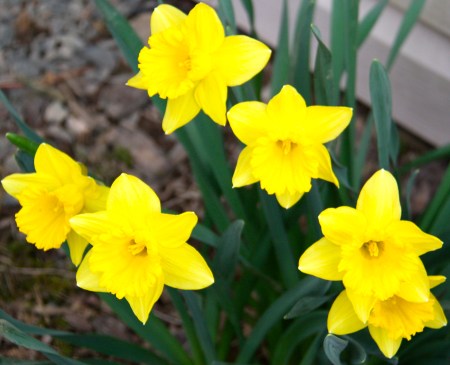
Sunshine and daffodils
and my grand-daughter
paddling in the kitchen sink
as her mother washes
the breakfast dishes.

“Sit,” the child says and “stand,”
following the words with actions.

Yellow, she says, yellow,
as daffodils fill the screen
to shine in that far-off kitchen
a thousand clicks away by road
but instantaneous as the child
reaches out to hug the I-Pad.

Yellow, she repeats, yellow.

Soon she will see the daffodils
dancing their spring dance,
snow gone,
beside the lake,
beneath the trees,
yellow, yes, yellow,
tossing their heads
dancing
yellow in the yellow
breeze.

Comment: Another raw poem, straight from the journal, with only minor revisions. We Skyped yesterday and discovered that our grand-daughter had added another word to her vocabulary: yellow. She repeated it again and again, with great joy and energy, as she paddled in the kitchen sink.

Frog Lake

dsc02197

FROG LAKE
THE OPERA

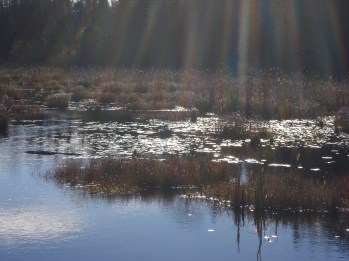
Frogs chant spring love song from pond to ditch.
Their tunes are one note symphonies,
croaks of joy that move other frogs to ecstasy.

Boy frogs seek girl frogs, encouraging them to share
the splendours of ditch life, pond life,
in a pairing whose springtime union will employ
frog song to spawn still more singers.

There’s joy in this calling, croaking, creating;
and where there’s joy, there’s laughter, love,
happiness, light, sun, brightness, flowing water:
everything frogs associate with spring.

Every night the frowning silence of frozen stars
wings deeper into memory. Spring moonlight
swings its cheerful love lamp. Earth also sings.

Whisperer

dsc02478

Whisperer

The bird whisperer, bag of bread crusts in his hand, walks towards that lake I knew so well in my childhood. His friends, the ducks and geese, wait for him to arrive so they can have their breakfast. The whisperer is late today and emerges slowly from the early morning damp and mist.

The whisperer’s friends are hungry and impatient. They leave the lakeside to waddle across the road in a lengthening gaggle, fastest at the front, laggards strung out, straggling behind. When they reach him, the whisperer stops for a moment to greet them. Ducks and geese and traffic stand still as the whisperer pulls the whole world to a halt. Watching him, I remember how, when I was a child, those same sharp bills nibbled at the crusts I held in my fingers as my father rowed our hired boat over the lake’s smooth waters.

The whisperer crosses the road with his flock strung out behind him. Drivers and passengers take photos and videos on their cell phones as the battalion marches on, down the slight slope, back to the waterside where the whisperer scatters crusts and breadcrumbs and throws corn as if it were a shower of stars from the firmament.

Greying skies threaten above dark waters. At lake’s end, above the waterfall, the monument to Scott of the Antarctic pierces the gloom with its fine, white tower. Scott sailed from this city in search of new lands and adventures at the South Pole. Like me and many others he left, never to return.

I look at the bruises that decorate my wrinkled hands. Neither spots nor wrinkles were there when I left that lake behind me, was it really fifty years ago? I view the video on YouTube, shot from an I-phone in a parked car, and my eyes mist over. This was my home, this was the land of my fathers, this was the land of choirs that would always welcome me back with song … yet I no longer go back.

The video is grainy and bears grey threads that mimic the passing clouds. I gaze on that well-remembered lake: there, so many years ago, I swam in its waters, ran and biked along its winding paths, rowed around its edges in and out of the reeds, and fed the lake birds as I floated beside them. I remember all too well the warmth of spring and the joy of the returning sun that strew gold daffodils beneath budding trees.

I see myself reflected in the computer’s screen: my wrinkled skin wraps my shriveled flesh in the same way crinkly paper winds itself round an Easter egg. There is so much inside that binding, so many memories and secrets that dream their lives away inside me. I close my eyes and for a moment I am once more that youthful body flashing its jack-knife blade into those rippling waters …

Evening comes and I stand in a shimmer of moonlight at the garden’s edge, my hands held out to catch a falling star. Alas, I seize only the mutterings of snowflakes strung between the constellations. My scarecrow dream stretches out a long, thin hand and clasps bright treasures in its tight-clenched fist. Inverted, the Big Dipper hangs its question mark from the sky’s dark eyelid. A honking of geese haunts the highway high above me. I swivel from north to south to catch an impression of darkness swift and sudden that blots out the scattered grains of stars.

A finger-nail of rising moon emerges from the trees and hoists itself skywards. The moon hones its cutting edge into an ice-thin blade and the lone dove of my heart flaps in its trap of barren bone. Moonlight and starlight run twin liquors, raw, within me. Stars nearby fade in its brightness. I have built a fire inside the house. When I go back in, my goose quill pen scratches black lines in my journal as I weave words by firelight across a flickering page. Ghosts of departed constellations drown in the nearby river. Pale planets scythed by moonlight bob phosphorescent on a rising flood of memories.

Comment: This would be a “raw poem” were it not a piece of “raw prose”! I found it among my notes late last night and revised it and put it up this morning. It was based on a YouTube video of a man, the bird whisperer, feeding geese at Roath Park Lake in Cardiff, South Wales. When I was a teenager, my family moved from Swansea to Cardiff and Roath Park was a short bike ride from our new home. The Scott Memorial stands at the lower end of Roath Lake, just by the waterfall. Apparently Robert Scott sailed from Cardiff on 15 June 1910 in a converted whaler in an effort to walk to the South Pole. Like me, when I left Cardiff, he didn’t return.

Here’s a link to Robert Scott: https://en.wikipedia.org/wiki/Robert_Falcon_Scott

This is the video on which the piece is based: https://www.youtube.com/watch?v=clbbMt2sl0k

Geese

cropped-15-may-2002-pre-rimouski-020.jpg

Geese

The arrowhead precedes its shaft and leads its feathers into night’s perfection. Summer catches flight and waves good-bye to Arcturus as an obsidian knife flashes black lightning across the icy threshold of a morbid sky. Darkness, swift and sudden, blots out each scattered scat of golden grain and swallows an iris of stars. Inverted, the Big Dipper hangs its question mark from the sky’s dark eyelid.

When daylight breaks cold sunshine over broken ground, the great white geese lay their burdens down by the riverside. Pristine as they drift to the land, flake by fluttering flake, they accumulate the colors of mud daub and anonymity as they grub food from the neat ploughed fields that march their earthen armies across the land. Fallen angels, they sprawl down from heaven and abandon eternity to adopt their waddling time-and-earthbound shapes.

Now, the afternoon gropes steadily to night. Some people have built fires; others read by candlelight. Geese litter the riverbanks with their mud-stained snowdrifts. Freshet mud besmirches them — or is it the black of midnight’s swift advance? The geese step on thin ice at civilization’s edge. Around them, the universe’s clock ticks slowly down. Who forced that scream through the needle’s eye? Night gathers its darkening robes and the seabed reaches its watery arms out towards a magnified moon.

Ghosts of departed constellations drown in the river. Pale planets scythed by moonlight bob phosphorescent on the flood. I walk on the beach sensing the flesh that bonds, the bones that scarcely bind, the shoulders and waist on which I hang my clothes. Now I stand nameless in a shimmer of moonlight and listen at the water’s edge to the whispering night. I catch the mutterings of snowflakes strung between the stars.

My dream stretches out a long, thin hand and clasps bright treasures in its tight-clenched fist. The moon hones its cutting edge into an ice-thin blade and the lone dove of my heart flaps in its trap of barren bone. Moonlight and starlight run their twin liquors, raw, within me. What will I bury beneath this year’s fallen leaves?

Marshall MacLuhan

img_0180

Marshall McLuhan

Black ants drip off my pen.
They crawl across my journal
organizing themselves
into marching battalions.

It doesn’t matter what each ant
weighs or means. What counts
is the accumulated weight
of all those ants. Just twenty-

-six of them: that’s all it takes,
as they divide and multiply,
shuffle their feet, form and reform.
All this jazz about medium

and message is meaningless
when internal organs start to fight
and the body’s civil war
tears me into tiny pieces

that the ants seek out,
reshape, rebuild,
and reconstruct into
new and relevant meaning.

Absence

IMG_0147

Absence

I left my father lying there
unable to look him in the eye;
I was his only living child,
but I never flew back to say goodbye.

My absence tore apart my heart.
I couldn’t face a hotel room,
no house, no friends, no family,
in the town I once called home.

I remembered my dad for a little while,
but then his face just fled.
Now I seek his smile in this photo,
but his eyes fill me with dread.

No life, no light, no focus,
nothing that I recall;
I look at him quite helplessly:
but he can’t see me at all.


This Fragile Light

img_0207

This fragile light
filtering through
the early-morning mind
filled as it still is
with night’s dark
shadowy dreams
their dance demonic
or perchance angelic
as light rises and falls
in time to the chest’s
frail tidal change
the ins and outs
of life-giving breath

Bright motes these birds
at the morning feeder
feathered friends
who visit daily
known by their song
their plumage
their ups and downs
as they dazzle and spark
breaking the day open
with their chorus of joy