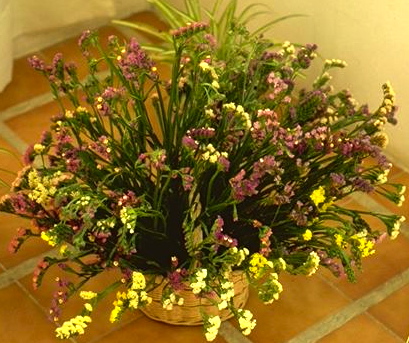
Flowers from Oaxaca. They will be carried by the young girl who will place them on her head. Her brother will walk beside her on her pilgrimage around the twelve central Oaxacan shrines.
Pilgrims
On the cathedral steps, a boy pierces his lips with a cruel spine of cactus.
The witch doctor catches the warm blood in a shining bowl.
The boy’s sister kneels before el brujo, who blesses her in an ancient ritual.
Walking the pilgrim road, she will visit all twelve central Oaxacan shrines.
On her head she will carry this basket filled with flowers and heavy stones.
El Brujo casts copal on his fire. Brother and sister girl inhale the incense. The witch doctor marks their cheeks with blood.
Light in dark bright yellow stridence shrill golden dog’s bark to warn off death’s wolves that freeze her blood
she dreaded night’s unease the devil’s wintry anti-spring life’s darkest sparks
but loved the daffodils’ sunny March cadence of brief piercing dance
Comment: A Golden Oldie. My mother loved daffodils and planted them all over the garden in Cardiff, Wales. They are the national flower of Wales and break into blossom just in time to welcome St. David on St. David’s Day, soon to be upon us, Dydd Dewi Sant.
Daffodils A poem for the lady who brought some to us when Clare fell
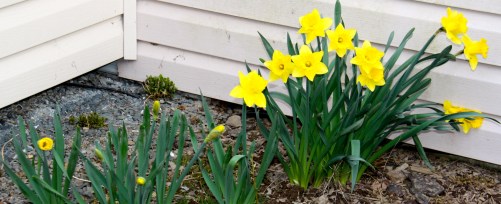
Daffodils in our garden, last year in Island View. We won’t see the live ones until May, at the earliest. I dream of them at night, tossing their heads in sprightly dance’, in Roath Park and Blackweir Gardens, Cardiff. They will be out now, all ready to welcome Dydd Dewi Sant on March 1.
Daffodils
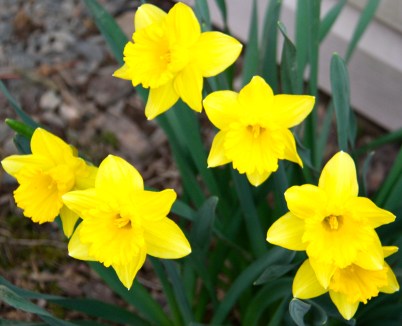
For ten long days the daffodils endured, bringing to vase and breakfast- table stored up sunshine and the silky softness of their golden gift.
Their scent grew stronger as they gathered strength from the sugar we placed in their water, but now they have withered and their day’s done.
Dry and shriveled they stand paper- thin and brown, crisp to the touch. They hang their heads: oncoming death weighs them down.
He knows the frogs are in there. He doesn’t need to hear them sing. But he loves to make them croak.
Croaking Angels
Their tunes are one note symphonies, croaks of joy that move their fellow frogs to ecstasy, exhorting them to share the splendors of ditch life, in a springtime bonding that will loft them skywards.
There’s an ancient magic in this calling: water and laughter, sunlight, warmth, and all those joyous things that fill the newborn spring.
Moonlight swings its cheerful love lamp. New leaves and buds are also known to sing.
Comment: This always makes me think of the croaking chorus from Aristophanes. I do hope all those wonderful ancient plays, songs, myths, and legends are not forgotten in our croaking frog chorus of modern jingoistic advertisements and propaganda. Ah well, what’s a source for the proper goose is probably a source for the proper gander. Who knows nowadays? What we do know is that spring is just around the corner. Warmth and the absence of snow will help change our lives. And yes, that croaking chorus will be back.
Where e’er she treads, the glossy flowers shall rise and light, like the light of flowers, will pierce any gloom and brighten the room.
Silence
When I wait for words to come and they refuse, I know that silence is golden and spreads its early morning sunlight across the breakfast table where yellow butter melts on hot toast.
Light from the rose window in Chartres once spread its spectrum over my hands and I bathed in its speckled glow.
My fingers stretched out before me and I was speechless, for in such glory, mortal things like words cease to flow.
So much can never be said even if it is sensed: fresh coffee, poutine à pain, bread baking, flowers bursting into bloom, the sense of immanent beauty that fills me each time my beloved enters the room.
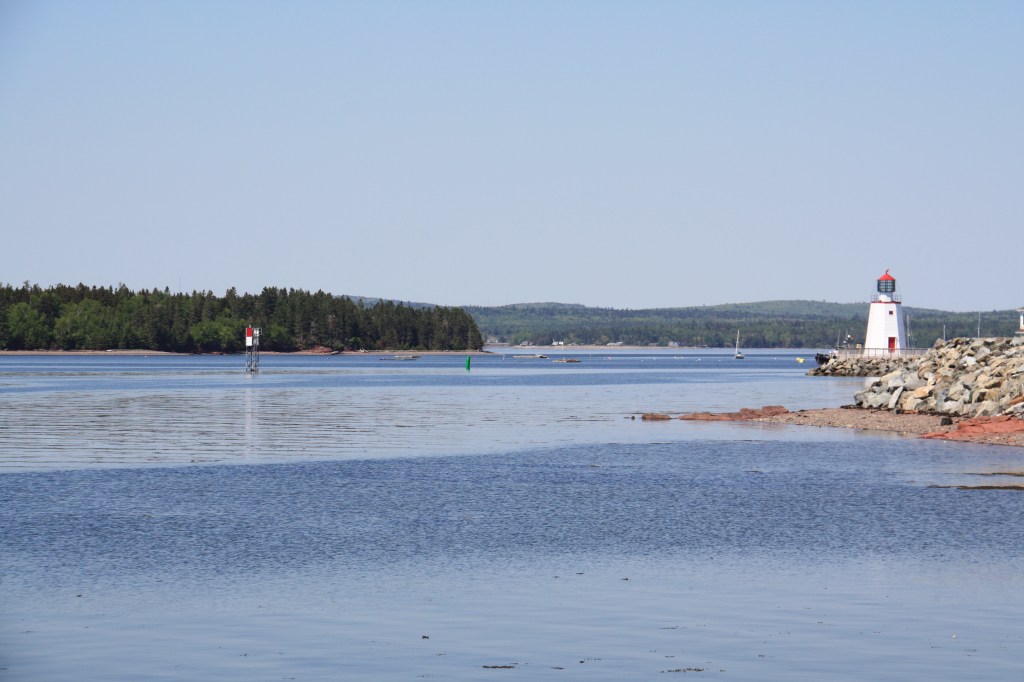
A lighthouse to light your way, shining to make the night as clear as day and to highlight any obstacles that might stand in your way.
Lighthouse
Once upon a time that lighthouse on the quay was a young boy who sat within the shadow of his father’s tale. He sensed he would never feel the power of his own words because he didn’t seem to have any on account of the black hole inside him that swallowed everything up. He thought he would never know the joys of creating his own myths, telling his own story. He thought he would never come to grips with storm music, wind and rain, a lost path sought and found. He longed for someone to gift him a rainbow, with or without its pot of gold. He also thought that the fatal shadow, cast upon a child by a father, would always be there. One day, the early morning sun knocked on his bedroom window. He drew back the curtains and let in the light. That day, he emerged from the shadow and saw that the world was bright and filled with sunshine. Each morning, he breathed in the sunlight, felt it flow through his body. His heart pumped new blood and he was refreshed by the joy of living, of being himself, of being nobody but himself, unique and wonderful, subject to nobody’s wishes and whims. Gradually he grew into the person he was always destined to be. The sun’s rays lit up his face and eyes. Sunshine flourished within him and renewed not only him but all that he touched. Light flooded out like the beam from that other lighthouse, over there, on those rocks, that was put there to help and guide wayfarers and seafarers lest they become lost at sea. Lost, he found himself. Found, he centred himself. Joy and hope, belief and knowledge took root under the sun that each day nourished his body, soul, and spirit. Renewed, light flooded from him. He burned like a bonfire or a beacon and became one of those special lights that enlighten the world. He became that lighthouse.
Comment: One of the prose poems from Tales from Tara that slipped in here by accident. I have included it for, and dedicate it to, my good friend and fellow writer, Judy Wearing, to wish her well with health and strength in this new year that is now turning into something special.
As I walked home, it started to snow. Not the pure white fluffy snow of a pretty Merry Christmas card, but the dodgy, slippery mixture of rain, snow, and ice pellets that turned the steep streets of Swansea into ice slides and traps for the elderly. I turned up the collar of my coat, bowed my head, and stuffed my hands into my pockets. Two houses before my own, I stopped in front of our neighbor’s house. The window shone, a beacon in the gathering dark. I drew closer, pressed my nose against that window and looked in. A Christmas tree, decorated with lights, candles, more decorations, a fire burning on the hearth, two cats curled up warm before the fire, presents beneath the tree, stockings hanging from the mantelpiece. For a moment, my heart unfroze and I felt the spirit of Christmas. Then I thought of my own house. Cold and drafty. No lights, no decorations. No fire. The snowball snuggled back into my chest and refused to melt. When I got home, our house stood chill and empty. My parents were out at work and the fire had died. Nothing was ready for Christmas. I sat at the kitchen table, took out my sketch book and began to draw, then color. When my mother came home, I showed her my picture. “Very nice,” she said without looking up. “But mum, you haven’t really seen it.” She stared at the picture again. This time, she saw the Christmas tree and the lights, the cats before the fire, the candles burning on the mantelpiece, the decorations and the presents wrapped and waiting beneath the tree. But she never noticed the little boy standing outside the house in the falling sleet, cold and shivering, peering in through the window.
Comment: Everyone remembers Dylan Thomas’s story A Child’s Christmas in Wales, but not all Welsh Christmases are like that. This is the story of a forgotten child’s Christmas in Wales. It is a story about a latch-key kid, left alone at Christmas to fend for himself. I enclose the drawing he did and I dedicate the story to anyone who is alone this Covid-19 Christmas. Christmas spent on your own is not much fun. Looking through another’s window, from the cold street outside, is not much fun either. So, at this time of year, let us remember those who are lost and lonely, those who need a kindly smile and a helping hand, those who do not have the comfort of family and friends, a warm wood fire, or a cat or a dog to snuggle up to them, to lick them, and to wish them ‘all the best’ in the languages that all animals speak on Christmas Eve, and sometimes into Christmas Day. Phone a friend, nod to a neighbor, and may your Christmas season be filled with joy.
Silence in the garden. A hawk perched nearby. There are so many ways to die.
Death by Devilry
Silence in the garden. A hawk perched nearby. There are so many ways to die.
A cerebral bleed, minor, but enough to send him to hospital and keep him there.
Cured, ready for release, he would need extra care and added attention.
The devil lived in the small print. Too much attention needed now: his care home wouldn’t care for him.
Back to the old folks ward he went. There he lay, waiting for a vacancy in a home that would really care.
One day, Covid came a-visiting, stalked the ward that night, choosing its victims: you, you, and her, and him.
What killed him? A cerebral bleed, a minor stroke? Or a major stroke from the devil’s pen?
Bold words, bare words, a barren ward, another vacant place around a Christmas table.
Comment: Sitting at the breakfast table, with an empty space before me, I penned these words. So tragic, so avoidable. Yet how many families have gone through something similar in the past twelve months? How many empty spaces are there, vacancies that will never again be filled? I look at today’s figures from the USA: 18,466,231 infected and 326,232 already perished, an increase of 227,998 and 3,338 since yesterday. I am reminded of the words of Pink Floyd: “Is there anybody out there?” Blas de Otero also echoes through my mind: “levanto las manos: tu me las cercenas” / I hold up my hands: you cut them off. And yet it is Christmas Eve and there is still the Christmas promise of joy, and hope, and a new year entering. Let us raise our hands in prayer: and let us pray they are not hacked off.
He was a good man, and a better friend. He came over to mow the lawn and stayed for a beer. “This is gonna sizzle!”
Some called him uneducated, no BA, no MA, no LLB, but he had a golden heart and a PhD in the school of life and hard knocks.
I met men like him in Wales, coal miners in bars, steel workers on rugby teams, sheep farmers from the hills in the big city for the game.
Humble, they were, honest, hard men, hard working, intolerant of pretension and fools. When I went to university, nineteen and full of ideals, they pulled me on one side.
“You’re one of us,” they said. “However high you rise, don’t lose the common touch.”
I met men like him in Spain, foot-soldiers from the Civil War, riflemen, dynamite throwers with their skills learned at coal face and quarry.
Machado wrote poems about them: “Donde hay vino, beben vino; donde no hay vino, beben agua de las fuentes.” Where there is wine, they drink wine. Where there is no wine, they drink water from the fountains.
A good man, an honest man, an uneducated man, some say, who taught me more about life and how to live it than any university professor.
Comment: I read the obituary of one of my best friends in the newspaper today. He moved away from the neighborhood and we lost touch. But I never forgot him. As I have never forgotten those who shaped me in Wales and Spain. I have forgotten many of their names. But I have never forgotten their faces, nor their words of wisdom.At first, his passing brought a shadow to my life. Then I realized that no, he would not have wanted that. I think now of the good times, the laughter, the joy and, instead of mourning for him, I rejoice in all the goodness he gave me. Rest in peace, my friend. I will forget-you-not.





 rogermoorepoet