Words are formed from a combination of letters and sounds. Join them together and they will march like Roman soldiers, in groups of meaning. A cohort, ten words, ten men, commanded by a Decurion. One hundred words, a century, commanded by a Centurion. Six thousand words, a legion with six thousand possible implications attached. I use the image of the Roman Legion because meanings in poetry are Legion and our Western Poetry tradition, of which I am a part, goes back more than two thousand years to Roman times and beyond. Tolle, lege: Latin for take and read. Sortes Virgilianae: fortune telling by chance words drawn, originally, from Virgil’s Aeneid and now from this poetry book. Choose your words and sentences at random. Interpret them as you will.
Associative Fields
While each word has an individual dictionary meaning, words are much more powerful than the dictionary. Each word is surrounded by a network of associations, called an associative field, and those connections are different for every reader. This means that each word and its associative field have very personal emotional strings attached. When you understand this, you will also understand that each reading, each interpretation, is your own and nobody else’s. This is not a grade school classroom. Here, there are no poetry thought police to tell you that you are wrong, that you are mistaken, that you do not understand what the teacher is telling you.
Take the word ‘grandmother’. The dictionary meaning is clear. Your grandmother is the mother of your father or the mother of your mother. Each of us has, if we are lucky, two grandmothers. Some of us have more than two. The emotional ties between you, as reader, and your own ‘grandmother(s)’ will determine your own personal version of the word’s emotional and poetic tones. Now you must apply these individual meanings to each word you read. Reading poetry in this fashion will allow you to create your own personal world of tone, meaning, associations, and emotions. This is what poetry brings to you, not a handful of information to be scanned for knowledge, but a series of sights, sounds, memories, all personal, that are triggered in your mind by the impact of the poet’s words.
Comment:Wednesday Workshops are my attempt to express some of my ideas and theories on writing in general and on poetry in particular. Hopefully, the will encourage other writers to think about their writing and to deepen their knowledge and understanding of what we do best: think and write. By all means add your own thoughts to what I have written here.
The Nature of Art and the Art of Nature is a book of poems each one of which celebrates humanity’s relationship both with the natural world and the way that world is recreated by artists in so many different forms. In order to read these poems and receive full value from them, it would help to know how to approach them.
Preparing to Read
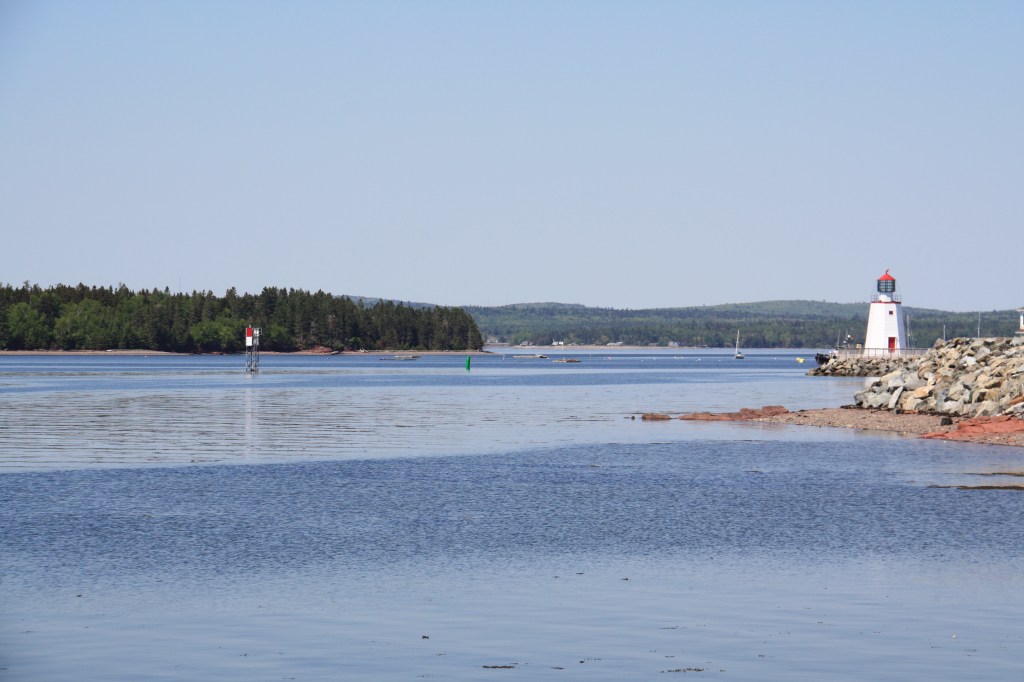
First, de-clutter the mind. Poetry cannot be hurried or rushed. Remember, it is better to read one poem a hundred times than to read one hundred poems once. Prepare yourself mentally and physically for your reading. Sit down. Make yourself comfortable. Close your eyes. Concentrate your mind on something you find peaceful: a sail on Passamaquoddy Bay, a rose in Kingsbrae’s Rose Gardens, a butterfly in the Butterfly Garden, or a fine white cotton cloud in a cerulean sky. Breathe in and then breathe out. Now slow your breathing down. Breathe in, count up to four, slowly, breathe out, counting up to six. Breathe in, count up to six, slowly, now breathe out, counting up to eight. Breathe in, counting up to eight, and breathe out, also counting up to eight. How long will you sit there? When your breathing has slowed and your mind is clear, you will be ready to start. You will know when that is.
Open your eyes. Take your book and begin to read. Don’t start on page one and rush through. Dip in, here and there, find a title or a first line that you like, and read that poem. Read it two or three times. Then move on, randomly to another poem. Select individual lines, phrases, sentences. Savour the words. Roll them around in your mind. Read them to yourself, quietly. Then read them out loud. Try to capture their essence, their rhythms. Taste them, as you would a fine Spanish Manzanilla wine. Select another word, another line, another poem. Seek and you will find some sequence that you like. Return to it often.
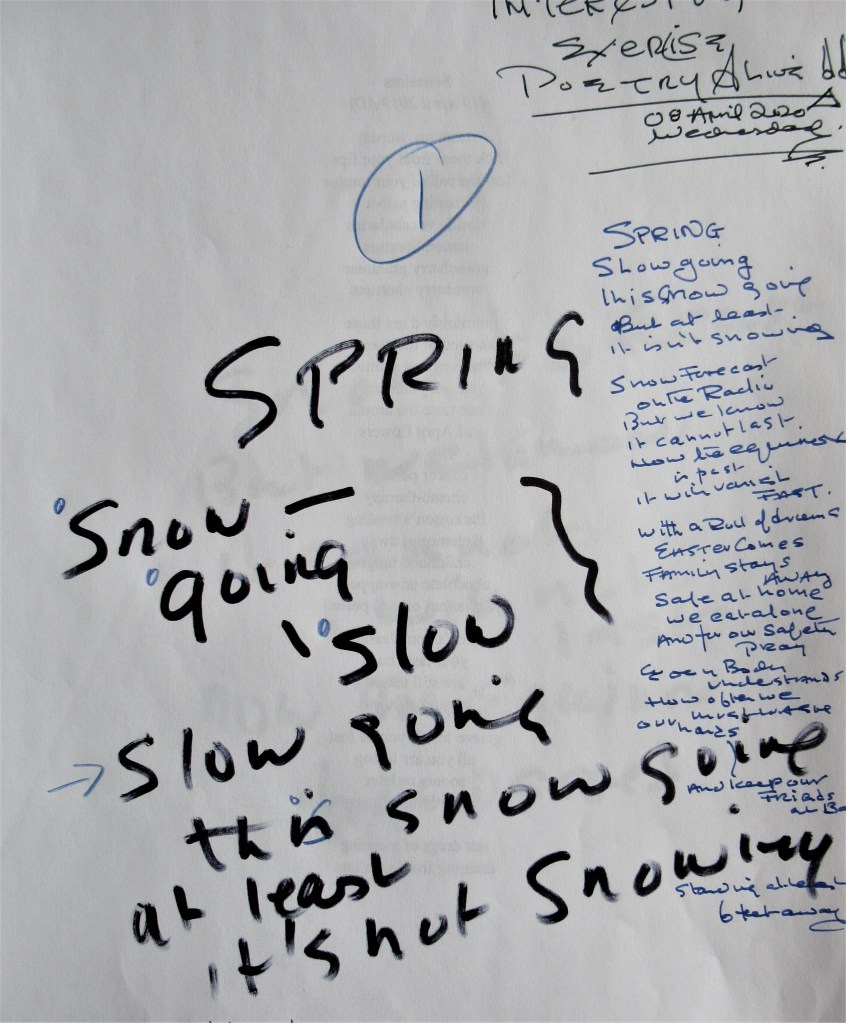
Comment: I will restart my Wednesday Workshops. The Nature of Art, the manuscript on which I am currently working, has an Introduction on The Nature of Poetry. I will put this up in installments. The handwritten opening page comes from an online video on Creativity and Writing Poetry during the Pandemic. This poetry video is the first one in the series. Click here for link. Other workshops on writing can be found by searching Writing Workshops on the Blog search (top right hand corner) or by going to this link Poetic Creativity and Thoughts on Writing
Spotify Don’t forget to scroll down to appropriate audio episode.
Painting the School Outing Beaver Pond, Mactaquac
The yellow of the school bus is easy, but what colors do you give the rain of school kids descending? And how do you portray their energy, their noise, the tones of French and English? What colors are their vowels, their consonants, their high-pitched voices?
You can sketch their orderly rows as they snack on the top-hat magic pulled out of backpacks. But it’s not so easy to paint the pop of Pepsi cans, the scent of chocolate bars, or the crackle of chips released from packets and popped into mouths.
Running round after lunch, they drive the wild birds wild with their unorganized games of tag, their impromptu dances, their three-legged races, their winners and losers, their joys and sorrows. Fishing nets are produced from nowhere. Girls, boys wander to water’s edge in search of prey: incipient frogs, newts, tadpoles, bullheads, but how do you paint the wet and wriggle of them?
Try painting this. Whistles sound. Kids regroup. The bus reloads and goes. Now paint the silence. Sketch the tranquility of woods, bird-calls back, of the beaver pond with its lilies stretching their green necks skywards towards a pale blue sky where cotton clouds cluster together in celestial flocks. A pastoral scene, this painter’s paradise.
Click on the link below to peruse my books for sale.
Spotify Remember to scroll down to the correct audio episode.
Mirror Image (on seeing the outline of a painting on the reverse side of my painted note-book page)
What price these corkscrew lines, reversed, seen through a glass, darkly, the wrong side of a tapestry, all twisted threads and imaginings, no clear pattern of thought or design, as if designated by an errant hand and signed by a man with a mission to bewilder, confuse, muddle, shock, turn inside out, back to front, upside down all our notions of what is what, and who is when, and why, and where?
Yet there is meaning to this madness, a sense of a blind man trapped underground in the labyrinth of his darkened mind with only a thin thread of belief to guide him, upwards and outwards, away from the torrid torment of doused flames, the damp spark’s midnight glow, the search for substance in a new world, insubstantial in a neologism, whirled through inner spaces and spun, guileful, out of the back of the hand to spin, this way, that way, who knows which way, according to the moment of delivery, the angle of acceptance, the untrained brain of the recipient, tottering on the brink of a world with a definite end: the suicide of logic.
Click on the link below to peruse my books for sale.
Spotify: Remember to scroll down to the appropriate audio episode.
Spring
Slow going this snow going, but at least it isn’t snowing.
Snow forecast on the weather show, but we all know it cannot last, now the equinox is past.
With a roll of drums Easter comes, but friends and family stay away.
So all alone and safe at home we’ll spend our Easter day.
Everybody understands how often we must wash our hands.
Don’t go unmasked, even when asked, and all our friends must safely stay at least six feet away.
Comment: I just received this poem as a memory on Facebook. Interesting. I remember writing it, online, a year ago today, and what a fun time I had. Here’s the link to the video. I loved being involved in the creative experience. It was my first poetry video. I do hope you like it.
I think of my creative writing in terms of visual, verbal photos. I create snapshots in words and these snapshots come from everywhere that I have been. For me, they are precious moments caught and frozen forever in the camera of the poet’s eye. Visual and verbal, they illustrate the life I have lived and the things I have seen. These are the phenomena on which my artistic life is founded.
I am not a philosopher by any means, but I have over time developed an artistic philosophy. It started a long time ago at Wycliffe College with my A level studies of French existentialism and continued later in the Graduate School at the University of Toronto, where I studied the origins of existentialism as they are expounded in phenomenology. Both these movements have influenced my life and my writing. Bakhtin’s chronotopos: “Man’s dialog with his time and place” has also been a great influence on my creative thinking. My art is indeed my dialog with my time, my place, and the people who inhabit them.
One Small Corner is the record of my stay at the KIRA Residence in St. Andrews-by-the-sea, New Brunswick, Canada. I was selected to be the only poet in the first cohort of Resident Artists and during the month of June, 2017, I was able to work full-time on this collection.
Photo by my good friend, Geoff Slater. Books by yours truly, who stayed on the bus and believed.
To be a writer ….
He who would true valor see, let him come hither. One here will constant be, come bad or fair weather. No line length can him fright, he’ll with a paragraph fight, and he will have a right, to be a writer.
Those who beset him round with dismal stories, do but themselves confound: his strength the more is. There’s no discouragement will make him once relent his first avowed intent, to be a writer.
Rejections nor bad critics can daunt his spirit. He knows he at the end will a book inherit. So critics fly away, he’ll fear not what they say, he’ll labor night and day to be a writer.
Comment: John Bunyan tempted me and I fell into temptation. In fact, as my good friend Oscar Wilde once said: “I can resist anything except temptation.” So, ladies and gentlemen, change the he to a she or the pronoun of your choice, turn the writer to a sculptor, stoneist, poet, playwright, painter, novelist, dramatist, comedian, song-writer, singer. Breathe deep. Believe in your own artistic talent and remember: “Genius is 99% perspiration and 1% inspiration.” Remember this too: “You’ll never get to Vancouver by bus, if you get off the bus at Montreal or Toronto.”
Los toros de Guisando, pre-Christian Celtic stone bulls, Avila, Spain.
Invisible Scars
Our minds absorb words as blotting-paper soaks up ink. Phrases carve beehives deep in our inner circuits. No te preocupes / don’t worry. Yet tone and carry are different in each language and the comfort-blanket serenity of note preocupes does not translate easily from Spanish to English. The verbal vibes are just not the same. Nor do the catcalls from the soccer, aimed equally at opponent and referee, and tumbling raucous from the stands where people sit. Shrill whistles sound in the bull ring: a matador who seems afraid to approach this particular bull for reasons only known to him, yet his shakiness visible to all who watch and understand what they are seeing. The Cordobés answers the telephone he places on the bull’s nose, yet fails to approach between the horns and his sword rebounds off bull bone: pincha hueso. Each one wounds, the last one kills. El Viti, stately, graceful, an elderly churchman proud of his vocation and always willing to perform to perfection the weekly ceremony of the sacrifice. The boos when the bull enters the ring, stumbles, and comes up lame and limping. The cheers that accompany the arrival of the seventh bull. The refusal to eat meat that has been slaughtered in the bullring, even though it is advertised outside the butcher’s: tenemos solomillo de toro de lidia / we have tenderloin steaks from fighting bulls. Bulls who have led the best of lives, fed on the tenderest pastures, watered by flowing streams. Bulls grown for slaughter and public sacrifice.
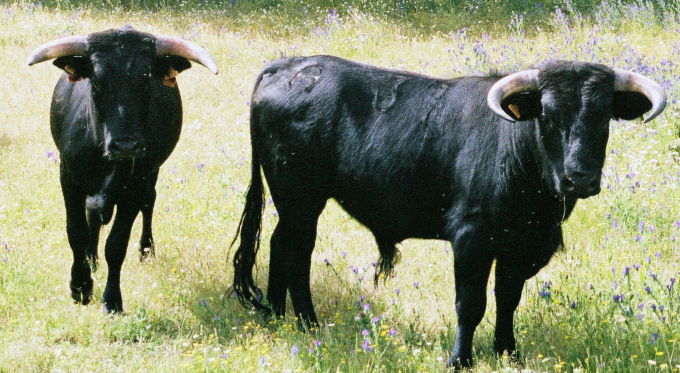
The real thing: young fighting bulls (novillos) on a bull farm in Salamanca, Spain.
Guernica. The bull fight in the sand-filled square. Except it wasn’t a fight, it was more a circus. The slippery pig. The hens and chickens. The rabbits and hares. All the animals running scared. The animals released, one by one, and the spectators jumping into the ring, really a sand-filled square, one by one, and chasing down the animals, taking them home for dinner, if they could catch them. Then the bigger beasts. The mule, ferocious, jumping into the air, kicking four tormentors, one with each leg, and biting a fifth with his teeth. No fearful, clucking chicken this, nor the cow who came after with her padded horns. Participants moved more carefully now. She watched them from her querencia, the where she chose to fight, not die. She knelt, scraped off the rubber balls that covered her horns. Re-armed, she charged and the crowd scattered, all but one young kid, caught, falling to the ground, the cow standing over him, ready to gore again. Sixteen years old, an outsider, I jumped with others over the barrier, twisted this away and that, thumped the cow’s side, smelled her fury, her fear, the whole soured being that emanated from her. Together, we hustled her, bustled her, dragged her kicking, butting, from the ring, backwards, pulled by the tail. Visible scars of damaged animals. Scars of the participants. That young man who broke his leg. That old man, inebriated, stuffed with food and drink, who loosened his belt to move more freely. We watched as his pants slipped from his waist to fall around his knees and trap him, just as the cow charged. He survived but will bear the scars forever, some visible, many not. Long summer days, on the Sardinero, the Segunda Playa, playing soccer. Different rules, different skills, different swear words: I carry a dictionary tucked into my bathing trunks and refuse to play while I look up the words spat at me by my opponent. Good heavens, I think, is that anatomically possible? The ball bounces away on the hard, sand ridges. I chase it and steadily dehydrate under the hot sun. A sea-salt wind desiccates my body. My mouth fills with salt water when I swim out to retrieve the ball from the sparkling sea. My tongue sticks to the inside of my mouth. When I spit, I spit dry and everyone laughs. Now I am totally dry, shiver, and no longer sweat. On the way home, we get off the trolleybus early, at Jesús del Monasterio and enter the long string of bars that lead past Numancia towards Perines. Red wine in glasses, in porrones, with tapas and raciones to soak up the alcohol, morcilla, mariscos, callos, patatas bravas, wine consumed until our blotting-paper bodies are ready once more to sweat. Bread soaks up the wine that relieves the oil that now filters through our skins and who needs suntan lotion when the oil is inside us and bodies are oiled, well-oiled, from the inside out? These excursions are all male, just like the soccer teams. I have four friends and I know them by their nicknames and the way they play soccer. I also know them from the way they try to trick me and laugh at my mistakes, or the way they treat me as a human being and help me to understand this new world into which, sink or swim, I have been thrust. Total immersion in another culture does not come with a set of instructions and the rules of soccer change from grass field to beach sand. Pedro plays centre-half, loves heading the ball, even when it’s laden with sand. I watch him playing field hockey one day, out at La Albericia, and when a low shot heads for the corner of the goal, he dives and heads it away. They carry him off on a stretcher, blood everywhere, and you wonder if his scars will ever heal. Tennis on the clay courts, also at La Albericia. I play so slow but they play so fast. I learn top spin, side spin, back spin, cutting the racket beneath the ball and learning to bend it sideways off the clay that is not clay really, but a fine-packed Italian sand on which I can slide and glide, and commit to a shot running one way then turn and commit to another in the opposite direction. I try it on a hard court, after the immersion period ends, when I get home, and my foot sticks on the tarmac (or whatever that hard, non-slip surface is) and over I go, skinning my knees, creating more scars.
Comment: Another Golden Oldie reclaimed from the reject file. I remember the scenes so well, even though I have moved deliberately in the piece from Elanchove and Guernica (Basque Country) to Santander (now Cantabria). I got lucky and was able to attend a series of workshops on memoirs run by Brian Henry of Quick Brown Fox. Taking his workshops, I realized that most of what I write is more akin to Creative Non-Fiction (CNF), rather then memoir, though much of what I write is rooted in memory. What thrills me in this style of writing is the rhythm that emerges, the word patterns I knit with my pen and a skein of ink, the remembered brightness of the Spanish sun, the sparkle of the waves, the warmth of a people, still grieving after their losses in a bitter civil war, their willingness to accept me, a foreigner, and take me to their hearts. The Other: we talk so much about The Other. But when we ourselves have been That Other, have been dependent on Other Others for food, drink, warmth, care, and love it is so much easier to understand what The Other is lacking and what we can give. Warmth, not scars; a hug, not a punch; open arms, not a fist… so easy to say. I have been there. I know. But can we, deep in our hearts, find it in ourselves to make the sacrifices for The Other that other others have made for us? Only time will tell.







 rogermoorepoet